Instant influencer
A hypothesis of how an unknown teenager seemingly comes out of the blue and suddenly captivates millions of people — within mere days.
In the realm of social media, I find it fascinating to watch how someone like EE seemingly comes out of the blue and suddenly captivates millions of people — within mere days.
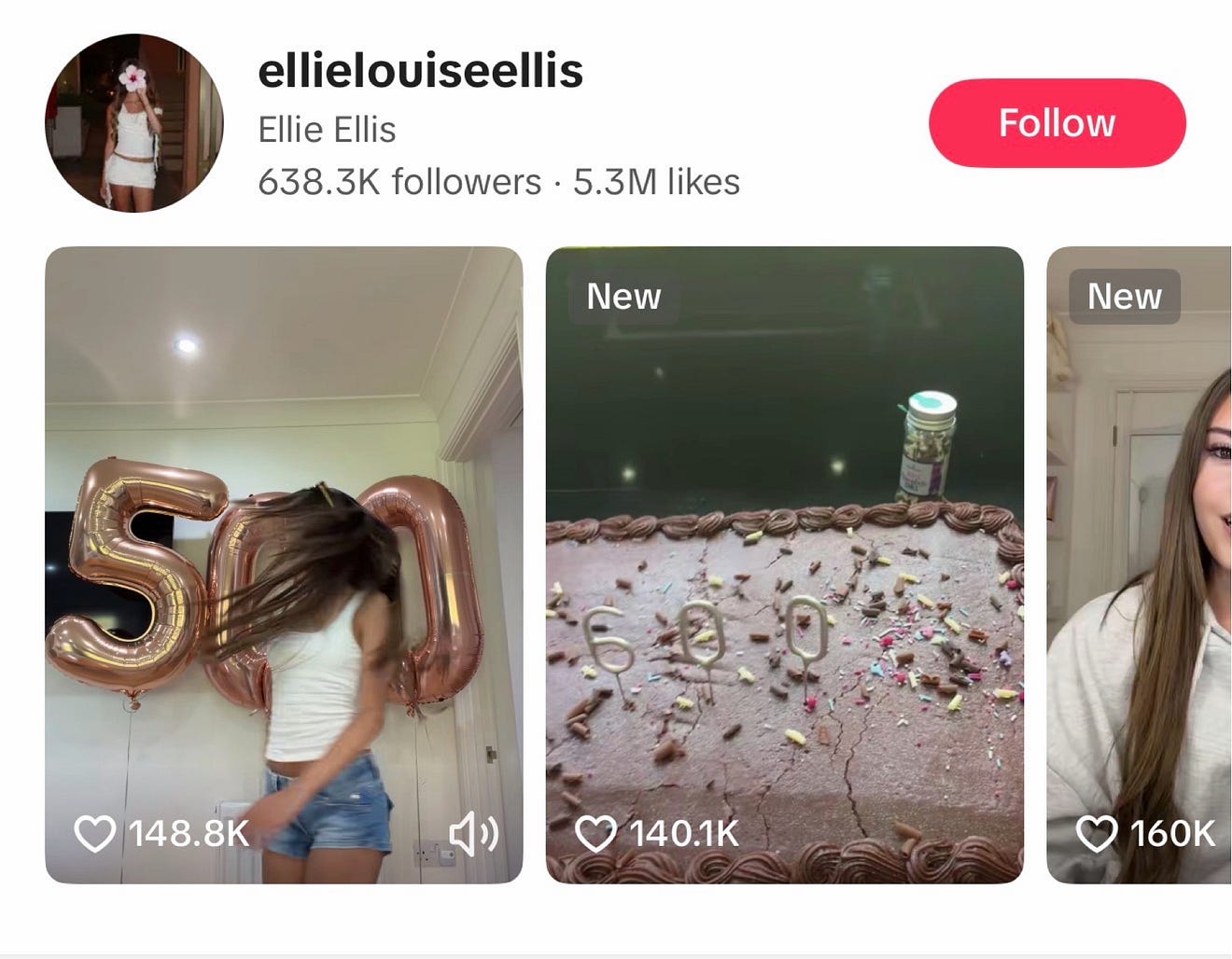
Once that first video goes viral, of course, there is a snowball effect: people become curious about where she came from, go back to watch the original video, and in doing so train the algorithm to amplify it even further.
Watching Ellie Ellis’ first video, I couldn’t help but wonder how much of what I’m seeing is genuine and accidental. Some people claim that she’s relatable, and that’s perfectly fine. However, I firmly believe that her debut is the result of a meticulously planned strategy, with room for making it appear spontaneous.
My hypothesis isn’t that she’s reading a script or acting. Quite the opposite. She seems genuinely charming, slightly awkward, funny and spontaneous. What interests me is the possibility that the spontaneity itself sits inside a carefully prepared new influencer “brand” strategy and framework. It begins with her name; first and last start with E; memorable and unique.
There are little contradictions throughout the video that made me notice this.
She begins with the wonderfully disarming, “Oh my God, I’m doing this.” “Hello.” (cute British accent). She tells us she’s shy and needs more confidence. “This is my GRWM account, I guess, I don’t know.” She has six followers. There are people following her, which is why she does not care. She has blocked people from school because she doesn’t want boys to find the account or anyone to bully her.
And then comes the recurring reassurance:
“Nobody will see this”
It is almost the premise of the entire performance.
I’m just doing this. Nobody is watching. I don’t care. I’m not going to get famous.
Then, almost immediately:
“But if I get famous, I get famous.”
And finally the video ends with essentially:
If you’re a brand, give me free stuff. Thank you.
Camera shakes. Abrupt cut.
That progression is almost too good.
The same thing happens visually.
This is ostensibly a “get ready with me,” yet she appears remarkably camera-ready when it begins: dramatic lashes, eyebrows, hair, complexion, bronzer/highlights. During the video she talks us through doing her makeup, but comparatively little changes. The lips with the liner are perhaps the most obvious addition. Even before wanting to applying highlighter and deciding against it, there already appears to be highlighter on her face, for example, the nose which makes it look smaller and perky.
That doesn’t mean she’s deceiving anyone. It may simply mean that the GRWM isn’t really about getting ready. It’s a device to launching her.
Using makeup utensils gives her something to do with her hands. She can look away from the camera, interrupt herself, search for something, return to the story, mumble, laugh, yell when something goes wrong and use filler words: “I guess,” “I don’t know,” “whatever.”
All of those things make the interaction feel less like someone presenting herself to an audience and more like a girl talking to you while she happens to be doing her makeup.
And that is extraordinarily effective.
Even the content has this quality. Paris. The train under the water. Convincing her parents. Manifesting things on August 8. The Lion’s Gate Portal. Bronzer. Boys at school. Being shy. Not knowing what she’s going to post.
None of it feels like “content” in the traditional sense. That’s precisely why it works. The content is her.
There are also details around the video that make me curious. The image is extremely crisp. The lighting appears quite good. The physical setting looks casual, yet she’s positioned in front of what appears to be a professionally, well-lit mirror, with a wall-mounted television behind her. And some interaction features on the account appear to have been deliberately disabled; no one can download or duet with her video.
Any one of these things means almost nothing. Together, they make me wonder whether someone thought more carefully about the launch than the “I have six followers and nobody will ever see this” narrative suggests.
Then there is the visual language. The extremely long hair, dramatic dark (false) lashes, long acrylic nails and highly polished version of teenage femininity are already familiar from successful young creators. Brooke Monk is an obvious reference point to me. Not necessarily because EE consciously copied her, but because this aesthetic has become a recognizable social-media archetype.
Which brings me to the possibility I find most interesting. Perhaps nobody gave her a narrative at all.
Maybe she — or a parent, older sibling, friend, manager, or even some AI-assisted research — worked out something much smarter, and a strong script to launch an attractive but inexperienced creator.
Here’s the premise:
Here’s roughly what you want people to learn about you.
Do your makeup while you’re talking.
Don’t perform.
Don’t worry about mistakes.
Talk about whatever comes into your head.
Be yourself.
In that scenario, every hesitation could be real. Every “I don’t know” could be real. The awkwardness could be real. Her shyness could be real. Even “nobody will see this” may have been something she genuinely believed.
But the container was designed.
That distinction matters. I don’t think the interesting question is whether EE is “fake” or “authentic.” Those categories are increasingly useless on social media.
A person can be completely genuine inside a deliberately constructed situation.
And this is where the dynamic becomes more unsettling — and more interesting. Because once that structure is released into a platform, it is no longer just a frame for identity. It becomes something the platform actively tests, optimizes, and rewards. The algorithm does not simply surface what already exists; it amplifies certain expressions, suppresses others, and feeds back signals that subtly encourage repetition, exaggeration, and refinement of whatever is performing best.
In that sense, EE is not only being discovered by the algorithm. She is being trained by it in real time — nudged toward the version of herself that retains attention, extended watch time, and emotional engagement. What begins as experimentation becomes iteration. What begins as self-expression becomes selection pressure.
At 16 or 18 experimenting with identity is completely normal. What is new is that the experiment is no longer private, and the feedback loop is no longer human. A teenager can try on an identity in her bedroom and wake up to discover that millions of strangers — and a machine optimizing their attention — have already begun shaping which version of her “works.”
If EE continues to become famous, that may ultimately be the more interesting story: not whether someone helped engineer the first viral video, but how quickly an identity that was still forming becomes stabilized by external reward systems — and how difficult it becomes, once that happens, to tell where the person ends and the algorithm’s preferences begin.
The algorithm doesn’t merely discover the person.
It learns her. It selects her. And in doing so, it begins to shape who she is allowed to become.
This post was proofread and consolidated with assistance of AI; however, the hypothesis and observations are all mine. 🧑💻
메타데이터
- post_id
- 6f0e9f87cbbc
- slug
- instant-influencer-6f0e9f87cbbc
- url
- https://medium.com/@vzgfsfgtt/instant-influencer-6f0e9f87cbbc
- canonical_url
- https://medium.com/@vzgfsfgtt/instant-influencer-6f0e9f87cbbc
- author_url
- https://medium.com/@vzgfsfgtt
- status
- ok
- fetched_at
- 2026-08-17 00:08:24




