The Future of Work: AI, Automation, and Human Collaboration
A New Era of Work Has Already Begun
The Future of Work: AI, Automation, and Human Collaboration
A New Era of Work Has Already Begun
What if your next colleague isn’t a person, but an AI assistant working alongside you every day?
Imagine walking into an office where routine reports are generated automatically, customer queries are resolved instantly by intelligent assistants, and employees spend less time on repetitive tasks and more time solving meaningful problems. Just a decade ago, this would have sounded like science fiction. Today, it is becoming the reality of workplaces across the globe.
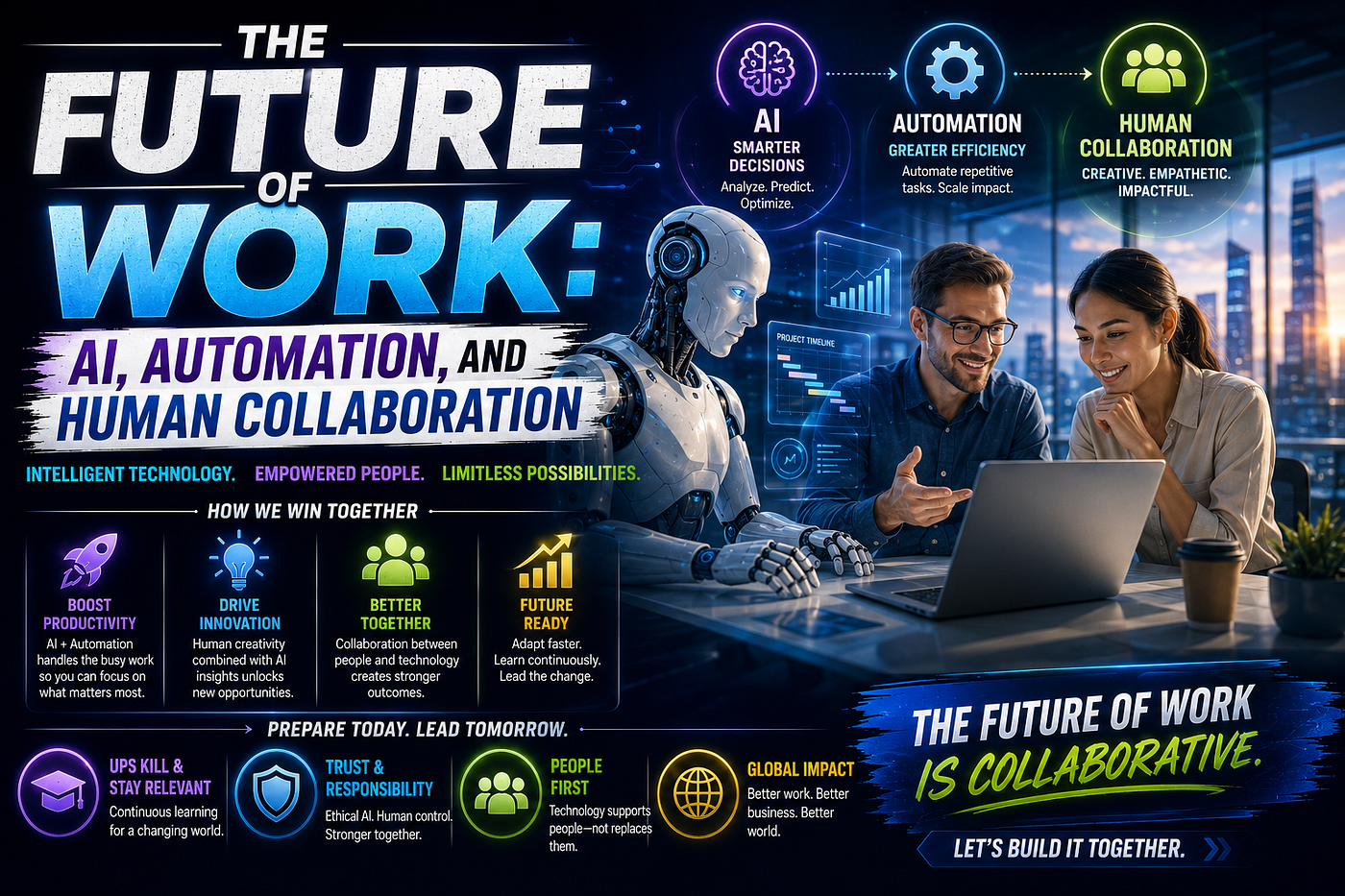
The future of work is no longer a distant concept. It is being shaped by three powerful forces: Artificial Intelligence (AI), Automation, and Human Collaboration. These technologies are driving digital transformation, helping organizations increase productivity, improve decision-making, and create new opportunities for innovation.
We are not simply changing the way work gets done — we are redefining the relationship between humans and technology.
How Artificial Intelligence is Transforming the Workplace
Artificial Intelligence has evolved far beyond simple automation. Modern AI systems can analyze vast amounts of data, identify patterns, and support business decisions faster than traditional methods.
Businesses are already leveraging AI in various ways:
- Predicting customer behavior and market trends
- Enhancing customer support through intelligent chatbots
- Improving business analytics and decision-making
- Streamlining recruitment and talent management
What makes AI truly transformative is its ability to augment human intelligence rather than replace it. Employees can use AI-powered insights to make better decisions, solve problems more effectively, and focus on strategic initiatives.
The future of work is shifting from human versus machine to human plus machine.
The Growing Impact of Automation
Automation is one of the most significant drivers of workplace transformation. By handling repetitive and time-consuming tasks, automation enables organizations to improve efficiency while reducing operational costs.
Today, automation is widely used in:
- Data entry and administrative tasks
- Software testing and deployment processes
- Manufacturing and production workflows
- Supply chain and logistics management
For employees, automation creates an opportunity to focus on creativity, innovation, and strategic thinking. Tasks that once required hours of manual effort can now be completed within minutes, allowing teams to dedicate their energy to higher-value activities.
Rather than eliminating jobs, automation is reshaping roles and creating demand for new skills in an increasingly digital economy.
Why Human Collaboration Remains Essential
Despite rapid advancements in AI and automation, human capabilities remain irreplaceable. Technology can process information and identify patterns, but it cannot fully replicate empathy, creativity, emotional intelligence, and ethical judgment.
Successful organizations understand that technology delivers the greatest value when combined with human expertise.
Consider the healthcare industry. AI can analyze medical records and suggest possible diagnoses, but doctors still play a crucial role in understanding patient needs, making final decisions, and providing compassionate care.
Similarly, in creative industries, AI can generate ideas, automate research, and analyze trends. However, human professionals continue to bring originality, emotion, storytelling, and strategic thinking to the final output.
The future workplace will not eliminate human involvement. Instead, it will strengthen collaboration between people and intelligent technologies
The Rise of Human-AI Collaboration
The most successful companies are not simply adopting AI and automation — they are creating environments where humans and technology work together seamlessly.
Imagine a marketing team launching a new campaign. AI analyzes customer behavior, automation schedules content distribution, and human marketers use those insights to create compelling messages that emotionally connect with audiences.
This combination creates a powerful competitive advantage.
Human-AI collaboration enables organizations to:
- Make faster and smarter decisions
- Improve productivity and operational efficiency
- Deliver personalized customer experiences
- Accelerate innovation at scale
The future belongs to organizations that embrace collaboration rather than competition between humans and machines.
Challenges Businesses Must Address
While the benefits are substantial, the future of work also presents challenges that organizations cannot ignore.
Some key concerns include:
- Workforce reskilling and upskilling requirements
- Data privacy concerns
- Ethical use of artificial intelligence
- Over-dependence on automated systems
- Cybersecurity risks in cloud-based environments
As businesses increasingly rely on cloud platforms and interconnected technologies, protecting sensitive information from cyber threats becomes more important than ever.
Organizations must invest in employee training, establish responsible AI policies, and create transparent strategies for technology adoption. Preparing people for change is just as important as implementing new technologies.
Future Trends in AI, Automation, and Work
Experts predict that AI-powered assistants, intelligent automation platforms, and collaborative technologies will become standard workplace tools within the next decade. Organizations that invest in these technologies today will be better positioned to adapt to future market demands.
In the coming years, we can expect:
- AI assistants supporting daily business operations
- Increased adoption of intelligent automation solutions
- Greater demand for creative and analytical skills
- Hybrid teams consisting of humans and AI systems
- Continuous learning becoming a workplace necessity
The workforce of the future will value adaptability, problem-solving abilities, and digital literacy more than ever before.
“The most successful professionals of the future won’t compete with AI — they’ll learn how to collaborate with it.”
The Future of Work Has Already Arrived
The question is no longer whether businesses should adopt AI, automation, and human-centered digital transformation strategies. The transformation is already underway.
The real opportunity lies in understanding how humans and technology can work together to achieve better outcomes. Organizations that embrace AI, automation, and collaboration will be better positioned to innovate, grow, and remain competitive in an increasingly digital world.
AI will provide intelligence. Automation will drive efficiency. Human creativity will continue to fuel innovation. Together, they are creating a smarter, faster, and more connected future of work.
The future isn’t waiting to arrive — it is already here. Those who learn, adapt, and collaborate with emerging technologies today will be the ones shaping the workplaces of tomorrow.
메타데이터
- post_id
- 6f0fc73b3399
- slug
- the-future-of-work-ai-automation-and-human-collaboration-6f0fc73b3399
- url
- https://medium.com/@mana_s/the-future-of-work-ai-automation-and-human-collaboration-6f0fc73b3399
- canonical_url
- https://medium.com/@mana_s/the-future-of-work-ai-automation-and-human-collaboration-6f0fc73b3399
- author_url
- https://medium.com/@mana_s
- status
- ok
- fetched_at
- 2026-06-18 00:10:23