Don’t Wait Until Life Hurts to Learn How to Live
Nine Stoic reminders about death, presence, loss, and the quiet privilege of an ordinary life
Don’t Wait Until Life Hurts to Learn How to Live
Nine Stoic reminders about death, presence, loss, and the quiet privilege of an ordinary life
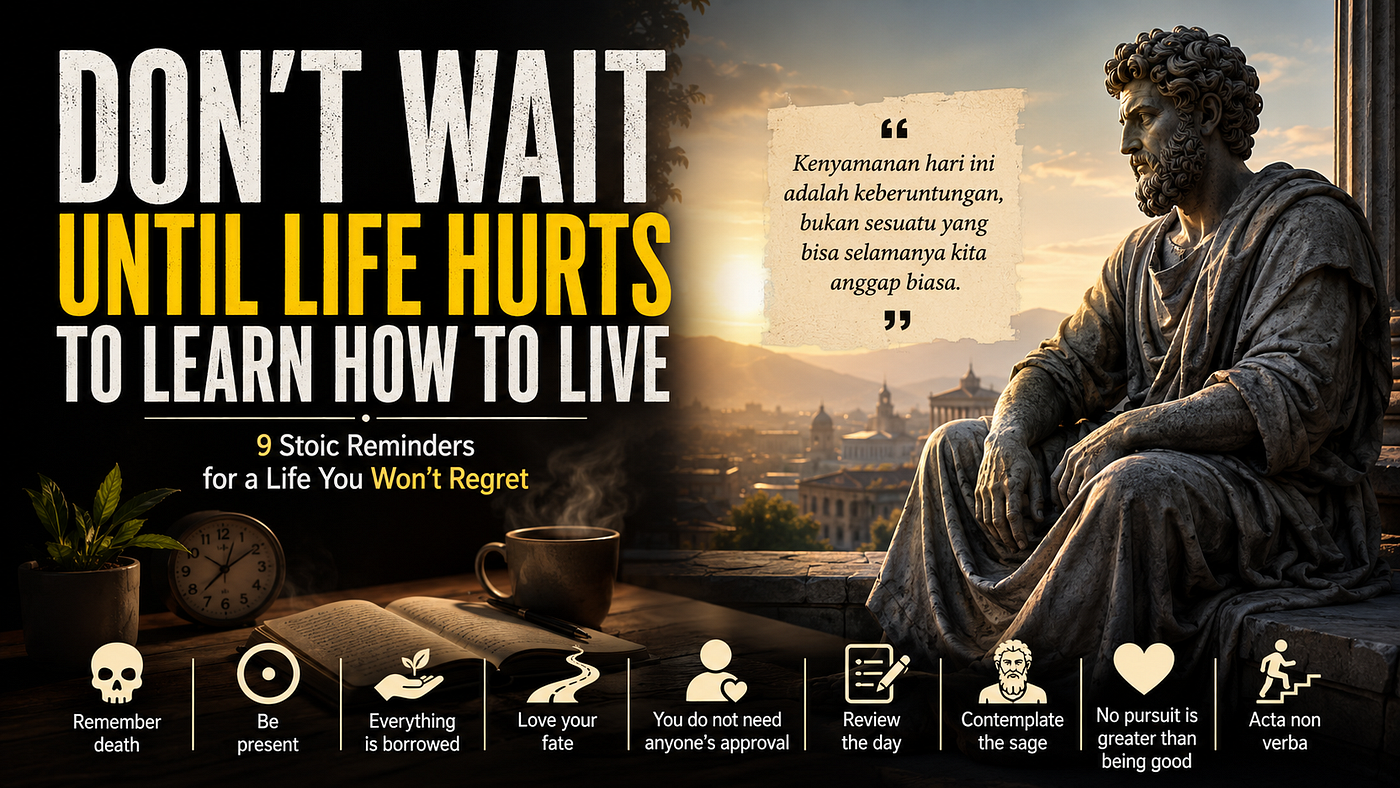
Image by ChatGPT
There are certain kinds of wisdom we tend to ignore when life feels comfortable.
Not because they are untrue.
But because they feel unnecessary.
When the lights turn on every morning, when water runs from the tap, when food is available, when our phones connect us instantly to people we love, when our bodies still carry us through the day, when work still gives rhythm to our lives, and when tomorrow still feels reasonably predictable, we begin to call these things normal.
We forget that normal is not always normal.
Sometimes, normal is a gift. Sometimes, ordinary life is a quiet form of privilege.
And perhaps this is why ancient wisdom can feel so distant to us. We read it as if it belongs to another world, another age, another kind of human struggle.
But maybe we should read it differently.
Maybe we should ask:
- What kind of world gave birth to these thoughts?
- What kind of pressure made people think so deeply about death, presence, loss, fate, self-control, and goodness?
And why do these old reminders still disturb something in us today?
Wisdom Was Not Born in Comfort
Stoic philosophy did not emerge from a world of ease.
It grew in a time marked by political uncertainty, war, exile, slavery, shifting empires, public instability, and the constant nearness of death. For many people in the ancient world, life was not something they assumed they could control.
Security was fragile. Power could change hands. Disease could arrive without warning. A person’s status could rise or collapse depending on forces far beyond their control.
Death was not hidden away in hospitals and funeral homes. It was visible, near, and woven into the ordinary rhythm of life.
In such a world, philosophy was not merely an intellectual exercise.
It was a way to survive without losing one’s soul. It was a discipline of the inner life.
It asked a question that remains painfully relevant:
How do we remain clear, decent, and free within ourselves when the world around us cannot be fully controlled?
That question gave birth to many of the Stoic reminders we still repeat today:
- Remember death.
- Be present.
- Everything is borrowed.
- Love your fate.
- You do not need anyone’s approval.
- Review the day.
- Contemplate the sage.
- No pursuit is greater than being good.
- Acta non verba — deeds, not words.
At first glance, these sound simple.
Almost too simple.
But perhaps they only sound simple because we have forgotten the fire in which they were formed.
Before We Judge Too Quickly
For some people, Stoicism can feel too human-centered.
It may sound like an attempt to rely on discipline, reason, and self-mastery alone. It can seem as though human beings are trying to save themselves through mental strength and emotional control.
That concern is understandable.
Any philosophy can become shallow when it turns into self-sufficiency. Any discipline can become pride when it forgets humility. Any wisdom can become incomplete when it closes itself off from mystery, grace, compassion, or transcendence.
But perhaps we should not judge too quickly.
Stoicism was born from human beings trying to live with dignity in a world that often felt unstable and harsh. They were not writing from comfort. They were wrestling with fear, loss, power, injustice, uncertainty, and mortality.
And when human beings wrestle honestly with how to live well, there is often something worth listening to.
Not everything must be accepted without question.
But not everything should be dismissed too quickly either.
- Sometimes wisdom appears in unfamiliar language.
- Sometimes truth reaches us through the suffering of people who lived long before us.
- Sometimes a philosophy does not need to replace our deepest convictions in order to become a useful mirror.
A mirror does not become our destination.
It simply helps us see.
And perhaps Stoicism, at its best, is not asking us to worship human strength.
- It is asking us to stop living carelessly.
- It is asking us to notice what we take for granted.
- It is asking us to become less fragile, less reactive, less enslaved by approval, less arrogant in comfort, and more responsible for the way we respond to life.
That is not a small thing.
We Ignore Wisdom When We Feel Safe
The strange thing about comfort is that it can make us forgetful.
When life is not pressing hard against us, we assume we have time.
- Time to apologize later.
- Time to forgive later.
- Time to take care of our body later.
- Time to call our parents later.
- Time to be present with our children later.
- Time to write, serve, love, change, simplify, and become better later.
But not every “later” arrives.
Ancient wisdom often sounds urgent because it came from people who knew this.
They did not have the luxury of assuming that life would remain stable. They knew how quickly fortune could turn.
We may not live under the same pressures they did, but our sense of control is still fragile.
- A medical diagnosis can change the atmosphere of a room.
- A phone call can divide life into before and after.
- A job loss can shake our identity.
- A death can rearrange our priorities overnight.
- A public failure can expose how much of our worth depended on approval.
- A crisis can reveal whether we had built our lives on depth or merely on convenience.
This is why wisdom should not be postponed until suffering forces us to learn it.
By then, the lesson may still come.
But it often comes with more pain.
1. Remember Death
“Remember death” sounds dark only when we misunderstand it.
It is not an invitation to become morbid. It is an invitation to become awake.
Death gives shape to life. It reminds us that our days are not infinite, that our relationships are not permanent in their present form, and that our opportunities to love, repair, create, and give are limited.
We do not remember death in order to hate life. We remember death so we do not waste life.
It asks us:
- If my time is limited, what deserves my attention?
- What am I postponing that should not be postponed?
- Who needs my tenderness while they are still here?
- What kind of person am I becoming with the days I have been given?
Death is not only an ending.
It is also a teacher.
A severe one, perhaps.
But often, a truthful one.
2. Be Present
To be present sounds easy until we notice how rarely we are.
Our bodies sit at the dinner table while our minds answer tomorrow’s emails.
- We hold someone’s hand while silently scrolling through our worries.
- We live in the present moment while emotionally negotiating with the past or rehearsing the future.
- Modern life gives us many tools for connection, but it also gives us endless ways to be absent.
Presence is not dramatic.
It is quiet.
It is the ability to be where we are, with who is before us, without constantly escaping into somewhere else.
To be present is to honor the only part of life we can actually touch.
Now. Not yesterday. Not tomorrow.
Now.
3. Everything Is Borrowed
This may be one of the most uncomfortable reminders.
Everything is borrowed.
- Our bodies.
- Our time.
- Our relationships.
- Our titles.
- Our homes.
- Our influence.
- Our strength.
Even the people we love most are not possessions. They are entrusted to us for a season whose length we do not control.
This does not make life less meaningful.
It makes life more tender.
If everything is borrowed, then we are not owners in the deepest sense.
- We are caretakers.
- We are stewards of what passes through our hands.
- We can love deeply without pretending we can keep everything forever.
- We can work faithfully without making our title the center of our identity.
- We can enjoy what we have without being owned by it.
- We can hold life with gratitude instead of entitlement.
The borrowed nature of life does not make love weaker. It makes love more awake.
4. Love Your Fate
“Love your fate” is easily misunderstood.
- It does not mean we approve of everything that happens.
- It does not mean injustice should be accepted passively.
- It does not mean we stop trying to change what can and should be changed.
It means we stop wasting our lives fighting reality after it has already arrived.
- Some things can be changed.
- Some things must be endured.
- Some things must be grieved.
- Some things must be transformed slowly.
- And some things must first be accepted before we can respond wisely.
To love your fate is not to love pain for its own sake.
It is to say:
This is now part of my life. I may not have chosen it. But I can still choose who I become within it. There is dignity in that choice.
5. You Do Not Need Anyone’s Approval
This reminder may be more urgent now than ever.
We live in an age where approval is measured, displayed, counted, and refreshed.
- Likes.
- Views.
- Comments.
- Followers.
- Invitations.
- Recognition.
- Relevance.
We may say we do not care, but many of us quietly do.
Approval feels good.
But when it becomes the source of our worth, we become fragile.
- If people praise us, we rise.
- If they ignore us, we disappear.
- If they misunderstand us, we collapse.
- If they criticize us, we lose ourselves.
The Stoic reminder is not that other people do not matter.
They do.
- Community matters.
- Feedback matters.
- Love matters.
- But our moral center cannot be outsourced to public opinion.
There is a quiet freedom in doing what is right even when it is unseen. There is a deeper freedom in no longer begging the world to confirm that we are enough.
6. Review the Day
A day that is not reflected upon easily becomes just another day.
We move from task to task, message to message, obligation to obligation, and then wonder why years pass without much inner growth.
Experience alone does not make us wise. Reflected experience does.
To review the day is not to condemn ourselves.
It is to return gently to our own life and ask:
- Where was I present today?
- Where was I careless?
- Where did I act from fear?
- Where did I act from love?
- What did I avoid?
- What did I learn?
- What needs repair?
- What deserves gratitude?
A life reviewed with honesty becomes a life slowly transformed.
Not all at once. But faithfully.
7. Contemplate the Sage
We do not have to learn everything through our own wounds.
This is one of the great mercies of being human.
We can learn from those who walked before us.
- From teachers.
- Parents.
- Elders.
- Writers.
- Friends.
- Quiet people whose lives carry more wisdom than their words.
- People who suffered and did not become bitter.
- People who had power and remained humble.
- People who lost much and still became generous.
- People who aged without becoming small inside.
To contemplate the sage is to ask:
- Who is shaping my imagination?
- Whose life am I studying?
- Whose voice am I allowing to become part of my conscience?
In a noisy world, choosing our sources of wisdom is an act of spiritual and moral survival.
8. No Pursuit Is Greater Than Being Good
This may be the most countercultural rule of all.
We are trained to pursue success.
- Productivity.
- Visibility.
- Achievement.
- Influence.
- Wealth.
- Growth.
- Legacy.
None of these is necessarily wrong.
But all of them become dangerous when they are detached from goodness.
- What is the point of success if we become cruel?
- What is the point of influence if we become dishonest?
- What is the point of achievement if we lose tenderness?
- What is the point of being remembered if we were difficult to love while we were here?
To be good is not to be weak.
It may require more strength than ambition. It requires restraint when anger feels justified.
- Honesty when lying would be easier.
- Humility when praise arrives.
- Compassion when indifference would cost less.
- Goodness is not always loud.
But it is the foundation without which every other pursuit becomes hollow.
9. Acta Non Verba
Deeds, not words.
At some point, life asks for proof. Not proof in the performative sense. But proof in the embodied sense.
- Love must become attention.
- Integrity must become decision.
- Gratitude must become practice.
- Humility must become posture.
- Compassion must become action.
- Wisdom must become behavior.
We can speak beautifully about values and still fail to live them. We can admire goodness and still postpone becoming good. We can agree with every noble sentence and still remain unchanged.
The final test of wisdom is not whether we understand it.
It is whether we live it.
Comfort Is Not the Enemy Comfort itself is not wrong.
There is nothing noble about unnecessary suffering. There is no virtue in pretending that hardship is always better than ease.
- A safe home is a gift.
- Clean water is a gift.
- Health is a gift.
- Friendship is a gift.
- Work is a gift.
- Peace is a gift.
- Technology, medicine, education, and freedom are gifts.
The problem is not that we have comfort. The problem is when comfort makes us unconscious.
When ease makes us entitled. When abundance makes us ungrateful. When convenience makes us impatient. When safety makes us spiritually lazy. When ordinary blessings become invisible because we see them every day.
Stoic wisdom reminds us that comfort should not make us asleep.
It should make us grateful. And gratitude, if it is real, should make us more awake, more generous, more present, and more responsible.
Learn Before Life Forces You To
There are lessons we can learn gently. And there are lessons life teaches us by force.
- We can learn to value time before time runs out.
- We can learn to love people before loss makes love ache.
- We can learn to be present before absence becomes permanent.
- We can learn to loosen our grip before life takes things from our hands.
- We can learn to live without applause before silence exposes our dependency.
- We can learn to become good before success tempts us to forget goodness.
This, perhaps, is the urgency behind those nine Stoic reminders.
They are not decorations for a wall. They are not quotes for a notebook. They are not ancient slogans for modern self-improvement. They are invitations to wake up before suffering has to shake us awake.
- Because the ordinary life we complain about may be the life someone else is praying for.
- Because the routines we find boring may one day become memories we would give anything to return to.
- Because the people we take for granted may not always sit across the table.
- Because the body we neglect is quietly carrying us.
- Because the time we waste is still time we cannot recover.
- And because comfort, when received with awareness, can become gratitude.
But comfort, when taken for granted, can become sleep.
The Quiet Privilege of an Ordinary Day
Maybe wisdom begins when we stop calling everything ordinary.
- A morning without bad news.
- A meal shared in peace.
- A body that still rises.
- A friend who still answers.
- A child who still calls.
- A parent who is still alive.
- A home to return to.
- A chance to begin again.
These are not small things. They are life, quietly offering itself to us.
The Stoics learned their wisdom in a world that often pressed hard against them.
We may be learning it in a world that often cushions us.
But the invitation is the same:
Do not waste your life. Do not postpone your humanity. Do not wait until loss teaches you what presence could have taught you gently.
- Remember death.
- Be present.
- Hold lightly.
- Accept wisely.
- Live without begging for approval.
- Review your days.
- Learn from the wise.
- Choose goodness.
- And let your life speak through what you do.
Because comfort is a gift. But awareness is what keeps the gift from being wasted.
메타데이터
- post_id
- 6f20aa1895ca
- slug
- dont-wait-until-life-hurts-to-learn-how-to-live-6f20aa1895ca
- url
- https://medium.com/thoughts-reflections/dont-wait-until-life-hurts-to-learn-how-to-live-6f20aa1895ca
- canonical_url
- https://medium.com/thoughts-reflections/dont-wait-until-life-hurts-to-learn-how-to-live-6f20aa1895ca
- author_url
- https://medium.com/@habillokadjaja56
- status
- ok
- fetched_at
- 2026-06-14 16:15:44