Why Preventative Maintenance Is Essential for Modern Commercial Buildings (And Why Waiting for…
Modern commercial buildings rely on far more than bricks and mortar. Behind every comfortable office, hotel, hospital, warehouse, school…
Why Preventative Maintenance Is Essential for Modern Commercial Buildings (And Why Waiting for Breakdowns Costs More)
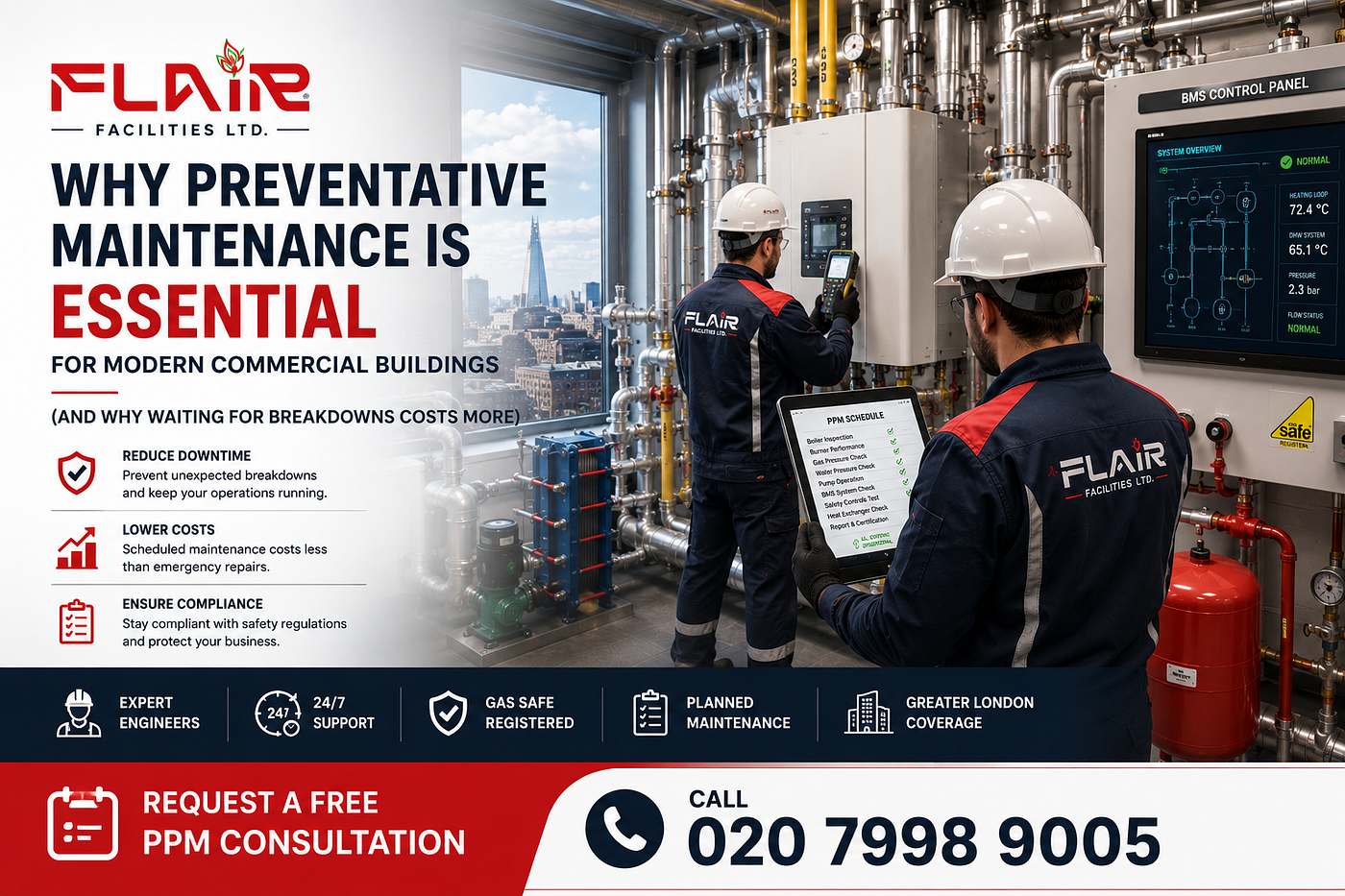
Modern commercial buildings rely on far more than bricks and mortar. Behind every comfortable office, hotel, hospital, warehouse, school, or retail centre is a network of critical mechanical systems working around the clock. Commercial boilers provide heating and hot water, HVAC systems regulate indoor comfort, pumps maintain water pressure, Building Management Systems (BMS) control equipment, and plant rooms keep everything operating together.
When these systems work properly, they often go unnoticed. But when one fails unexpectedly, the consequences can be significant. Occupants become uncomfortable, operations may be disrupted, emergency repair costs increase, and businesses can face unplanned downtime.
This is why preventative maintenance has become an essential part of modern facilities management.
What Is Preventative Maintenance?
Preventative maintenance is a planned approach to maintaining building systems through scheduled inspections, servicing, testing, cleaning, adjustments, and component replacement before failures occur.
Unlike reactive maintenance, which only begins after equipment breaks down, preventative maintenance focuses on reducing risk by identifying small issues before they develop into expensive repairs or complete equipment failure.
For commercial buildings, preventative maintenance commonly covers:
- Commercial boilers
- HVAC systems
- Building Management Systems (BMS)
- Commercial pumps
- Plant rooms
- Commercial gas installations
- Pipework and valves
- Water pressure systems
- Hot water systems
The objective is simple: improve reliability while reducing operational disruption.
Why Reactive Maintenance Is No Longer Enough
Many organisations still adopt a reactive approach, waiting until equipment fails before calling an engineer.
Although this may appear to reduce maintenance costs in the short term, it often creates larger problems over time.
Unexpected failures can lead to:
- Emergency call-out charges
- Unplanned business interruption
- Higher repair costs
- Reduced equipment lifespan
- Increased energy consumption
- Discomfort for staff, customers, patients, students, or residents
- Pressure on facilities management teams
A failed commercial boiler in the middle of a busy working week, for example, can affect an entire building. Likewise, a faulty booster pump or HVAC system can quickly disrupt normal operations.
Preventative maintenance helps reduce these risks by addressing developing issues before they become emergencies.
The Long-Term Business Benefits
A well-managed preventative maintenance programe delivers value beyond simply avoiding breakdowns.
Reduced Downtime
Scheduled maintenance allows organisations to plan engineering work around business operations instead of reacting to unexpected failures.
Improved Equipment Reliability
Routine servicing helps boilers, pumps, HVAC systems, and mechanical equipment continue operating efficiently throughout their expected service life.
Lower Operating Costs
Maintained systems generally operate more efficiently than neglected equipment, helping reduce unnecessary energy consumption and avoid expensive emergency repairs.
Better Asset Management
Regular inspections provide valuable information about equipment condition, allowing facilities managers to make informed decisions about future repairs, upgrades, or replacements.
Greater Compliance Confidence
Many commercial buildings have legal and contractual responsibilities relating to safety, maintenance, and inspections. Planned maintenance supports organisations in meeting these obligations while maintaining clear maintenance records.
Preventative Maintenance Supports Every Building Type
Preventative maintenance is not limited to one industry.
It plays an important role in:
- Commercial office buildings
- Hospitals and healthcare facilities
- Schools and universities
- Hotels and hospitality venues
- Warehouses and logistics centres
- Manufacturing facilities
- Retail centres
- Commercial kitchens
- Care homes
- Mixed-use developments
Each environment depends on reliable building services to maintain safety, comfort, and operational continuity.
Technology Is Improving Maintenance — But It Doesn’t Replace Experience
Modern commercial buildings increasingly use Building Management Systems (BMS), smart controls, sensors, and remote monitoring to help identify potential issues.
These technologies provide valuable information, but they do not replace routine inspections by experienced engineers.
Skilled maintenance professionals can identify wear, corrosion, leaks, unusual operating conditions, and early warning signs that automated systems may not fully detect.
Combining smart technology with planned engineering inspections creates a more resilient maintenance strategy.
A Smarter Investment Than Emergency Repairs
One of the biggest misconceptions is that preventative maintenance is simply another operational expense.
In reality, it is an investment in business continuity.
Rather than waiting for critical equipment to fail at the most inconvenient time, organisations can plan maintenance, manage budgets more effectively, extend asset life, and reduce operational risk.
For facilities managers, property managers, and building owners, preventative maintenance offers greater control over both costs and building performance.
Final Thoughts
Commercial buildings have become increasingly complex, with multiple mechanical and engineering systems working together every day. Waiting until equipment fails can expose organisations to unnecessary costs, disruption, and operational risk.
A structured preventative maintenance programme helps keep these systems operating safely, efficiently, and reliably while supporting long-term asset performance.
For businesses responsible for commercial buildings, preventative maintenance is no longer simply good practice — it is an important part of protecting people, property, and operational continuity.
About Flair Facilities Ltd
Flair Facilities Ltd provides commercial mechanical engineering and building services across Greater London, supporting organisations with planned preventative maintenance, commercial heating, HVAC, plant room maintenance, commercial gas, Building Management Systems (BMS), commercial pumps, and water pressure systems.
Learn more about our **Commercial Planned Preventative Maintenance (PPM) Services** and how a tailored maintenance programme can help protect your building’s critical assets.
메타데이터
- post_id
- 6f427d359ab2
- slug
- why-preventative-maintenance-is-essential-for-modern-commercial-buildings-and-why-waiting-for-6f427d359ab2
- url
- https://medium.com/@hayescharlotte2110/why-preventative-maintenance-is-essential-for-modern-commercial-buildings-and-why-waiting-for-6f427d359ab2
- canonical_url
- https://medium.com/@hayescharlotte2110/why-preventative-maintenance-is-essential-for-modern-commercial-buildings-and-why-waiting-for-6f427d359ab2
- author_url
- https://medium.com/@hayescharlotte2110
- status
- ok
- fetched_at
- 2026-07-25 08:11:21