The Civilisation That Never Was
Entrepreneurs in Human Flesh: Why Ethiopia Cannot Claim Ancient Civilisation Without First Reckoning with Its Slave-Trading Rulers
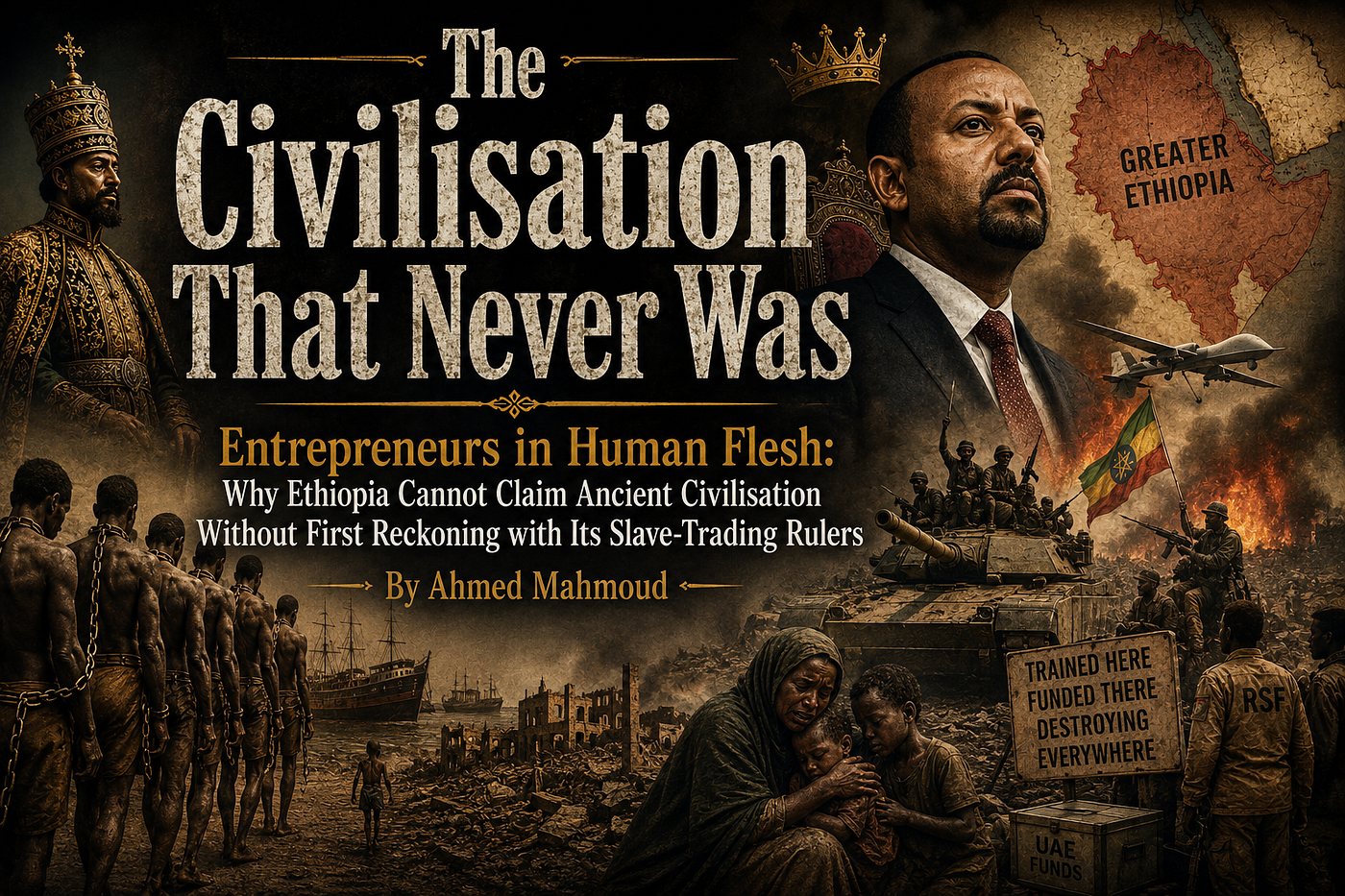
The Civilisation That Never Was
Entrepreneurs in Human Flesh: Why Ethiopia Cannot Claim Ancient Civilisation Without First Reckoning with Its Slave-Trading Rulers
By Ahmed Mahmoud
There is a question that every new generation in the Horn of Africa deserves to have answered honestly, and that every iteration of Ethiopian imperial mythology has been designed to prevent from being asked: what, precisely, was the ancient civilisation whose glory is being invoked to justify the latest war?
Since the end of World War II, the territory governed as Ethiopia has existed in a state of near-permanent catastrophe. War in Eritrea — more than thirty years of it. War in Tigray. War in Amhara. War in Oromia. Famine that killed hundreds of thousands in 1973, and again in 1984–1985, while the state presiding over the famine continued spending on military operations. Displacement on a scale that has scattered communities across every continent. The current war in Tigray, Amhara, Oromia, Afar, Benishangul, etc — an estimated 800,000 dead, more than the recent combined toll of conflicts in Gaza, Ukraine, and Sudan. A current civil war in which a militia characterised by the United Nations as conducting operations with “the hallmarks of genocide” is being trained on Ethiopian soil and financed through Gulf money, while the government hosting the training camp co-signs ceasefire statements calling for the war to end.
At the heart of each of these catastrophes — across every political iteration, every change of regime, every new name given to the ruling apparatus — stands a single political technology. The invocation of ancient glory, 3,000 years of glory, which reduced by Abiy Ahmed last month to 1,000 years. Ethiopia’s rulers, from Emperor to Dictator to Liberation Front Chairman to Nobel Peace Prize Laureate, have each reached, at the moment of requiring public compliance with some new catastrophe, for the same justification: we are the inheritors of a great civilisation, a thousand years old, three thousand years old — the number adjusting monthly according to political requirement, the function remaining constant. Ancient rights. Historic claims. Natural boundaries. The formulation changes. The mechanism does not.
Before any of this mythology can do further damage — before another generation of young men and women in Ethiopia, Eritrea, Sudan, or Somalia is mobilised to die recovering something ancient and glorious that was supposedly stolen — one question demands an honest answer.
What exactly does that history consist of?
I. The Moment That Exposes the Claim
There is a precise historical moment at which the Abyssinian rulers’ claim to Red Sea “historic rights” — the specific claim now being used to threaten Eritrea and manufacture a maritime crisis — can be tested directly. Not in the medieval period. Not in ancient trade routes. But at the single most consequential moment in the modern history of the Red Sea: 17 November 1869, when the Suez Canal opened.
The Suez Canal — 120 miles of waterway cut through the Isthmus of Suez by French engineering, Egyptian forced and paid labour, and European capital — was the greatest engineering achievement of the 19th century. Construction had begun in April 1859, employing dredgers, steam shovels, and tens of thousands of workers across a decade of sustained technical effort.[1] Its opening ceremony was attended by the Austrian Emperor, the Prince of Wales, the Prince of the Netherlands, and the French Empress Eugenie — a gathering of European and global power whose presence signalled what every government with any strategic intelligence understood: the Red Sea had just become the world’s primary maritime trade highway.[2]
Before the canal, ships travelling between Europe and Asia sailed around the Cape of Good Hope — a journey of months and extraordinary expense. After the canal, the Red Sea was the shortcut connecting the Mediterranean to the Indian Ocean, reducing the journey by thousands of miles and transforming the ports along its coastline — Massawa, Assab, Aden, Djibouti — overnight from secondary regional trading posts into strategic assets of global commercial significance. Every power with maritime ambitions, trade interests, or genuine historical connection to that coastline understood immediately what this meant and moved accordingly.
Egypt’s Ismail Pasha — the ambitious moderniser who co-hosted the canal’s opening celebrations — had in fact moved four years earlier, occupying the port of Massawa in 1865 in explicit anticipation of the canal’s strategic consequence.[3] Italy moved: between 1869 and 1880, an Italian navigation company acquired stretches of coastline near Assab; in 1882 these holdings transferred to the Italian state; in 1885 Italian troops landed at Assab and Massawa, establishing the territorial foundation of what would become Eritrea.[4] France, Britain, and every external power with regional ambitions recognised what the Suez Canal had done to the Red Sea geography and positioned accordingly.
What were Abyssinian's rulers doing in November 1869?
Menelik, then King of Shewa, was conducting southward territorial consolidation campaigns — subduing local rulers through military force, expanding his territorial base, and beginning what would from the late 1880s onward become a systematic programme of southward expansion: dispatching armies and colonists across the west, south, and southeast in what he called “Agar Maqnat” — the colonisation, cultivation, and Christianisation of peripheral lands deemed available for appropriation.[5]
He was not at the Red Sea. He was not building port infrastructure. He was not engaging with the technological transformation that was remaking global commerce at his doorstep. He was not establishing the presence that would have constituted, in any meaningful legal or historical sense, a claim to the coastline. He was riding south — away from the sea, away from the moment, and toward the slave-raiding campaigns that would reach their documented scale with the Walayta campaign of 1894, in which one French witness recorded 18,000 enslaved people taken in a single military operation, with approximately 2,000 going to the emperor personally.[6]
By 1890, when Italy formally declared the Colony of Eritrea — incorporating Massawa, Assab, and the Red Sea coastline that Abiy Ahmed now invokes as Ethiopia’s ancient birthright — Menelik was conducting the southward campaigns whose human consequences are documented in the historical record. The Red Sea coastline was claimed by Italy not by defeating a sovereign Ethiopian highland state defending an occupied territory, but by arriving at a coastline that highland rulers had not administered, not developed, and not engaged with as a strategic priority at precisely the moment when strategic priority would have mattered most.
The “historic rights” being invoked today were not exercised at the moment they would have needed to be exercised to constitute historic rights. They are the retrospective invention of rulers who missed the moment — because at the moment, they were engaged in slave trading in the opposite geographic direction — and now require their successors to die recovering what was never properly theirs to lose.
II. What “Ancient Abyssinian Civilisation” Actually Consisted Of
The entity invoked as “ancient Ethiopia” — the civilisation whose glory is claimed to justify contemporary wars, whose territorial reach justifies contemporary demands, whose historical continuity is deployed as the foundation of threats directed at Eritrean sovereignty — was, when examined through its actual documented record rather than its nationalist mythology, a slave-trading empire.
This is not a polemical characterisation originating in hostile external commentary. It is the documented finding of Ethiopia’s own most distinguished historians, and of European parliamentary records, diplomatic dispatches, and eyewitness accounts spanning three centuries.
Richard Pankhurst, the most eminent scholar of Ethiopian historical studies, assessed the institution plainly. The wars through which highland kingdoms expanded their territory “led to the capture of slaves of many ethnic groups. A significant proportion of the men, women and children thus seized were taken from the less powerful communities of the periphery of the state… regarded as morally easier to enslave than other inhabitants of the area. Enslavement was driven by war, raiding, tribute, and conquest.”[7]
The rulers who conducted these operations were not peripheral or aberrant figures in the Ethiopian historical record. They are the emperors whose reigns constitute what nationalist mythology presents as the golden thread of ancient civilisation — the same figures whose portraits are invoked, whose names are deployed, and whose legacy is claimed whenever a contemporary ruler requires the authority of antiquity to justify a contemporary war.
Emperor Menelik II — whose late 19th-century expansion created the borders of modern Ethiopia and is presented as the apex of Ethiopian state-building — was conducting slave raids of documented scale while the Suez Canal was being built at his doorstep. From a single campaign in Walayta, one French observer present at the time recorded 18,000 enslaved people taken, with approximately 2,000 going to the emperor personally.[8] The French observer who witnessed and documented these atrocities, it should be noted, accepted 11 enslaved people himself — a detail that illuminates not only the emperor’s conduct but the broader commercial ecosystem in which it operated.
Haile Selassie — celebrated globally as a symbol of African freedom, a moral exemplar, the father of pan-African unity, a voice at the League of Nations against fascist aggression — presided over a country with an estimated 400,000 enslaved people in the early 1930s.[9] Six hundred slaves were sent to his wife as a gift in 1927.[10] As Martin Plaut documents in Unbroken Chains: A 5,000-Year History of African Enslavement (2025), Haile Selassie’s “reluctance to confront slavery head-on allowed the institution to linger longer in Ethiopia than in almost any other part of Africa.”[11] Slavery was not officially abolished until 1942. The Gumuz people suffered enslavement through Haile Selassie’s reign and beyond. As recently as 1993, children in some communities carried weapons to school to defend against being captured and enslaved.[12]
- Not the medieval period. Not the colonial era. 1993 — within the lifetimes of people now in their thirties, in a country whose rulers were simultaneously claiming the inheritance of an ancient civilisation.
There is a specific kind of historical dishonesty involved in building a national mythology on the achievements of rulers whose primary commercial activity was the enslavement and sale of surrounding populations. It is not merely inaccurate. It is the active prevention of the historical reckoning that might allow the communities whose ancestors were enslaved by those rulers to understand their own past — and to resist being mobilised, in those same rulers’ names, to wage the next war in the same pattern.
The glorification of slave traders as civilisation-builders is not an academic error. It is a political technology. And it has consequences.
III. Egypt Was Not the Ancient Enemy. Egypt Was the Customer.
Contemporary Ethiopian rulers — and Abiy Ahmed with particular frequency — invoke Egypt as Ethiopia’s historical adversary. The Nile is framed as the eternal arena of Ethiopian-Egyptian conflict. Ancient rivalry. Historic enmity. The framing serves a precise political purpose: it positions Ethiopia as a sovereign state defending its natural resources against a powerful external competitor, and positions Eritrea — aligned with Egypt in the counter-coalition against Ethiopian regional aggression — as a proxy for that ancient adversary.
The historical record does not support this framing. It supports, with considerable documentary evidence, its opposite.
The ruling elites of the Ethiopian highland kingdoms and the ruling dynasty of Egypt under Mohamed Ali Pasha were not historical enemies. They were commercial partners in the trade of enslaved human beings.
Mohamed Ali Pasha rebuilt the Egyptian state’s relationship with Sudan specifically to reestablish the slave trade — and planned his new modernised army substantially from enslaved Sudanese and Ethiopian people. His invasion of Sudan in 1820–1821 was partly designed to secure this human supply. Enslaved people from Ethiopian interior markets were transported northward via caravan and river routes into Egypt, where they became soldiers in Mohamed Ali’s military, labourers in his industries, domestic servants in Egyptian households, and taxable commodities in Egyptian commercial accounts.[13]
The trade routes ran through specific, documented geography. Enslaved people from the Ethiopian interior traveled to the East African coast via the ports of Massawa and Zayla — then northward through the Red Sea to Egypt.[14] The upper Nile Valley and the Ethiopian highland kingdoms together accounted for approximately half of the estimated two million enslaved people imported into the Middle East and North Africa during the nineteenth century.[15]
This is not the relationship of ancient enemies. It is the relationship of commercial partners. The highland ruling class was the supplier. The Mohamed Ali Pasha dynasty was the customer. The commodity was human beings from the communities surrounding the highland kingdoms. The transaction routes ran through Massawa — through what is now Eritrea, through the Red Sea coastline whose “historic rights” Abiy Ahmed now claims — and northward to Egypt.
The “ancient enmity” with Egypt is therefore doubly fraudulent. First, because the historical relationship was commercial partnership in human trafficking rather than civilisational rivalry. Second, because the victims of this partnership were not the highland ruling class but the peripheral communities whose enslavement constituted the trade — the same communities whose descendants are now being asked to take pride in the history that enslaved them and to die recovering the ports through which their ancestors were shipped.
IV. The Template These Rulers Left Behind
What makes this history significant beyond its moral dimensions — though its moral dimensions are considerable enough to demand attention on their own — is what it reveals about the political technology these elites developed and left as their primary inheritance.
The template operates as follows. A ruler — whatever their background, whatever their stated ideology, whatever the specific historical moment they inhabit — claims the inheritance of ancient Ethiopian greatness. This claim simultaneously legitimises their authority by connecting it to something pre-political and therefore resistant to challenge; manufactures external enemies whose threat justifies internal authoritarian consolidation; mobilises populations who would otherwise focus on economic failure, political repression, or the ruler’s personal enrichment; and provides cover for whatever external commercial or political patron is currently financing the operation.
Haile Selassie used it. Mengistu Haile Mariam used it. The TPLF used it. Abiy Ahmed uses it — with the added innovation of a Nobel Peace Prize accepted for a peace agreement he was already, in the financial architecture of his Gulf patron relationship, preparing to abandon.
What none of these rulers has used it to justify is honest examination of what the history they claim actually consists of. Because the honest examination produces findings that are incompatible with the mythology. The ancient civilisation was a slave-trading enterprise. The glorious emperors were slave raiders and slave entrepreneurs. The historic access to the Red Sea was used to export enslaved human beings to Egyptian purchasers. The continuity — whatever number of years it is assigned this month — is the continuity of this template: powerful elites extracting from surrounding communities, exporting the extracted value through Red Sea ports, and invoking ancient glory as justification for the next round of extraction.
The template is not ethnically specific. It is not religiously specific. It does not belong to any particular community and it cannot be attributed to any particular people. It belongs to ruling elites — to the specific class of people who have repeatedly found in Ethiopian imperial mythology a tool for their own perpetuation, regardless of which community they came from or which ideology they professed. The victims of the template have been drawn from every community the empire surrounded. The beneficiaries of the template, across its iterations, have been the specific individuals who occupied the apex of the ruling structure at the relevant moment — and the foreign patrons who financed them.
This is what was built. Not civilisation. Not greatness. A commercial operation — slaving, raiding, and territorial conquest — and the political mythology designed to make the populations bearing its costs feel that they are participants in something glorious rather than instruments of something predatory.
V. Abiy Ahmed: The Latest Iteration
Abiy Ahmed did not inherit this template through lineage or institutional connection. He adopted it — and he adopted it as someone with no personal connection whatsoever to the ruling class whose mythology he now deploys with the enthusiasm of the recently converted.
He came from a poor family in a rural area. He joined the Ethiopian military at approximately fifteen years of age as a radio operator — the entry point of the institutionally unconnected, the young man with neither education nor family networks to secure a more elevated position. He was trained and advanced within the TPLF system alongside other officers recruited from outside the traditional ruling class. Before assuming the prime ministership in April 2018, he owned essentially nothing. No land. No institutional inheritance. No family connection to the emperors whose legacy he now claims as his political foundation.
Since assuming power: he controls billions of dollars of Ethiopian state assets administered as if they are personal property. He is constructing what Le Monde described as a “pharaonic palace seized with delusions of grandeur” — a $15 billion project on 503 hectares of land cleared through forced evictions, built with money whose source he told parliament he has no legal obligation to disclose.[16] He has signed Air Force cooperation agreements at Dubai Airshows, received $817 million UAE currency swaps that keep his government financially solvent, and allowed his generals to speak publicly of annulling the independence of the country that saved his government from military collapse during the Tigray war.
As Reuters documented in February 2026, a secret camp in the Benishangul-Gumuz region of western Ethiopia is training 4,300 fighters for the Rapid Support Forces — the militia that the United Nations has characterised as conducting genocide in Sudan — with UAE financing of the camp’s construction confirmed by eight sources including a senior Ethiopian government official.[17] On January 6, 2026, while the camp was fully operational, the UAE and Ethiopia issued a joint statement calling for a ceasefire in Sudan.[18]
A man who owned nothing before power, claiming the history of rulers whose institutions he was never part of, deploying that history to threaten a sovereign neighbour while building personal wealth through a relationship with a Gulf patron who holds his government’s financial survival — this is not a statesman. This is the template’s latest expression: the same mythology, the same manufactured enemies, the same personal enrichment, the same foreign financing, briefly and incongruously awarded a Nobel Peace Prize before the packaging came off.
Dr. Milkessa Gemechu — a former member of Abiy’s own governing party’s Central Committee — described the Assab agenda plainly: “The Assab project is UAE’s and Abiy is just an errand boy.”[19]
An errand boy invoking 3,000 years of history. The number will adjust again when required. The errand will not.
VI. The Disclaimer Ethiopia’s History Demands
The German state undertook, after 1945, a systematic process of confronting what the Nazi period represented — not to condemn the German people but to protect future generations from the political technologies that had produced the catastrophe. The process was uncomfortable, contested, and incomplete. It was also the condition for the development of a German democratic culture that has proved more durable than the mythology it replaced.
No comparable process has occurred in Ethiopia. The slave-trading emperors are not disclaimed. They are celebrated — in public spaces, in national narratives, in the political speeches of rulers who invoke their legacy as justification for contemporary territorial ambitions. The history that should produce reckoning is instead producing repetition: the same template, reproduced faithfully by each successive ruling elite, mobilising populations in the name of a civilisation that the documented historical record reveals to have been, primarily, a commercial enterprise in human beings.
The disclaimer Ethiopia’s history demands is not an ethnic accusation. It is not a religious grievance. It is not an invitation to communal conflict between the communities of a complex and diverse country. It is something simpler and more necessary: an honest assessment of what these rulers actually did, placed alongside the mythology that has been built upon their legacy, so that the gap between the two becomes visible and the template that exploits it becomes resistible.
The gap is substantial. The mythology claims: ancient civilisation, glorious empire, cultural achievement, historic rights to coastlines and waterways. The documented record shows: systematic slave raiding of surrounding communities, sale of enslaved people through Red Sea ports to Egyptian purchasers, absence from the Red Sea coastline at the precise moment — the opening of the Suez Canal in 1869 — when historic rights would have needed to be asserted and defended, southward expansion conducted at the cost of the communities it subjugated, and an estimated 400,000 people still enslaved under the ruler simultaneously being celebrated as a symbol of African freedom before the League of Nations.
This is not civilisation. This is not greatness. This is a commercial operation dressed in the language of civilisation — by the elites who conducted it, and by the successive ruling classes who have found it useful to maintain the dressing because it provides political cover for the next commercial operation in the same pattern.
VII. What the New Generation Deserves
The communities of the Horn of Africa have paid, across eight decades since the Second World War, a price in dead, displaced, and impoverished people that no mythology of ancient civilisation — however elaborately constructed, however frequently invoked, however recently Nobel-prized — can justify or compensate for.
The wars have not produced stability. The invasions have not produced development. The manufactured crises have not delivered the restored glory they promised. They have produced 800,000 dead. Sudan’s hundreds of thousands. Somalia’s fragmentation. Eritrea’s sixty years of defending a sovereignty that should never have required the cost it has required. Ethiopia’s own populations — across every community the empire has historically surrounded — have borne, generation after generation, the cost of wars fought in the name of a greatness from which they have consistently received no material benefit.
The new generation of Horn of Africa populations does not owe this history its loyalty. It does not owe these rulers its compliance. It does not owe the mythology its lives.
What it owes itself is what has been systematically withheld: the honest account of what is actually being claimed in these wars, what commercial interests are being served, what foreign patrons are financing the operations, what the specific rulers deploying the mythology have personally accumulated while deploying it, and what the history invoked to justify the next war actually consisted of when examined without the mythology.
That history consisted of slave trading. Its most celebrated figures were entrepreneurs in human flesh — rulers who built their power not on cultural achievement, not on architectural legacy, not on intellectual tradition, not on the development of institutions that served their populations, but on the capture, sale, and export of surrounding communities’ members through Red Sea ports to Egyptian purchasers who deployed them as soldiers, labourers, and domestic servants.
Not only does this history not deserve glorification. It demands disclaimer — explicit, public, and incorporated into the educational and political culture of every state that claims continuity with these rulers’ legacy. Not to condemn any contemporary community. Not to produce grievance between peoples who share a complex and intertwined history. But to close, definitively, the political space in which this mythology operates — the space in which young men and women can be told that they are fighting for the recovery of ancient glory, when the documented reality of that glory is a slave trade whose victims included their own ancestors.
The Suez Canal was completed in 1869 by engineers, workers, and capital drawn from across Europe and the Mediterranean world. It transformed the Red Sea — the very body of water whose “historic rights” are being invoked today — into the world’s primary maritime trade highway. The rulers of the highland kingdoms, at that precise transformative moment, were conducting slave raids in the opposite geographic direction.
The civilisation that might have been — one that engaged with the technological moment, developed the port infrastructure, built the commercial institutions, and established through presence and practice the genuine historic rights that would have made the contemporary claim meaningful — was not built. What was built instead was the template: mythologise the past, manufacture the enemy, mobilise the population, extract the wealth, repeat.
Abiy Ahmed is not the first to use it. He will not be the last, unless the new generation for which this article is written understands clearly what the template is, where it came from, and what it has consistently cost every population that has been mobilised in its name.
The civilisation that is being claimed never existed. What existed was a slave trade. What exists now is its political inheritance: rulers who have learned that the mythology of a civilisation is more useful than a civilisation itself, because mythology asks populations to die for it while civilisation would ask rulers to serve them.
The new generation deserves to know this. It is, at minimum, where the honest reckoning must begin.
References
[1] Britannica, “Suez Canal — History”; construction commenced April 1859, completed August 1869.
[2] History Hit, “What Was the Impact of the Suez Canal?”; official opening ceremony November 17, 1869; European heads of state attendance documented.
[3] EBSCO Research Starters, “Menelik II”; Egypt’s Ismail Pasha occupying Massawa in 1865 in anticipation of canal strategic significance.
[4] History World, “History of Eritrea”; Italian Rubattino Navigation Company acquiring Assab coastline 1869–1880; transfer to Italian state 1882; Italian troops landing at Assab and Massawa 1885; formal declaration of Eritrean Colony 1890.
[5] Wikipedia, “Menelik II’s Conquests”; “Agar Maqnat” southern expansion programme from late 1880s; armies dispatched west, south, and southeast.
[6] French witness account of Menelik II’s Walayta campaign; documented in Richard Pankhurst, History of Ethiopian Towns (1968); cited in EthioReference analysis, December 2025.
[7] Richard Pankhurst, cited in Martin Plaut, “Ethiopia’s Role in African Enslavement and the Paradox of Haile Selassie,” extract from Unbroken Chains: A 5,000-Year History of African Enslavement, August 2025.
[8] Ibid.; Walayta campaign documentation; French observer account.
[9] Ibid.; 400,000 enslaved people in early 1930s Ethiopia.
[10] Ibid.; 600 slaves sent to Haile Selassie’s wife, 1927.
[11] Ibid.
[12] John Young, cited in Plaut, August 2025; 1993 date documented.
[13] Oxford Research Encyclopedia of African History, “Muhammad ‘Ali”; slave trade reestablishment with Sudan; army of enslaved Sudanese; invasion of 1820–1821.
[14] Project on Middle East Political Science, “The Contradictions of Afro-Arab Solidarities,” February 2022; slave routes via ports of Massawa and Zayla documented.
[15] Springer Nature, Slavery in the Middle East and North Africa; upper Nile Valley and Ethiopia accounting for half of estimated two million enslaved people imported into Middle East and North Africa during the nineteenth century.
[16] The Continent/Substack, “The Ethiopian Prime Minister’s New Dubai,” June 2024; Chaka Project 503 hectares, forced evictions; Le Monde characterisation cited in Ethiopian Policy Institute, “The Abiy Doctrine,” November 2024; Borkena, December 2023, Abiy parliamentary statement on palace funding.
[17] Giulia Paravicini and Reade Levinson, “Ethiopia builds secret camp to train Sudan RSF fighters, sources say,” Reuters, 10 February 2026; eight sources; UAE financing confirmed; 4,300 fighters January 2026.
[18] UAE-Ethiopia Joint Statement, 6 January 2026.
[19] Dr. Milkessa Gemechu, former Prosperity Party Central Committee member, cited via @eri_blooming, 27 January 2026; Red Sea Beacon, January 2026.
[20] Eritrea-Ethiopia Boundary Commission ruling 2007; Badme award to Eritrea; non-implementation documentation under Abiy Ahmed’s government.
[21] Ethiopia Eurobond default documentation; IMF and World Bank debt restructuring; Borkena, December 2023; Abiy parliamentary statement on palace funding.
메타데이터
- post_id
- 6f429dec87d6
- slug
- the-civilisation-that-never-was-6f429dec87d6
- url
- https://medium.com/@amm121/the-civilisation-that-never-was-6f429dec87d6
- canonical_url
- https://medium.com/@amm121/the-civilisation-that-never-was-6f429dec87d6
- author_url
- https://medium.com/@amm121
- status
- ok
- fetched_at
- 2026-08-04 00:11:41