DAST vs SAST: The Two Pillars of Modern Application Security
Security is no longer something you “add later.” It’s something you build into your application from day one.
DAST vs SAST: The Two Pillars of Modern Application Security
Security is no longer something you “add later.” It’s something you build into your application from day one.
Yet many teams still ask a fundamental question:
Should we use Static Application Security Testing (SAST) or Dynamic Application Security Testing (DAST)?
The honest answer? Both. But to understand why, let’s break them down in a practical, real-world way.

Dast Vs Sast
The Problem: Vulnerabilities Everywhere
Modern applications are complex:
- Multiple APIs
- Third-party integrations
- Rapid deployments (CI/CD)
In this environment, a small vulnerability — like an unvalidated input field — can turn into a serious security breach.
This is where SAST and DAST come into play.
SAST: Catch Issues Before Your Code Runs
Static Application Security Testing (SAST) analyzes your code without executing it. Think of it as reviewing your application’s blueprint before the building is constructed.
💡 Simple Example:
Imagine a developer writes:
query = "SELECT * FROM users WHERE id = " + userInput;A SAST tool will immediately flag this as a SQL Injection risk — before the code is even deployed.
Why Teams Love SAST:
- Detects vulnerabilities early (cheap to fix)
- Integrates easily into CI/CD pipelines
- Gives precise location of the issue in code
Where It Falls Short:
- Doesn’t understand runtime behavior
- Can generate false positives
- Needs access to source code
DAST: Test Like a Real Hacker
Dynamic Application Security Testing (DAST) works on a running application. It behaves like an external attacker trying to break into your system.
Instead of looking at code, it interacts with your app:
- Sends malicious inputs
- Tests APIs
- Checks authentication flows
Simple Example:
A DAST tool might:
- Enter
' OR 1=1 --in a login form - Detect if it bypasses authentication
Why Teams Love DAST:
- Finds real, exploitable vulnerabilities
- No need for source code
- Tests the application in real-world conditions
Where It Falls Short:
- Happens later in the lifecycle
- Harder to pinpoint exact code issues
- May miss hidden/internal vulnerabilities
SAST vs DAST: Not a Competition
Here’s the mistake many teams make:Treating SAST and DAST as alternatives.
They’re not. They solve different problems.
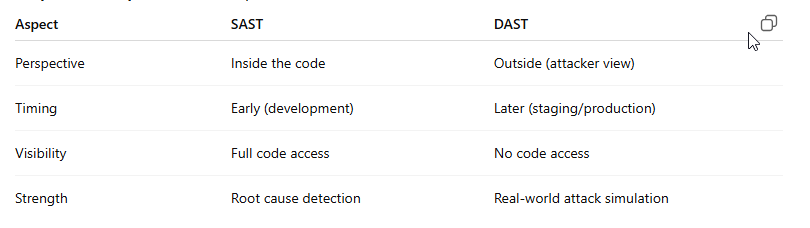
The Winning Strategy: Combine Both
Think of it like this:
- SAST = Prevent problems early
- DAST = Catch what slips through
When combined, they create a defense-in-depth strategy.
A Practical Workflow:
- Developer writes code
- SAST scans run in CI/CD
- Code is deployed to staging
- DAST scans simulate attacks
- Fix vulnerabilities before production
Popular Tools You Can Explore
For SAST:
- SonarQube
- Checkmarx
- Veracode
For DAST:
- OWASP ZAP
- Burp Suite
- Acunetix
Final Thoughts
If you’re serious about building secure applications, you can’t rely on a single approach.
- SAST helps you write secure code
- DAST ensures your app is secure in reality
In a world where security breaches can cost millions — and trust — using both isn’t overkill.
It’s the standard.
메타데이터
- post_id
- 6f72fb70e700
- slug
- dast-vs-sast-the-two-pillars-of-modern-application-security-6f72fb70e700
- url
- https://medium.com/@zubairkhansh/dast-vs-sast-the-two-pillars-of-modern-application-security-6f72fb70e700
- canonical_url
- https://medium.com/@zubairkhansh/dast-vs-sast-the-two-pillars-of-modern-application-security-6f72fb70e700
- author_url
- https://medium.com/@zubairkhansh
- status
- ok
- fetched_at
- 2026-06-21 12:17:11