8 Advanced Information Retrieval Techniques Explored (RAG, TAG, CAG, CoAG, LightRAG, GraphRAG &…
How AI is Getting Smarter with Information Retrieval
8 Advanced Information Retrieval Techniques Explored (RAG, TAG, CAG, CoAG, LightRAG, GraphRAG & Beyond)
How AI is Getting Smarter with Information Retrieval

Pixabay
Artificial Intelligence is becoming more powerful by the day, but even the most advanced AI models have their limitations.
Enter RAG (Retrieval-Augmented Generation) and its growing family of techniques, which are revolutionizing how AI systems access and use information.
We’ll explore the different facets and developments of Retrieval Generation; and what they mean for the future of AI.
The Foundation: Retrieval-Augmented Generation (RAG)
At its core, RAG addresses a fundamental challenge with large language models (LLMs): while they possess impressive knowledge, they can struggle with factual accuracy and staying up-to-date.
RAG solves this by connecting AI models to external knowledge bases, allowing them to ground their responses in reliable, current information.
Here’s how traditional RAG works:
- Your question gets converted into a mathematical representation (a vector)
- The system searches a knowledge base for relevant information
- The AI uses this retrieved information to generate an accurate response

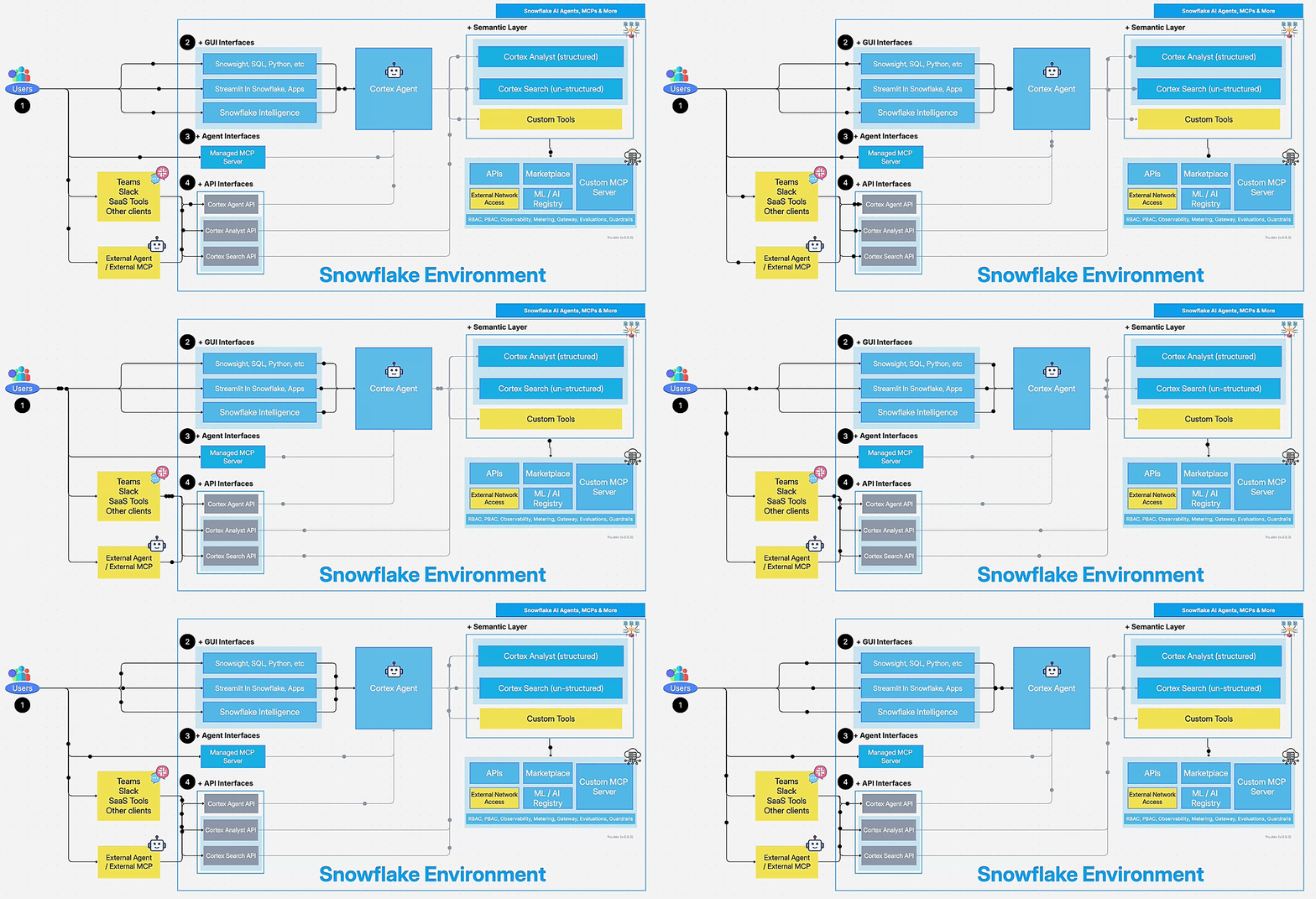
Image Source
Think of it as giving AI the ability to “look things up” before answering, just like a human might consult reference materials.
Building on the foundational Retrieval-Augmented Generation (RAG), the article explores various innovative RAG variants such as TAG, CAG, CoAG, LightRAG, and GraphRAG.
Each variant enhances AI’s capabilities in unique ways, addressing specific challenges and expanding the applications of AI in information retrieval.
1. Context-Aware Generation (CoAG)
Imagine an AI that doesn’t just know facts, but understands your specific situation. That’s what CoAG brings to the table. It considers factors like:
- Your previous interactions
- Your location and time zone
- Your preferences and needs
This personalization makes AI interactions feel more natural and relevant, especially in customer support and personal assistant applications.
2. Cache-Augmented Generation (CAG)
CAG is all about speed and efficiency. Instead of looking up information every time, it keeps frequently used data in a quick-access memory cache. This approach is particularly valuable for:
- Real-time applications needing quick responses
- Domain-specific tasks where certain information is frequently needed
- Reducing computational overhead in high-traffic systems
3. Tool-Augmented Generation (TAG)
TAG takes AI capabilities to the next level by connecting models with external tools and services. This means AI can:
- Query databases for real-time data
- Use calculators for precise computations
- Access APIs for current information
- Trigger automated workflows
This makes AI systems more dynamic and capable of handling complex, real-world tasks.
4. Graph-RAG: Adding Relationship Intelligence
Graph-RAG introduces a new dimension by understanding relationships between pieces of information. Instead of treating data as isolated facts, it sees connections and patterns. This is particularly powerful for:
- Drug discovery research
- Complex enterprise knowledge management
- Fraud detection systems
- Any application where understanding relationships is key
[embed]Graph-RAG in AI: What is it and How does it work? Introductionmedium.com
5. LightRAG: Making It All More Efficient
As powerful as these techniques are, they can be resource-intensive. LightRAG offers a streamlined approach that:
- Optimizes retrieval to use fewer resources
- Maintains quality while reducing computational costs
- Makes advanced AI more accessible for resource-constrained environments
6. Self-RAG: Teaching AI to Self-Reflect
One of the most exciting developments is Self-RAG, introduced in late 2023. This approach teaches AI systems to retrieve, generate, and critique through self-reflection. Think of it as giving AI the ability to double-check its work and learn from its mistakes. This leads to more accurate and trustworthy outputs.
7. DuetRAG: The Power of Collaboration
DuetRAG brings a collaborative approach to information retrieval and generation. By working in tandem with other AI systems or components, it can produce more comprehensive and nuanced responses. This is particularly valuable for complex tasks that benefit from multiple perspectives.
8. Agentic RAG: The Self-Driving Knowledge Worker
Agentic RAG takes AI autonomy to the next level by enabling systems to independently decide what information to retrieve and how to use it.
While Tool-Augmented Generation (TAG) focuses on selecting and using specific tools like calculators or APIs, Agentic RAG concentrates on autonomous information discovery and validation.
Think of TAG as a craftsperson with a specialized toolbelt, while Agentic RAG acts more like an independent researcher who knows how to find, validate, and synthesize information.
Other Notable Innovations
Corrective RAG
This variant acts like a fact-checker, verifying the accuracy of generated content against retrieved documents. It’s particularly effective at reducing AI hallucinations and ensuring factual correctness.
Speculative RAG
When faced with incomplete information, Speculative RAG can make educated guesses based on available data and patterns. It’s especially useful in scenarios where perfect information isn’t available but informed predictions are valuable.
Fusion RAG
By merging information from multiple sources, Fusion RAG creates more comprehensive responses. It’s like having multiple experts contribute to answering a question, each bringing their unique perspective.
Multimodal RAG
Taking RAG beyond text, Multimodal RAG can work with various types of content including images and video. This broadens the scope of what AI can understand and reference when generating responses.
What This Means for the Future
The rapid evolution from basic RAG to these sophisticated variants shows just how quickly AI capabilities are advancing. Each new approach addresses specific challenges or enhances particular aspects of AI performance, leading to systems that are:
- More self-aware and capable of self-improvement
- Better at collaboration and information synthesis
- Increasingly autonomous in information gathering
- Capable of working with diverse types of data
- More reliable and factually accurate
For businesses and developers, this means more options for building AI systems that fit their specific needs, whether prioritizing accuracy, efficiency, or contextual understanding.
Resources
A Comprehensive Survey of Retrieval-Augmented Generation (RAG): Evolution, Current Landscape and Future Directions https://arxiv.org/pdf/2410.12837
[embed]
Hello and welcome! Thrilled you’re here. We share insights on Data, AI, Tech trends, and the Future. Thank you for being a part of this community!
🙏 Before you go: If you found value in this post, please clap and follow to stay updated! 👏
Discover more handy projects at: **Fru.dev**
메타데이터
- post_id
- 6f873f5d6c4d
- slug
- 8-rag-tag-cag-and-beyond-a-survey-of-advanced-information-retrieval-in-ai-6f873f5d6c4d
- url
- https://medium.com/demohub-tutorials/8-rag-tag-cag-and-beyond-a-survey-of-advanced-information-retrieval-in-ai-6f873f5d6c4d
- canonical_url
- https://medium.com/demohub-tutorials/8-rag-tag-cag-and-beyond-a-survey-of-advanced-information-retrieval-in-ai-6f873f5d6c4d
- author_url
- https://medium.com/@frulouis
- status
- ok
- fetched_at
- 2026-06-13 16:23:23