Part II: The Opposition, The Stakes, and The Wall
Why Very Few Understand This
Part II: The Opposition, The Stakes, and The Wall
Why Very Few Understand This
Before we get to who opposes this and why, there is something that needs to be understood.
Very few can see what CTMP actually is.
Not because they lack intelligence. Not because they lack credentials. But because the project does not fit inside any single discipline, and we have trained people to think in disciplines.
Show CTMP to an energy economist, and they see a power plant. They evaluate it against solar, wind, nuclear. They miss the water. They miss the steel. They miss the concrete. They miss the food system. They miss the geopolitics.
Show it to a hydrologist, and they see a desalination system. They evaluate it against reverse osmosis benchmarks. They miss the brine economics. They miss the mineral extraction. They miss the fact that water becomes free because lithium and magnesium pay for it.
Show it to a materials scientist, and they see green steel production. They evaluate it against electric arc furnace efficiency. They miss that the steel makes the turbines that make the power that makes more steel.
Show it to an economist, and they see disruption to energy markets. They model price effects. They miss that this is not market disruption. It is market replacement. They miss that the internal economy operates on different rules than the external economy.
Show it to a climate scientist, and they see emissions reduction. They calculate avoided carbon. They miss that this does not just reduce emissions. It makes the economics of emissions physically impossible to sustain.
Show it to a geopolitical strategist, and they see energy independence. They model shifts in national power. They miss that this does not shift the board. It flips the table. Resource wars become economically irrational when the resources are abundant.
CTMP sits at the intersection of energy physics, hydraulic engineering, industrial chemistry, materials science, atmospheric science, hydrology, economics, finance, governance, geopolitics, public health, urban planning, agricultural systems, and computational infrastructure.
It bisects every one of them. It transforms every one of them. And almost no one is trained to see across all of them simultaneously.
You do not need to be a polymath to understand CTMP. You just need to let go of the assumption that something this big must fit neatly into someone’s existing expertise. It does not. That is why the experts keep missing it. That is why the institutions keep stalling. That is why the people with the most credentials are often the most confused.
They are not seeing a project. They are seeing the corner of a project that happens to fall within their discipline, and they are evaluating that corner as if it were the whole.
The 17 Verticals
Let me show you what I mean.
CTMP is not one thing. It is seventeen verticals, each designated as its own special purpose entity, each feeding the others, each trading internally at cost with zero markup. Here they are:
Canal Construction and Excavated Materials. Green Steel Production. Green Concrete Manufacturing. Desalination Plant. Tunnel Boring Machines. Refined Materials including silica, iron, kaolin, clays, tin, sand, gravel, rare earth elements, and bagging. Green Molecules Platform covering hydrogen, ammonia, methanol, and synthetic natural gas. Data Centers. Green Wafer Manufacturing. Logistics Facility, Housing, and Infrastructure Development. Transshipment and Port Operations. Turbines. Carbon Sequestration and Credits. Hydro. HVDC. Research and Development. 3D Factory.
Seventeen verticals. Each one would be a major industrial operation on its own. Together, they form something unprecedented: a closed loop industrial ecosystem where the output of each vertical becomes the input for the others.
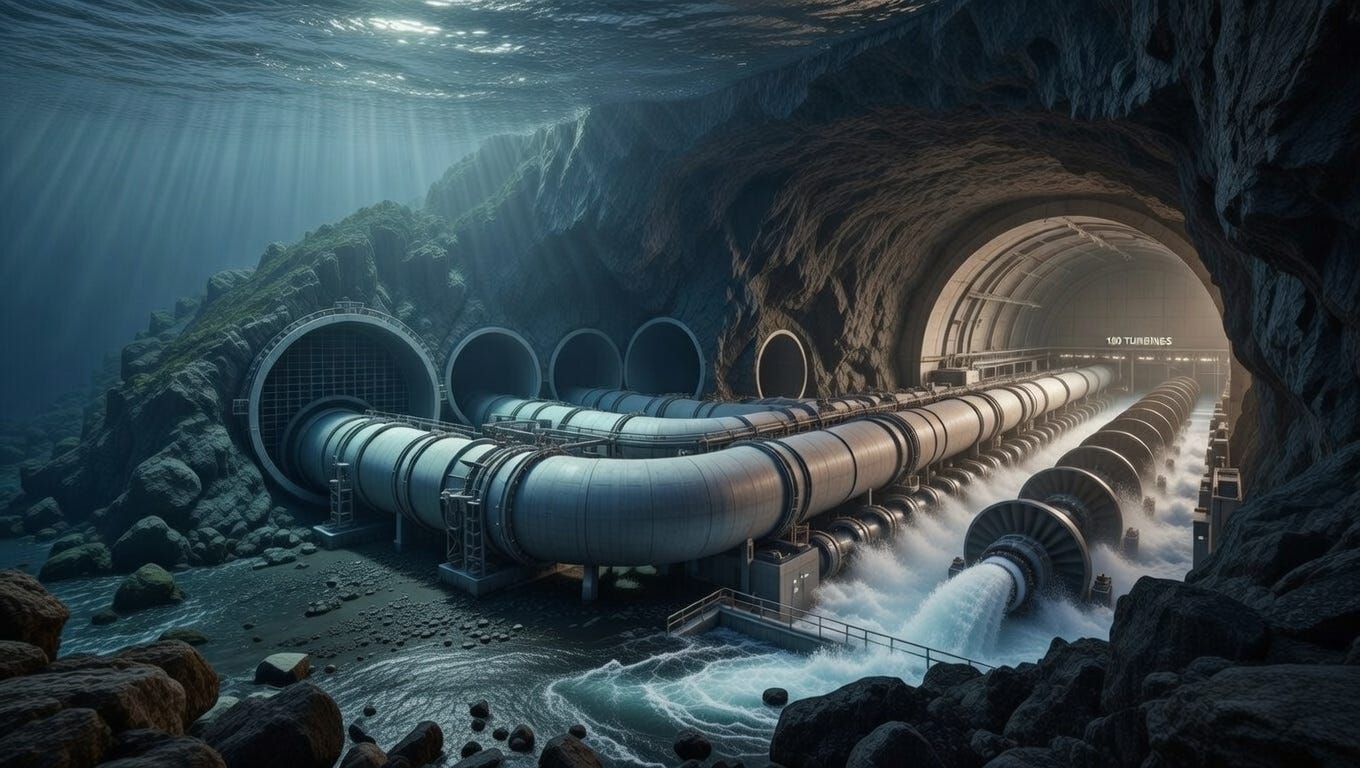
The steel vertical makes the turbines. The turbines generate the power. The power runs the desalination. The desalination produces the water. The water enables the concrete. The concrete builds the infrastructure. The infrastructure houses the data centers. The data centers require the HVDC transmission. The HVDC requires the steel. The loop closes. And it compounds.
This is not a supply chain. This is a self-reinforcing industrial organism that consumes scarcity economics and produces abundance.
What It Actually Touches
Energy and Climate
One CTMP module produces 300 gigawatts of baseload power at a 95% capacity factor. That is not a typo. That is 2.5 petawatt-hours per year from a single installation.
Global electricity production in 2024 was approximately 30 petawatt-hours. One module produces roughly 8% of that. The full platform of 80 modules produces 214 petawatt-hours annually. That is seven times current global electricity production.
At that scale, you do not transition away from fossil fuels. You make them economically extinct. Coal plants do not get regulated out of existence. They become stranded assets because no one will buy their expensive, dirty power when clean power costs a fraction of a penny.
The climate implications cascade from there. Over 100 gigatonnes of CO2 equivalent avoided per year at full deployment. Not through carbon capture. Not through offsets. Through the simple physics of not burning things.
Artificial Intelligence and Computation
Here is something most people have not considered.
The AI revolution is an energy revolution. Every large language model, every training run, every inference query requires electricity. The data centers powering this transformation are already straining grids worldwide. The projections show AI energy demand doubling, tripling, quintupling over the next decade.
The current answer from some quarters? Launch thousands of rockets to deploy millions of solar panels in orbit, beaming power back to Earth.
Think about that for a moment.
We are seriously proposing to pollute our atmosphere with thousands of rocket launches, burning massive quantities of fuel, creating enormous amounts of space debris, to deploy solar panels that will achieve a capacity factor of perhaps 65 to 70 percent if they are extraordinarily lucky. Meanwhile, one CTMP module sits on the ocean floor at 95% capacity factor, producing more power than all the space-based solar proposals combined. Without the rockets. Without the orbital infrastructure. Without the microwave transmission losses. Without the debris fields. Without the geopolitical nightmare of who controls power infrastructure in orbit.
At 2.5 cents per kilowatt-hour, dropping over time toward the internal cost of 0.08 cents, AI training becomes radically cheaper. The computational frontier expands. The models that today only wealthy nations and corporations can afford to train become accessible to researchers everywhere.
The AI revolution either runs on abundant clean energy or it runs on fossil fuels and orbital fantasies. CTMP is the former. Everything else currently proposed is some version of the latter.
Water and Agriculture
Each module produces 2.5 billion cubic meters of fresh water per year. Of that, 2 billion cubic meters goes free to the host nation.
Free. Not subsidized. Not means-tested. Free.
The water is free because the brine pays for it. When you desalinate seawater, you concentrate the minerals. Most plants dump this as waste. CTMP extracts it as product: magnesium, lithium, potassium, bromine, sodium chloride. The mineral revenue exceeds the cost of water production. The economics invert.
Now extend that to agriculture. Half the people currently alive exist because of the Haber-Bosch process, which is industrial nitrogen fixation for fertilizer. That process consumes 1 to 2 percent of global energy. When energy costs drop by 95%, fertilizer costs drop. When water becomes free, irrigation costs drop. When transportation costs drop, distribution costs drop.
The entire food system reprices around abundant energy and water. Not in theory. In accounting.
Materials and Manufacturing
Steel is the skeleton of civilization. Concrete is its flesh. Both are energy-intensive to produce. Both are fundamental to everything we build.
CTMP does not just use steel and concrete. It produces them. The green steel vertical makes the turbines. The turbines make the power. The power makes more steel. The concrete vertical pours the infrastructure. The infrastructure enables more production.
At the external tariff of 2.5 cents per kilowatt-hour, CTMP steel production costs approximately $450 to $500 per tonne. At the internal rate of 0.08 cents, the cost drops to $350 to $400 per tonne. Either way, legacy steel producers face $800 or more per tonne with volatile inputs and carbon penalties.
They do not get outcompeted. They get made obsolete.
This is a self-reinforcing industrial loop where every output becomes another vertical’s input, at internal cost, not market price. The loop compounds. 10% annual growth for 20 years. Each module makes the next one easier to build.
Geopolitics and Conflict
Most wars in the past century have been, at their root, about resources. Oil. Water. Arable land. Minerals. The nations that control scarce resources project power. The nations that need them pay tribute in money, in policy, in blood.
When energy becomes abundant, oil loses its strategic value. When water becomes abundant, river conflicts lose their logic. When materials become cheap, mineral deposits stop being worth fighting over.
Russia cannot threaten Europe with gas cutoffs if Europe does not need the gas. Saudi Arabia cannot buy influence if nobody needs their crude. China cannot dominate rare earth supply chains if the minerals come from seawater at scale.
This is not idealism. This is the structural transformation of the conditions that make resource wars rational.
Defense contractors understand this. Petrostates understand this. That is why they will fight it.
Public Health and Human Development
7 million people die every year from air pollution. 1.4 million die from unsafe water. These are not abstract statistics. These are grandmothers who could not breathe. Children who drank contaminated water. Fathers who developed lung cancer from the particulates outside their window.
CTMP does not reduce these deaths. It eliminates the conditions that cause them. When fossil fuels become economically extinct, the combustion stops. When clean water becomes free, waterborne disease collapses.
The public health implications extend further. Cheap energy means affordable refrigeration for vaccines. Affordable heating and cooling for vulnerable populations. Affordable medical equipment manufacturing. Affordable hospital construction.
Health is downstream of energy. Always has been. We just pretend otherwise because acknowledging it would require us to fix the energy system.
The Philosophical Implications
Now we arrive at the part that most people never reach. The part that keeps me awake at night. The part that makes this more than an engineering project.
What does it mean for human civilization when scarcity becomes optional?
For all of recorded history, scarcity has been the organizing principle of human society. We compete because there is not enough. We hoard because we fear running out. We fight because someone else has what we need. We build hierarchies to control access to limited resources. We accept suffering as inevitable because the alternative seems impossible.
Our economics assumes scarcity. Our politics assumes scarcity. Our morality, in many ways, assumes scarcity. We have built entire philosophical frameworks around the management of not having enough.
What happens when the assumption breaks?
CTMP does not propose a utopia. It does not promise that humans will suddenly become kind, or wise, or cooperative. It does not solve greed or tribalism or the capacity for cruelty.
What it does is remove the material basis for certain kinds of conflict. You cannot fight a water war when water is free. You cannot leverage energy dependence when energy is abundant. You cannot maintain a political coalition based on fear of scarcity when scarcity has been engineered out of the system.
This is not the end of human problems. It is the end of a particular category of human problems, the ones rooted in not having enough of the things we need to survive.
The implications ripple outward.
If energy is abundant, then the question of who deserves access to electricity disappears. Everyone gets it. The moral calculus changes.
If water is free, then the political fights over rivers and aquifers lose their urgency. The Middle East peace problem looks different when water is not a weapon.
If materials are cheap, then the argument that we cannot afford to house everyone, to build the infrastructure, to develop the technology, that argument collapses. We can afford it. We just have to decide to do it.
If health is downstream of energy, and energy is abundant, then the suffering we currently accept as inevitable becomes a choice. Not a necessity. A choice.
CTMP forces a question that most of human history has allowed us to avoid: If we can solve these problems, what does it mean if we choose not to?
The architecture exists. The physics work. The economics work. The governance is designed to be uncapturable.
Every day we do not build it is now a choice. A choice with a body count. A choice that will be visible to future generations who will look back and ask: They knew how to do this. Why did they wait?
That is the philosophical weight of this moment. That is what the Death Clock measures. Not just lives lost, but the moral clarity of a species that can see the exit and is still debating whether to walk through it.
Who Does Not Want This to Happen
Now you understand why this is hard to see. It is not a project. It is a phase transition. And phase transitions threaten everyone invested in the current phase.
Some people make their money from scarcity. They will fight this with everything they have.
Oil companies face stranded assets worth trillions. Their reserves, currently booked as assets on their balance sheets, become worthless. Not gradually. Suddenly. The moment the market believes CTMP will deploy, the repricing begins. They will fund doubt. They will fund delay. They will fund confusion.
Petrostates like Russia, Saudi Arabia, Iran, and Venezuela derive their geopolitical power from energy scarcity. Their sovereign wealth funds, their military budgets, their regime stability all depend on oil revenue. These are nations with intelligence services, and deep ties to global media.
Utility monopolies profit from controlling access to electricity. Their entire business model is regulatory capture: getting permission to charge you more than the service costs. If electricity costs nearly nothing, their margins disappear, their stock collapses, their executives lose their positions. They will lobby, litigate, and delay.
Defense industries profit from conflict. Fewer resource wars means smaller military budgets, fewer contracts, less demand for weapons systems designed to project power over oil fields and shipping lanes. Their shareholders expect growth. Abundance is bad for business.
Financial institutions have trillions invested in fossil fuel assets, utility bonds, and commodity trading. The repricing event threatens their portfolios, their lending, their entire investment thesis. They will argue for managed transition, which means delay.
Politicians who run on scarcity need fear to win elections. “They are coming for your jobs, your water, your land.” That message loses power when there is enough for everyone. Abundance makes demagogues irrelevant. They will fight it to stay relevant.
These entities are not evil. They are rational actors protecting their interests. The problem is that their interests require your continued suffering.
And here is what they do not want you to understand.
They can lobby. They can litigate. They can fund confusion. They can buy media coverage and politicians and think tanks. They can stall in boardrooms and bury proposals in committees. They have done this for decades. They are very good at it.
But they cannot stop you.
One person, they can ignore. A thousand people, they can manage. A million people, they must acknowledge. Ten million people, they cannot control. A hundred million people speaking with one voice, demanding one thing, with their names recorded and their timestamps permanent?
That is a force no institution on Earth can withstand.
Your voice matters because it is the one thing they cannot buy. Your name on The Wall is the one vote that cannot be gerrymandered, lobbied, or filibustered. Your demand, combined with millions of others, creates a mandate that no politician can ignore, no fund can dismiss, no board can table for further review.
They have the money. They have the lobbyists. They have the access.
You have the numbers. And the numbers win. They always win. Eventually.
The only question is whether “eventually” comes soon enough to save the 1,382 who will die today. And tomorrow. And every day until we build.
Why I Refused $400 Billion
Over the past two years, I have been offered more than $400 billion in funding for CTMP.
Sovereign wealth funds. Private equity. Development banks. Governments.
I refused every offer.
The $106 billion offer was loaded with debt. Debt requires interest. Interest requires raising prices. Within five years, the 2.5 cent tariff would become 7 cents. At 7 cents, fossil fuels remain competitive. At 7 cents, coal plants keep running. At 7 cents, people keep dying. The abundance machine would become an extraction machine wearing abundance’s clothing.
The $13 billion offer was for fossil fuel exploration using CTP, the predecessor platform. They wanted to use the subsurface technology to extract oil and gas. They wanted me to become part of the disease instead of the cure.
The $285 billion offer wanted majority control. Majority control means whoever holds that stake decides the tariff. They could say 2.5 cents today and 8 cents tomorrow. The constitutional lock would become a suggestion. The Sovereign Logic Engine would become a marketing gimmick.
Every offer had the same flaw: it would have killed the tariff.
The 2.5 cent tariff is not just a price. It is the kill switch for the scarcity economy.
At 2.5 cents, solar becomes uneconomic. Wind becomes uneconomic. Gas becomes uneconomic. Coal becomes uneconomic. Nuclear becomes uneconomic. Not because we banned them. Because no one will buy expensive power when cheap power exists.
The tariff had to be protected. The offers that would have destroyed it had to be refused. Not out of nobility. Out of engineering logic. A machine designed to end scarcity cannot be funded by instruments that reintroduce scarcity.
Without the tariff, the whole thing is just another infrastructure project. With the tariff, it is the end of artificial scarcity.
The Death Clock
There is a number at the center of this.
1,382.
That is how many people die every single day from causes CTMP can prevent.
This is not rhetoric. This is WHO mortality data, Global Burden of Disease statistics, and conservative attribution modeling. Air pollution: 7 million dead per year. Unsafe water: 1.4 million dead per year. CTMP attribution at conservative rates: 505,000 per year. Divided by 365: 1,382 per day.
There is a clock that counts them.
It runs on the website. Updates every 62.5 seconds. Never stops. Never resets.
The Death Clock exists because “delay” sounds bureaucratic and “1,382 deaths per day” sounds like what it is: a massacre in slow motion.
It exists because before CTMP was published, institutions could claim ignorance. “We did not know there was an alternative.” After publication, that excuse is gone. The architecture is public. The math is auditable. Every day of delay is now a documented choice by people with names, in institutions with addresses.
It exists because if the only pressure comes from capital, capital will capture the machine. The Death Clock makes humanity the client. When institutions argue for delay, they do it in front of a counter showing 1,382 deaths per day. The bodies count in real time.
The deaths were not unavoidable. They were the result of choices. The clock makes those choices visible.
The Wall
The Death Clock shows the cost. The Wall shows the demand.
The Wall is a public ledger. Anyone on Earth can add their name. No money required. No membership. No organization. No gatekeepers. Just your name, your country, and a timestamp.
When you sign The Wall, you are making a statement:
“I have seen the architecture. I understand what it does. I want it built. I am recording my demand in public, where it cannot be erased, bought, or spun.”
Consider what this actually means.
For the first time in human history, the species can speak with one voice on a specific, technical, actionable demand. Not a vague petition. Not a symbolic gesture. A named, timestamped, permanent record of global consensus that a particular architecture should be built.
One thousand names is a curiosity.
One hundred thousand names is a signal.
One million names is a mandate.
Ten million names is a political fact that no institution on Earth can ignore.
One hundred million names rewrites what is possible.
Think about what those names represent. A farmer in Kenya and a software engineer in Finland. A grandmother in Brazil and a student in Vietnam. A doctor in Egypt and a factory worker in Indonesia. Each one saying the same thing: We see the path. We want it taken. We are recording our demand where it cannot be hidden.
The Wall is not a protest. Protests ask those in power to change. The Wall does not ask. It records. It accumulates. It creates an undeniable evidence base that humanity, when shown a way out of artificial scarcity, said yes.
Every name on The Wall is a data point in the largest informed consent document ever assembled.
This changes the negotiating dynamics with every institution on Earth. Sovereign wealth funds cannot claim there is no public appetite. Governments cannot claim their citizens do not want this. Development banks cannot claim the demand is uncertain. The names are there. The timestamps are there. The countries are there. The record is permanent and public.
When an institution tries to delay, they do it in front of The Wall. The names are watching. The record does not forget.
When history asks why it took so long, The Wall answers: We demanded. We recorded our demand. The delay was not our choice. It was theirs. And here are their names, their institutions, their timestamps of inaction, set against the names of everyone who said yes.
The Wall is humanity’s receipt. Proof that we knew, we understood, and we chose. Whatever happens next, that record exists.
The Pivot
For years, CTMP followed the conventional path. Approach the institutions. Brief the sovereign wealth funds. Present to the development banks. Meet with the ministries. Seek the capital that builds megaprojects.
The result? Paralysis. Interest without action. Meetings that lead to more meetings. Offers that would have killed the tariff. Institutional logic that cannot process something designed to make institutional logic obsolete.
So the strategy has changed.
CTMP is going public. Not an IPO. The opposite of an IPO. Public listings exist to extract value from companies and concentrate it among shareholders. That runs completely contrary to what CTMP is designed to do.
Going public means taking this directly to the people it was designed to serve.
If you do not have a billion dollars in your account, this was built for you.
The 99%. The ones who pay the energy bills. The ones who drink the water. The ones who eat the food and live in the housing and breathe the air. The ones whose children die from pollution and whose grandparents cannot afford to heat their homes. The ones who have been paying scarcity prices their entire lives for resources that do not need to be scarce.
This is who CTMP was designed for. And this is who will demand that it gets built.
The institutions had their chance. They stalled. They hedged. They tried to capture. They asked questions designed to delay rather than clarify. They treated a solution to human suffering as a due diligence exercise to be managed rather than an emergency to be addressed.
So now we go around them.
Not to fight them. Not to vilify them. Simply to change who the client is. When millions of people record their demand on The Wall, when the Death Clock makes the cost of delay impossible to ignore, when the 99% speak with one voice and say “build it,” the institutions will follow. They always do. They just need permission. They need political cover. They need to be able to say “the people demanded this” when their boards ask why they acted.
The Wall gives them that permission. The Death Clock gives them that urgency. The 99% gives them that mandate.
This is no longer a pitch to capital. This is a pitch to humanity.
The Moment We Are In
I want to be very clear about what is happening.
We are not in a normal moment. We are not facing normal choices.
The climate is destabilizing. Water scarcity is accelerating. Energy demand is exploding, driven by AI, by development, by a species that needs more power every year. The current trajectory ends in conflict, in suffering, in constraints that will shape human possibility for centuries.
And here, now, there exists an architecture that addresses all of it. Not partially. Not incrementally. Completely.
Energy so cheap it changes the economics of everything. Water so abundant it ends scarcity as a political weapon. Materials so available that building becomes easy. Air so clean that millions stop dying.
The architecture exists. The physics work. The economics work. The governance is designed to be uncapturable.
The only question is whether we build it.
The opposition will tell you it is too big, too ambitious, too different from how things are done. They will say we need more studies, more pilots, more phased approaches. They will say this with great seriousness while the clock ticks and the bodies accumulate.
But you have now seen what they do not want you to see.
You have seen the cascade. You have seen the disciplines it transforms. You have seen who benefits from delay. You have seen why the money was refused. You have seen the cost in lives. You have seen the philosophical weight of what we are choosing.
You have seen enough to choose.
The Choice
You can close this document. Scroll past. Go back to your life. Hope someone else does something.
Or you can sign The Wall.
It costs nothing. Takes thirty seconds. Requires no expertise.
Just your name. Your country. Your timestamp.
A permanent record that you saw, you understood, and you demanded.
The Wall opens December 2025.
The Death Clock is already running.
1,382 preventable deaths today.
1,382 more tomorrow.
Every day we wait.
Until we build.
When The Wall goes live, will your name be on it?
End of Part II
메타데이터
- post_id
- 6fa8f5069e8a
- slug
- part-ii-the-opposition-the-stakes-and-the-wall-6fa8f5069e8a
- url
- https://medium.com/@chris_16327/part-ii-the-opposition-the-stakes-and-the-wall-6fa8f5069e8a
- canonical_url
- https://medium.com/@chris_16327/part-ii-the-opposition-the-stakes-and-the-wall-6fa8f5069e8a
- author_url
- https://medium.com/@chris_16327
- status
- ok
- fetched_at
- 2026-06-17 08:20:12