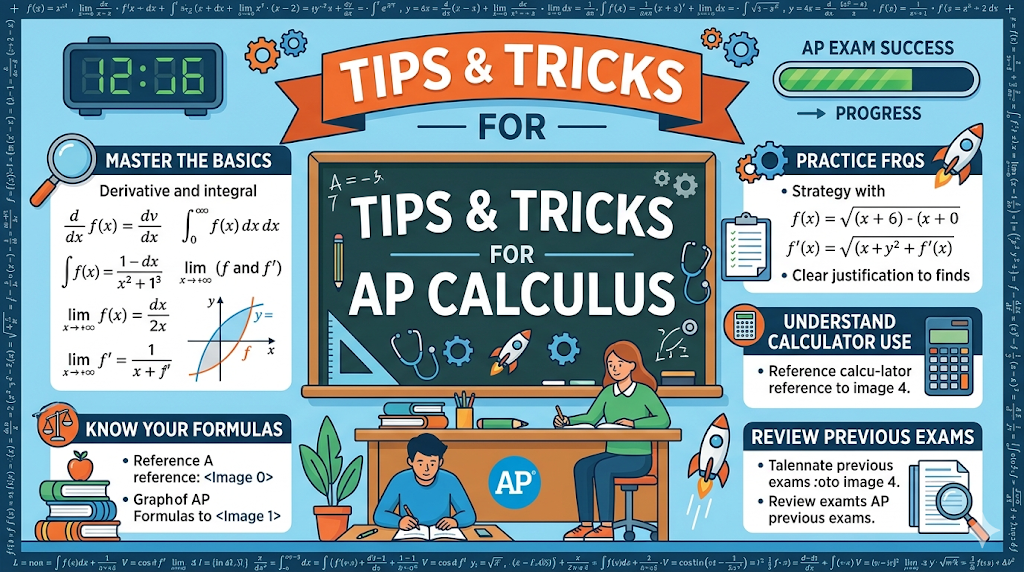
Tips & Tricks for AP Calculus
AP Calculus has a reputation for being one of the most intimidating classes in high school. The word calculus alone can make students…
Tips & Tricks for AP Calculus
AP Calculus has a reputation for being one of the most intimidating classes in high school. The word calculus alone can make students nervous before they even step into the classroom. Between derivatives, integrals, limits, and endless practice problems, it’s easy to feel overwhelmed at first.
But here’s the truth: AP Calculus is not about being a “math genius.” More than anything, it’s about consistency, pattern recognition, and learning how to think through problems step by step.
At first, the concepts may feel confusing or abstract. Over time, though, calculus starts to feel less like memorizing formulas and more like learning a new language, one that becomes easier the more you practice it.
Whether you’re taking AP Calculus AB or BC, here are some helpful tips, tricks, and resources to make the class feel more manageable and less stressful.
1. Focus on Understanding Why, Not Just How
One of the biggest mistakes students make in calculus is memorizing steps without understanding what the math actually represents.
For example:
- A derivative represents change
- An integral represents accumulation or area
- A limit describes what a function approaches
When you understand the meaning behind the concepts, the formulas become easier to remember and apply.
Instead of asking: “What formula do I use?”
Try asking: “What is this problem actually asking me to find?”
That mindset shift can completely change how you approach calculus.
2. Practice Consistently, Even for Short Amounts of Time
Calculus is not a class you can cram for the night before a test.
The concepts build on each other constantly. If you fall behind on one topic, the next topic often becomes even harder.
A better strategy is:
- 20-30 minutes of practice daily instead of
- 4 hours of panic studying once a week
Even doing a few problems consistently helps strengthen your understanding over time.
3. Don’t Memorize Without Patterns
At first, calculus can feel like there are too many rules:
- Product rule
- Quotient rule
- Chain rule
- Power rule
But after enough practice, you’ll begin noticing patterns.
For example:
- The chain rule almost always appears when you see a function inside another function
- Related rates problems nearly always involve implicit differentiation
- Optimization problems follow similar structures repeatedly
The more problems you do, the more familiar these patterns become, and eventually, many questions start feeling predictable.
4. Write Out Every Step
It can be tempting to skip steps in your work, especially if you think you understand the process mentally. But in AP Calculus, writing clearly matters.
Showing steps:
- Helps catch mistakes early
- Organizes your thinking
- Earns partial credit on FRQs
Sometimes students lose points not because they don’t understand the concept, but because their work becomes messy or incomplete.
Calculus rewards organization more than speed.
5. Learn from Mistakes Instead of Erasing Them
One of the best ways to improve in calculus is reviewing what went wrong.
When you miss a problem:
- Don’t just look at the correct answer
- Figure out why your approach didn’t work
- Identify the exact step where the mistake happened
A lot of calculus errors come from:
- Algebra mistakes
- Sign errors
- Small arithmetic slips
Sometimes the issue isn’t calculus itself, it’s the foundational math underneath it.
6. The FRQs Are Different from Regular Homework
Many students do well on homework but struggle with AP free-response questions because FRQs test explanation and reasoning, not just computation.
The AP exam often asks you to:
- Interpret graphs
- Explain meaning in context
- Justify answers mathematically
- Connect multiple concepts together
This means you should practice:
- Writing explanations clearly
- Using correct mathematical notation
- Explaining reasoning in words
The more FRQs you practice, the less intimidating they become.
7. Graphs Are Extremely Important
AP Calculus is not just about equations, it’s also about visual understanding.
You should feel comfortable analyzing:
- Function behavior
- Slopes and tangent lines
- Increasing/decreasing intervals
- Concavity
- Accumulation on graphs
Sometimes a graph can explain a concept faster than a formula can.
8. Helpful Resources for AP Calculus
Here are some of the most helpful resources for learning and reviewing calculus concepts:
YouTube Channels
- The Organic Chemistry Tutor: Clear step-by-step explanations and practice problems
- Professor Leonard: In-depth lessons with strong conceptual explanations
- Khan Academy: Great for foundational review and guided practice
- 3Blue1Brown: Excellent visual explanations that help concepts “click”
Practice Resources
- College Board AP Classroom
- Released AP FRQs from previous years
- Fiveable study guides
- Review books like Princeton Review or Barron’s
9. Don’t Compare Yourself to Other Students
Calculus classes can sometimes feel competitive, especially when some students seem to understand concepts instantly.
But math understanding develops differently for everyone.
Some students:
- Learn quickly but forget later
- Need more time initially but build deeper understanding over time
Struggling with a concept does not mean you’re “bad at math.” Calculus challenges almost everyone at some point.
The goal is progress, not perfection.
10. Confidence Matters More Than You Think
A lot of students walk into calculus already convinced they’ll fail because they’ve heard how difficult it is.
That mindset can become part of the problem.
When you approach every question expecting confusion, you’re more likely to panic and give up quickly. But when you slow down and trust the process, difficult problems often become manageable.
You do not need to solve every problem instantly. You just need to stay patient enough to work through it.
Final Thoughts
AP Calculus is challenging, but it’s also one of the most rewarding classes because it teaches more than just math.
It teaches:
- Persistence
- Logical thinking
- Problem-solving
- Patience
There will be moments when concepts feel impossible at first. That’s normal. Almost everyone taking calculus experiences that frustration.
But over time, the problems that once seemed overwhelming become familiar. The formulas start making sense. The patterns become clearer.
And one day, you’ll solve something that once intimidated you, and realize just how much you’ve grown.
Calculus isn’t about being naturally gifted. It’s about learning not to quit when something feels difficult.
메타데이터
- post_id
- 6fe04749e312
- slug
- tips-tricks-for-ap-calculus-6fe04749e312
- url
- https://medium.com/@medmindset/tips-tricks-for-ap-calculus-6fe04749e312
- canonical_url
- https://medium.com/@medmindset/tips-tricks-for-ap-calculus-6fe04749e312
- author_url
- https://medium.com/@medmindset
- status
- ok
- fetched_at
- 2026-06-09 15:37:30