I Started an Etsy Digital Product Business From Pakistan Without Quitting My Full-Time Job.
For a long time, I wanted to earn extra money, but I didn’t want to risk my full-time job. This difference affected nearly every choice I…
I Started an Etsy Digital Product Business From Pakistan Without Quitting My Full-Time Job. Here’s What I Learned
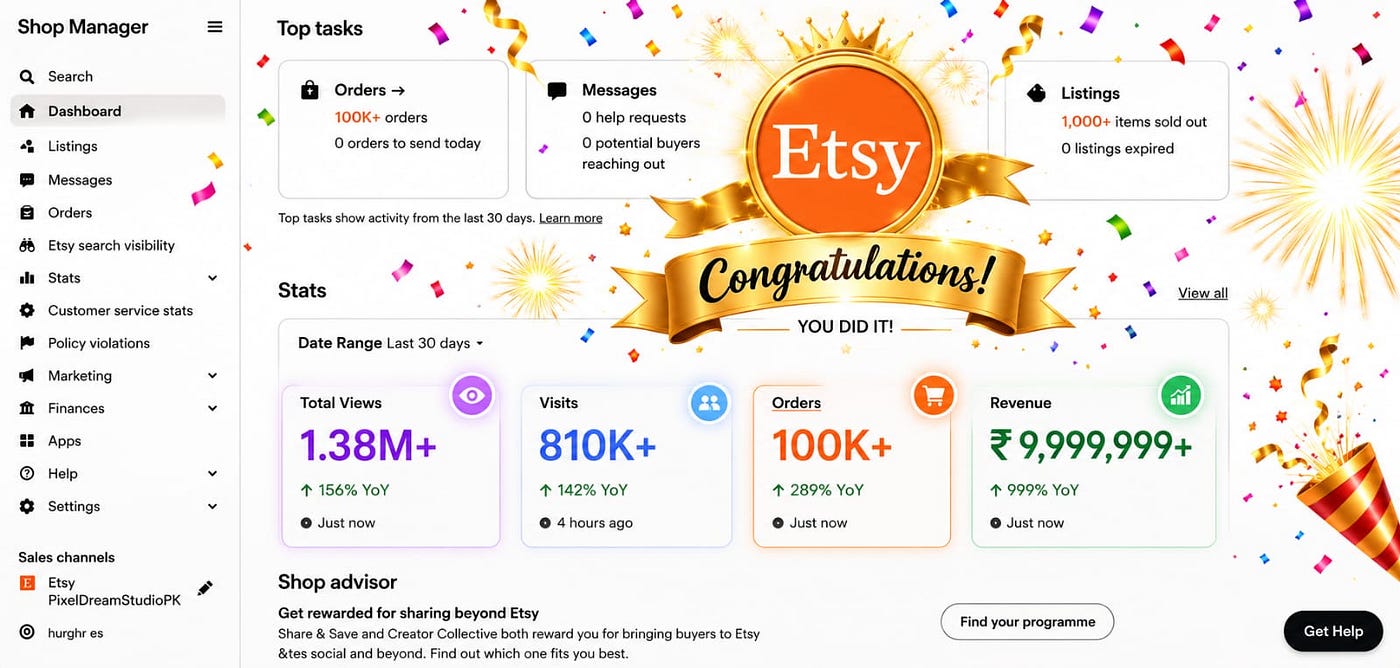
Etsy shop performance dashboard showing views, visits, orders, and revenue — Shahid Writes
For a long time, I wanted to earn extra money, but I didn’t want to risk my full-time job. This difference affected nearly every choice I made when I started selling digital products on Etsy. I didn’t want a quick fix, a scheme to get rich fast, or a business that would instantly replace my income. I aimed to build something slowly during my nights and weekends. I wanted a chance to learn valuable skills while creating a second income stream.
I eventually decided to sell digital products on Etsy because it fit my situation. Digital downloads don’t require inventory, packaging, or shipping, and Etsy automatically delivers the files after a purchase. This setup let me concentrate on research, design, creating listings, customer experience, and improving my shop, rather than dealing with physical logistics.
However, starting was much easier than figuring out how to build a sustainable business. I learned that having an attractive product does not guarantee a successful business. I needed to understand what customers wanted, choose a niche I could consistently create for, learn Etsy SEO, improve product presentation, manage my time well, and accept that some products would sell better than others.
Most importantly, I found that keeping my full-time job was not an obstacle to building my business. In many ways, it gave me the freedom to learn without putting my financial security at risk.
Here’s what the experience taught me.
Why I Wanted an Income Stream Beyond My Full-Time Job
Why I Needed a Business That Fit My Schedule
A full-time job offers something valuable: stability. However, it also limits how much you can earn in that role. To boost your income, you might need a promotion, switch jobs, take on more responsibilities, or put in extra hours.
I wanted another option.
I explored different online business models, like freelancing, affiliate marketing, and selling physical products. The problem wasn’t coming up with ideas; it was finding one that fit into my available time.
Since I was working full-time, I needed a business I could manage after work and on weekends. I also wanted something that wouldn’t require me to be available to clients all the time.
Digital products interested me for this reason. I could create a template, document, planner, worksheet, or other downloadable resource once and sell it to customers in various countries. Items like Canva templates, resume templates, invoice templates, business documents, printable planners, and social media resources could address real problems without requiring inventory or shipping.
That didn’t mean the business was easy. It just meant the model suited my schedule.
Keeping my job also took a lot of pressure off. I didn’t need Etsy to pay my monthly bills right away. If a product didn’t sell, I could evaluate what went wrong, improve the listing, and try again.
This changed my mindset.
Instead of asking, “How quickly can this make money?” I started asking, “What can I learn from this?”
That became one of my biggest advantages.
Why I Chose Digital Products
The Operational Advantage of Digital Downloads
Before deciding on digital products, I compared them to physical products. Physical products can be good businesses, but they come with responsibilities that are difficult to ignore. You need to buy and store inventory, package orders, prepare shipping labels, and monitor deliveries. Damaged or delayed packages can create extra customer service problems. For someone with a full-time job, these tasks can quickly consume the limited time available for a side business.
The Shift From Designing to Solving Problems
Digital products eliminate a lot of the hassle. When a customer buys a downloadable product, it gets delivered automatically through the marketplace. I don’t need a warehouse, shipping boxes, or physical inventory at home.
This allows me to focus on the parts of the business that truly interest me: research, design, writing, SEO, customer experience, and product improvement.
The range of possible products is another benefit. A seller can create business templates, career resources, productivity tools, planners, printable worksheets, spreadsheets, or other digital resources.
However, I learned an important distinction. The goal should not be to make something just because it’s digital.
The goal is to solve a problem.
A professional invoice template can save a freelancer time. A resume template can help a job seeker present information more clearly. A business planner can help an entrepreneur manage tasks and goals.
Design matters, but usefulness matters more.
That shift, from “What can I design?” to “What problem can I solve?” changed how I approached product research.
Why Etsy Made Sense for My Business
Access to Existing Customer Demand
The next question was where to sell. I wanted to reach customers outside my local market, and I did not want to spend all my time building a website and finding every customer on my own. Etsy stood out because it is a well-known marketplace where people already look for creative products and digital downloads. That existing customer interest was important.
The Importance of Etsy Search
Instead of opening a store and trying to persuade people to visit, I could place products in a marketplace where customers were already looking for items like templates, planners, business documents, and printable resources.
Etsy’s search system made SEO important from the start. Customers use search terms to find products, so listing titles, descriptions, tags, categories, and other listing information must clearly communicate what a product is.
The platform also made it easy to deliver digital products for a side hustle. Customers can buy and access digital files without me having to process each order manually.
For someone with a full-time job, that automation is important.
Etsy also shares information about shop performance, including listing stats, search terms, customer activity, and order details. Reviewing that data helped me stop guessing and start making decisions based on what I could see.
Of course, Etsy has its challenges. Competition is strong, marketplace rules can change, and just publishing a listing doesn’t guarantee sales.
The platform connected me to a global audience, but I still had to create a useful product and clearly communicate its value.
Starting From Pakistan Added Another Layer
Serving an International Audience
Starting an international online business from Pakistan took more preparation than just opening a shop. I needed to understand the marketplace, seller requirements, payment setup, international customers, and the practical challenges of serving people in various countries. The global audience was one of the greatest draws. Instead of restricting the business to local customers, I had the opportunity to create products for small business owners, freelancers, students, job seekers, and professionals in diverse markets.
Taking Intellectual Property Seriously
Serving an international audience required careful consideration of customer expectations. A resume format that works well in one market may not be suitable for another. Customers have different preferences regarding layouts, file formats, instructions, and editing tools.
Language was also important. Product titles, descriptions, instructions, and file names needed to be clear and professional.
Time zones created another challenge. Customers could send questions while I was working or sleeping. Since I had a full-time job, I could not always respond right away.
I discovered that being professional does not mean being available all the time. It means communicating clearly, setting realistic expectations, and responding responsibly whenever I can.
Intellectual property was another area I had to take seriously. Digital products rely heavily on design assets, fonts, graphics, templates, and other resources. I needed to ensure that what I created and sold was either original or properly licensed, and that I was following marketplace rules.
This was not just a legal issue or a matter of platform compliance. It was essential for building a business I could trust. I wanted the foundation of my shop to be my own work instead of someone else’s copyrighted material.
The Biggest Misconception I Had
A Good Product Is Only the Beginning
My biggest misconception was simple: I thought creating a good product would be enough. I assumed that if I made a professional Canva template or a well-formatted business document, customers would naturally find it. They didn’t. I learned that product quality is only one part of the equation. Customers have to discover the product, understand it, and believe it will solve their problem. Only then do they decide whether it is worth buying. That made Etsy SEO, product titles, descriptions, listing images, and customer communication much more important than I initially expected.
I also expected sales to come faster. After spending hours researching ideas, designing products, writing descriptions, and creating listing images, it was tempting to think that the work would immediately produce results. Instead, I learned that launching a shop and building a business are two different things. A new shop has to develop visibility and credibility. Products need to be tested. Listings need to be improved. Customer behavior needs to be understood.
Another misconception was that more listings automatically meant more sales. I eventually learned that quantity cannot replace quality. Ten well-researched products that solve real problems can be more valuable than dozens of rushed listings. A large catalog is not useful if the products are poorly designed, poorly presented, or targeted at no clear audience. That realization helped me stop measuring progress simply by how many products I could publish.
Choosing Products Based on Problems, Not Preferences
Using Customer Language to Find Opportunities
Product research became a vital part of my process. At first, it was easy to think about products from the seller’s viewpoint. I considered what would be fun to design, what looks good, and what I could create quickly. But customers think differently. They typically want a solution.
A freelancer might need a professional invoice. A job seeker may need a resume template. A small business owner could need an order form or expense tracker. A student may need a planner or worksheet. The product is just the tool. The problem is the reason they make a purchase.
I started looking at Etsy’s search suggestions and studying existing listings to see how buyers described their needs. I paid attention to titles, product features, preview images, descriptions, and the problems the products aimed to solve.
Customer reviews were particularly useful because they highlighted what buyers liked and what they wanted differently. I was not trying to imitate successful sellers; I wanted to understand the patterns. If customers frequently praised a product for being easy to customize, it indicated that usability mattered. If buyers often requested more layouts or formats, it suggested an opportunity to improve future products.
Competition alone was not a reason to shy away from a niche. A crowded category might indicate there is demand. The challenge lies in finding a unique way to better serve a specific customer. This led me to another important decision: choosing a niche.
Finding a Niche I Could Actually Build Around
Choosing a Niche I Could Sustain
At first, I thought a larger shop might bring in more customers. The problem is that a shop offering everything can get confusing. If one listing is a resume template, another is a wedding printable, another is a business invoice. Yet another is a classroom worksheet; customers may not understand what the brand really focuses on. A specific niche builds a clearer identity.
For example, a shop for business templates can easily branch out into invoices, order forms, expense trackers, proposals, and planners. A shop for career resources can expand from resumes to cover letters, interview worksheets, reference sheets, and application trackers. This structure supports growth without losing focus.
I also considered my own skills. A niche is easier to manage when you are already familiar with the tools and challenges involved. I had experience with digital documents and templates, so making products in those areas was more practical than entering an entirely new field.
The most important question became: Can I keep creating useful products for this audience? This question helped me avoid chasing every trend. Trends can spark ideas, but a lasting business needs a catalog that still makes sense months or even years later.
Quality Over Quantity
Making Every Product Usable
Working full-time made me more selective. I didn’t have enough time to create many products each week, which turned out to be helpful. Instead of trying to increase the number of listings, I focused on making products that were useful, complete, and well presented.
For each product, I considered usability. If it was a Canva template, could the customer easily access and edit it? If it was a printable planner, were the pages formatted correctly? Were the instructions clear? Were the files organized? These details may seem minor, but they impact the customer experience.
A digital product isn’t finished when the design looks good on the seller’s computer. It’s finished when the buyer can use it without unnecessary confusion. I also found that products can improve after publication. Customer questions can highlight unclear instructions. Feedback can reveal missing features. A listing that attracts attention but doesn’t convert may indicate that the presentation or communication needs work.
This turned product creation into an ongoing process instead of a one-time event.
Building My First Shop
Creating a Consistent Shop Identity
I wanted my shop to feel like a business, not just a group of unrelated files. I chose a clear identity and aimed for a consistent visual style. I created several related products rather than relying on a single listing. Then I carefully built the listings. Each listing needed a clear title, a detailed description, relevant keywords, appropriate categories, and strong preview images. The downloadable file itself was just part of the product. The listing had to address the customer’s practical questions before they bought anything.
What exactly am I getting?
Is it editable?
Which software do I need?
What file formats are included?
How do I access it?
What is not included?
Clear information helps reduce uncertainty. This was especially important for templates. If a product was made for Canva and not meant for Microsoft Word, I needed to make that clear. I learned that honest descriptions are not only good customer service; they also make good business sense. The same principle applied to product images. Since customers cannot physically check out a digital download, the listing images must do more work.
Creating Listing Images That Explain the Product
Making the Product Easy to Understand
The first image is often the first chance to show what a product is. I initially focused on making images look good. Later, I realized that looks alone don’t cut it. Customers should quickly grasp what the product is.
For instance, if I was selling an editable invoice template, the image needed to make that clear. For a printable planner, the preview should display the pages and their purpose. With a Canva template, I could use preview images to showcase the layouts and editing options.
Mockups helped customers envision the product in use, but I learned not to let the mockup overshadow the product. I also included multiple preview images to answer various questions. One image could show the overall design; another could highlight features; one could show the included files; and another could explain how customers would use or edit the product.
Clean design was key. Cluttered images with too much text could make the product confusing to use. Consistent typography, spacing, colors, and visual hierarchy made the shop look more professional.
Most importantly, the images had to represent the product honestly. A preview should not create expectations that the downloadable file can’t fulfill. If a listing gets views but few clicks, I need to reevaluate the thumbnail. If customers click but don’t understand the product, the description or preview images might need work.
This approach turned listing design into an ongoing experiment instead of a one-time task.
Learning Etsy SEO
Writing for Search and Humans
SEO was another area where my expectations shifted. At first, I thought Etsy would display a new listing to potential customers. I later realized that search visibility relies on how clearly a listing conveys what it is and how well it matches customer searches.
Turning Features Into Benefits
That meant learning keyword research and understanding search intent. I used Etsy’s search suggestions to grasp the language customers use. I focused on specific phrases rather than broad terms. For example, “invoice template” describes a product category, but a more specific phrase can show a particular audience or use case. The goal was not to cram every keyword into a title. Keyword stuffing can make a title hard for people to read. I wanted titles to be clear first and optimized second.
Descriptions also needed a clear structure. Rather than a single long paragraph, I found it more helpful to organize the information into sections such as “What’s Included,” “Features,” “How to Use,” and “Important Information.” This made the listing easier to scan.
I also learned to link features with benefits. “Editable template” is a feature. “Customize it with your business information and create professional documents faster” explains the benefit. That difference matters because customers are not just buying features. They want the results those features can provide. SEO was, therefore, not just a technical task; it was a way to communicate effectively.
Managing the Business Around a Full-Time Job
Building a Realistic Weekly Routine
The toughest resource I faced was not money; it was time. I had a full-time job and personal commitments, and I often felt drained at the end of the day. Initially, I thought I needed to work on Etsy every day for several hours, but that proved unrealistic.
I eventually created a simpler routine. Some evenings were dedicated to product research and keyword research. Other nights focused on designing products. I also set aside time to write product descriptions or prepare product images. Weekends allowed me longer stretches to create complete products, test files, organize assets, and plan future listings.
My aim was not to fill every free hour; instead, I wanted to make each hour count. That meant focusing on high-impact tasks. Creating a useful product, improving a weak listing, researching customer demand, or clarifying a confusing description was far more valuable than endlessly tweaking colors or fonts.
I also realized the value of small time blocks. Just thirty minutes could be enough to update a description, organize files, respond to a customer question, or review shop statistics. Those little sessions added up.
Another key lesson was to avoid multitasking. Trying to research keywords, design a template, edit images, and respond to messages at once usually reduced the quality of my work. Concentrated effort was faster and produced better results.
I also needed to keep my schedule flexible. Some weeks, my job required more focus. During those times, I lightened my Etsy workload instead of giving up on the business or burning myself out. That made my routine sustainable.
Avoiding Burnout
Consistency Over Extreme Effort
I learned that working more hours doesn’t always lead to more progress. After a long workday, late-night design sessions left me tired and careless. I started to overlook mistakes, and my creativity dropped.
I stopped seeing rest as wasted time. A sustainable side business must fit into a balanced life.
I began setting smaller goals. Instead of committing to several new products each week, I focused on completing one meaningful task well. Some weeks that meant publishing a new product. Other weeks, it involved improving an existing listing or researching future ideas.
I also stopped comparing my start with established Etsy shops. Experienced sellers have spent years building their product catalogs, understanding their customers, and developing their systems and skills. Comparing my early-stage business to someone else’s well-established shop created pressure without offering helpful insights.
My true benchmark became my own progress. Was the next product better? Was the listing clearer? Did I understand customer demand better? Did I learn something about SEO? Those questions were more valuable than fixating on someone else’s sales.
The Biggest Mistakes I Made
Expecting Results Too Quickly
My early mistakes mostly came from misunderstanding. The first mistake was expecting results too quickly. I spent time creating products and thought my efforts would lead to sales right away. They didn’t.
Creating Before Researching
That taught me patience.
Underestimating SEO and Presentation
The second mistake was creating before doing enough research. I could spend hours designing something only to realize that I hadn’t fully understood what customers wanted. Research had to come first.
The third mistake was underestimating SEO. A strong product cannot help a customer who never finds it. Learning about titles, keywords, tags, descriptions, and search intent changed how I approached every listing.
The fourth mistake was underestimating presentation. I initially thought the downloadable file was the main selling point. While it is important, customers often judge the product before they even download it. The thumbnail, mockups, description, and overall listing presentation convey value before the purchase.
The fifth mistake was trying to do too much at once. I considered unrelated products because they seemed popular. That made the shop less focused and complicated my workflow.
The sixth mistake was reacting to poor performance by immediately creating something new. Eventually, I learned to stop and investigate. If a listing was underperforming, I could review the product itself, the title, keywords, description, images, pricing, and customer feedback before deciding what to do next. Sometimes, the better choice was to improve an existing product rather than add a new one.
What Actually Helped My Shop Improve
Using Data and Customer Feedback
The biggest improvements came from small changes, not one big strategy.
I became more disciplined about listing quality.
I reviewed titles and descriptions regularly. I improved preview images. I organized product files. I made instructions clearer.
I also became more comfortable using data.
Instead of assuming a product was bad because it wasn’t selling, I tried to understand where the problem might be.
Was the product hard to find?
Was the thumbnail confusing?
Did the description address the customer’s questions?
Was the product targeted at a specific audience?
Did the product solve an important problem?
These questions helped improve the decision-making process.
Customer feedback provided more insight.
Questions and reviews can uncover issues that the seller might miss. If many customers have trouble with the same instruction, that instruction likely needs improvement. If customers frequently ask for a feature or another format, that feedback can shape future products.
Customer service became part of product research. Even though digital products can be delivered automatically, the business still involves people. A helpful response can build trust. Clear instructions can prevent frustration. Professional interactions can improve the overall experience.
Treating the Shop Like a Real Business
Building Repeatable Systems
One of the biggest changes in my mindset was moving from “I have an Etsy shop” to “I am running a business.” That difference sounds small, but it changes behavior. A business needs systems. I organized my design files, product assets, listing images, instructions, and editable versions. I created repeatable workflows, so every new product did not require me to reinvent the process. I also started thinking about decisions in terms of long-term value.
Would this product fit the market?
Can I create similar products based on the same customer need?
Can this listing be better?
What did customers teach me?
What skill do I need to develop next?
That mindset helped me build a catalog instead of just collecting listings.
It also made ongoing learning a part of the business.
Product research, SEO, design, writing, communication, time management, organization, and problem-solving became skills that I could use for every future product.
These skills were valuable even if a specific listing was not.
The Skills I Gained
Skills That Compound Over Time
Building the shop taught me much more than just how to upload digital products. Product research became an essential skill. I learned to consider customer problems, market demand, competition, and search intent before I spent time designing. SEO also became a valuable skill. Once I grasped keyword research and listing optimization, I could use those lessons for every future product. My design skills improved as well.
I became more aware of typography, spacing, readability, layout, and user experience. I learned that good design is not just about looking good. It should make a product easier to understand and use.
Writing became more crucial.
Every product needs a clear title, description, instructions, and customer communication. The skill of explaining a product became nearly as important as the skill of designing it.
Time management was essential because of my full-time job. I learned to prioritize, work in focused blocks, and make progress through small tasks. Problem-solving also became a daily routine. A low-performing listing was no longer just a disappointment; it became a question.
What is not working?
What evidence do I have?
What can I change?
What happens after the change?
That approach reduced the urge to make decisions based only on emotion.
Most importantly, I learned patience.
An online business can challenge your expectations because effort and results do not always align in terms of speed.
I learned to appreciate the skills and systems I was building, even when the visible results were slow to appear.
The Lessons I Would Give a New Etsy Seller
Start With Research
If I were starting over, I would focus on research before design. I would invest more time in understanding the customer before making the product. I would select a niche that aligns with both demand and my ability to create helpful products consistently.
Launch, Learn, and Improve
I would focus on quality instead of trying to build a large catalog right away.
I would prepare strong listing images from the start.
I would learn Etsy SEO early rather than seeing it as an optional extra.
I would also launch before everything felt perfect.
Perfectionism held me back at first. At some point, making more adjustments adds less value than putting out a well-prepared product, watching how customers respond, and improving based on what I learn.
This doesn’t mean publishing incomplete work. It means recognizing the difference between being “ready” and being “perfect.”
I would also create a schedule I could stick to. A side business shouldn’t force you to sacrifice your health or hurt your performance at your main job.
Being consistent is more beneficial than occasional extremes of effort.
Additionally, I would maintain a long-term view. There’s no set timeline for making a first sale. Factors like product quality, demand, competition, how well you optimize your listing, and customer trust all influence results.
Anyone who promises guaranteed quick success is selling a story, not a real business plan.
My Advice to Anyone Starting From Pakistan
Understand the Marketplace First
If you are in Pakistan and thinking about starting an Etsy digital product business, my first suggestion is to understand how the marketplace operates before you invest a lot of time in creating products. Learn the seller requirements, how to set up payment, the rules of the marketplace, customer expectations, and the international scope of the platform. After that, pick a niche.
Build Around Real Customer Needs
Look for a place where you can regularly create helpful products and where you understand customers’ problems. Don’t pick a niche just because someone online claims it is profitable.
You need to be able to create products that offer real value.
If your skills are in design, consider exploring Canva templates, resume resources, social media templates, and printable items. If you understand business documentation, consider focusing on invoices, planners, spreadsheets, order forms, or other tools that boost productivity.
The specific product is less important than the link between what customers need and your product’s value.
Also, take intellectual property seriously. Use original work and resources that are properly licensed. Make sure your products follow Etsy’s policies. A business built on questionable assets is not a strong long-term venture.
Finally, don’t think that being based in Pakistan keeps you from serving international customers. It can lead to extra considerations, especially regarding payments, communication, time zones, and marketplace requirements. However, the key lesson remains the same: understand the system before you rely on it.
Why I Did Not Quit My Job
Financial Stability Creates Room to Experiment
Perhaps the most important decision I made was to stay in my full-time job. There can be a lot of pressure online to leave work and fully commit to a business. My experience made me more careful. A few successful sales do not prove that a side business can replace a salary.
I want to see steady performance over time, dependable systems, repeat customers, ongoing product improvements, and stable income before making a big career decision. Keeping my job provided me with financial security.
It also let me reinvest in the business when I needed to. This could mean better design tools, educational resources, professional mockups, or software. Most importantly, it let me experiment.
If an idea didn’t work out, I could learn from it without fearing that my main source of income was gone. For me, the Etsy business didn’t have to replace my job right away to be valuable.
It was already providing me with something important: skills, experience, a growing catalog, and a better understanding of how online commerce works.
Build Skills Before Chasing Revenue
Why Skills Matter More Than One Listing
One of the biggest lessons from this experience is that skills can create long-term value. At first, it is easy to focus on revenue.
How many sales will I get?
How quickly will I become profitable?
When can I quit my job?
Those questions are understandable, but they can create pressure before the underlying skills are in place.
I found it more useful to focus on learning.
Every product research session taught me something about customers.
Every listing taught me something about SEO.
Every design taught me something about usability.
Every customer question taught me something about communication.
Every low-performing product allowed me to analyze a problem.
The value of those skills extends beyond one Etsy listing.
When you know how to do keyword research, you can reuse that knowledge. When you learn how to improve the template design, future products become easy. When you learn how to plan product workflows, you can increase your production without just putting in extra hours.
Knowledge builds on itself.
This is why I stopped considering each period of slowness unproductive.
As long as I was getting better at doing the work, I was still moving forward.
Think Long-Term, Not Quick Results
Small Improvements Compound
The internet is full of stories about overnight success.
Those stories can be motivating, but they can also create unrealistic expectations.
My Etsy experience taught me to think differently.
A sustainable shop is built through many small improvements.
Better product.
A clearer product description.
More compelling listing image.
Relevant keyword.
Customer questions that help improve instructions.
New skill.
Not even one of these changes will have an immediate effect on a business.
Together they can help build a more sustainable business over time.
This made me think about trends differently as well.
Instead of trying to chase everything currently popular, I started focusing more on evergreen issues.
There will always be a need for people to structure information, highlight their professional experience, manage business operations, write documents, plan projects, and save time.
A product developed to meet such needs can provide a more solid basis for a business than one based on a current trend.
The business will still change.
Customer needs can change; new competitors can emerge, and people’s search behavior in the market can shift.
This is why constant learning is important.
Because the objective here is not to find one perfect strategy and keep applying it forever.
The objective is to develop the ability to adapt.
My Biggest Takeaway
Build Value Before You Chase Results
If I had to sum up everything I learned in one idea, it would be this: Build value before you chase results.
I started hoping to create an additional income stream, but I learned that revenue usually comes from many factors working together.
You need to understand customers.
You need to research products.
You need to create something useful.
You need to communicate its value.
You need to make it easy to find.
You need to provide a good customer experience.
And you need to keep improving.
No single product, keyword, design trick, or strategy transformed the business overnight.
Instead, progress came from small improvements repeated over time.
This experience also changed how I view entrepreneurship. I used to believe that starting a business required perfect conditions. I thought you needed more time, more money, more experience, or a completely free schedule.
I learned that you can start with what you have as long as you are realistic about what it will take.
My full-time job limited my available hours, but it also provided financial stability.
Starting from Pakistan introduced some challenges, but it also showed me that a digital business can reach customers beyond a local market.
My lack of experience created a learning curve, but every challenge became an opportunity to develop a skill.
That is why I no longer see my Etsy shop as just a place to sell digital downloads.
It became practical education in product research, design, SEO, writing, customer service, organization, and online business.
Those skills are more valuable than any single listing.
Conclusion
Launching an Etsy digital product store alongside a regular nine-to-five job didn’t yield any stories of instant success.
Instead, it offered me a process.
I gained experience in defining customer needs, researching product demand, identifying a niche, creating valuable digital products, writing effective listings, improving product appearance, understanding Etsy SEO, working under tight deadlines, gathering customer feedback, and making decisions based on my observations.
Moreover, having a full-time job proved quite beneficial for developing a side business, thanks to the extra financial cushion I could use to try different things without immediate results.
And the worst mistake one can make make when starting such a business is to treat Etsy as an automatic income machine.
This platform is a marketplace, not a money maker.
It is possible to deliver products automatically but not to run a business successfully.
Regardless of whether it’s in Pakistan or somewhere else, the basics of it stay the same.
Identify a problem your customer needs a solution for.
Select a niche that you can reliably satisfy.
Build something that can be useful to them.
Do so professionally.
Know how to research your customer.
Improve using evidence-based data.
Protect your time.
Give it enough time to teach you things.
I began because I needed an additional source of income.
I stayed because I realized that building a business was also about building myself.
The most important thing I learned was not how to sell my digital product on Etsy.
It was about taking an idea, making it useful, placing it in front of a customer, and refining it with each iteration based on their feedback.
This is what I’ll take with me into the next venture.
Frequently Asked Questions
1. Can you start an Etsy digital product business while working full-time?
Yes. You can build an Etsy digital product business alongside a full-time job by working consistently during evenings and weekends without relying on immediate Etsy income.
2. What digital products can you sell on Etsy?
You can sell digital products such as Canva templates, resume templates, invoice templates, business documents, planners, and printable worksheets.
3. Is Etsy a good platform for selling digital products?
Etsy can be a practical platform because it provides access to an established marketplace, search-based discovery, and automatic delivery for digital downloads.
4. Can you start an Etsy shop from Pakistan?
Yes. The article explains that starting from Pakistan is possible, but sellers need to understand Etsy’s requirements, payment methods, international customers, and marketplace policies.
5. How do you choose an Etsy digital product niche?
Start by researching customer problems, search demand, competitors, and buyer needs. Choose a focused niche where you can consistently create useful products.
6. How important is Etsy SEO for digital products?
Etsy SEO is important because it helps customers discover your listings. Keyword research, relevant titles, descriptions, tags, and categories should clearly match what buyers search for.
7. Why aren’t new Etsy digital products getting immediate sales?
A new Etsy shop may need time to build visibility. The article emphasizes that expecting immediate sales was a mistake and that consistent improvement and realistic expectations are important.
8. What are the biggest Etsy digital product mistakes?
Common mistakes include creating products without enough research, underestimating SEO, using weak product presentation, targeting too many unrelated niches, and trying to do too much while working full-time.
9. How do you balance an Etsy shop with a full-time job?
Prioritize high-value tasks such as product research, product creation, SEO, and listing improvements. Use shorter weekday sessions for smaller tasks and weekends for larger projects.
10. Should you quit your job to run an Etsy business?
Not based on a few sales. The article recommends considering a major career change only after seeing consistent performance, reliable systems, repeat customers, and stable income over time.
메타데이터
- post_id
- 6fe0793c2e31
- slug
- i-started-an-etsy-digital-product-business-from-pakistan-without-quitting-my-full-time-job-6fe0793c2e31
- url
- https://medium.com/@businessidmansoorahmed41/i-started-an-etsy-digital-product-business-from-pakistan-without-quitting-my-full-time-job-6fe0793c2e31
- canonical_url
- https://medium.com/@businessidmansoorahmed41/i-started-an-etsy-digital-product-business-from-pakistan-without-quitting-my-full-time-job-6fe0793c2e31
- author_url
- https://medium.com/@businessidmansoorahmed41
- status
- ok
- fetched_at
- 2026-08-16 21:26:00



