How to Actually Use the Business Model Canvas (A Guide for Founders Who’ve Already Filled It In…
The first time you fill out a Business Model Canvas, you’re documenting assumptions. The second time, you should be testing them. Most…
How to Actually Use the Business Model Canvas (A Guide for Founders Who’ve Already Filled It In Once)
The first time you fill out a Business Model Canvas, you’re documenting assumptions. The second time, you should be testing them. Most founders never get to the second time.
Most founders fill out the BMC once — usually in a workshop, usually under time pressure, usually with the goal of having something to show. They walk away with nine filled blocks and the feeling that the work is done.
It isn’t. It’s just started.
The Business Model Canvas is not a deliverable. It’s a thinking instrument. The filled version isn’t the output — the thinking that produced it is. And that thinking only becomes useful when you start stress-testing it against reality.
Here’s how to actually use it.
Start With the Riskiest Assumption
Every block on your canvas contains at least one assumption. Some assumptions are low-risk — easy to verify, unlikely to break your model if wrong. Others are existential: if they’re wrong, the entire business stops making sense.
Your first job is to identify which is which.
Ask yourself: if this turns out to be false, does the model still work? Go through every block with that question. The assumptions that produce a “no” are your riskiest ones. Those are what you test first — not the easiest ones, not the most exciting ones. The ones that, if wrong, make everything else irrelevant.
Most founders test what’s comfortable. The BMC should tell you what’s necessary.
Map the Dependencies
The nine blocks don’t operate independently. They form a system — and systems have dependencies.
Your value proposition depends on your key activities. Your key activities depend on your key resources. Your revenue streams depend on your customer segments being willing to pay in the way you’ve assumed. Your cost structure determines how long you can afford to test everything else.
Draw the lines. Literally — take your canvas and draw arrows between the blocks that depend on each other. If your value proposition changes, which other blocks change with it? If your key channel disappears, what breaks?
This exercise reveals something most founders miss: the fragile points in the model. The places where one wrong assumption cascades into several wrong assumptions. Those are the places to strengthen before you’re in a room with an investor.
Use It as a Version Control Tool
The BMC is most powerful when you have more than one version.
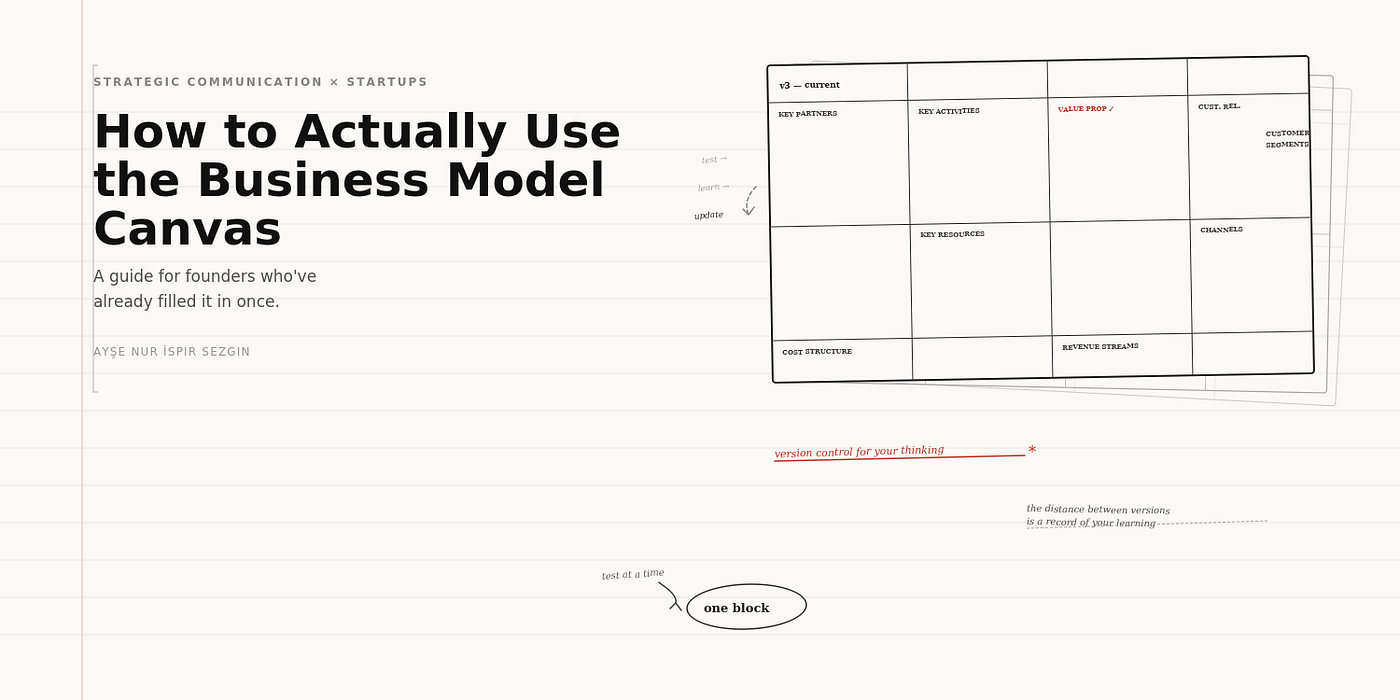
Version 1 is your starting hypothesis. Version 2 is what you learned after talking to 20 customers. Version 3 is what changed after your first failed channel test. Each version is a record of your thinking — and the distance between versions is a record of your learning.
Investors don’t just evaluate where you are. They evaluate how you got there. A founder who can walk an investor through three versions of their canvas — what they assumed, what they tested, what they discovered, and what they changed — is demonstrating something more valuable than a polished pitch: intellectual honesty and the ability to learn from the market.
Keep your versions. Date them. Know what changed and why.
Test One Block at a Time
One of the most common mistakes founders make when using the BMC is trying to validate the entire model at once.
You can’t. And trying to do so means testing nothing properly.
Pick the riskiest block — the one your model is most dependent on — and design the smallest possible test that would tell you whether your assumption holds. Not a survey. Not a focus group. A real-world action with a measurable outcome.
Testing your value proposition? Talk to 10 potential customers, pitch them your solution, and count how many ask “how do I get this?” Testing your channel? Run a small paid campaign to a specific segment and measure cost per qualified lead. Testing your revenue model? Try to collect actual money, not just commitments.
The goal of each test is not to prove you’re right. It’s to find out as quickly and cheaply as possible whether you’re wrong.
Align the Canvas With Your Pitch
Here’s where the BMC becomes a communication tool rather than a planning tool.
Your pitch deck should be a narrative version of your canvas. The problem slide maps to your customer segments and their pain points. The solution slide maps to your value proposition. The business model slide maps to your revenue streams. The team slide maps to your key resources.
If there’s a block on your canvas that doesn’t appear anywhere in your pitch, one of two things is true: either it’s not important enough to mention, which means it might not be important enough to include on the canvas — or your pitch is missing something it should say.
Go through your canvas and your pitch side by side. Every block should have a corresponding moment in the narrative. If it doesn’t, find out why.
Present It to Someone Who Will Push Back
The most underused function of the BMC is as a conversation starter.
Not a presentation. A conversation — with a mentor, an advisor, a potential customer, or a co-founder who’s willing to ask hard questions. The goal is not to defend the canvas. The goal is to find where it breaks under scrutiny.
The questions that should make you uncomfortable are the valuable ones: “Why would a customer pay for this instead of doing nothing?” “What happens to your cost structure if this channel doesn’t scale?” “Who else is already doing this, and why are you better?”
If you can answer all of them without hesitation, the canvas is probably solid. If some of them make you pause — that’s where the work is.
Know When to Pivot the Canvas, Not Just a Block
Sometimes testing reveals that one block needs updating. Sometimes it reveals that the entire model needs rethinking.
The difference matters. A block-level change — a new channel, a refined customer segment, a different pricing model — is iteration. A canvas-level change — a fundamentally different value proposition, a different customer, a different revenue logic — is a pivot.
Both are legitimate. But conflating them is dangerous. Founders who make canvas-level changes while calling them block-level changes are avoiding the harder conversation: that the original hypothesis was wrong at a deeper level.
The BMC should make that conversation easier to have — because the model is visible, the assumptions are explicit, and the version history shows how you got here.
The Canvas Is Never Done
A finished canvas is a contradiction in terms.
As long as your business is operating, the canvas should be a living document — updated when you learn something that changes an assumption, reviewed before every major decision, and revisited before every investor conversation.
The founders who use it well don’t frame it as something they completed. They frame it as something they’re continuously interrogating.
Fill it in. Then question everything you wrote.
메타데이터
- post_id
- 6fe978699ecd
- slug
- how-to-actually-use-the-business-model-canvas-a-guide-for-founders-whove-already-filled-it-in-6fe978699ecd
- url
- https://medium.com/@aniversel/how-to-actually-use-the-business-model-canvas-a-guide-for-founders-whove-already-filled-it-in-6fe978699ecd
- canonical_url
- https://medium.com/@aniversel/how-to-actually-use-the-business-model-canvas-a-guide-for-founders-whove-already-filled-it-in-6fe978699ecd
- author_url
- https://medium.com/@aniversel
- status
- ok
- fetched_at
- 2026-06-12 22:02:08