What future discoveries could change our understanding of atomic structure?
Learn how future discoveries in quantum physics, particle science, and advanced technology could transform our understanding of the…
What future discoveries could change our understanding of atomic structure?
Learn how future discoveries in quantum physics, particle science, and advanced technology could transform our understanding of the structure of the atom.
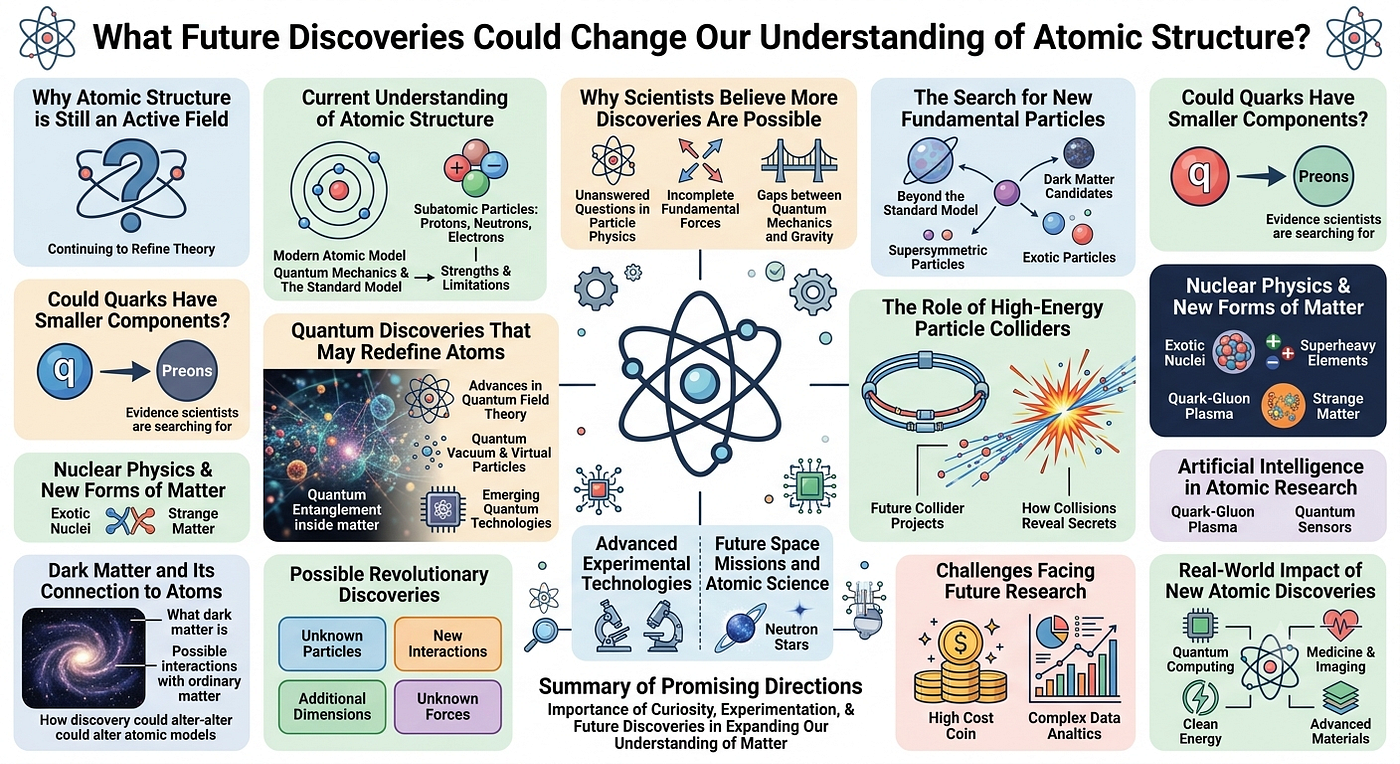
For more than a century, scientists have explored the mysteries of the atom. Once thought to be the smallest, indivisible building blocks of matter, the atom is now known to contain a fascinating world of subatomic particles, powerful forces, and complex quantum interactions. Discoveries such as the electron, proton, neutron, and quark have transformed our understanding of nature, while quantum mechanics has revealed that the world of atoms behaves in ways that often go beyond our everyday intuition.
Despite these remarkable achievements, modern physics is far from complete. Many of the great mysteries of the universe still remain unanswered. Scientists still don’t know what dark matter is made of, why gravity behaves differently from other fundamental forces, or whether even smaller particles exist below the quarks. Each major scientific breakthrough has shown that when new evidence comes to light, our understanding of atoms can evolve greatly.
Today’s researchers use powerful particle accelerators, quantum computers, advanced microscopes, and artificial intelligence to study matter with unprecedented precision. Just as the discoveries of electrons and quarks in the past radically changed our understanding of the structure of the atom, future discoveries could also radically change it.
This article explores the exciting possibilities that could redefine atomic science in the coming decades and examines how future discoveries could transform our understanding of the fundamental components of matter.
Current Understanding of Atomic Structure
According to modern atomic theory, an atom is composed of a solid nucleus surrounded by a cloud of electrons. The nucleus contains positively charged protons and electrically neutral neutrons, while the negatively charged electrons are in potential regions called orbitals rather than in fixed circular paths.
According to the Standard Model of particle physics, protons and neutrons are not fundamental particles themselves. Instead, they are made up of even smaller particles called quarks, which are held together by the strong nuclear force called gluons.
Scientists currently identify four fundamental forces that govern all interactions in nature:
- Gravity
- Electromagnetism
- Strong nuclear force
- Weak nuclear force
Quantum mechanics successfully explains how electrons behave inside atoms, how atoms form molecules, and how matter interacts with light. This theory has enabled countless technological innovations, including semiconductors, lasers, MRI scanners, and quantum devices.
Despite its success, the Standard Model cannot explain everything. It does not account for dark matter, dark energy, or gravity at the quantum level. These limitations strongly suggest that our current understanding of the structure of the atom is incomplete.
Why Scientists Believe More Discoveries Are Possible
History teaches us that scientific knowledge is constantly evolving.
Ancient philosophers believed that atoms were indivisible. Later, scientists discovered the electron. Then came the nucleus, protons, neutrons, quarks, neutrinos, and hundreds of other particles.
Each discovery changed textbooks and forced physicists to rethink their previous theories.
Today, researchers believe that more discoveries are yet to come, because many important questions remain unanswered:
- Why do particles have the masses they do?
- Why does matter dominate over antimatter?
- What exactly is dark matter?
- Are quarks truly fundamental?
- Can gravity be explained using quantum physics?
- Do extra dimensions exist?
When science faces unanswered questions, new discoveries are often needed.
The Search for New Fundamental Particles
Particle physicists are actively searching for particles beyond those described in the Standard Model.
The discovery of the Higgs boson in 2012 confirmed a key prediction, but it also highlighted that many pieces of the puzzle are still missing.
Scientists are studying a number of hypothetical particles.
Dark Matter Particles
Astronomical observations show that visible matter accounts for only a small fraction of the total mass of the universe. The majority of the universe appears to be made up of invisible dark matter.
If dark matter particles are found, scientists may have to expand atomic theory to include entirely new interactions between ordinary matter and previously unknown particles.
Axions
Axions are extremely light hypothetical particles that have been proposed to solve some of the problems in particle physics.
Although they have never been directly observed, they are one of the strongest candidates for dark matter.
Sterile Neutrinos
Normal neutrinos interact only weakly with matter.
Sterile neutrinos will interact even less, making them extremely difficult to detect and potentially providing an explanation for many cosmic mysteries.
Supersymmetric Particles
Supersymmetry states that every known particle has an unknown partner particle.
If these particles exist, they would greatly expand our understanding of matter and could help explain dark matter.
The discovery of any one of these particles would significantly change modern atomic theory.
Could Quarks Have Smaller Components?
One intriguing possibility is that quarks themselves are not fundamental.
Some physicists have proposed theoretical particles called prions, which would combine to form quarks and leptons in the same way that quarks combine to form protons and neutrons.
If prions exist, the class of matter would be:
- Atoms
- Protons and neutrons
- Quarks
- Preons
Such a discovery would be one of the greatest revolutions in physics since the discovery of the atom.
Although there is currently no experimental evidence to support preons, increasingly powerful particle accelerators are finding signs that quarks have internal structure.
If confirmed, many existing theories would have to be revised significantly.
Quantum Discoveries That May Redefine Atoms
Quantum mechanics is one of the most successful scientific theories ever developed, yet many of its predictions continue to surprise researchers.
Future advances may reveal that atoms behave in even more complex ways than currently understood.
Scientists are exploring many exciting areas.
Quantum Vacuum
Empty space is not truly empty.
According to quantum field theory, virtual particles are constantly appearing and disappearing in a vacuum.
A better understanding of these fluctuations could reveal new aspects of the behavior of atoms.
Quantum Entanglement
Entangled particles remain connected to each other even when separated by vast distances.
Although entanglement is well-established experimentally, scientists are still exploring how it relates to the deeper structure of matter.
Quantum Fields
Many physicists believe that particles are simply excitations in underlying quantum fields.
Future discoveries may show that atoms can be better understood as patterns in these fields, rather than as collections of individual particles.
Such ideas could radically change the way matter is described in textbooks.
The Role of High Energy Particle Colliders
To unravel the deep mysteries of matter, scientists need enormous amounts of energy. High-energy particle colliders accelerate particles to speeds very close to the speed of light and then smash them into each other. The debris produced from these collisions can reveal particles and interactions that are not normally seen.
The Large Hadron Collider (LHC) at CERN is currently the world’s most powerful particle accelerator. It was responsible for the discovery of the Higgs boson, a milestone that confirmed a key part of the Standard Model. However, the LHC was not built just to find the Higgs. It is also searching for evidence of dark matter, extra dimensions, supersymmetry, and other forms of new physics.
Future collider projects could reach even higher energies. Scientists are discussing devices like the Future Circular Collider (FCC) and the Compact Linear Collider (CLIC). These facilities will allow researchers to study matter at much closer distances than ever before.
Why is high energy important? According to Einstein’s mass-energy relation, extremely energetic collisions can produce particles of such enormous mass that they would otherwise be impossible to create. If new fundamental particles exist, future colliders could create them directly.
An unexpected clue in collider data could force physicists to rewrite our understanding of the structure of the atom. Quarks were discovered in the 20th century through increasingly sophisticated scattering experiments, and future colliders could reveal another, deeper layer of reality.
Nuclear Physics and New Forms of Matter
Particle physics explores the smallest building blocks of matter, while nuclear physics studies how protons and neutrons behave under extremely harsh conditions.
Exotic Nuclei
Most atoms found on Earth contain stable combinations of protons and neutrons. However, scientists have created thousands of unstable or exotic nuclei with unusual neutron-to-proton ratios.
Studying these nuclei helps researchers understand the strong nuclear force in more detail. Some exotic nuclei exhibit behaviors that challenge current models of nuclear structure, such as neutron halos and unusual shapes.
Superheavy Elements
The periodic table is expanding as scientists synthesize new elements with increasingly high atomic numbers. These superheavy elements exist for only a few moments, but they provide valuable information about nuclear stability.
Physicists predict the existence of ‘islands of stability’, a region where certain superheavy nuclei can persist for much longer than expected. If such nuclei are discovered, our understanding of how protons and neutrons are organized in nuclei will be deepened.
Quark Gluon Plasma
In ordinary matter, quarks are trapped inside protons and neutrons. However, under conditions of extremely high temperatures and densities, quarks and gluons can break free, a state known as quark-gluon plasma.
This strange form of matter existed for a short time immediately after the Big Bang. By reconstructing it in particle accelerators, scientists can study conditions similar to those in the early universe.
Understanding quark-gluon plasma could reveal new properties of the strong force and provide clues about how the first atomic nuclei formed.
Strange Matter
Another theoretical possibility is strange matter, which consists of a large number of strange quarks. If strange matter were more stable than ordinary nuclear matter under certain conditions, it could challenge our understanding of what the most stable form of matter is.
Although no definitive evidence yet exists, neutron stars could contain much more strange matter than anything found on Earth.
Dark Matter and Its Connection to Atoms
Dark matter is one of the strongest evidences that modern physics is incomplete. Galaxies rotate so fast that the visible matter in them alone cannot produce the necessary gravitational force. There seems to be additional invisible mass throughout the universe.
If dark matter interacts with ordinary matter in any measurable way, it could have far-reaching effects on the structure of atoms.
Scientists are pursuing several approaches:
- Direct detection experiments attempt to observe dark matter particles colliding with atomic nuclei.
- Indirect detection experiments search for signals produced when dark matter particles annihilate or decay.
- Collider experiments try to create dark matter particles in high-energy collisions.
Imagine that dark matter particles occasionally interact with electrons or quarks through a previously unknown force. Such a discovery would require expanding the Standard Model and adding new elements to our description of atoms.
It could also explain why ordinary matter behaves the way it does on a cosmic scale. The atom would no longer be seen as a separate object governed by just four known forces, but as part of a larger web of interactions involving invisible forms of matter.
Unifying the Fundamental Forces
One of the greatest goals in physics is to unify the fundamental forces.
Electromagnetism and the weak nuclear force have already been successfully unified in the electroweak theory. Many physicists believe that at very high energies, the strong force could also be unified.
This idea is known as a ‘Grand Unified Theory’ (GUT).
A successful GUT would mean that the forces we observe today are simply different forms of a single fundamental force that existed immediately after the Big Bang.
The ultimate goal is a ‘Theory of Everything’, which would include gravity.
Why would this affect the structure of atoms?
Because the properties of atoms depend directly on the strength and behavior of the fundamental forces. If these forces were to finally unify, the mass of particles, the stability of nuclei, and even the existence of atoms could emerge from a deeper and more refined principle.
Evidence for the unification of forces can be found in the following sources:
- Proton decay experiments
- Precision measurements of particle interactions
- High-energy collider data
- Cosmological observations
The discovery of a unified theory would be comparable in importance to the discovery of quantum mechanics. It would not only add another particle to the list of particles; it would also explain why the entire atomic structure exists in its present form.
Artificial Intelligence in Atomic Research
Future breakthroughs may come not only from new machines, but also from new ways of analyzing information.
Modern physics experiments generate an enormous amount of information. The LHC alone produces petabytes of information every year. Human researchers cannot examine every collision event themselves, which is why artificial intelligence (AI) and machine learning have become essential tools.
Artificial intelligence (AI) is already helping scientists:
- Identify rare particle collision patterns
- Distinguish genuine signals from background noise
- Optimise detector performance
- Simulate quantum systems
- Predict the properties of unknown materials
In atomic and quantum research, machine learning algorithms can detect patterns that are difficult for humans to notice. For example, artificial intelligence (AI) can analyze millions of possible quantum states and identify the most promising candidates for new physical phenomena.
These techniques have greatly benefited quantum chemistry. Researchers can now model complex electron interactions with greater precision than ever before.
In the future, AI could help discover entirely new laws of physics by detecting subtle discrepancies in experimental data. A tiny discrepancy overlooked by conventional methods could be the first clue to a revolutionary new understanding of atomic structure.
Advanced Experimental Technologies
Scientific revolutions often follow technological revolutions. Many discoveries that revolutionize atomic theory were made possible only after the invention of new instruments.
Next Generation Microscopes
Modern electron microscopes can take images of individual atoms. Future instruments may achieve even higher temporal resolution, allowing scientists to watch the movement of electrons in real time.
Quantum Sensors
Quantum sensors use quantum phenomena such as superposition and entanglement to achieve extraordinary sensitivity. They can detect subtle changes in electromagnetic fields, gravity, or interactions between particles.
Precision Spectroscopy
Spectroscopy measures how atoms absorb and emit light. Increasingly precise measurements can reveal subtle deviations from theoretical predictions. Such deviations may indicate the existence of new particles or forces.
Improved Particle Detectors
Future detectors will be faster, more accurate, and able to handle larger amounts of data. They can observe processes that are currently too rare or too subtle to detect.
Historically, improved measurements have often led to unexpected discoveries. Cathode ray experiments discovered the electron, and scattering experiments revealed the nucleus. Similarly, the next big breakthrough may come only because our instruments become sensitive enough to see something previously invisible.
Future Space Missions and Atomic Science
Space provides a natural laboratory for studying matter under conditions that are impossible to recreate on Earth.
Cosmic Rays
Cosmic rays are extremely energetic particles that constantly bombard our planet. Some have energies many times greater than those achieved in man-made accelerators. By studying them, scientists can discover new particles or interactions.
Neutron Stars
Neutron stars contain matter compressed to a density billions of times greater than that of ordinary matter. They may contain strange states of matter, such as quark matter or other unknown states of matter.
Observations from space telescopes and gravitational-wave detectors are providing increasingly detailed information about these strange objects.
Space Based Particle Experiments
Orbital instruments can operate above Earth’s atmosphere, allowing them to detect particles and radiation that would otherwise be absorbed before they reach the ground.
Missions studying cosmic rays, antimatter, and high-energy astrophysical phenomena could reveal evidence of physics beyond the Standard Model.
If space-based observations reveal particles or interactions that cannot be explained by current theories, nuclear physics will have to expand to accommodate those findings.
So the next revolution in our understanding of atoms may not come from a laboratory underground, but directly from the depths of space.
Possible Revolutionary Discoveries
Throughout the history of science, revolutionary discoveries have repeatedly changed our understanding of matter. Until the discovery of the electron, atoms were thought to be indivisible. Later, scientists discovered nuclei, protons, neutrons, quarks, and countless other subatomic particles. Each major discovery revealed that nature is more complex than previously thought.
Equally transformative discoveries could occur in the coming decades. While no one can predict exactly what scientists will discover, many possibilities have the potential to reshape atomic theory.
Unknown Fundamental Particles
The Standard Model successfully explains many observed particles and their interactions, but it does not answer every question about the universe. Researchers suspect that there are still additional particles unknown.
Future experiments may uncover particles that:
- Explain the nature of dark matter.
- Clarify why neutrinos have mass.
- Reveal new interactions between known particles.
- Extend or replace parts of the Standard Model.
Even if a new fundamental particle is discovered, it could change the way we describe atoms, especially if it interacts with electrons, quarks, or atomic nuclei.
New Fundamental Forces
Physics currently recognizes four fundamental forces:
- Gravity
- Electromagnetism
- Strong nuclear force
- Weak nuclear force
However, some theoretical models predict the existence of additional forces that are only noticeable at very short distances or at very high energies.
If a fifth fundamental force is discovered, scientists will have to rethink how particles interact with each other inside atoms. Such a force could affect nuclear stability, particle decay, or the behavior of electrons in very difficult conditions.
Extra Spatial Dimensions
Several advanced theories, including string theory, suggest that the universe has more dimensions than the familiar three dimensions of space.
These extra dimensions could be:
- Extremely small and tightly curled.
- Detectable only at very high energies.
- Responsible for some currently unexplained particle properties.
If experimental evidence confirms the existence of extra dimensions, our understanding of the structure of atoms would be greatly enhanced. Particle behavior that currently seems mysterious could become easier to explain in a higher-dimensional universe.
Unexpected Quantum Phenomena
Quantum mechanics has repeatedly surprised scientists. Future research could reveal entirely new quantum effects that influence the behavior of atoms.
Possible discoveries include:
- Previously unknown quantum states.
- New forms of particle entanglement.
- Unexpected interactions between quantum fields.
- Hidden symmetries in nature.
Such discoveries could improve our understanding of chemical reactions, the properties of matter, and even biological processes.
A New Layer Beneath Quarks
Although quarks are currently considered fundamental, future experiments may show that they are made of even smaller elements.
If a deeper layer of matter exists, textbooks would need major revisions, as was the case with the discovery of electrons and quarks.
Rather than marking the end of a particle class, quarks would be the next step in the even more fundamental structure of matter.
Challenges Facing Future Research
Although scientific technology is improving rapidly, there are many obstacles before these discoveries can become a reality.
Technological Limitations
Studying extremely small particles requires extremely powerful equipment.
Particle accelerators of the future could be:
- Hundreds of kilometres in circumference.
- More powerful than any machine currently operating.
- Capable of generating unprecedented collision energies.
There are enormous engineering challenges in building such facilities.
Extremely High Costs
Major scientific projects require international cooperation because of their cost.
Building and operating advanced research facilities costs billions of pounds over many years.
Governments, universities and scientific institutions must work together to fund these ambitious projects.
Rare Experimental Events
Some hypothetical particles may interact with ordinary matter so weakly that they are extremely difficult to detect.
Researchers can only observe a handful of relevant events in the collisions of billions of particles.
Distinguishing true discoveries from statistical fluctuations requires extraordinary precision and patience.
Interpreting Complex Data
Modern experiments generate an enormous amount of information.
The Large Hadron Collider alone records enormous datasets every year, requiring sophisticated software and artificial intelligence to identify meaningful patterns.
As detectors become more advanced, analyzing the data will become even more challenging.
Scientific Verification
Extraordinary claims require extraordinary evidence.
Any proposed discovery must be:
- Independently verified.
- Reproduced by multiple experiments.
- Consistent with existing observations.
- Carefully reviewed by the scientific community.
This rigorous process ensures that new theories are supported by reliable evidence before they are accepted.
Real World Impact of New Atomic Discoveries
Although atomic research often seems highly theoretical, its discoveries often lead to technologies that transform everyday life.
Quantum Computing
A deeper understanding of atomic and quantum behavior could lead to the development of more powerful quantum computers.
Future quantum technologies could revolutionize the following areas:
- Drug discovery.
- Climate modelling.
- Artificial intelligence.
- Cryptography.
- Complex scientific simulations.
Medicine
Advances in atomic physics have already led to the development of medical technologies such as MRI scanners, PET imaging, and radiation therapy.
Future discoveries could enable:
- More accurate diagnostic imaging.
- Better cancer treatments.
- Precision drug delivery.
- Improved medical sensors.
- New forms of targeted radiation therapy.
Clean Energy
A more complete understanding of how atoms interact could lead to improvements in energy technology.
Potential benefits include:
- Safer nuclear reactors.
- More efficient fusion energy.
- Better battery materials.
- Advanced solar cells.
- Improved hydrogen production.
These developments could help meet growing global energy demands while reducing environmental impacts.
Advanced Materials
Many modern materials rely on precise control of the structure of atoms.
Future discoveries could lead to:
- Stronger lightweight alloys.
- Superconductors operating at higher temperatures.
- Self-healing materials.
- Ultra-efficient semiconductors.
- Novel nanomaterials.
These innovations could impact transportation, electronics, construction, and manufacturing.
Space Exploration
Nuclear science plays a key role in space technology.
Future advances could contribute to:
- More efficient spacecraft propulsion.
- Improved radiation shielding.
- Better life-support systems.
- Advanced scientific instruments.
- Long-duration missions to the Moon and Mars.
As humanity explores deeper into the solar system, improved knowledge of matter at the atomic level will become increasingly valuable.
The Future of Atomic Science
Atomic science stands at an exciting juncture. The ‘Standard Model’ has explained numerous experimental observations with remarkable accuracy, yet it is widely acknowledged to be incomplete. Some of the greatest mysteries of the universe (including dark matter, dark energy, quantum gravity, and the origin of particle mass) remain unanswered.
New technologies are enabling researchers to probe nature with unprecedented precision. Future particle accelerators, quantum computers, artificial intelligence, advanced detectors, space telescopes, and gravitational-wave observatories are expected to yield discoveries that today’s scientists can only imagine.
History shows that each generation thinks its understanding of nature is nearly complete, but then unexpected discoveries are made that reveal entirely new levels of complexity. There is good reason to believe that the twenty-first century will continue this tradition.
Whether the next major discoveries come from laboratory experiments, particle colliders, space missions, or unexpected observations, It has the potential to change our understanding of atoms and the universe itself.
Conclusion
The story of the atom is not yet complete. From the discovery of electrons and atomic nuclei to the development of quantum mechanics and the Standard Model, each scientific breakthrough has revealed that matter is more complex than previously thought. Yet, many fundamental questions remain unanswered, reminding us that our current knowledge is only one step in a continuing journey of discovery.
Future research may reveal new particles, hidden forces, a layer deep below the quarks, or entirely new principles that govern the universe. Advances in particle accelerators, artificial intelligence, quantum technology, precision experiments, and space exploration will continue to push the boundaries of what scientists can observe and understand.
While it is impossible to predict the next big discovery, history suggests that the greatest advances often come when researchers explore the unknown with curiosity, creativity, and rigorous experimentation. Each new discovery about atomic structure not only advances our understanding of matter, but also drives new discoveries that improve medicine, energy, computing, communications, and countless other fields.
As technology advances and international scientific cooperation deepens, the coming decades may bring discoveries that will once again fundamentally change our understanding of the atom. The quest to understand the fundamental building blocks of matter is far from over, and the next revolutionary chapter in atomic science may already be waiting to be revealed.
Thank you for reading this article. We hope it has strengthened your understanding of the future of nuclear science. Stay tuned for more fascinating science topics with **Science Spectrum**.
Related Articles
- Why are force and pressure fundamental concepts in physics?
- Physics basics every curious learner should understand well
- What technologies are enabling more precise measurements in quantum physics?
- How are units and measurements used in artificial intelligence and robotics?
- Why are SI prefixes important when working with large and small quantities?
메타데이터
- post_id
- 6ffabbec1517
- slug
- what-future-discoveries-could-change-our-understanding-of-atomic-structure-6ffabbec1517
- url
- https://medium.com/@sciencespectrum/what-future-discoveries-could-change-our-understanding-of-atomic-structure-6ffabbec1517
- canonical_url
- https://medium.com/@sciencespectrum/what-future-discoveries-could-change-our-understanding-of-atomic-structure-6ffabbec1517
- author_url
- https://medium.com/@sciencespectrum
- status
- ok
- fetched_at
- 2026-08-10 03:09:24