PRFAQ: The One Product Document That Forces Clarity (Before You Build Anything)
PRFAQ is all about the “why”!
PRFAQ: The One Product Document That Forces Clarity (Before You Build Anything)
Most product documents explain what you’re going to build.
Very few force you to explain why it should exist at all.
That’s exactly why companies like Amazon, Zalando, and other high-bar product orgs rely on a deceptively simple artifact called a PRFAQ — Press Release + Frequently Asked Questions.
Before a single line of code is written, before roadmaps are locked, before teams are staffed, the idea must survive this document.
And many don’t.
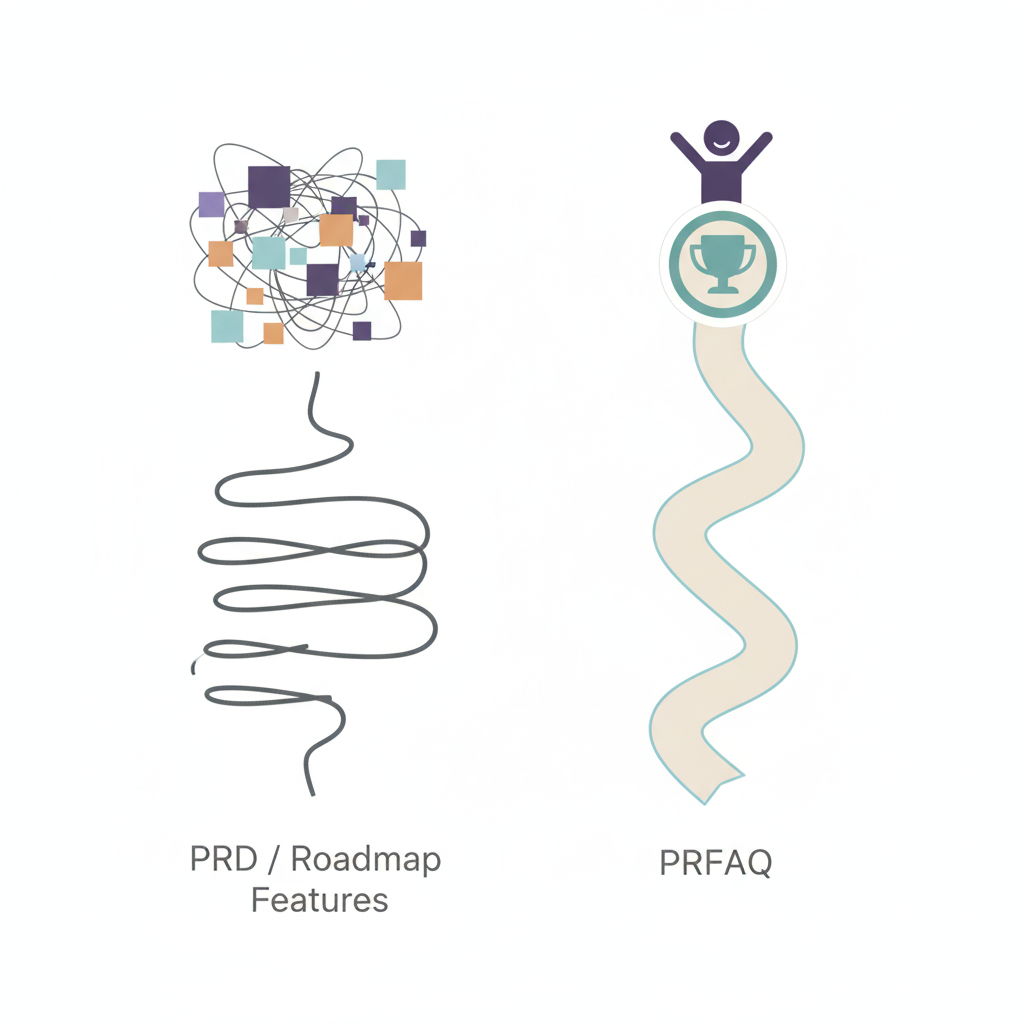
What is a PRFAQ (in plain English)?
A PRFAQ is a future-facing document written as if the product has already launched successfully.
It has two parts:
- Press Release Written for customers and the outside world. Clear, confident, and outcome-driven.
- Frequently Asked Questions (FAQ) Written for leaders, stakeholders, and internal teams. This is where the hard questions live.
The goal isn’t documentation. The goal is alignment and conviction.
If you can’t explain your idea clearly in writing, you probably don’t understand it well enough yet.
Why Amazon (and others) swear by PRFAQs
Amazon famously has a rule:
“No PowerPoint. We read narratives.”
Here’s why PRFAQs work so well:
- They start with the customer, not the feature
- They expose weak thinking early
- They reduce opinion-driven debates
- They scale alignment across large orgs
Instead of asking:
“Can we build this?”
PRFAQs force you to answer:
“Should this exist?”
The Press Release: Sell the outcome, not the roadmap
The press release is usually one page and answers:
- Who is this for?
- What problem are we solving?
- Why should anyone care?
- What measurable impact does this create?
There can be high-level implementation details here.
No tech stacks. No timelines. No dependencies.
If you can’t make the idea sound valuable without explaining how it works, that’s already a signal.
Think of it as a test:
Would a customer, leader, or journalist understand why this matters?
The FAQ: Where ideas earn their right to exist
This is the real meat of the PRFAQ.
The FAQ section forces you to answer uncomfortable but essential questions, such as:
- What exact customer problem are we solving?
- Who are we not building this for?
- How do we define success (with numbers)?
- What assumptions are we making?
- Why is now the right time?
- What are the biggest risks and trade-offs?
- What happens if this fails?
This section is intentionally written to invite scrutiny.
A good PRFAQ doesn’t avoid tough questions — it surfaces them early, when it’s still cheap to change direction.
PRFAQ vs PRD: Don’t confuse the two
A common mistake is treating a PRFAQ like a lighter PRD.
They’re very different.

In strong product orgs, the PRFAQ comes first. Only once there’s alignment on why does the team invest in a detailed PRD.
When should you write a PRFAQ?
PRFAQs are especially powerful when:
- You’re proposing a new product or a big bet
- Multiple teams or domains are involved
- Leadership alignment is required
- The problem is ambiguous
- The cost of building the wrong thing is high
If your idea needs buy-in from Product, Design, Engineering, Business, and Leadership, a PRFAQ is your best friend.
A real PRFAQ example (with comments and thought process)
Theory is useful, but PRFAQs truly click when you read a real one.
I’ve shared a full PRFAQ example (Google Doc) that I wrote for a hypothetical global marketplace initiative, focused on improving conversion for international buyers in emerging markets.
What makes this example useful:
- It includes the press release
- A detailed FAQ covering goals, personas, problems, metrics, and risks
- Clear prioritization and sequencing
- Comments explaining why certain choices were made
👉 **Link to the PRFAQ example**
If you’re new to PRFAQs, I recommend reading the Press Release first, then jumping straight to the FAQs. That’s exactly how leaders read them.
How PRFAQs change the way teams work
Once teams adopt PRFAQs consistently, a few things change:
- Fewer “drive-by ideas.”
- Stronger product intuition
- Less thrash during execution
- Clearer success metrics
- Better-written PRDs downstream
Most importantly, teams stop confusing activity with impact.
Final thought
Writing a PRFAQ is hard.
That’s the point.
It’s supposed to feel uncomfortable. It’s supposed to expose gaps. It’s supposed to slow you down before you speed up.
Because the cost of rewriting a document is far lower than the cost of building the wrong product.
If you like this, be sure to clap, share, and follow me — it means a lot to me!
메타데이터
- post_id
- 6ffe6df24957
- slug
- prfaq-the-one-product-document-that-forces-clarity-before-you-build-anything-6ffe6df24957
- url
- https://medium.com/@angshumangupta/prfaq-the-one-product-document-that-forces-clarity-before-you-build-anything-6ffe6df24957
- canonical_url
- https://medium.com/@angshumangupta/prfaq-the-one-product-document-that-forces-clarity-before-you-build-anything-6ffe6df24957
- author_url
- https://medium.com/@angshumangupta
- status
- ok
- fetched_at
- 2026-06-28 14:26:31



