The Mystery of History
How Sherlock Holmes reveals another great truth as observed by Dr. Watson for us all.
The Mystery of History
How Sherlock Holmes reveals another great truth as observed by Dr. Watson for us all.

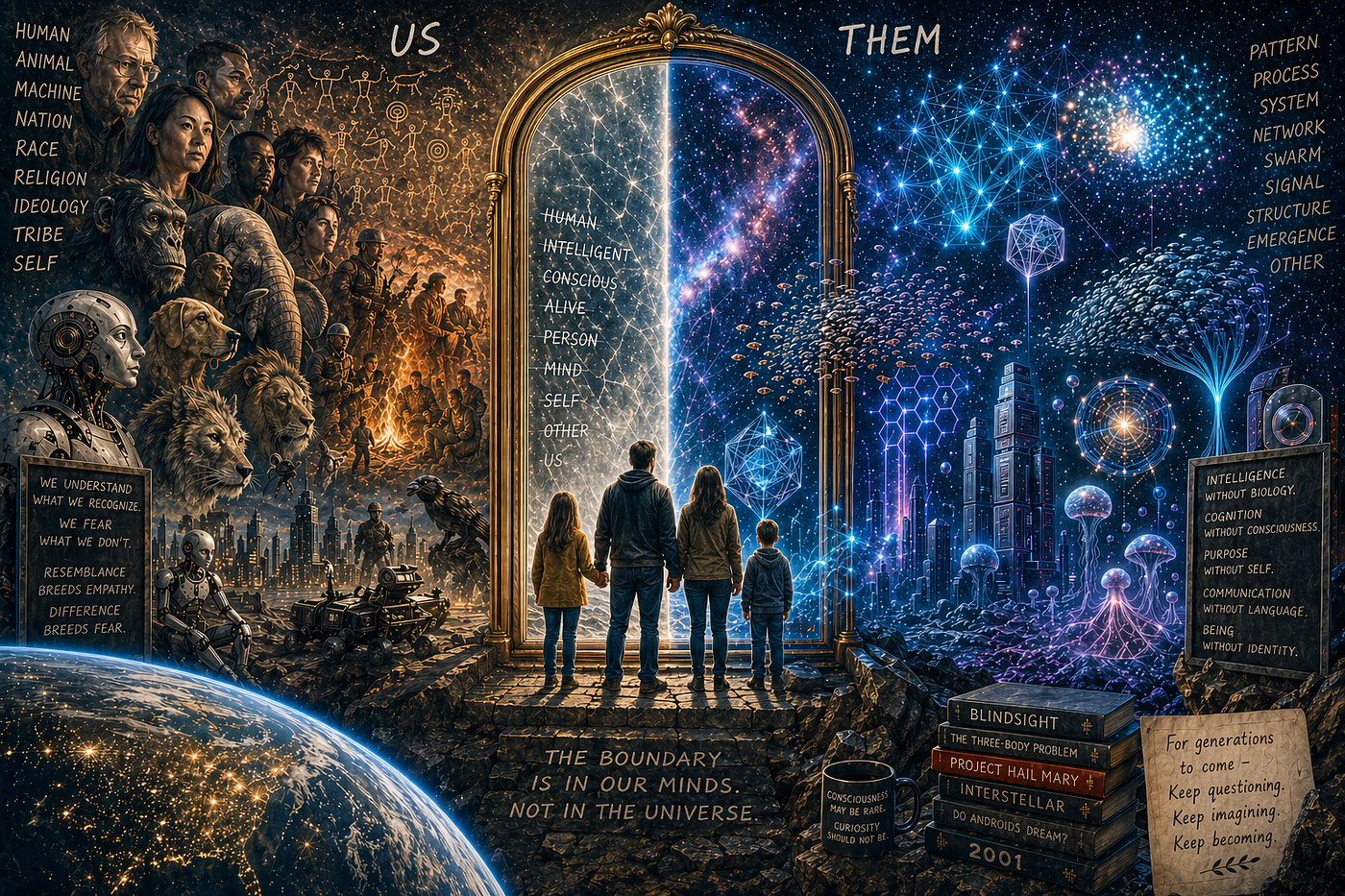
The Poets, the Prophets, and the Citizens of all Time (by DALL-E AI)
I see no purpose in preaching to the choir. I could rant about all manner of evil doing with full support voiced by fellow believers, while speaking in tongues to those who don’t share a similar world view. Politics is a lot like religion. Our grievances are faced with opposing dogma. A review of facts encounters an alternate reality. All reason drowns in the flood of untested assertions.
The granular details of principled legislation are intended to be executed by trusted representatives and interpreted by an impartial court, for this is not our role. We, the people, can only indicate our preferences and hopes, with very little say in how to get there. Bureaucrats are elected for their informed expertise and civic integrity, not greedy grins or peddling abilities. At least, that is how it’s supposed to be.
These essays are not intended as sermons, regardless of how they may sound. My intention is to follow the trail of ideas through a larger contextual landscape. I try to present examples that are analogous to contemporary issues and view them as fundamental mysteries to be resolved, like Sherlock Holmes investigating a crime scene. To speak metaphorically about controversial subjects expels the identity politics and associated baggage, leaving nothing but the evidence of history.
Mystery novels set the scene of events that reveal hidden clues leading to outcomes that are yet unknown. Sherlock was able to deduce critical insights by closely attending to the details. It was left for Dr. Watson to narrate the surprising observations of his mentor, while Arthur Conan Doyle surely knew whodunit all along.
The author’s omniscience reflects an objective reality unavailable to the reader, leaving us to collaborate with Sherlock in a collective search for meaning, while Watson merely reports on our findings. That collective goal focuses all our attention on the same pages of time, following an ingrained impulse called curiosity.
“When you have eliminated the impossible, whatever remains, however improbable, must be the truth.” — Sherlock Holmes, (The Sign of Four, 1890)
Time & History
Time itself is difficult to comprehend, framed, as it is, by the age of the individual. Believe me when I tell you that time passes more quickly as the years go by, as though my watch were literally running faster (you’ll see). A child waiting for a treat seems to them like an eternity, no different than a puppy restrained from its food bowl. Our memories deceive, but I still recall the final ticking minutes of each school day lasting longer than my bated breath, held over and over interminably.
I think the sense of time’s passage similarly felt different in past ages of history. Typical lifespans were shorter, which should make seasons seem faster, but the pace of change and mobility of the population was much more static. Generational change must inherently be relative to the era in which it is lived.
2,500 years ago, you would not have been able to read a text like this; not on an electronic device or even papyrus. If living in the region of Greece, you might be listening to an epic poem recited by a rhapsode, an itinerant lyricist stitching memorized songs and historic tales into a cultural mythology for a common value system.
The role of the rhapsode was reenacted by performers in various lands throughout the ages of antiquity. It was the only way for people to remember where they came from, how they got there, and why there should be hope for the future. They didn’t just hear it; they felt it. They didn’t just remember; they believed.
Their culture enveloped them with a uniform experience, unlike the discordant output of electronic devices today. Given a singular source for the transmission of knowledge, the resulting mythology is hard to refute. It reinforces civic norms and ethical judgements that exceed the bounds of codified law, any witness of events would have testified.
“The past is not dead. It is not even past.” — William Faulkner (Requiem for a Nun, 1951)
Morals & Ethics
The prophets of scripture continued a similar oral tradition in preaching a fixed morality and a linear path toward the promised land and salvation. Ethics and morals are two related but different ways of thinking about right and wrong, good and evil. Both sprout from the fertile soil of civilization and their roots must be nourished, not neglected.
Imagining what life was like in antiquity is not really much harder than understanding events that transpired only 50 years ago, if you were not around to live through them. The pace of change over time collapses in direct proportion to its historical remoteness, as Sherlock insists somebody else must have said.
The narrative of norms that evolved in the ’70s were, largely, a result of polarized dissent over war in southeast Asia. Blind deference to the government and the military-industrial establishment was challenged by draft resistance, marches and mass protests. Patriotism was redefined as conscientious objection in place of compliance with unjustified commands. Actions that would have been treasonous 30 years earlier were recognized as a legitimate exercise of free speech in combating unethical international pursuits of the government.
Within that same time frame, while norms were severely tested, they also compensated for inadequate legal constraints against abuses of presidential authority. Nixon’s Watergate fiasco demonstrated that laws alone were insufficient protection from abuses of power by the executive branch. The expectation that presidents should act honorably and above partisan abuse of power was belied by his secret surveillance tricks and use of the FBI, CIA and IRS for political ends.
Bipartisan expectations about presidential norms of behavior brought (Tricky Dick) Nixon down more quickly than deliberate legal processes would have been able. He resigned in disgrace when the White House tapes revealed the depth of his dishonesty, shattering public trust in the integrity of his position. Ethical standards and honorable conduct reclaimed their proper priority in the judgement of the populace, just as in the heroic epics of Homer. The roots of social norms held firm, and they thought a lesson had been learned.
“Morality is not the doctrine of how we may make ourselves happy, but of how we may make ourselves worthy of happiness.” — Immanuel Kant (Groundwork of the Metaphysics of Morals)
Freedom & Liberty
The highest ethical virtues and hopeful aspirations for the people of ancient Greece were defined by Homeric myths of godlike valor. The only kind of liberty they experienced was hard-earned by success of the City-State on the battlefield and communal action toward a common goal. Liberty came from active and constant participation in collective power at the agora, where all citizens shared in decision-making. Society was of small enough scale for individual voices to be heard.
The terms ‘liberty’ and ‘freedom’ seem synonymous but, like ‘ethics’ and ‘morals’, carry subtle intonations of difference. Liberty implies rights or privileges granted in a more social or collective context, while freedom generally denotes an absence of constraints on the individual.
Autonomous freedom was virtually unknown, outside of Athens, and was certainly beyond the expected norms of citizens at the time. Personal gain was not their primary quest. This came much later with growth and progress through the expansion of markets and trade. As individuals became more absorbed in their pursuit of self-interest, they increasingly relinquished the right to share political power.
Holmes astutely detects a paradox here. The idea that the personal freedom that has accrued in modern times could be endangered by a reduction of public participation safeguarding civil liberties is a shocking revelation. A tradeoff exists in the balance between our desire for independent freedom and prosperity, versus our civic responsibility to strengthen civil liberty and safeguards. There may be no solution to this dichotomy beyond awareness of the issue, Watson diligently notes.
“The secret of happiness is freedom, and the secret of freedom is courage.” — Thucydides
Economics & Scale
As liberty found a connection with commerce, so did growth of the population meet abundance. From a few million citizens trading around the Aegean to eight billion participants in global supply chains, the scale has changed beyond imagination, yet the underlying principles remain.
With the expansion of markets into neighboring regions, all benefitted from more efficient economies of scale, product specialization, and exchanges of technology. Global interconnection led to a cultural Renaissance, and shared scientific discoveries produced an age of Enlightenment. We experience identical synergies in the modern world today.
Here, Holmes makes a significant observation. Trade, even now, occurs between people rather than nations and the illusion of “international” rivalry is simply a change in the scale.
By the linking of individuals and commercial entities, world trade extends both prosperity and the liberty that makes freedom possible. To retreat from that interdependence is to deny the same principles that have lifted civilization over time.
“Man is a social animal: he whose nature is to live alone must be either a beast or a god.” — Aristotle, Politics I.2
Art & Context
A painting is more than a single brushstroke; all art is a compilation of gestures rendering a personal world view.
I have not spoken one word about party politics or liberal and conservative agendas. To do so would immediately reduce the number of remaining interested readers. Contemporary issues can be presented in a non-partisan manner by historical analogy and inspecting the underlying principles.
Our frame of reference always makes a difference. The investigator and investigated are both motivationally involved, one to uncover clues of information, the other to camouflage them in complexity. They represent subjective and objective versions of reality. The writer creates the context with an interest in crosscurrents of meaning, while the reader is enticed by the inferences of each dramatic turn of events.
Holmes searches, Watson narrates, Doyle creates, and the reader connects the dots. All are emotionally linked, unless a higher level of interpretation can be achieved. A neutral observer might gain the perspective to see the entire interplay of characters and events without a cognitive bias. This may be our ultimate, unachievable desire, until the preacher and choir are gone, and all become one with the congregation.
“We do not see things as they are; we see them as we are.” — Anaïs Nin
메타데이터
- post_id
- 702a5a0a8a47
- slug
- the-mystery-of-history-702a5a0a8a47
- url
- https://medium.com/@philmraz/the-mystery-of-history-702a5a0a8a47
- canonical_url
- https://medium.com/@philmraz/the-mystery-of-history-702a5a0a8a47
- author_url
- https://medium.com/@philmraz
- status
- ok
- fetched_at
- 2026-07-16 23:46:37