What Kinds of Materials and Workpiece Shapes Are Suitable for Honing?
In modern precision manufacturing, honing is one of the few finishing operations capable of achieving sub-micron tolerances and mirror-like…
What Kinds of Materials and Workpiece Shapes Are Suitable for Honing?
In modern precision manufacturing, honing is one of the few finishing operations capable of achieving sub-micron tolerances and mirror-like surface finishes. Yet honing is not universally applicable; its effectiveness depends on choosing the right material and component geometry.
So, what kinds of materials and shapes are best suited for honing? Let’s explore the real-world facts and engineering data that drive this decision.
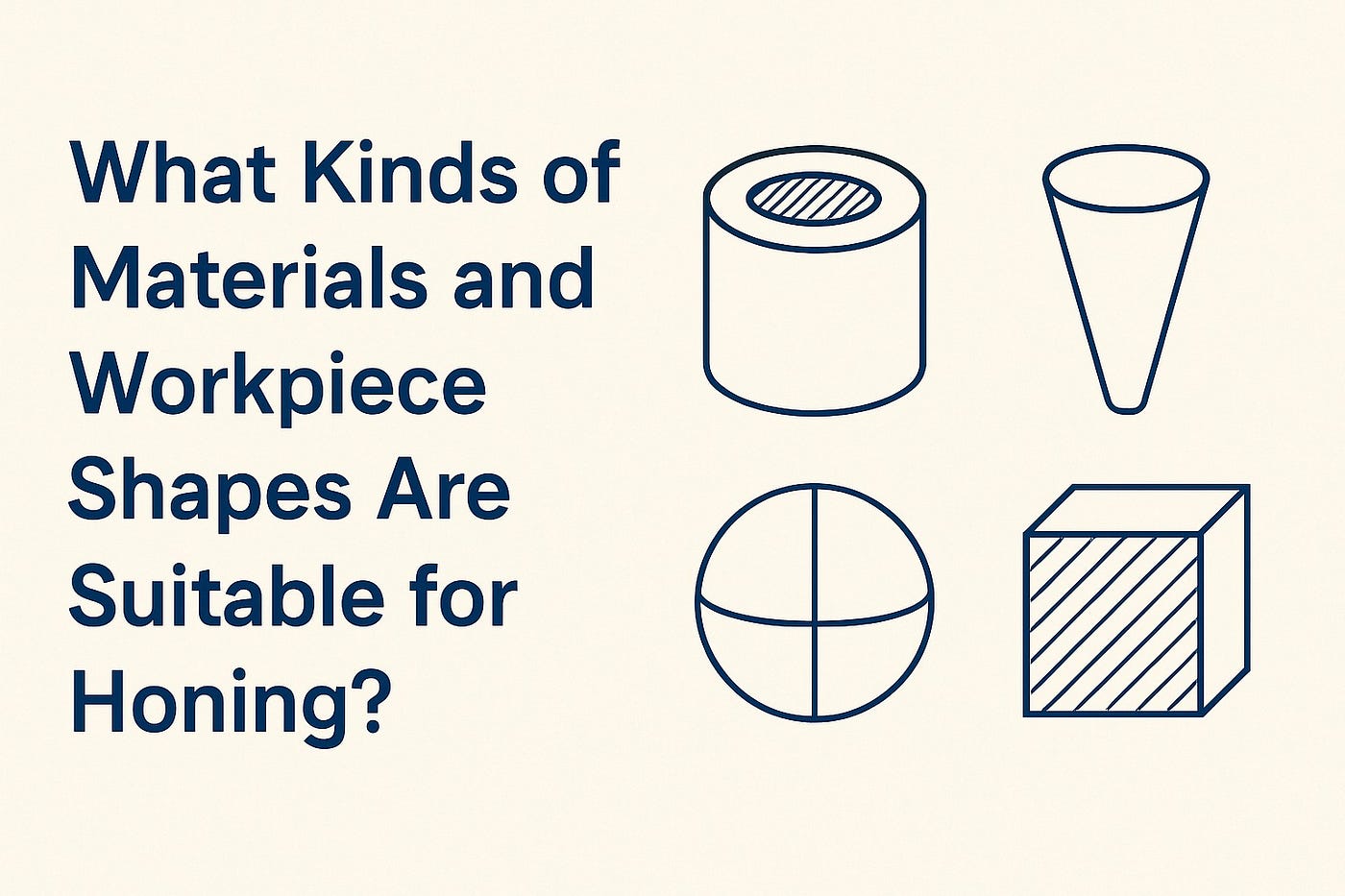
Common workpiece shapes suitable for honing include cylindrical, conical, spherical, and rectangular forms
Why Honing Matters in Global Manufacturing
Honing is used when a part requires ultra-precise dimensions and exceptional surface integrity. According to industry reports, over 70% of automotive engine blocks worldwide undergo honing to meet Ra surface finishes between 0.1 to 0.4 μm (micrometers) and roundness tolerances below 2 μm.
Materials Suitable for Honing (With Industry Facts)
1. Cast Iron
Type: Gray cast iron with high graphite content
Use Case: Automotive cylinder liners
Fact: Engine blocks made from cast iron are honed to achieve bore diameters with a tolerance of ±0.002 mm, ensuring proper piston fit and sealing.
2. Alloy Steels
Common Alloys: 4140, 4340, and 8620 steels
Industries: Aerospace, oil & gas, heavy equipment
Fact: Aircraft landing gear bushings honed in 4340 steel routinely achieve bore straightness of ≤0.003 mm over 300 mm.
3. Aluminum Alloys
Grades: 2618, 4032, and Al-Si composites
Challenge: Aluminum is soft; must use diamond or CBN abrasives
Fact: Modern racing engines use Nikasil-coated aluminum liners, which are diamond-honed to a surface finish of Ra ≤ 0.15 μm for reduced friction and increased durability.
4. Bronze & Brass
Use: Bearings, hydraulic valve sleeves
Fact: Honing of bronze parts can reduce internal leakage in hydraulic components by improving concentricity to better than 0.0015 mm.
5. Titanium & Superalloys (Inconel, Hastelloy)
Use: Aerospace, nuclear, and defense
Fact: Honing Inconel 718, a superalloy used in jet engines, requires CBN abrasives and delivers bore tolerances of ±0.001 mm, which grinding alone often cannot achieve without micro-cracking.
6. Ceramic-Coated Surfaces
Condition: Only machinable ceramics or composite liners can be honed
Fact: Honing diamond-like carbon (DLC) or thermal spray coatings like WC-Co is done using superabrasive tools, helping increase surface hardness to >1000 HV while achieving Ra <0.2 μm.
Workpiece Shapes Best Suited for Honing
Honing is geometry-dependent, especially for internal shapes. While traditionally focused on cylindrical bores, today’s honing systems are far more flexible.
1. Cylindrical Bores (Blind or Through)
Fact: Cylinder bores in engines must maintain uniformity within 0.002–0.005 mm over 200 mm length for efficient combustion and reduced blow-by.
2. Tapered Bores
Honing systems with automated stroke control adjust for tapers.
Use case: Gun barrels and injector sleeves, where precise mating angles are vital.
3. Spherical and Elliptical Bores
Fact: Honing spherical bearing housings in the aerospace sector helps achieve conformity within ±0.003 mm, enhancing load distribution and component lifespan.
4. Polygonal & Irregular Bores
Only possible with multi-axis CNC-controlled or PLC-controlled honing heads
Use case: Military-grade missile sleeve components, which require honed polygonal holes for tight assembly fit.
5. Flat and External Surfaces (Superfinishing)
Not conventional honing, but flat honing or microfinishing can achieve surface finishes of Ra ≤ 0.05 μm, particularly in pump and turbine disks.
What Makes a Workpiece Ideal for Honing?
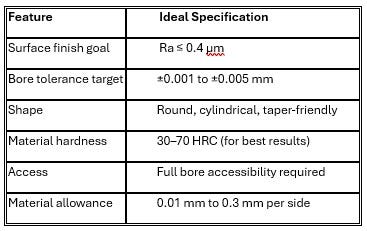
Here are the measurable benchmarks that determine honing compatibility:
Global Industry Applications
Automotive (Global): 85% of internal combustion engines worldwide use honed cylinders.
Aerospace (US, Europe): Honed components include landing gear sleeves, actuator housings, and critical engine parts.
Oil & Gas (Middle East, North Sea): Honing enhances sealing in high-pressure valve components made of Inconel or stainless steel.
Medical (Germany, Japan): Orthopedic implants made of titanium are honed to improve biocompatibility and longevity.
Summing It Up
Honing is a data-driven precision process. Precision isn’t accidental; it’s engineered. The honing process isn’t merely a surface treatment; it’s a mission-critical process backed by facts, tolerances, and surface integrity science. Choosing the right material and shape ensures not only manufacturability but also the long-term performance of components in high-stakes industries.
Whether you’re honing titanium turbine sleeves or aluminum racing blocks, the right approach ensures components perform flawlessly; every micrometer counts.
메타데이터
- post_id
- 703c10b7fc7e
- slug
- what-kinds-of-materials-and-workpiece-shapes-are-suitable-for-honing-703c10b7fc7e
- url
- https://medium.com/@abhifinejohn/what-kinds-of-materials-and-workpiece-shapes-are-suitable-for-honing-703c10b7fc7e
- canonical_url
- https://medium.com/@abhifinejohn/what-kinds-of-materials-and-workpiece-shapes-are-suitable-for-honing-703c10b7fc7e
- author_url
- https://medium.com/@abhifinejohn
- status
- ok
- fetched_at
- 2026-07-18 11:07:01