AI in Healthcare — Data-Driven Diagnostics, Personalized Medicine, and AI-Assisted Surgery
Category: PhD Research 2026 · Healthcare & Artificial Intelligence Reading Time: 8–9 minutes Published by: Gateway Research Academy
AI in Healthcare — Data-Driven Diagnostics, Personalized Medicine, and AI-Assisted Surgery
Category: PhD Research 2026 · Healthcare & Artificial Intelligence Reading Time: 8–9 minutes Published by: Gateway Research Academy
AI in Healthcare Research
Introduction
Healthcare has always been about one fundamental goal — saving lives. But in 2026, the tools available to achieve that goal have changed dramatically. Artificial Intelligence is no longer a futuristic concept sitting in research laboratories. It is actively working inside hospitals, clinics, radiology departments, and operating theatres around the world — diagnosing diseases earlier than ever, tailoring treatments to individual patients, and guiding surgeons through procedures with precision that human hands alone cannot guarantee.
For PhD scholars, this transformation is not just a news story. It is one of the most expansive, well-funded, and socially urgent research landscapes in modern academia. AI in Healthcare — covering data-driven diagnostics, personalized medicine, and AI-assisted surgery — represents a rare convergence where cutting-edge technology directly serves human life. If you are looking for a PhD topic that is technically rigorous, deeply meaningful, and professionally rewarding, this is the field to explore in 2026.
The Scale of the Transformation
To understand why this is such a rich research territory, it helps to appreciate just how rapidly AI has embedded itself in healthcare delivery.
Artificial intelligence in healthcare is accelerating at an unprecedented pace in 2026, reshaping how organisations deliver care, conduct research, and improve patient outcomes. From advanced diagnostic imaging to AI-driven drug discovery, these technologies are no longer experimental — they are producing measurable, real-world results across the healthcare ecosystem.
By 2026, AI improves diagnostic accuracy, predicts disease earlier, automates workflows, and enables personalised treatment planning through real-time data analysis. This is not incremental progress. It is a fundamental rethinking of how medicine is practised. Accesshealthcarestaffing
Healthcare workers currently spend up to 70% of their time on administrative tasks. AI-powered integration could reduce this burden by handling approximately 50% of routine administrative work, potentially saving the average physician 15 to 20 hours per week — time that can be redirected entirely toward patient care.
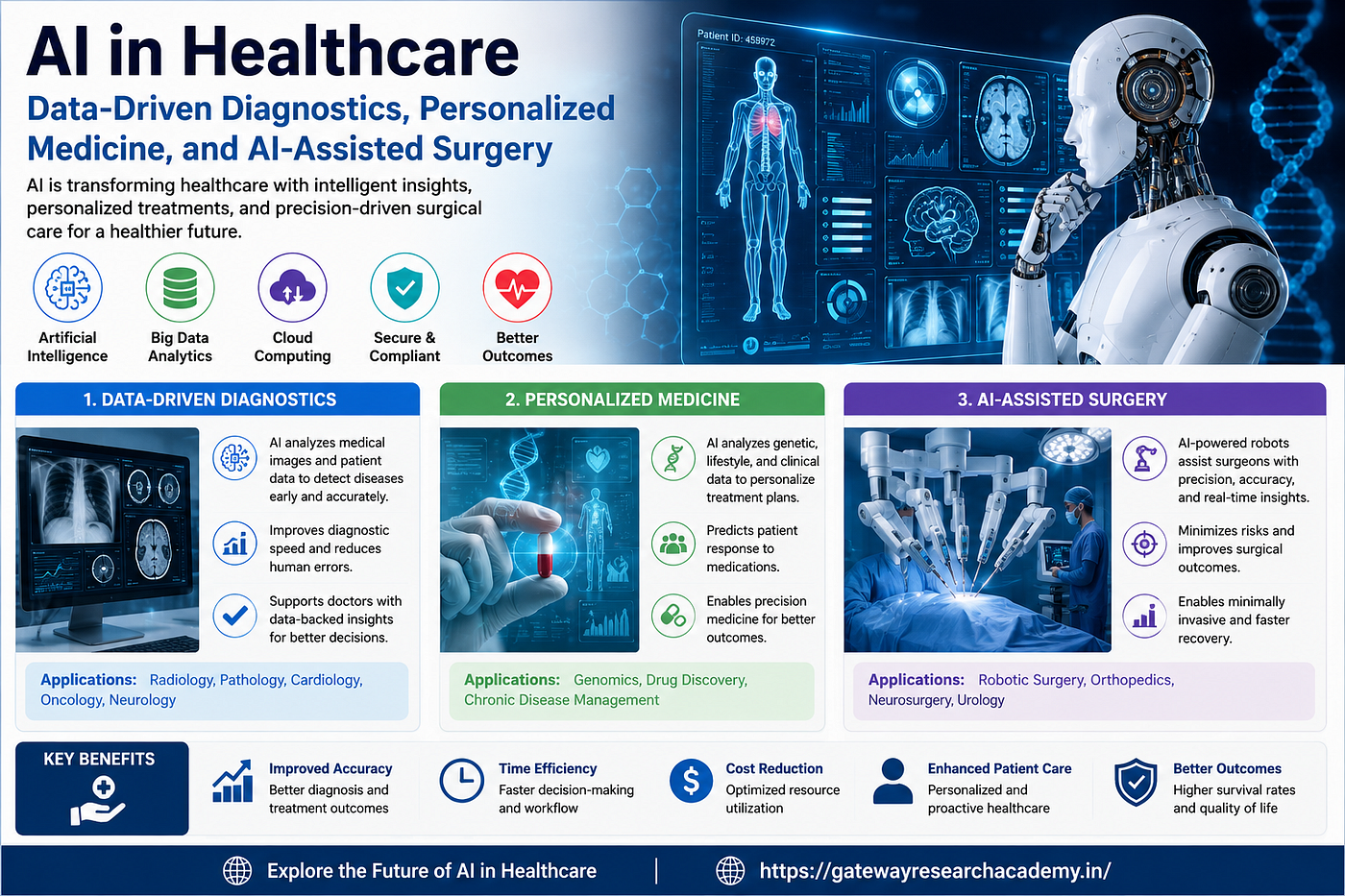
Part 1: Data-Driven Diagnostics — Seeing What Human Eyes Miss
The first and perhaps most immediately impactful application of AI in healthcare is diagnostics. The challenge has always been the same: human doctors are highly skilled but limited by time, attention, and the sheer volume of data modern medicine generates. AI changes that equation entirely.
AI-powered diagnostic systems can analyse thousands of X-rays, lab results, pathology slides, and clinical notes in seconds. Clinicians can detect early signs of cancer, cardiovascular disease, and neurological conditions long before symptoms appear. These tools do not replace doctors — they supercharge them.
AI-based diagnostic tools have achieved up to 98.88% accuracy in multiclass disease classification from X-ray images — a figure that rivals or surpasses experienced specialist radiologists in controlled trials. This level of accuracy has enormous implications for early detection programmes, particularly in resource-constrained settings.
The next generation of diagnostic AI will provide sophisticated clinical reasoning support that integrates multiple data sources simultaneously — combining recent lab trends, imaging data, patient history, and physiological signals to arrive at a unified diagnostic picture.
Key PhD Research Opportunities in AI Diagnostics:
- AI-assisted early detection of rare diseases using multimodal clinical data
- Bias and fairness in AI diagnostic tools across different demographic groups
- Performance of AI diagnostics in low-resource, rural healthcare settings in India
- Real-time pathology analysis using deep learning for cancer screening
- Evaluation frameworks for validating AI diagnostic tools before clinical deployment
Part 2: Personalized Medicine — Treatment Designed for You, Not the Average Patient
Traditional medicine operates largely on population-level evidence. A drug is approved because it works for most patients in a clinical trial. But patients are not averages — they are individuals with unique genetics, lifestyles, environments, and health histories. Personalized medicine, powered by AI, is changing this at scale.
By 2026, AI is making personalised medicine accessible to routine clinical practice through rapid genomic analysis — AI systems can now interpret genetic testing results and provide clinical recommendations within hours rather than weeks.
AI-driven platforms generate personalised treatment plans by combining genetic data, medical history, and real-time physiological information. Gene therapy, pharmacogenomics-guided prescribing, and personalised cancer immunotherapies are redefining treatment approaches.
The next phase of personalised medicine will see treatment protocols tailored not just to genetic factors, but to real-time physiological data, environmental factors, social determinants of health, and individual patient preferences. This is an extraordinarily complex data problem — and one that demands rigorous academic research to solve responsibly.
Key PhD Research Opportunities in Personalized Medicine:
- AI models for pharmacogenomics — predicting individual drug response from genetic data
- Machine learning for personalised cancer immunotherapy treatment planning
- Privacy-preserving AI for patient data in personalised treatment systems
- AI-driven mental health personalisation — tailoring therapy to individual psychological profiles
- Equity gaps in personalised medicine — who benefits and who is left behind
Part 3: AI-Assisted Surgery — Precision Beyond Human Limits
If data-driven diagnostics is AI’s role before treatment, and personalised medicine is its role during planning, AI-assisted surgery is where it enters the operating theatre itself. This is perhaps the most dramatic and publicly visible frontier of AI in healthcare.
The next wave of innovation in AI in healthcare will be driven by physical AI — robotics and intelligent systems powered by foundation models, enabling real-world clinical applications in surgery and procedural medicine.
Robotic surgical systems guided by AI can now perform complex procedures with sub-millimetre precision, correcting for the natural tremor of human hands, maintaining consistent force application, and providing surgeons with real-time imaging overlays that highlight critical structures. In neurosurgery, cardiac surgery, and orthopaedics, these capabilities translate directly into better patient outcomes and shorter recovery times.
Agentic AI in 2026 is moving from hype to substance — AI clinical agents are no longer just supporting clinicians, but actively uncovering overlooked insights and suggesting evidence-based treatment pathways in real time. In the surgical context, this means AI that monitors a procedure as it unfolds, alerts the surgeon to anomalies, and provides predictive guidance based on thousands of previous similar operations.
Key PhD Research Opportunities in AI-Assisted Surgery:
- Human-AI collaboration frameworks in robotic surgical systems
- Real-time intraoperative decision support using computer vision
- Patient safety validation methodologies for AI surgical guidance systems
- AI for surgical training simulation and competency assessment
- Ethical and legal accountability when AI-guided surgery causes adverse outcomes
The Research Gaps — Where PhD Scholars Are Needed Most
Despite remarkable progress, AI in healthcare is far from a solved problem. Key challenges include data security risks, algorithmic bias, and the need for robust regulatory frameworks for AI-integrated medical devices. These are precisely the areas where doctoral research can make the most original and lasting contribution.
Several major gaps define the frontier of this research space in 2026:
Data Quality and Bias: Most AI healthcare models are trained on data from Western, urban, and affluent populations. Their performance on South Asian, African, or rural Indian patient data is poorly understood and frequently disappointing. Research addressing this gap has both scientific value and direct humanitarian impact.
Explainability in Clinical Contexts: When an AI system recommends a treatment or flags a diagnosis, clinicians need to understand why. The intersection of Explainable AI (XAI) and healthcare is one of the most urgently needed research combinations in 2026.
Regulatory and Ethical Frameworks: Regulators worldwide are updating rules as AI embeds itself in diagnostics, and the challenge now is to use these tools wisely — preserving empathy, ensuring fairness, and letting AI handle routine work so human doctors can focus on the patient. Research developing practical regulatory audit frameworks is in enormous demand.
Global Health Equity: AI tools have the potential to provide expert-level medical knowledge and diagnostic capability in underserved areas around the world, potentially reducing healthcare disparities that have persisted for generations. Making this potential real requires dedicated research effort.
How to Frame Your PhD Proposal in AI Healthcare
A strong PhD proposal in this space needs to do three things well.
First, anchor in a real clinical problem. Do not start with the technology — start with the patient. Identify a specific health challenge where AI could make a measurable difference, and use that as the foundation of your proposal. Committees respond to research that matters.
Second, identify a precise technical gap. AI in healthcare is a large field. Your proposal must narrow to something specific — a particular disease domain, a specific type of data, a defined patient population, or a particular stage of the clinical workflow. Broad proposals are rejected; focused proposals are funded.
Third, address the ethical dimension. In 2026, no healthcare AI proposal is complete without acknowledging data privacy, algorithmic fairness, and the regulatory landscape. Showing awareness of these issues strengthens your proposal considerably — it signals maturity and real-world awareness.
Career Prospects After a PhD in AI Healthcare
The career landscape for graduates with AI and healthcare research expertise is exceptionally strong in 2026. Hospitals and health systems are hiring clinical AI specialists. Pharmaceutical companies need researchers who understand how machine learning intersects with drug discovery and personalised treatment. Government health agencies in India, the EU, and the US are building AI policy teams that require people who understand both the technology and the medicine.
In academia, positions combining medical informatics, health data science, and AI ethics are among the fastest-growing faculty roles worldwide. For those with an entrepreneurial inclination, the AI healthcare startup ecosystem is receiving record levels of investment — and PhD-level expertise is a significant differentiator.
Conclusion
AI in healthcare is not a trend — it is a transformation. Data-driven diagnostics are catching diseases earlier than ever before. Personalised medicine is moving from clinical trials to everyday practice. AI-assisted surgery is pushing the boundaries of what human skill alone can achieve. And all of this is happening right now, creating research questions of profound importance and complexity.
PhD scholars who choose this path are not merely studying a technology. They are shaping how humanity heals itself. That is a calling that deserves the full ambition of doctoral research.
About Gateway Research Academy
Gateway Research Academy is a premier academic guidance institution dedicated to empowering PhD scholars, research professionals, and doctoral candidates at every stage of their research journey. With a team of experienced academicians, published researchers, and domain specialists, we provide end-to-end support for scholars pursuing research in Artificial Intelligence, Healthcare Technology, Data Science, Engineering, Management, Social Sciences, and beyond.
Whether you are identifying your research topic for the first time, navigating the complexities of proposal writing, or seeking expert guidance on journal publication — Gateway Research Academy brings structured mentorship and proven academic frameworks to turn your research ambitions into impactful, publishable outcomes.
Our Services Include:
- PhD Topic Selection & Research Gap Analysis
- Research Proposal Writing & Refinement
- Data Analysis, Statistics & Methodology Support
- Thesis and Dissertation Writing Guidance
- Scopus & Web of Science Journal Publication Support
- AI, Healthcare & Interdisciplinary Research Mentoring
Hundreds of PhD scholars have successfully defended their dissertations and published in internationally indexed journals with Gateway Research Academy’s expert guidance. Join a growing community where research ambition meets academic excellence.
https://gatewayresearchacademy.in
📩 Contact Gateway Research Academy today and take the first step toward a successful PhD journey.
메타데이터
- post_id
- 7044ea03d41f
- slug
- ai-in-healthcare-data-driven-diagnostics-personalized-medicine-and-ai-assisted-surgery-7044ea03d41f
- url
- https://medium.com/@gatewayresearchacademy/ai-in-healthcare-data-driven-diagnostics-personalized-medicine-and-ai-assisted-surgery-7044ea03d41f
- canonical_url
- https://medium.com/@gatewayresearchacademy/ai-in-healthcare-data-driven-diagnostics-personalized-medicine-and-ai-assisted-surgery-7044ea03d41f
- author_url
- https://medium.com/@gatewayresearchacademy
- status
- ok
- fetched_at
- 2026-07-08 07:00:21