Data Objects and Attribute Types
Data sets are made up of data objects. A data object represents an entity. An attribute is a data field representing the data object’s…
Data Objects and Attribute Types
Let’s face it: data is everywhere. But knowing what to do with it is a whole different ball game. Understanding your data is like knowing your best friend — it’s the key to making the most of it. In this post, we’ll break down different types of data and what they mean. Whether you’re building a fancy machine learning model or just trying to make sense of your spreadsheets, this information will be useful. So, let’s dive in and get to know your data better!
Data Objects
Data sets are made up of data objects. A data object represents an entity — for example in a Student database, an object may be the name of the student, roll number, marks, etc. Attributes describe these data objects. In a relational database, we can think of data objects as the rows of the database and columns as the attributes. Data objects can also be referred to as examples, samples, instances, data points, or objects. Next, we clearly define what an attribute is and the different types of attributes.
Attributes
An attribute is a data field representing the data object's characteristics or features. It describes the data. The nouns attribute, dimension, feature, and variable are often used interchangeably. The attributes describing a person can include, for example, age, height, hair colour, and occupation. Observed values for a given attribute are known as observations.
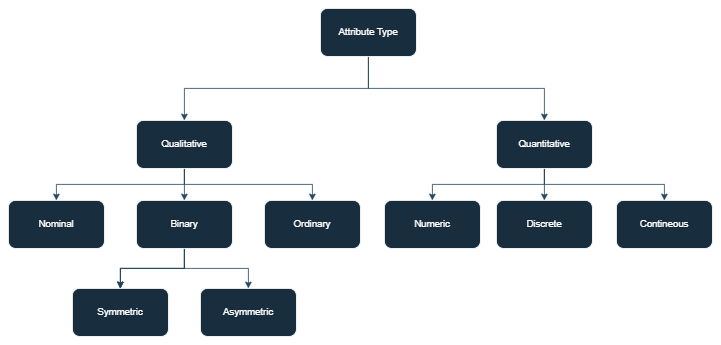
The type of an attribute is determined by the set of possible values — nominal, binary, ordinal, or numeric — the attribute can have. In the following sections, we introduce each type.
Nominal Attributes
Nominal attributes are categorical data that represent distinct categories or labels without any inherent order or ranking. These attributes consist of symbols or names of things, and their values lack any meaningful sequence. Although nominal attributes can be represented using integers, these numbers are not intended for quantitative use. Consequently, mathematical operations on nominal attributes are meaningless. This is why we need to encode nominal attributes (using techniques like one-hot encoding, label encoding, etc.) before feeding them into a machine-learning model. This encoding process prevents the model from incorrectly interpreting the attributes as having an order and typically improves the model’s accuracy.
Given that nominal attributes lack meaningful order and are not quantitative in nature, it is illogical to calculate the mean or median for such attributes. However, we can still assess the central tendency of nominal data by determining its mode. The mode represents the most frequently occurring value in the dataset and serves as an appropriate measure of central tendency for nominal attributes.
Binary Attributes
A binary attribute is a specific type of nominal attribute that consists of only two categories or states: 0 (absent) and 1 (present). This attribute type represents a simple yes/no or true/false scenario. For example, if we use the attribute “attendance” to describe a student’s status, 0 would indicate that the student is absent, while 1 would signify that the student is present. Binary attributes are commonly used in data analysis and machine learning due to their simplicity and efficiency.
A binary attribute is symmetrical if both of its states are equally valuable or significant. A binary attribute is asymmetrical if one state or value is more significant than the other.
Ordinal Attribute
Ordinal attributes have values with meaningful order or rank, but the magnitude between successive values is unknown. These attributes help rank things based on qualities we can’t measure exactly. Thus, ordinal attributes are commonly used in surveys for ratings. For example, in a customer satisfaction survey, the possible values can be dissatisfied, neutral, satisfied, and very satisfied.
Their mode and median can represent the central tendency of ordinal attributes, but their mean cannot be defined.
Numeric Attributes
A numeric attribute is quantitative. The measurable quantity is represented by integers or real numbers. They can be interval-scaled or ratio-scaled.
Interval-Scaled Attributes
Interval-scaled attributes are measured on a scale with equal-sized units. The values of interval-scaled attributes have a definite order and can be positive, zero, or negative. However, these attributes lack a true zero point. While we can calculate the difference between values, we cannot express one value as a multiple of another.
For example, temperatures in Celsius and Fahrenheit are interval-scaled. We can add temperature values in Celsius, such as 3°C and 4°C, but we cannot claim that 6°C is twice as warm as 3°C. In other words, we cannot express these values in terms of ratios. This limitation leads us to the concept of ratio-scaled attributes.
Ratio-Scaled Attribute
A ratio-scaled attribute is a numeric attribute with a natural zero point. This means if a measurement is ratio-scaled, we can talk about one value being a multiple (or ratio) of another value. Plus, the values are ordered, and we can figure out the difference between them, as well as calculate things like the mean, median, and mode.
Let’s look at an example to make this clearer. Think about measuring height in centimetres. Zero centimetres means no height at all, and 200 cm is twice as tall as 100 cm. We can easily compare heights, find the average height of a group, or calculate the difference between two people’s heights. This makes height a perfect example of a ratio-scaled attribute.
Discrete vs Continuous attributes
A discrete attribute has a limited or countable set of values. These values might be numbers, but they don’t have to be. For example, hair colour, smoker status, medical test results, or drink sizes — each of these has a set number of options, so they’re discrete. Even when discrete attributes use numbers, they’re still discrete because they have distinct, separate values. Consider the number of cars a family owns. This attribute can only take whole number values like 0, 1, 2, 3, and so on. There are no fractional cars, so there are gaps between each possible value, making it a discrete attribute. Another example of a discrete attribute is grade level in school.
If an attribute isn’t discrete, we call it continuous. Continuous attributes can take any value within a range. There are no gaps between possible values.
Let’s look at an example to make this clearer. Height is a continuous attribute. Someone could be 170.5 cm tall, or 170.51 cm, or 170.513 cm — there’s no limit to how precise we can get. We can always squeeze another possible value between two heights, no matter how close they are.
Conclusion
Understanding data attributes is fundamental to unlocking the full potential of your data. It guides how you preprocess, analyze, and model information, ensuring you choose appropriate techniques for each data type. This knowledge helps prevent misinterpretation and improves the accuracy of your insights and predictions. Whether you’re conducting basic data analysis or building complex machine learning models, recognizing the nature of your attributes — from categorical labels to continuous measurements — is crucial. It allows you to ask the right questions, apply suitable statistical methods, and draw meaningful conclusions. Ultimately, a solid grasp of data attributes empowers you to make more informed decisions and extract maximum value from your data resources.
메타데이터
- post_id
- 704d7d9ea8a8
- slug
- data-objects-and-attribute-types-704d7d9ea8a8
- url
- https://medium.com/@netrajpatil12mati/data-objects-and-attribute-types-704d7d9ea8a8
- canonical_url
- https://medium.com/@netrajpatil12mati/data-objects-and-attribute-types-704d7d9ea8a8
- author_url
- https://medium.com/@netrajpatil12mati
- status
- ok
- fetched_at
- 2026-08-22 20:13:55