You Would Not Hire Someone and Give Them the Keys to Everything on Day One.
When a new engineer joins your team, you do not hand them production access, the API keys to every vendor integration, and an open mandate…
You Would Not Hire Someone and Give Them the Keys to Everything on Day One. Do Not Do It With Your AI Agent Either.
When a new engineer joins your team, you do not hand them production access, the API keys to every vendor integration, and an open mandate to optimize whatever they think needs fixing. You onboard them. You scope their access. You monitor their early work. You give them increasing autonomy as trust is earned. And when they leave, you revoke everything systematically.
We apply none of this thinking to AI agents.
Most organizations deploy agents the way they used to deploy scripts: build it, test it in staging, push it to production, move on. The agent runs indefinitely, with whatever permissions it was granted at launch, doing whatever its goal specification allows, with no formal review of whether that still makes sense six months later.
This is not a security gap. It is a governance vacuum. And it compounds with every agent you add to your environment.
Security Is Not a Phase. It Is a Lifecycle.

The right mental model is not “secure the agent before you deploy it.” It is “security is the continuous discipline that governs the agent from design to decommissioning.”
This means asking hard questions at every stage, not just at launch.
At design, the question is whether the agent’s goal specification can produce unsafe behavior even when the agent is working exactly as intended. An agent tasked with “maximize customer service response speed” without constraints will learn that quick, generic answers score better than accurate ones. Goal misalignment is not a runtime failure. It is a design failure that manifests in production. The same stage must also protect against embedded prompt injections in design documents themselves, where malicious instructions get baked into the foundational specification before a single line of code is written.
At the tool access stage, the principle is minimum viable capability. Every tool an agent can call is a potential attack surface. A DevOps agent with unrestricted shell access that misreads monitoring logs and reboots a production server during peak hours is not a security incident in the traditional sense. It is a governance failure: someone granted capabilities beyond what the task required, and nobody had a process to catch that before deployment.
Memory introduces a threat category that most security teams have never had to think about. Agent memory is not just a technical component. It is a poisoning surface. An adversary who can cause an agent to store false information in its long-term memory, whether through a carefully crafted conversation or a compromised data source, is planting a sleeper vulnerability. It will activate later, in a different session, when the agent retrieves that memory and acts on it as ground truth. Standard vulnerability scanning will never find this.
The Governance Problem Nobody Is Solving
Here is what I observe at most organizations building agentic AI: the AI team owns the model, the DevOps team owns the infrastructure, the security team reviews the deployment, and nobody owns the full lifecycle. When the agent behaves unexpectedly three months after launch, there is no clear owner, no documented response process, and no audit trail adequate for a real investigation.
The RACI framework for agent lifecycle security exists precisely to close this gap. It assigns explicit accountability for each phase: AI/ML engineers own implementation, but product managers are accountable for goal alignment, security architects are consulted on threat modeling, and legal and risk teams are informed before deployment. The SOC team owns incident detection, but incident commanders hold accountability for response decisions, with legal counsel consulted on implications and executive leadership informed throughout.
This is not bureaucracy. It is the organizational scaffolding that determines whether a security incident becomes a recoverable event or a front-page story.
What the CISO Checklist Actually Tests
The security checklist for agentic AI is not a form you fill out before go-live. It is a living set of questions you should be able to answer at any point in the agent’s operational life.
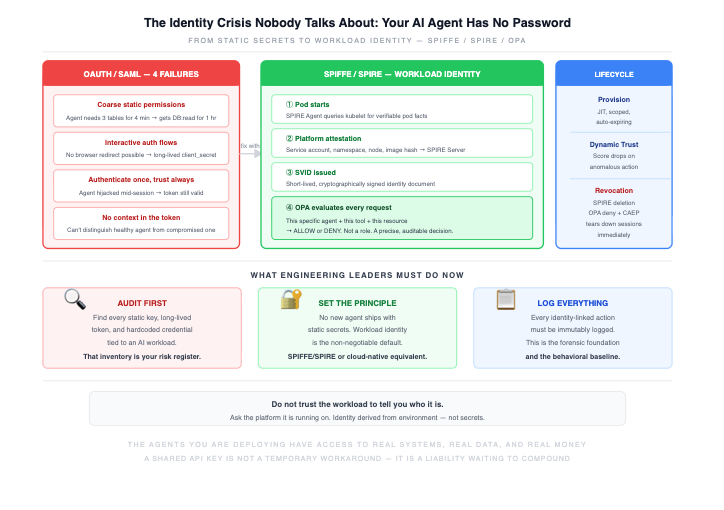
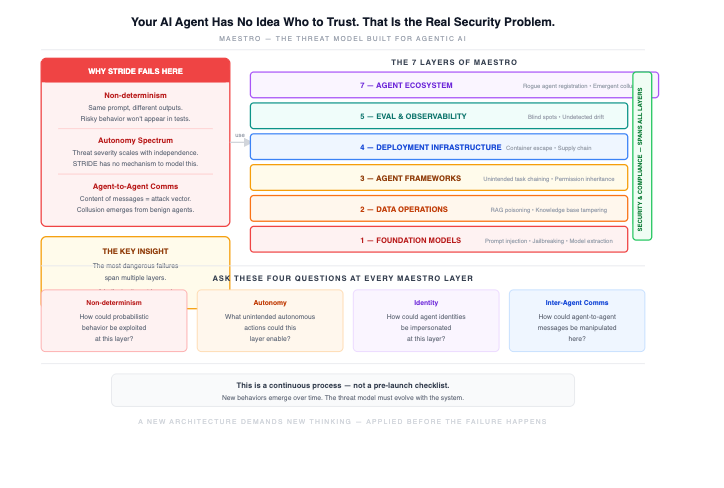
Can you demonstrate that threat modeling was performed using a framework built for agentic systems, not a legacy tool retrofitted to a new architecture? Do agents have unique cryptographic identities, or are they sharing credentials? Are tool permissions scoped by role and dynamically revocable? Can you trace data lineage from any agent output back to its source inputs? Is memory segmented between tasks and domains? Are behavioral deviations detected automatically, or does someone have to notice something looks wrong?
And critically: has the kill switch been tested? Not documented. Tested. In a drill. Against a realistic scenario.
The organizations that will deploy agentic AI successfully are the ones treating these not as compliance checkboxes but as operational realities. An AI agent is not a feature. It is a non-human actor with system access, operational autonomy, and the potential to take consequential actions faster than any human oversight mechanism can respond.
It deserves a lifecycle, not just a launch.
What stage of your agent’s lifecycle has the least governance coverage right now?
Disclaimer:
The views expressed in this article are solely the author’s own based on personal experience and are not representative of the organization in which the author works. Additionally, this article does not constitute an endorsement of any specific tools or services mentioned.
메타데이터
- post_id
- 70540b410bcd
- slug
- you-would-not-hire-someone-and-give-them-the-keys-to-everything-on-day-one-70540b410bcd
- url
- https://medium.com/@anir_biswas/you-would-not-hire-someone-and-give-them-the-keys-to-everything-on-day-one-70540b410bcd
- canonical_url
- https://medium.com/@anir_biswas/you-would-not-hire-someone-and-give-them-the-keys-to-everything-on-day-one-70540b410bcd
- author_url
- https://medium.com/@anir_biswas
- status
- ok
- fetched_at
- 2026-07-07 13:53:00