Would You Say That to Their Face? Rebuilding Community in an Age of Digital Conflict
Most of what has been written about social media concerns attention and mental health, both of them serious subjects, both exhaustively…
Would You Say That to Their Face? Rebuilding Community in an Age of Digital Conflict
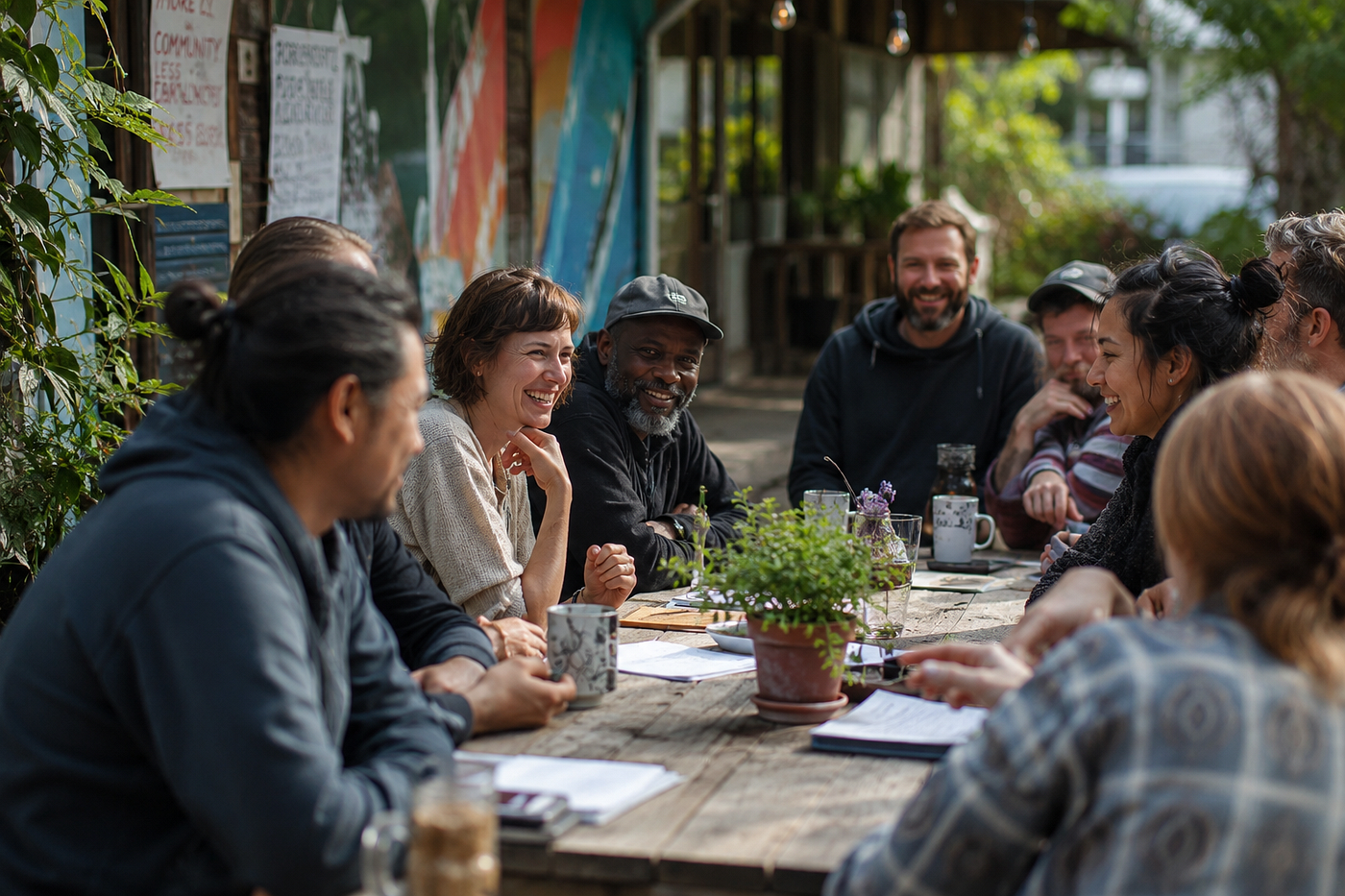
Most of what has been written about social media concerns attention and mental health, both of them serious subjects, both exhaustively covered. The deeper damage sits somewhere else, in the social ethics that make liberal democracies workable in the first place. Any honest project of rebuilding community, in this country or any other, has to begin with the question of how we allowed our public conversation to become what it has become, and whether we are still capable of behaving like neighbours when there is no immediate social cost for failing to.
I left Facebook and Instagram last week. The decision had been forming for a long time, and when I finally made it I felt no triumph and very little nostalgia, only a flat sense of relief that I would no longer be a passive participant in something I had come to find indefensible. I am not interested in arguing that these platforms are uniquely evil, or that any individual user is to blame for the way the medium behaves. The problem is structural, and what the structure rewards would be unrecognizable in the houses, pubs, classrooms and offices where ordinary social life still takes place. The longer I scrolled, the more I noticed how much of what I was reading consisted of things I could not imagine anyone saying aloud to the person they were saying it about.
That is the question I want to sit with here. If you would not say something to another human being while standing in front of them, why has it become acceptable to type it? The answer matters, because it tells us less about the platforms than about ourselves.
A short note about what this essay is not
I want to clear two things off the table before going any further, because they tend to derail this kind of argument. This is not a piece about censorship. I have a deep and old skepticism of anyone who responds to speech they dislike by reaching first for the regulator, and that skepticism applies as much to progressive paternalism as to authoritarian impulse. The classical liberal tradition that shaped most of the freedoms I actually use is the one I am writing from, not against. Mills understood, in a way many of his modern descendants have forgotten, that the case for free expression rests on a particular kind of civic character, namely the capacity to disagree without contempt. Take that capacity away and the argument for tolerance does not collapse, but it does become much harder to defend in the rooms where it has to be defended.
What follows is therefore not an argument for limiting anyone’s speech. It is an argument that freedom and responsibility are not separable, and that a culture which acts as though they are will not stay free for very long. Liberty without civility tends, given enough time, to corrode the very conditions liberty depends on, rather than amounting to some stronger or purer expression of it.
The internet is not a separate country
A great deal of the worst behaviour online happens because people still treat the internet as somewhere else, a second jurisdiction with its own rules of conduct, distinct from the rules that apply when you are looking another person in the face. That distinction was never quite real, and it gets less real with every passing year. The device is in your pocket from breakfast to bed. The conversations you have on it are with your colleagues, your customers, your relatives, the parent at the school gate. Your account carries your name, and even when it does not, it carries a username you chose and a posting history that any half competent observer can read like a personality profile.
What you write online accumulates as rehearsal. Sarcastic contempt expressed daily calcifies into a habit of perception. Conspiratorial framing, returned to often enough, becomes the lens through which the world is read. People tell themselves they are venting. What they are actually doing, in many cases, is training. The internet does not always reveal hidden character, but it reliably amplifies whatever character is being practised on it. Two hours a day spent being cruel under a username is two hours a day spent being cruel, and the person it shapes is the one holding the phone.
What proximity does, and what its absence undoes
Most of the social technology that keeps human beings tolerable to one another runs on signals that screens cannot transmit. The flinch, the small tightening at the eyes, the breath someone takes before answering, the hand that finds a partner’s hand under the table, all the shifts in body language that tell you, without conscious decision, that you are pushing too hard and should soften. None of those signals reach you through a comment thread. The person at the other end ceases to be a body in a room and becomes a username, an avatar, a paragraph of text, and an avatar cannot flinch.
This is a much larger psychological shift than it sounds. Research stretching back to Milgram has shown, in setting after setting, that physical distance from the consequences of our actions makes those actions easier to perform. Screens are distance machines. They are also disinhibition machines, escalation machines, and pile-on machines, and none of that is metaphor. It is the predictable behaviour of human beings whose feedback loops have been stripped of the bodily information they evolved to use.
How isolation feeds prejudice
There is a deeper damage in this kind of mediation, and it operates below the level of any single exchange. If the dominant mode through which you encounter people unlike yourself becomes screen mediated rather than physical, those people start to function in your mind as abstractions rather than neighbours. The neighbour you would have spoken to twenty years ago, while waiting at the school gate or queuing at the post office, becomes a category. The category hardens into a stereotype. The stereotype becomes a caricature you can dislike without guilt, because you no longer know any actual member of it well enough for the caricature to feel embarrassing.
That is how prejudice grows in a culture that genuinely believes itself to be tolerant. It is rarely grown by the kind of people who would describe themselves as hateful. It is grown by people who simply stop meeting. Political segregation by postcode, generational segregation by lifestyle, ideological segregation by feed, we end up surrounded by people who confirm us, and then we go online to argue with strangers who, in our minds, have stopped being people at all. A democracy whose citizens no longer share rooms with one another is a democracy that will struggle to share decisions.
Conflict as a business
It would be intellectually dishonest to discuss any of this as though the platforms themselves were neutral stages on which we happen to misbehave. They are not neutral. They are commercial environments engineered to maximize engagement, and engagement, as the research is now boringly clear about, follows emotional activation, particularly the activation that comes from anger, fear, and indignation. None of this is conspiracy theory. It is the openly described operating logic of the business model, documented in academic papers, in regulatory submissions, in the testimony of the platforms’ own former engineers.
Calm disagreement does not travel. A well sourced, measured rebuttal will reach a few hundred people. A sneering one-line takedown of the same argument will reach hundreds of thousands. There is no malice in the algorithm, only the indifference of a slot machine, rewarding what works and learning from every click. We have spent two decades teaching it that we click on conflict, and it has spent two decades obliging us.
Stacked on top of all that, you have an economy of professional provocateurs whose income depends on producing viral outrage, a press ecosystem competing for the same attention by amplifying whichever voice happens to be most extreme in any given dispute, and a political class that has discovered tribal mobilization is cheaper than persuasion. The result is a public conversation that systematically over represents the angry and under represents almost everyone else, after which we mistake the resulting feed for the country.
Division as a political instrument
Politicians did not invent this dynamic, but a great many of them have learned to ride it with considerable skill. Tribal identity is, for the modern electoral strategist, an extraordinarily efficient resource. You do not need to persuade a voter of anything complicated. You need only to make them feel that the other side is alien, contemptible, and dangerous, and that you alone are willing to fight them. This pattern is not the property of any one party. It works in every direction, on every continent, and most of the people doing it know exactly what they are doing.
The damage is paid further down the social stack, in the places electoral strategists never have to visit. Once opponents have been framed as enemies for long enough, ordinary citizens begin to treat each other accordingly. Conversations at family dinners become careful and resentful. Friendships quietly thin out. Neighbours stop speaking about anything beyond the weather. The basic assumption that we are at minimum fellow members of the same society, sharing the same set of problems and obligated to disagree without dehumanizing one another, begins to slip. Once that assumption goes, almost everything democratic culture relies on becomes harder to do.
Cruelty wearing humour’s clothes
One specific symptom of this drift deserves its own paragraph, because it does more damage than it is usually given credit for. A great deal of what passes for humour online is not humour. Humour in the form that has historically helped societies hold together, rather than tear themselves apart, is generous even when it is sharp. It includes the people in the room. It punctures pretension, including its own. It creates conditions in which uncomfortable conversation can keep going long enough to reach somewhere useful.
What dominates many of the most popular registers online runs on a different fuel, contempt with a punchline attached. The mockery of an accent. The ritual humiliation of whoever has said something foolish that day. The screenshot circulated to a million strangers, none of whom will ever meet the person being laughed at. Audiences laugh because laughing aligns them with the powerful side of the exchange, not because anything funny has actually occurred. A culture that confuses contempt with comedy will manufacture a great deal of cruelty and call it banter, and at some point, some of us are going to have to be willing to say that the joke is not actually funny.
A test, not a censor
It is worth being explicit about what I am and am not proposing here, because the position is easy to caricature. I am not arguing that we should never criticize anyone, never disagree in public, never name what we believe to be wrong. Strong criticism is essential to any serious civic life, and a society that has lost its appetite for honest disagreement is in just as much trouble as one that has lost its capacity for civility. What troubles me, and what this essay is really about, is the widening gap between honest disagreement and the cruelty that increasingly gets passed off as disagreement online.
The test I have started using on myself is plain, and I offer it without claiming any moral high ground, because I have failed it often enough to know how easy it is to fail. Before posting anything sharper than a recipe, I try to ask whether I would phrase it the same way if the person I was writing about were physically in the room. The question is not whether I would say nothing, but whether I would say it like this. If the honest answer is no, the distance between the two versions usually tells me something useful about which version is genuine and which is performance. That is the ordinary discipline of an adult speaking in public, with nothing self censoring about it.
What is actually at stake
Why does any of this matter beyond personal manners? Because small habits accumulate into something much larger. Social trust is not a free resource. It is built slowly, in school runs and corner shops and overheard conversations on buses, and it is spent on every difficult collective decision a country has to make. The thinner that everyday texture becomes, and the more hostile our routine encounters with each other are, the harder it gets to refill the reservoir when a society actually needs to draw on it.
You can see the downstream effects already, in declining institutional confidence, in the long quiet collapse of membership in community organizations, in the loneliness statistics that public health bodies have been alarmed about for a decade. You can see it too in how readily people now assume the worst of fellow citizens they have never met. Democracies can survive sharp disagreement. They struggle to survive the loss of the basic assumption that the people on the other side of an argument remain members of the same human community, entitled to the same treatment, the same dignity, and the same benefit of the doubt.
What rebuilding actually looks like
I do not believe the answer to any of this is principally technological, and I am suspicious of any solution framed entirely in terms of platform reform. Platforms will continue to optimize for whatever we reward them for optimizing, and the people who run them are not going to fix this on our behalf. The deeper work has to happen offline, in the parts of life that algorithms have not yet found a way to monetize.
In practice that means spending more time with people in actual rooms, not as a nostalgia exercise but as a discipline. Joining something. A choir, a residents’ association, a sports club, a volunteer group, a local political ward meeting, a place of worship if that suits, a class on something you are bad at if it does not. Having longer and harder conversations with neighbours whose politics you suspect you disagree with. Eating meals with people who do not share your assumptions. Listening for two minutes longer than feels comfortable before responding, and then responding the way you would want to be responded to.
Honesty about our own digital habits matters as well. Reading before reacting. Following fewer accounts whose business model depends on keeping you angry. Replying less in heat and more in considered writing, or, more often, not at all. Treating the screen as an extension of who you are rather than an exemption from it. None of these moves on its own is a complete answer, but empathy, like conflict, is learned by repetition. The societies we want to live in are not delivered by platforms or politicians. They are built, slowly, by the people who decide to keep behaving as members of them.
The art of community
We will not rebuild a healthier public culture by winning online arguments. That game is un-winnable by design, because the medium rewards escalation more reliably than it rewards persuasion, and anyone who has spent a year trying to win it knows that the only thing you accumulate at the end is your own contempt. What is left, and what has always been left, is the slower and less glamorous work of restoring proximity, dignity, and ordinary respect to the way we deal with one another, online as well as off.
If the art of conflict is winning, perhaps it is time to become students of community again.
메타데이터
- post_id
- 70602c922e7e
- slug
- would-you-say-that-to-their-face-rebuilding-community-in-an-age-of-digital-conflict-70602c922e7e
- url
- https://medium.com/@kingsnorth66_36087/would-you-say-that-to-their-face-rebuilding-community-in-an-age-of-digital-conflict-70602c922e7e
- canonical_url
- https://medium.com/@kingsnorth66_36087/would-you-say-that-to-their-face-rebuilding-community-in-an-age-of-digital-conflict-70602c922e7e
- author_url
- https://medium.com/@kingsnorth66_36087
- status
- ok
- fetched_at
- 2026-06-09 15:37:30




