Bosnia and Herzegovina 2026–2030: Built Not to Move
In April 2025 the state of Bosnia and Herzegovina tried to arrest a man, and could not.
Bosnia and Herzegovina 2026–2030: Built Not to Move
In April 2025 the state of Bosnia and Herzegovina tried to arrest a man, and could not.
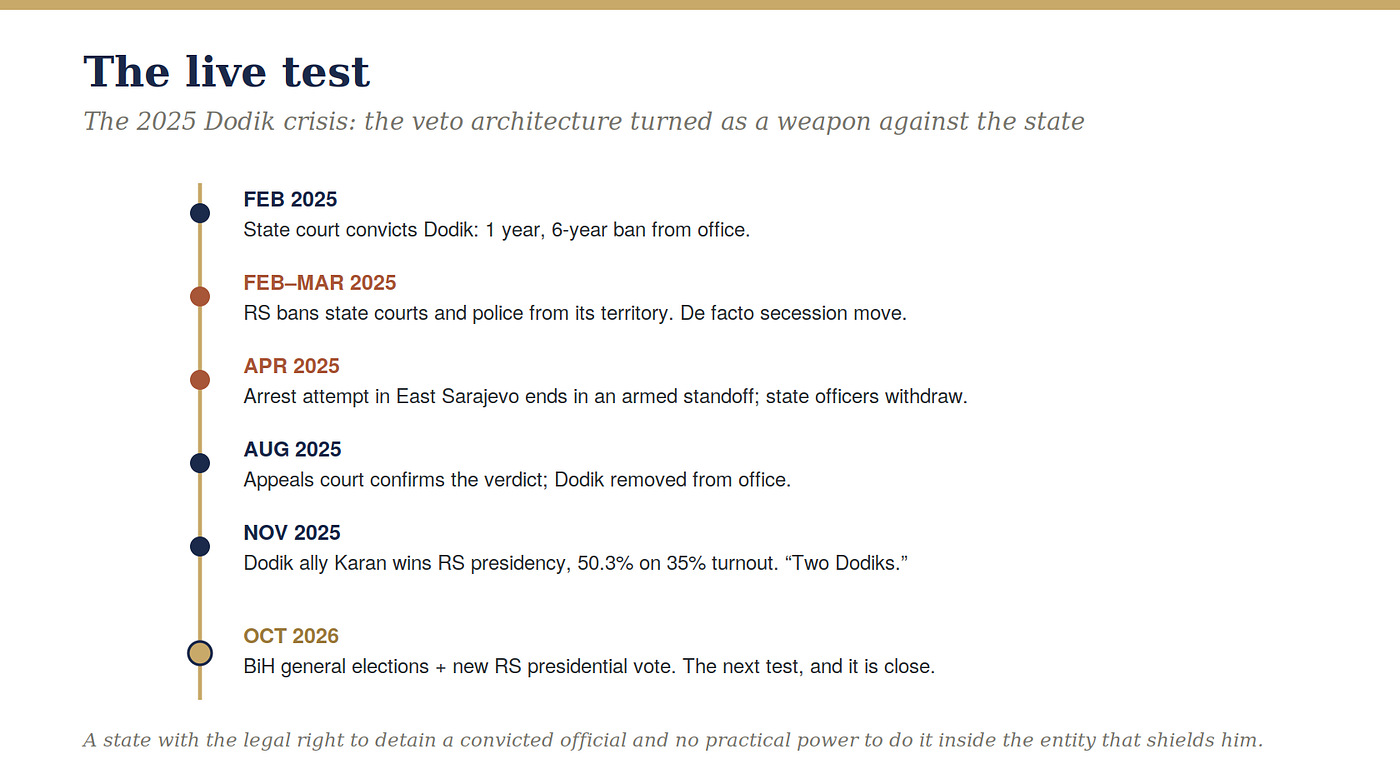
The man was Milorad Dodik, then president of Republika Srpska, the Serb-majority half of the country. A state court had convicted him in February of defying the international overseer who guards the peace agreement, sentencing him to a year in prison and a six-year ban from office. His response was to have the RS assembly pass laws barring the state’s own courts and police from operating on its territory, which the constitutional court called an attempt to abolish state authority over part of the country. When the state intelligence agency went to East Sarajevo to detain him, RS police met them in an armed standoff, and the state officers withdrew. Dodik went to Moscow. By August the conviction was confirmed and he was removed. By November his ally Siniša Karan had won the RS presidency, and Dodik told his supporters that those who tried to be rid of him had ended up with two.
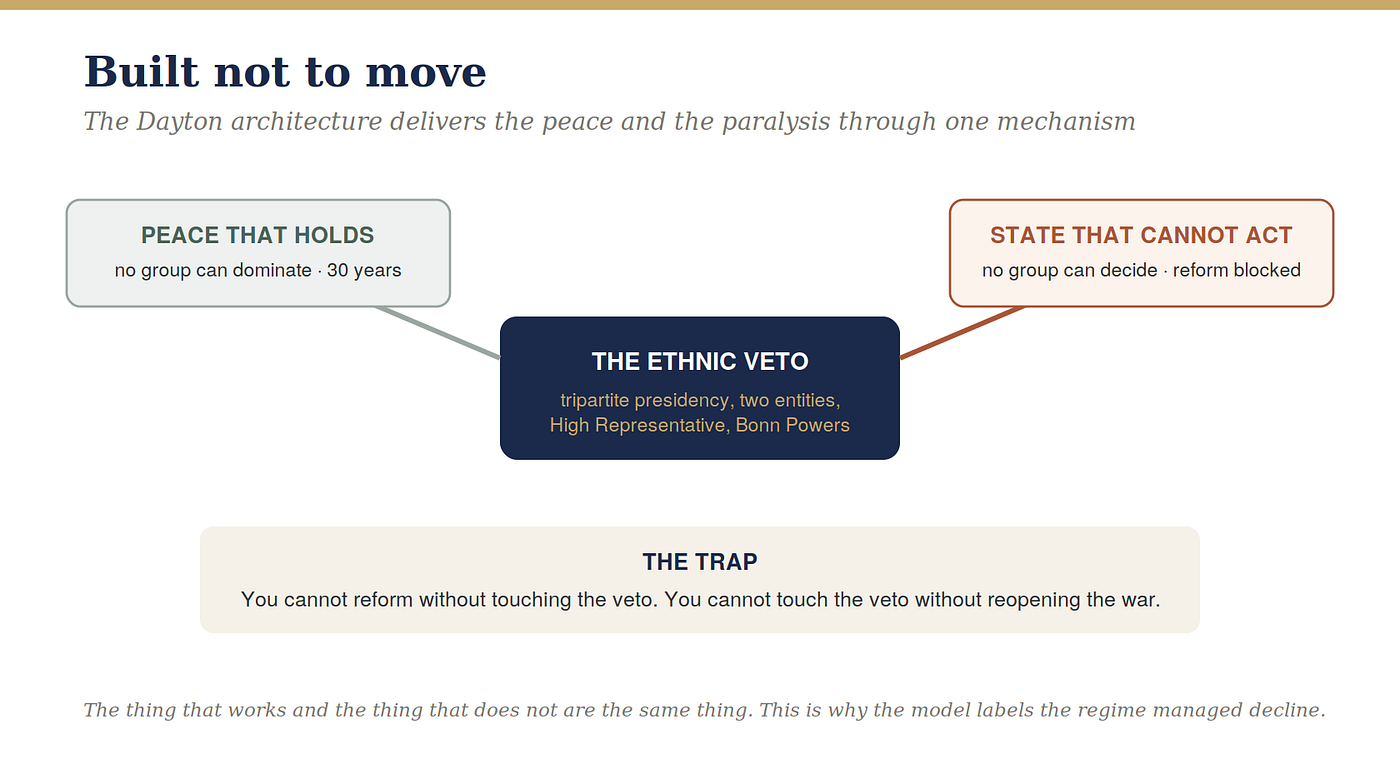
This is the country at full volume, but the quiet version runs underneath it every day, and it is the more important one. Bosnia is a state that cannot move. It was built that way on purpose, in 1995, to stop a war, and the design worked: the war stopped and has not come back for thirty years. The same design also froze the state in place, because a constitution engineered so that no group can dominate is also a constitution in which no group can act. You cannot reform Bosnia without touching the ethnic veto, and you cannot touch the ethnic veto without reopening the question the war was fought over. So the state stays still. And while it stays still, the country drains out the bottom faster than anywhere else in this series.
That is why the ACDM framework scores Bosnia at 35%, the lowest in the Balkan set, with its weakest single layer down at 20% and a fifteen-point gap between the two that flags the headline as optimistic. The regime label is managed decline, and it is chosen against the alternatives with care. Muddling through, the label for Türkiye, implies no clear direction. Bosnia has one, and it points down. Constrained normalisation, the label for Montenegro, implies a working external anchor pulling the country toward reform. Bosnia’s anchor is formally attached and doing nothing. What is left is managed decline: a slow, legible deterioration that the institutions are structured to permit and unable to arrest. The closest historical rhyme the model finds is Lebanon, where confessional power-sharing produced not renewal but a long, managed slide.
What follows runs the model across the 2026–2030 window: ten layers, two reinforcing loops, three scenarios, the watchpoints, the peers, and a note on what the reading cannot reach. The headline numbers first. Geometric stability is 35%, the weakest layer is 20%, and that weak layer is the elite bargain, which is another way of saying the thing most broken in Bosnia is the agreement among its own leaders to run a single country. As in the rest of the series, the stability scores, the scenario odds and the peer figures are the model’s estimates rather than official statistics. The empirical numbers feeding them are dated below and run to 2025 where the data exists.
The Machine That Stops Itself
The Dayton Peace Agreement is one of the more successful documents of its generation, and saying so is not a criticism waiting for a “but.” It ended a war that killed around a hundred thousand people, and the silence it bought has held for three decades. The trouble is that the mechanism delivering the peace and the mechanism delivering the paralysis are the same mechanism, and they cannot be separated.
Dayton built a state from mutual suspicion. There is a three-member presidency, one Bosniak, one Croat, one Serb. There are two entities, Republika Srpska and the mostly Bosniak-and-Croat Federation, each with wide powers and an effective veto over the centre. Above all of it sits a High Representative, an unelected international official with what are called Bonn Powers, able to impose laws and remove officials to protect the settlement. Every piece of that architecture exists to stop one group from running the country at another’s expense. Each piece also gives every group a way to stop the country doing anything at all. The result is a state that can veto but cannot decide, that can block but cannot build. The framework registers this directly: the institutional layer scores high stress, the elite bargain scores 20%, and the central political loop the model traces runs from weak institutions to ethnic mobilisation and back, each turn of dysfunction handing the ethnic entrepreneurs a fresh grievance to mobilise, each round of mobilisation blocking the reform that might ease the dysfunction.
The cruel part is what this does to the one tool meant to break the cycle. Bosnia is, on paper, advancing toward the European Union. It became a candidate in December 2022, and in March 2024 the European Council agreed to open accession negotiations. That should be the anchor. It is not, because the reforms the EU asks for are exactly the reforms the veto architecture is built to prevent, and the Commission’s 2025 assessment noted, with diplomatic flatness, that the previous year’s recommendations had simply not been implemented. The door was opened and the country could not walk through it, not for lack of wanting but for lack of a mechanism to act. A frontrunner like Montenegro is held back by arithmetic and identity. Bosnia is held back by its own constitution.
The Live Test
The 2025 crisis was not a departure from this pattern. It was the pattern, escalated to the point where the machinery turned visibly against itself.
When the state court convicted Dodik for ignoring the High Representative, it was the centre asserting that there are limits to what an entity leader may defy. When Republika Srpska answered by banning state courts and police from its territory, it was the veto architecture being used not to block a law but to dismantle the state’s authority over half its own ground. The constitutional court called it what it was, an attempt to abolish state authority over part of the country, and then discovered the limit of a court that cannot enforce its own rulings. The arrest that failed in East Sarajevo was the whole problem in one scene: a state with the legal right to detain a convicted official and no practical power to do it inside the entity that shields him.
The politics around it sharpened the stakes. Dodik has led Republika Srpska for some twenty years as a pro-Russia figure and a denier of the Srebrenica genocide, and during the crisis he restated the goal plainly, calling Bosnia not a state of Serbs but a temporary refuge and pressing again for unification with Serbia. His removal changed the office and not the project. The November 2025 RS presidential election went to his ally Karan with 50.3% on a turnout of just 35%, and Karan promised to continue the policy with greater force. Dodik, by his own account, had been replaced by two of himself. The model’s depth-psychology layer is built for exactly this: war-trauma narratives that never closed, kept warm by leaders who find them useful, reactivated on schedule around Srebrenica commemorations and every constitutional fight. The secession talk may or may not lead to an actual attempt. As a permanent background pressure on a state that cannot defend its own decisions, it does its damage either way.
The Bleed
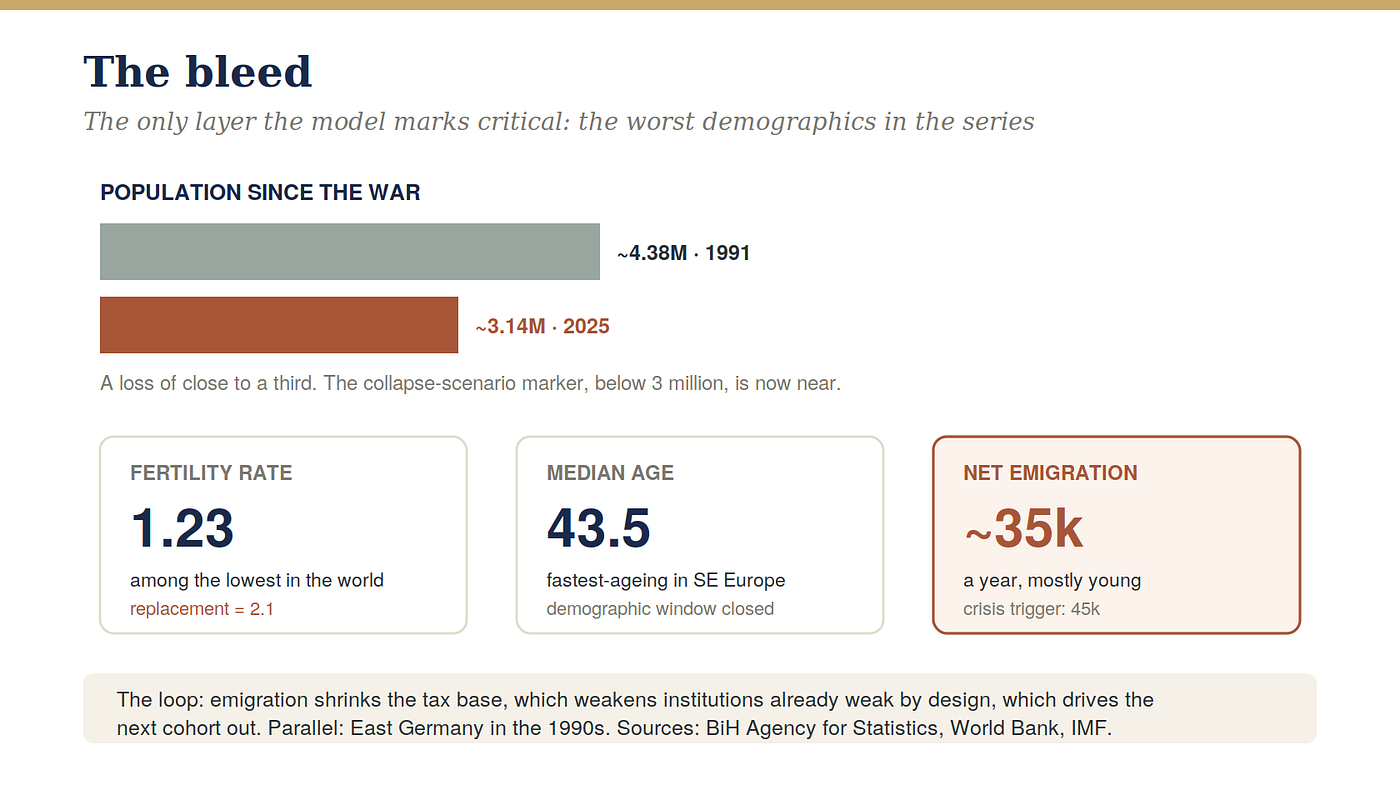
While the politics lock at the top, the population leaves from the bottom, and the demographic layer is the one the model rates not high or elevated but critical, the only such mark in the framework.
The numbers are the worst in this Balkan series and among the worst anywhere. Bosnia has lost somewhere between a quarter and a third of its people since the 1991 census, and the resident population now sits around 3.14 million and falling. The fertility rate, near 1.23, is among the lowest in the world. The median age, 43.5, makes Bosnia the fastest-ageing country in southeastern Europe. Net emigration runs near 35,000 a year, most of it young, most of it bound for the EU labour markets that 70% of Bosnia’s trade already depends on. The World Bank’s language about this is unusually blunt for the institution: the country, it warns, cannot afford to keep losing its human capital this way.
Here the second reinforcing loop runs, and it is the engine of the managed-decline label. People leave; the tax base shrinks; thinner public finances weaken institutions already weak by design; the weakened institutions deepen the sense that nothing will improve; and the next cohort leaves. The model rates the loop strong and slow, and reaches for East Germany in the 1990s as the parallel, a region that emptied of its young not because anything dramatic happened but because the structural future looked better elsewhere and the door was open. Bosnia’s door has been open for years. The difference from East Germany is that there was no richer western half waiting to absorb and rebuild Bosnia, only a Union that takes its emigrants and asks reforms of its government that the government cannot pass. A state can be frozen indefinitely. A population cannot, and Bosnia’s is voting with its feet against the freeze.
The Ledger
The economy is the part of Bosnia that works, which is the surprise, and it is also the part least able to rescue the rest.
The structural picture is steadier than the politics deserve. Growth ran around 2.5% in 2024 and slowed toward 2% in 2025, held up by household consumption, remittances worth more than a tenth of GDP, and strong wage growth, with a slowdown in industry pulling the other way. Public debt is modest. Unemployment, long the country’s worst macroeconomic number, has fallen to around 11%, though youth unemployment near 28% still tells the truer story about why the young leave. Inflation sits in the low-to-mid single digits. The one clear weakness is the external account, where a drought-driven collapse in electricity exports widened the current-account deficit to around 4% of GDP in 2024. Per capita income is the quiet indictment: after a decade of growth, it remains about a third of the EU average, which is the gap that makes leaving rational.
None of this is a crisis on its own. The danger is that the economy is hostage to the politics rather than the other way round. The IMF puts it carefully, warning that an escalation of political tensions could fragment the economy further and erode the investor confidence that growth depends on. The model’s cascade scenario draws the line directly: a European recession cuts the remittances that prop up consumption, the fiscal squeeze meets a constitutional system incapable of a coordinated response, and the fiscal stress accelerates the emigration that was already the country’s deepest problem. The economy is not where Bosnia breaks. It is the channel through which a political shock would become a demographic one.
Three Roads to 2030
The model resolves into three scenarios, and what is striking is how little daylight separates the most likely one from the floor.
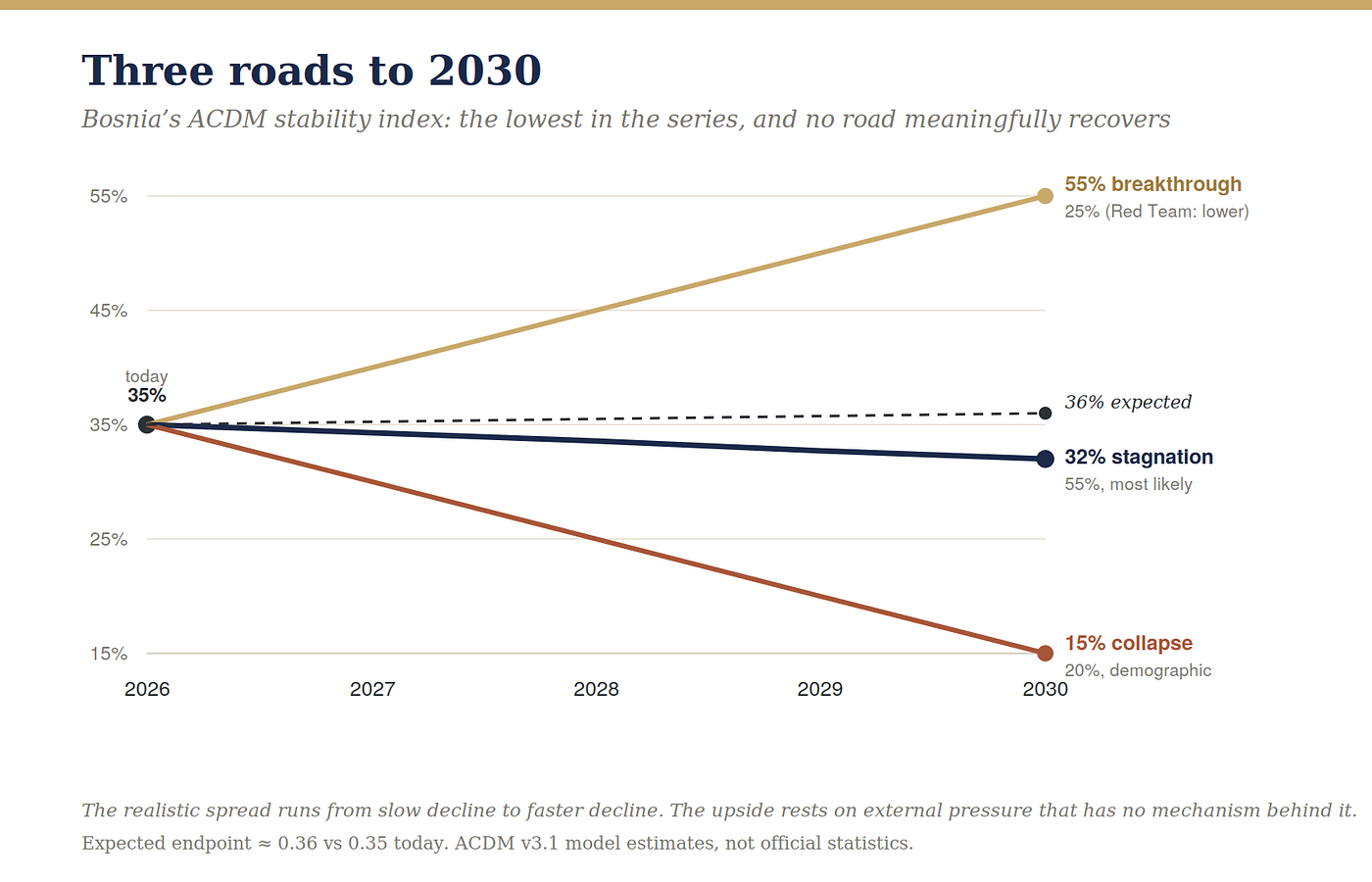
The baseline, managed stagnation, sits at 55%. The constitutional deadlock holds, the EU process stays formally alive and practically frozen, the economy grows slowly on remittances and EU trade, and emigration keeps accelerating without quite tipping into crisis. The system muddles on through periodic confrontations of the kind 2025 produced, each one alarming and none of them final. Stability lands at 32%, a little below today, because the demographic loop never stops grinding. This is the likeliest road for the plainest reason: it requires nobody to do anything, and Bosnia’s architecture is very good at ensuring nobody does anything.
The optimistic road, breakthrough reform, takes 25%. External pressure forces a constitutional settlement, the EU path unlocks, modernisation begins, and the demographic slide slows as the young find reasons to stay. Stability climbs to 55%. The Red Team dissent is severe and rests on history: the EU has no mechanism to force constitutional reform on Bosnia, the ethnic elites hold a veto that external goodwill cannot override, and the serious reform attempts of 2006 and 2009 both failed with similar international backing behind them. The 2025 crisis is sometimes read in Western capitals as a chance to push reform through the disruption. The dissent’s reply is that the same crisis demonstrated, again, that the entity leaders can simply refuse, and that there is no lever to make them do otherwise. Read 25% as generous.
The downside, demographic collapse, takes 20%. Accelerating emigration erodes the tax base, the fiscal crisis arrives, the constitutional system cannot mount a response, institutional legitimacy gives way, and partition pressure moves from rhetoric to substance. Stability falls to 15%. The marker the model watches is the population dropping below three million, a line Bosnia is now close to.
Weighted together, the scenarios point to about 0.36 against 0.35 today, which is the model telling the truth in its own way: there is no version of the next five years, on current structure, in which Bosnia meaningfully recovers. The realistic spread runs from slow decline to faster decline. The optimistic case is real but rests on an external force that does not exist, and the framework is honest enough to price it accordingly.
The Watchpoints
The signals to watch divide cleanly into the slow and the binary.
The slow ones are demographic and fiscal. Net emigration above roughly 45,000 a year would mark the demographic loop tipping from erosion into spiral, with six months to a year before the fiscal effect lands. Youth unemployment back above 40% would pull the same trigger from the other direction, since it is the metric that most directly drives the young to go. A budget-execution rate falling below 70% would signal that the governance machinery had moved from slow to broken. These are readable in the statistics agency’s releases and the finance ministry’s accounts, and they move with enough warning to see them coming.
The binary one is political, and it is close. Bosnia holds general elections in October 2026, with a Republika Srpska presidential vote alongside, and the campaign will run straight through the unresolved aftermath of the Dodik affair. A constitutional crisis that blocks the state budget for more than six months, the model’s institutional tipping point, is not a tail risk in that environment but a live possibility. The deeper watchpoint has no clean number: whether the secession rhetoric stays rhetoric. Republika Srpska has drafted the language of statehood, talked of re-establishing its own army, and found a patron in Moscow. None of that is the same as an actual attempt, and an actual attempt remains unlikely. But the gap between an entity that talks secession to extract concessions and an entity that means it is exactly the gap a frozen state has no reliable way to measure, and the 2026 elections are the next occasion to test it.
Among Its Peers
Three comparisons place Bosnia, and all of them turn on the capacity to act. Against North Macedonia (48% in this model run), the difference is that North Macedonia, for all its own paralysis, settled its name dispute and at least possesses a state that can take a decision when it chooses to; Bosnia’s deadlock is constitutional, structural, and not subject to a single negotiable fix. Against Albania (52%), the gap is demographic as much as institutional: Albania emigrates heavily too, but from a younger base, while Bosnia ages fastest in the region. Against Serbia (45%), the contrast is the sharpest and the most uncomfortable: Serbia drifts toward the authoritarian, but it has a centre that can govern, and a governing centre in decline still outscores a divided one that cannot govern at all. Bosnia sits at the bottom of the table not because it is the most badly led but because it is the least able to be led, by design.
The Symbolic Layer (L11), Held Apart
The framework carries a symbolic layer, fenced off in the same two ways as everywhere in this series. It never enters the stability number, only the interpretation around it; and the reading below was done blind, as a straight interpretation of the founding chart’s 2026–2030 transits, with the directions read first and mapped onto the scenarios only afterwards. In Bosnia’s case the founding chart is unusually clean to date, since the state was born on a known day in December 1995, but the discipline is the same: read the transits without reference to the news, then check where they land.
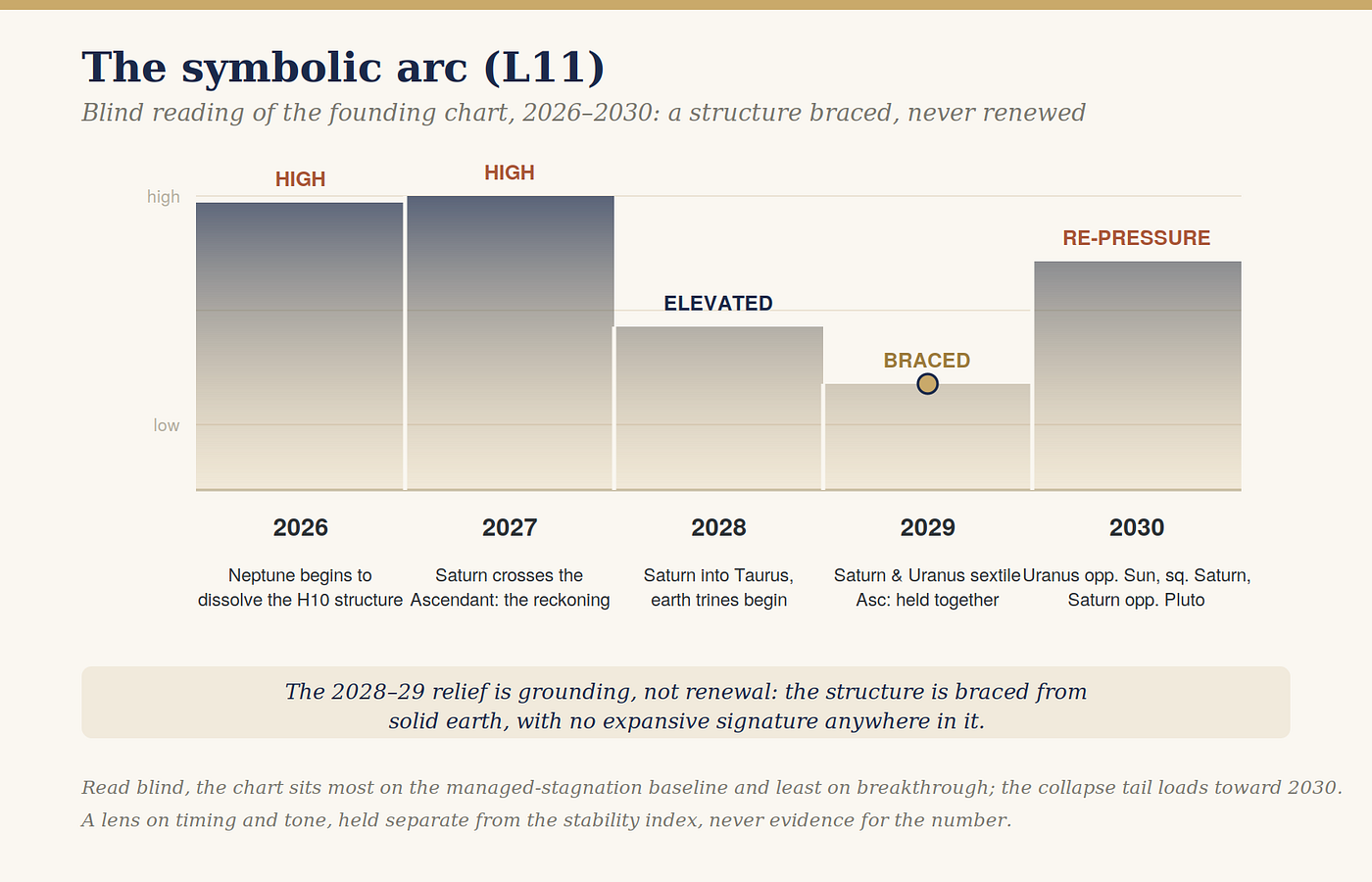
The chart itself is almost on the nose, which is worth noting precisely because the reading was blind to it. It carries an Aries Ascendant and a dense cluster of planets in Capricorn in the tenth house of public authority and the state itself, and that cluster is the tell: alongside the structural, hierarchy-building weight of Capricorn sit Uranus, the principle of fracture and partition, and Neptune, the principle of dissolution and of boundaries that will not hold. A state whose tenth house is built from rigid structure wrapped around a fault line and a fog is a strange and specific thing for a chart to say on its own. The five-year arc then does something relentless with it. From 2026 the transiting Neptune, moving through the hidden twelfth house, begins squaring that Capricorn structure one planet at a time, a slow dissolving pressure that runs the entire length of the window and finishes on Mars, the tenth-house planet of action, only in 2030. Dissolution, not rupture, and it never resolves.
The year that stands out is 2027, when transiting Saturn crosses the Ascendant in March, the classic threshold transit, a heavy new weight landing on the identity of the thing itself, arriving directly after the constitutional reckoning the empirical model flags for late 2026. The pressure eases in the middle of the window. Through 2028 and 2029 Saturn moves into Taurus and trines the Capricorn cluster from solid earth, with sextiles to the Ascendant from both Saturn and Uranus, the most supportive stretch the chart offers. But its character matters: this is grounding and holding-together, the structure being braced rather than rebuilt, with no expansive Jupiter signature of genuine renewal anywhere in it. And it does not last. By 2030 the disruptive pressures return and sharpen, Uranus opposing the Sun and squaring the natal Saturn while Saturn opposes Pluto, the structural backbone and the leadership both shaken as the window closes.
Read blind against the three scenarios, the chart sits most comfortably on the managed-stagnation baseline and least comfortably on the breakthrough. There is no renewal signature in it, no clean reward configuration that would underwrite reform; the best the chart offers is the bracing of 2028 and 2029, a structure held together rather than transformed, bracketed by the Saturn-on-Ascendant reckoning of 2027 and the Uranus-and-Saturn pressure of 2030. The collapse tail is present, carried by the relentless Neptune dissolution and the late Uranian disruption, real but not dominant, and weighted toward the end of the window. The resonance with the empirical reading is hard to miss, a rigid public structure built around a fracture and a dissolution, eroded slowly across five years and braced but not renewed in the middle of them. It should be named and then immediately discounted as evidence, because a symbolic layer agreeing with an empirical one is not a second witness. The chart’s arc and the model’s trajectory are two descriptions of the same calendar, not two independent arrivals at the same place. The symbolic layer is used here only as a lens on timing and tone, never as a reason to move the number.
What This Reading Cannot See
The model’s limits belong at the end. The data is moderate: official statistics exist but emigration is undercounted, which means the demographic numbers, bad as they are, likely understate the bleed. The harder limit is inference, because the entire forecast turns on ethnic-elite behaviour and the choices of external actors, neither of which a structural model prices well. Whether Republika Srpska’s secession project is a bargaining posture or a genuine intention, whether the EU finds a will and a mechanism it has never had, whether Moscow’s interest in keeping the Balkans unsettled deepens or fades, all of it sits outside what the layers can calculate, and all of it could move the outcome more than anything the layers can.
There is also a reflexivity cost the model flags, and for Bosnia it is unusually sharp. An analysis that documents decline in a country whose educated young are already deciding whether to leave can hand them one more reason to go, accelerating the very emigration it measures. The same analysis, read in Brussels or Washington, might add to the pressure for reform. The framework’s own estimate is that the first effect outweighs the second. Writing honestly about Bosnia’s trajectory is not a neutral act, and the most useful thing a reading like this can do is be precise enough to inform the people with leverage without being so bleak that it persuades the people without leverage to give up on the place.
Conclusion: The Peace and the Price
Bosnia is the hardest case in this series to write about, because the usual move, praising what works and criticising what does not, breaks down. The thing that works and the thing that does not are the same thing.
Dayton stopped the killing and has kept it stopped for thirty years, which is not a small achievement and should not be discounted by anyone who remembers what it replaced. The price of that peace was a state designed around mutual veto, a state that cannot be reformed without reopening the wound the veto was built to close. For three decades the trade has held: paralysis in exchange for quiet. What has changed, and what the model captures in its critical demographic mark, is that the trade now has a clock on it. A frozen state can sit frozen for as long as its guarantors keep it so. A population draining at 35,000 a year, ageing fastest in the region, already down by close to a third since the war, cannot wait for the freeze to thaw. The managed decline the framework names is not a forecast of a country falling apart in a crisis. It is something slower and sadder: a country that keeps its peace and loses its people, that holds together at the top while emptying from the bottom, until the question of whether Bosnia can become a functioning state is overtaken by the question of how many Bosnians will be left to live in it.
The 2026 elections will produce another round of the confrontation 2025 made vivid, and the secession talk will rise and probably subside again, and the EU process will stay formally open and practically shut. None of that is the real story. The real story is the one the stability number tells without drama: 35%, drifting toward 36% only because there is not much further down the structure allows it to go in five years, a state built so well to prevent the worst that it cannot reach for anything better. Bosnia will not move, because it was built not to move. The tragedy is that everything around it, most of all its own people, keeps moving anyway.
The Archos Civilizational Dynamics Model is documented at chrisarchos.com/methodologies. Empirical sources: BiH Agency for Statistics, Central Bank of Bosnia and Herzegovina, IMF Article IV (2025), World Bank, wiiw (Vienna Institute for International Economic Studies), European Commission enlargement reporting (2025), the Office of the High Representative, Transparency International, and Balkan Insight. Figures are dated explicitly and reflect 2024–2025 data where available; the model’s horizon is 2026–2030. ACDM stability scores, weakest-link values, peer scores, scenario probabilities and operational thresholds are model estimates, to be read as structured analytical outputs rather than official statistics. The astrological layer (L11) is derived from the state’s founding chart and is held separate from the stability index: it modulates interpretation and does not enter the geometric or weakest-link calculation.
메타데이터
- post_id
- 7067fb70e881
- slug
- bosnia-and-herzegovina-2026-2030-built-not-to-move-7067fb70e881
- url
- https://medium.com/archos-civilizational-dynamics/bosnia-and-herzegovina-2026-2030-built-not-to-move-7067fb70e881
- canonical_url
- https://medium.com/archos-civilizational-dynamics/bosnia-and-herzegovina-2026-2030-built-not-to-move-7067fb70e881
- author_url
- https://medium.com/@archoschristos
- status
- ok
- fetched_at
- 2026-06-15 20:49:13