314 Stainless Steel Pipe and 1045 Carbon Steel Pipe — They’re Not the Same Kind of Material
When selecting pipe materials, a lot of people see “stainless steel” and assume it’s premium, and see “carbon steel” and assume it’s cheap…
314 Stainless Steel Pipe and 1045 Carbon Steel Pipe — They’re Not the Same Kind of Material
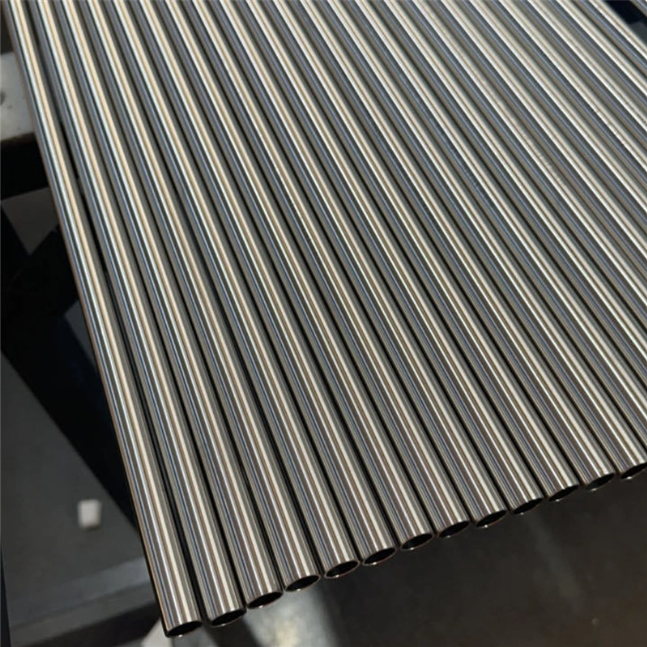
When selecting pipe materials, a lot of people see “stainless steel” and assume it’s premium, and see “carbon steel” and assume it’s cheap but lower‑grade. That kind of thinking often leads to problems in material selection.
314 and 1045 — one is built for high‑temperature resistance, the other for mechanical strength. Let’s go through both materials and then compare them side by side.
First, 314 Stainless Steel Pipe
314 stainless steel pipe is an austenitic heat‑resistant stainless steel pipe. Its Chinese grade is 1Cr25Ni20Si2, UNS designation S31400, SUS314 in Japan, and 1.4841 in Germany.
Its composition is distinctive: chromium 23‑26%, nickel 19‑22%, and silicon 1.5‑3.0%. Chromium and nickel aren’t unusual in stainless steel, but the high silicon content in 314 is added to form a denser oxide film, giving it significantly better oxidation resistance at 800‑1050°C. It is typically produced to ASTM A312 and ASTM A213 standards, in round, square, and rectangular pipe forms.
314’s standout capability is high‑temperature resistance. It can be used continuously at 1050°C, and short‑term exposure up to 1150‑1250°C is possible. Ordinary 304 starts to struggle around 800°C, and 316 doesn’t exceed 850°C. That’s why industrial furnace tubes, heat treatment equipment, and high‑temperature flue ducts often use 314.
Mechanical properties: tensile strength ≥689 MPa, yield strength ≥345 MPa, elongation ≥40%. Welding can be done with TIG, MIG, or arc welding, but austenitic stainless steel has poor thermal conductivity — welding heat is concentrated and can cause distortion, so heat input must be controlled. Post‑weld heat treatment is generally not required.
A few things to watch: prolonged exposure in the 600‑800°C range can cause precipitation of harmful phases, leading to embrittlement. It’s also sensitive to sulfur‑containing environments. And 314 is expensive — nickel, chromium, and silicon are costly, and the price is far higher than ordinary stainless steel.
Now, 1045 Carbon Steel Pipe
1045 is a classic medium‑carbon steel, primarily produced to ASTM A519. A519 is the specification for “seamless carbon and alloy steel mechanical tubing.” Unlike pressure piping standards like A53 and A106, A519 is specifically designed for mechanical and structural applications, with stricter requirements for dimensional accuracy and machinability.
1045 has carbon content of 0.43‑0.50%, manganese 0.60‑0.90%, and no chromium or nickel.
Mechanical properties depend on the delivery condition. In the cold‑drawn condition, tensile strength is 620‑760 MPa, yield strength 480‑585 MPa, and elongation 12‑18%. In the normalized condition, tensile strength is about 517 MPa and yield strength about 331 MPa. Brinell hardness in the cold‑drawn condition is approximately 200‑230 HB.
1045’s biggest advantage is heat‑treatability — quenching and tempering can significantly increase surface hardness, making it suitable for shafts, gears, hydraulic cylinder tubes, and other parts requiring strength and wear resistance. But it doesn’t resist corrosion — it rusts quickly in humid environments.
The Difference Between the Two Materials
First, purpose. 314 is made for high temperatures. 1045 is made for mechanical parts. One handles furnace tubes above 1000°C, the other handles rotating shafts at room temperature — completely different jobs.
Second, composition. 314 is a high‑alloy steel with large amounts of chromium, nickel, and silicon. 1045 is just iron and carbon — alloy cost is almost zero. Price difference? 314 costs several times more than 1045 — nickel and chromium are expensive.
Heat resistance is where the gap is widest. 314 can handle 1050°C. 1045 starts losing strength above 400°C. If the service temperature exceeds 800°C, 1045 isn’t even a consideration — only 314 will hold up.
At room temperature, 1045 doesn’t lose to 314 in strength — cold‑drawn 1045 can actually be stronger. For shafts and gears, 1045 holds its own and costs much less.
Corrosion resistance is where 314 has a clear advantage — the passive film formed by high chromium and nickel content is far superior to what 1045 can offer. 1045 relies on coatings or galvanizing for protection.
For weldability, 314 requires heat input control — austenitic stainless steel has poor thermal conductivity and is prone to distortion. 1045 medium‑carbon steel requires preheating, but low‑carbon steel welding is much simpler.
How to Choose — Two Sentences Say It All
If the service temperature exceeds 800°C, choose 314 stainless steel pipe. Industrial furnace tubes, heat treatment equipment, high‑temperature flue ducts — these applications need to “withstand high heat,” and 314 is the right call. 1045 loses strength rapidly at high temperatures and is simply unusable.
If the application is room‑temperature mechanical parts, choose 1045 carbon steel pipe. Hydraulic cylinder tubes, drive shafts, gears, connecting rods — these need “adequate strength, heat‑treatability, and reasonable cost,” and 1045 is actually more suitable than 314 — and much cheaper.
The first principle of material selection is not about which is better — it’s about which is more suitable. Using 314 for 1045’s job is expensive and wasteful. Using 1045 for 314’s environment will fail within days. Get the temperature, load, and environment straight first, and the answer will follow.
Why choose Shandong Mingtong Metal?
Shandong Mingtong Metal provides one-stop sourcing of **carbon steel, [alloy](https://www.mtsteels.com/products), [galvanized steel](https://www.mtsteels.com/products/galvanized-steel), [stainless steel](https://www.mtsteels.com/products/stainless-steel), and [aluminum](https://www.mtsteels.com/products/aluminum) alloys in a full range of shapes and finishes. We also offer a wide range of profiles ([angle steel](https://www.mtsteels.com/products/carbon-steel/carbon-steel-angle-iron), [I-beams](https://www.mtsteels.com/products/carbon-steel/section-beam), [Steel Sheet Pile](https://www.mtsteels.com/products/carbon-steel/steel-sheet-pile), [H-beams](https://www.mtsteels.com/products/carbon-steel/h-section-steel), [flat steel](https://www.mtsteels.com/products/carbon-steel/steel-flat), [C-beams](https://www.mtsteels.com/products/carbon-steel/c-section-steelion-steel), [reinforcing bars](https://www.mtsteels.com/products/carbon-steel/rebar), [square steel](https://www.mtsteels.com/products/carbon-steel/square-steel)**, etc.). Partnering with us can reduce your procurement and shipping costs, while saving you procurement time.
We have 5,000 tons of stock of commonly used sizes (including 1000×2000 mm, 1250×2500 mm, 1500×3000 mm, etc.) and surface treatments such as 2B, NO.4, and BA; The zinc coating can be customized according to your requirements. We can also customize products according to your needs. We support expedited orders (4–7 days) and large-volume orders (7–15 days) to ensure fast delivery.
If you’re pricing a project or just want to talk through your requirements, reach out to our team. We’ll get you a same-day quote and an honest answer to any technical question you have.
FAQ
Q: Do you offer sample services?
A: Absolutely! We provide complimentary samples with worldwide express shipping at no charge. This allows you to evaluate our product quality firsthand before placing bulk orders.
Q: Can you manufacture custom products?
A: Yes, we specialize in custom manufacturing services. Whether you have specific designs, technical drawings, or unique specifications, our engineering team can produce tailored solutions that perfectly match your requirements.
Q: What is your typical lead time?
A: Our standard production and delivery timeline ranges from 7 to 15 days for most orders. For exceptionally large quantities or specialized products, we will provide you with a precise delivery schedule based on your specific requirements.
Q: Are factory visits available?
A: Certainly! We warmly welcome clients from around the globe to visit our manufacturing facilities in Wuxi. Factory tours provide an excellent opportunity to witness our production capabilities and quality control processes firsthand.
Q: How do you ensure product quality before shipment?
A: Quality assurance is our top priority. Every product undergoes comprehensive inspection before packaging, including Mill Test Certificates (MTC) and optional third-party verification (SGS, BV, etc.). Any products failing to meet our stringent quality standards are rejected. Additionally, clients are welcome to arrange independent third-party inspections at their discretion.
Q: What packaging methods do you use?
A: We utilize professional export-grade seaworthy packaging designed for ocean freight. Our multi-layer protection system includes waterproof interior wrapping, robust steel outer packaging, and fumigation-treated wooden pallets for secure loading. This comprehensive packaging safeguards your products against corrosion, moisture, and environmental challenges throughout international transit.
메타데이터
- post_id
- 70a3fbd0b06d
- slug
- 314-stainless-steel-pipe-and-1045-carbon-steel-pipe-theyre-not-the-same-kind-of-material-70a3fbd0b06d
- url
- https://medium.com/@jile123451999/314-stainless-steel-pipe-and-1045-carbon-steel-pipe-theyre-not-the-same-kind-of-material-70a3fbd0b06d
- canonical_url
- https://medium.com/@jile123451999/314-stainless-steel-pipe-and-1045-carbon-steel-pipe-theyre-not-the-same-kind-of-material-70a3fbd0b06d
- author_url
- https://medium.com/@jile123451999
- status
- ok
- fetched_at
- 2026-08-06 18:49:02