The Story Behind OAuth (and Why It Matters to Us Today)
Learn the basics of OAuth, its origin, and why it became the standard for secure authorization. Also learn its evolution so far.
The Story Behind OAuth (and Why It Matters to Us Today)
Introduction
The Story Before OAuth
Imagine it’s 2006. You’ve just discovered this cool blogging tool that can automatically pull in your Flickr photos. Exciting, right? There’s just one catch — before it can work, the tool asks for your Flickr username and password.
That feels… a little wrong. But you give it anyway.
Now this blogging tool has full control over your Flickr account — your private photos, settings, even the ability to delete content. You only wanted it to read your photos, but it can do far more than that. And if you ever want to stop it? Well, the only way is to change your Flickr password, which means updating every other app that uses it.
This was the reality of the early internet.
As more apps began to integrate with each other — think Twitter, Facebook, Google services — the cracks in this “share your password” model became obvious:
- Apps got more power than they needed.
- Users had no fine-grained control.
- Revoking access was clumsy and painful.
- A single hacked app meant your credentials were exposed everywhere.
The web desperately needed a better way.
That’s when a small group of developers working across Twitter and an early bookmarking service called Ma.gnolia came together. They wanted a system that would allow apps to act on a user’s behalf without ever seeing the user’s password.
That idea became OAuth — an open standard for secure, delegated authorization. Over time, OAuth evolved into a cornerstone of modern web security, powering everything from logging into apps with Google to securing financial APIs in banks.
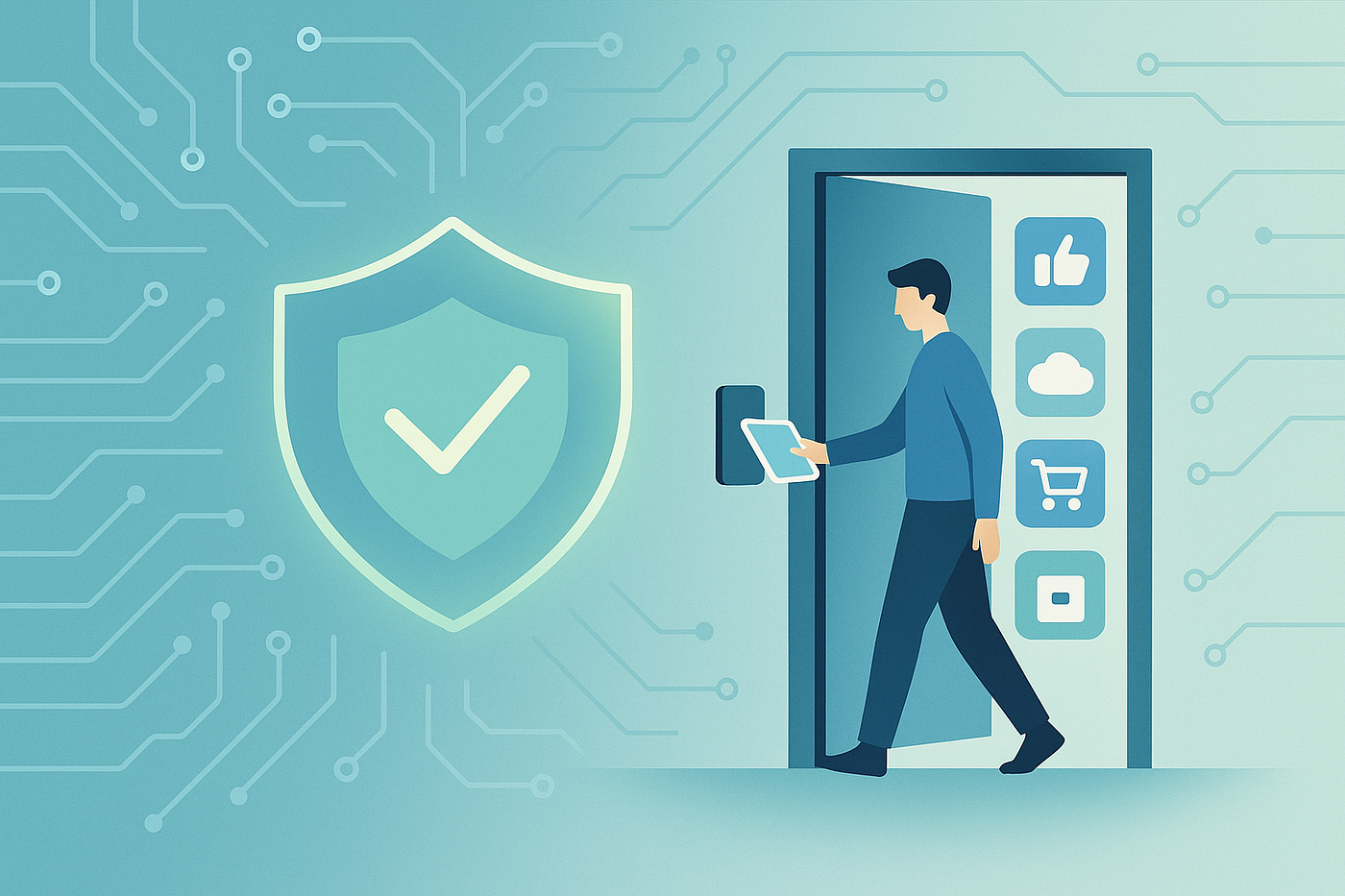
🔑 Visual Analogy: OAuth is Like a Hotel Keycard

OAuth Visual Analogy
Imagine checking into a hotel.
- You give the receptionist your ID (this proves who you are → authentication).
- In return, they hand you a keycard.
That keycard is special:
- It only opens your room, not every room in the hotel.
- It works only for the duration of your stay.
- If you lose it, the hotel can deactivate it and issue you a new one.
Now, compare this to the old way of sharing passwords online. That would be like handing over your house keys to a friend who only wanted to borrow your WiFi. Sure, they can use the WiFi — but they also now have access to your bedroom, your fridge, and your safe.
OAuth fixes this by saying:
“Don’t give away your house keys. Instead, issue a temporary keycard that works only for what’s needed, and nothing more.”
That’s the essence of OAuth: secure, limited, revocable access without sharing your real keys (passwords).
This temporary keycard provides access that is minimal and essential for the end user to perform the task. This is a form of delegated access.
In other words, it's a way for users to say
“This app or medium can access specific resources on my behalf, without giving it my password.”
For example:
- Let a calendar app access only your Google Calendar (not Gmail).
- Let a payment app charge up to a limit (not empty your bank account).
This is also called delegated authorization.

OAuth Evolution
🎯 What did OAuth provide that Changed Everything
OAuth provided:
- Token-based access → Apps received tokens, not passwords.
- Scoped permissions → Tokens could limit what apps could do.
- Revocability → Tokens could be revoked without changing passwords.
- Industry adoption → Quickly became the standard for APIs (Google, Facebook, Twitter, GitHub, banking APIs).
In short OAuth came into picture because the internet needed a safer way to delegate access without sharing passwords. It standardized secure authorization, which became the backbone of API security today.
🚀 The Evolution of OAuth: A Timeline
OAuth didn’t just appear overnight — it evolved to solve very real security challenges as the web matured. Let’s walk through its journey.

OAuth Evolution Timeline
🔒 2006 — The Problem Emerges
Back in the early days of the social web, apps frequently asked users for their username and password to access data. This meant:
- Apps held full control over user accounts.
- Passwords were stored or transmitted insecurely.
- Revoking access was nearly impossible without changing your password everywhere.
This sparked the search for a safer alternative.
🤝 2007 — OAuth 1.0: The First Draft
The first version of OAuth introduced the idea of delegated access.
- Apps could request limited permissions without seeing user passwords.
- Security was handled through cryptographic signatures. While effective, OAuth 1.0 was considered complex and heavy for developers.
🛡️ 2010 — OAuth 2.0: A New Standard (RFC 6749)
OAuth 2.0 simplified the flow:
- Introduced tokens instead of sharing credentials.
- Allowed for different grant types (Authorization Code, Implicit, Client Credentials, etc.).
- Became flexible enough for web apps, mobile apps, and APIs.
This quickly became the industry standard.
🌍 2012–2015 — Widespread Adoption
Major platforms like Google, Facebook, Twitter, GitHub adopted OAuth 2.0 for third-party logins and API integrations. Suddenly, “Login with Google” and “Connect with Facebook” became familiar buttons everywhere.
🔑 2023 and Beyond — OAuth 2.1 and Best Practices
The OAuth community has been refining the standard to reduce confusion:
- OAuth 2.1 consolidates best practices.
- Stronger emphasis on Proof Key for Code Exchange (PKCE).
- Modern recommendations discourage insecure flows like Implicit Grant.
OAuth continues to evolve alongside OpenID Connect, FAPI (Financial-grade API), and emerging zero-trust architectures.
👉 Takeaway: OAuth’s journey shows how the web moved from sharing raw passwords to a token-based, scoped, and revocable system that powers secure logins and API access today.
✨ “This was just the beginning of our journey into OAuth. In the upcoming posts, I will dive deeper into how OAuth 2.0 works under the hood, explore JWT as the token format of choice, and also build hands-on projects with modern frameworks like FastAPI , Keycloak auth library and modern best practices.”
메타데이터
- post_id
- 70d832ff2ffa
- slug
- the-story-behind-oauth-and-why-it-matters-to-us-today-70d832ff2ffa
- url
- https://medium.com/@raditya.mit/the-story-behind-oauth-and-why-it-matters-to-us-today-70d832ff2ffa
- canonical_url
- https://medium.com/@raditya.mit/the-story-behind-oauth-and-why-it-matters-to-us-today-70d832ff2ffa
- author_url
- https://medium.com/@raditya.mit
- status
- ok
- fetched_at
- 2026-08-05 19:15:56