Cassocks and Complicity
On massacre, pastoral silence, and the theology of comfort
Cassocks and Complicity
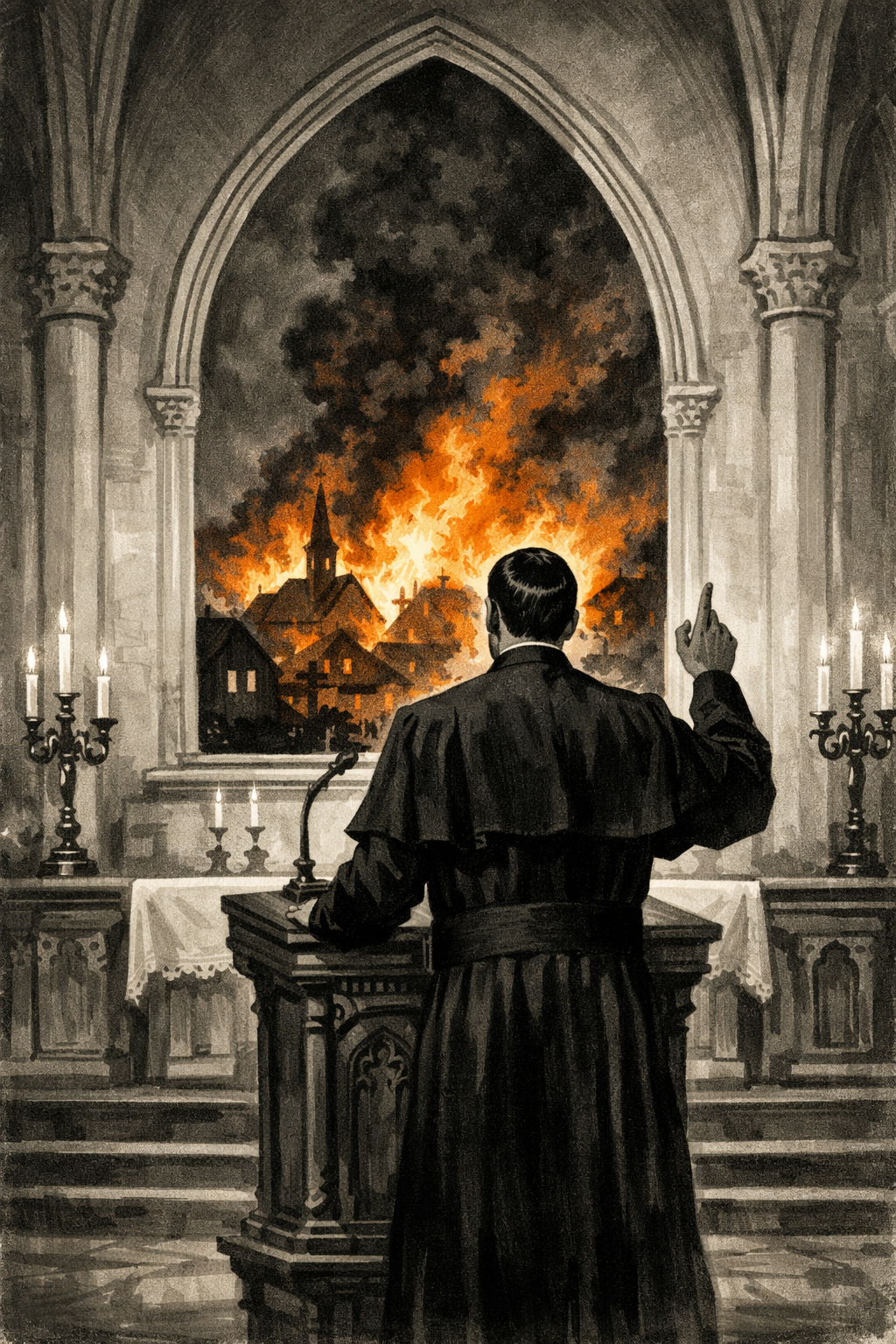
In 1998, with a military dictator’s boots on the necks of Nigerians, the Catholic Bishops found their voice. They did not tweet. They did not post. They prayed. And their prayer, was a prosecutorial document dressed in the language of worship:
“All powerful and merciful Father, you are the God of justice, love and peace. You rule over all the nations of the earth. Power and might are in your hands and no one can withstand you…….”
The bishops were not comforting the afflicted. They were briefing the Almighty on his own portfolio. If justice belongs to you Heavenly Father, then what is reigning here is an affront to your sovereignty. If no one can withstand you, then the man in Aso Rock is on borrowed time. The prayer named no one. You can argue that the bishops did not have the courage to speak to him directly but at least, they had courage enough to pray to God about him to his hearing. The significance of that prayer was not merely that it was courageous. It was that it treated prayer as public moral speech. It invoked God’s justice in a way that rendered political injustice visible, intolerable, and answerable.
Twenty-eight years later, with bodies in Jos still warm, a verified pastor with 3.2 million subscribers typed: “Let there be light.”
That is the distance the Nigerian church has travelled. From prosecutorial precision to spiritual decoration. From prophetic indictment to inspirational content. From cassocks with conviction to comfortable prophets with ring lights.
What is at issue here is not mere tone. It is function. In a country where mass violence is repeatedly spiritualized, vague religious language does political work: it consoles the grieving while protecting the structures and actors that made their grief possible.
There is a theology embedded in those four sentences that the bishops understood and that their successors have deliberately forgotten. you cannot confess divine sovereignty and remain politically neutral. The two positions are incompatible; To say that God rules over all the nations of the earth is to establish a standard against which all earthly rule is measured. To say that power and might are in his hands is to say that the power in Aso Rock, in the Government house in Jos, in the hands of every militia commander who has ever lit a village on fire in Plateau State, is derivative, conditional, and accountable. The prayer for Nigeria in distress was not merely devotional. It was constitutional. It was asserting a higher law above the law of the strongman.

This is not a novel idea. In fact, It is the oldest idea in the prophetic tradition; When Amos walked into Bethel , he did not bring greetings. He brought an indictment. “I hate, I despise your religious festivals,” God says through him. “Your assemblies are a stench to me.” Why? Because the worshippers were prosperous and pious while the poor were being sold for a pair of sandals. The worship had become aesthetic. It had lost its ethical nerve. God, apparently, was not impressed by the performance.
Jeremiah, writing of the prophets of his day, was more precise about the mechanism of failure. “They dress the wound of my people as though it were not serious,” . “Peace, peace, they say when there is no peace.” Today’s prophets’ specific function is to comfort power by sedating the powerless. To take genuine suffering and reframe it in language so spiritually agreeable that it requires nothing of anyone.
“It is well with you Jos.” “Let there be light.” Really?
Is this cowardice? I do not believe so. Cowardice implies that the correct response was known and avoided out of fear. What we are witnessing is not a failure of nerve. It is appears like a success of class interest.
The men posting inspirational content about Jos are not afraid. They are comfortable. And comfort, when it reaches a certain altitude, reorganizes a man’s entire moral geography without his noticing. What was once injustice becomes “a complex situation.” What was once a massacre becomes “the work of the enemy”; a phrase so theologically vague it indicts no one, names no perpetrator, demands no accountability, and allows the poster to sleep soundly in his mansion in Magodo or his estate in Enugu.
Track the alignment of interests and the silence explains itself.
These are men who fill stadiums that require government cooperation to secure. Men whose ministries are registered entities operating in a regulatory environment controlled by the same political class overseeing the state where the bodies are. Men who have stood at presidential podiums and called it prophetic access. Men who are visited before elections and are asked to lay hands on aspiring candidates who eventually get into offic and ruin lives. Men who prayed at inaugurations and called it intercession. Men whose networks of influence are maintained precisely because they have demonstrated, over years of careful positioning, that their spiritual authority will not be converted into political inconvenience.
This is not conspiracy. It is class logic operating exactly as it always does; quietly, structurally, without the need for explicit instruction. Nobody needed to call them. Institutions rarely require explicit instruction when incentives have already done the work. The prosperity gospel framework that dominates Nigerian Pentecostalism has over four decades constructed a clergy whose economic interests, social relationships, and theological assumptions are perfectly aligned with the Nigerian elite. ‘Daddy GO’ flies private. The other Daddy GO is courted by presidents. The lesser stars orbit that same sun.
The cassock and the aso-oke have always been at the same table. What has changed is that they no longer bother to hide it.
Ezekiel saw this clearly. “Woe to the shepherds of Israel who only take care of themselves,” in the 34th chapter, God continues; “You eat the curds, you clothe yourselves with the wool, you slaughter the choice animals but you do not take care of the flock.” And then, with the specificity that makes Ezekiel scary: “You have not strengthened the weak or healed the sick or bound up the injured. You have not brought back the strays or searched for the lost. You have ruled them harshly and brutally.”
He was not describing neglect. He was describing a system. Shepherds who had reorganized the entire purpose of the flock around their own sustenance.
The dominant public face of the Nigerian church now bears the marks of capture. Not by the government in any crude sense. But by the same gravitational pull of wealth, access, and comfort that has captured every other institution in the country. The difference is that the church alone among Nigerian institutions still carries the moral vocabulary of resistance. It has the texts. It has the tradition. It has Amos and Jeremiah and the 1998 bishops. It knows exactly what prophetic speech sounds like.
It has simply decided that the price of speaking it is too high.

Somewhere in Jos today, a woman is sitting in a church pew. She may have lost a brother. A neighbor. A child. She is surrounded by people who are also carrying something unnameable ; the specific weight of violence that has become so routine, it no longer shocks the national conscience, it only exhausts it.
Her pastor will stand before her this Sunday. He will be well dressed. The sound system will be excellent. The worship will be professional and emotionally engineered to produce the precise frequency of feeling that makes people reach for their wallets and their faith simultaneously. And at some point, he will reference Jos. He will say that God sees. He will say that evil shall not prevail. He will say let there be light.
And she will feel, briefly, seen.
That is the cruelest sophistication of spiritual anesthesia. It does not feel like betrayal. It feels like comfort. The language is warm. The intentions may even be genuine in some attenuated sense. But the function, the structural, measurable, political function of what is being performed is pacification. The wound is being dressed as though it were not serious. Peace is being declared where there is no peace. And the woman in the pew will go home still carrying her grief, still living under the same conditions that produced the massacre, still waiting for a justice that no one with a microphone and a verified account has thought to demand by name.
Too much of the church’s public witness has become exactly this: not prophetic resistance, but the manufacture of bearable suffering. It has taken the raw material of Nigerian pain which should by now have produced either revolution or reformation and processed it into something manageable. Something that keeps people coming back on Sundays. Something that does not trouble the powerful or inconvenience the comfortable or require anything of the men on the podium beyond a well-timed declaration.
The 1998 bishops understood that prayer, at its most honest, is an act of political confrontation. To bring human suffering before a God of justice is to simultaneously indict the humans responsible for that suffering. You cannot do one without doing the other. The prayer for Nigeria in distress worked because it refused to spiritualize what was political. It named the attributes of God precisely because naming them created an unbearable contrast with what was happening on the ground.
That contrast is still unbearable. The bodies in Jos are still real. The militia commanders are still free. The politicians who benefit from ethnic instability are still in office. The conditions that have made Plateau State a killing field for three decades are still intact.
Dear reader, “let there be light”.
메타데이터
- post_id
- 70e00d77dc1e
- slug
- cassocks-and-complicity-70e00d77dc1e
- url
- https://medium.com/@igenegba/cassocks-and-complicity-70e00d77dc1e
- canonical_url
- https://medium.com/@igenegba/cassocks-and-complicity-70e00d77dc1e
- author_url
- https://medium.com/@igenegba
- status
- ok
- fetched_at
- 2026-06-09 15:37:30



