The 60/40 Portfolio Isn’t Dead, But Here’s Why Advisors Look Beyond It
Why financial advisors build portfolios around people, not percentages, and why chasing the “best” portfolio can backfire on you.
The 60/40 Portfolio Isn’t Dead, But Here’s Why Advisors Look Beyond It
Why financial advisors build portfolios around people, not percentages, and why chasing the “best” portfolio can backfire on you.

Image courtesy of Getty Images (Unsplash+ license).
I’m not a professional investor, but I’ve been investing for over 30 years.
During that time, I’ve often read about the 60/40 portfolio, and in recent years, many of those headlines pronounced its “death.”
The arguments varied, but the one that made the most sense to me was that bonds and stocks increasingly moved up or down together, making bonds less effective at reducing portfolio risk.
From my perspective, over the 20+ years I was a W-2 employee, I saw my salary as a bond-like asset, which meant that also holding 40% of my financial assets in bonds would have been far too conservative.
That’s why, for those decades, I kept my financial asset allocation closer to 90/10.
However, when I recently looked through Morningstar’s Diversification Landscape report, I was surprised to read that their research found that the plain-vanilla 60/40 portfolio outperformed a more diversified approach over the past 3, 5, 10, 15, and even 20 years!
What’s more, it even had a higher Sharpe ratio, which measures if excess investment returns are due to smart investment decisions or luck, over all those time periods!
But if the utterly simple 60/40 portfolio performed so well for so long, why do so many advisors guide their clients to more diversified options?
I asked them.
Their answers, which you’ll find below, offer a fascinating look into how the pros think about these things.
But before we get there, it’s worth understanding why the venerable 60/40 portfolio remains so difficult to beat.
Do Advisors Agree that the 60/40 Portfolio Is Dead?
In a word, no.
As Matthew Higbie, CFP®, of Birchwood Capital, notes, “The 60/40 portfolio (using VBIAX as a proxy) has generated a 9% annualized return over the past 10 years and (per Ben Carlson’s book Risk & Reward) the 60/40 portfolio has not lost money over any 10-year period since 1928.”
As a result, he sees that the 60/40 strategy still has merit, especially for retirees. He says, “For clients relying on their portfolio to fund living expenses, we think a 60/40 portfolio (with the 60% stock allocation diversified between US stocks, international stocks, and REITs) is a great place to start.”
Scott Bishop, MBA, CPA/PFS, CFP®, of Presidio Wealth Partners, explains how the 60/40 used to be the go-to solution, but isn’t that any longer. He says, “The 60/40 portfolio isn’t dead, but it is no longer the default answer for every investor (unlike when I got into the wealth management business in the 1990s). Twenty-five years ago, diversification primarily meant owning stocks and bonds. That 60/40 allocation was the ‘science’ of Modern Portfolio Theory and optimized diversification.”
Mark Stancato, CFP®, EA, ECA, CRPS®, of VIP Wealth Advisors, agrees with Bishop, “I don’t believe the 60/40 portfolio is dead. I think the idea that every investor should own the same 60/40 portfolio is what has become outdated. Historically, the traditional 60/40 portfolio was built around a fairly specific retirement framework. An investor worked until age 65 or 67, retired, and relied on a portfolio to generate income, with a 40% fixed-income allocation helping dampen volatility and support withdrawals. For many retirees, that framework still works.”
Jim Crider, CFP®, Founder of Intentional Living FP, sees things differently: “The phrase ‘60/40 is dead’ misses what actually changed. The stock-bond split was never the point. The point was owning things that don’t fall together, and 2022 proved that a generic bond allocation doesn’t always do that job. When stocks and bonds dropped in tandem, a lot of investors learned their ‘diversification’ was thinner than they thought. So, when we talk diversification today, we’re looking past the stock-versus-bond line entirely.”
Why Has the 60/40 Been So Hard to Beat?
Higbie explains why the 60/40 portfolio has been on such a tear, “Given the strong performance history, low cost, and tax efficiency of a well-built 60/40 portfolio, the bar is high for adding alternatives (which generally have higher fees/costs, less liquidity, worse tax efficiency, and often higher risk/more volatility) or commodities/crypto (which have no reliable way to calculate expected return).”
However, one of the main reasons the 60/40 portfolio has done so well has to do with an unusually long period of US stock outperformance compared to international equities.
Nate Byers, CPA/PFS, Founder of Calculated Wealth, explains, “Investors have benefited from a long period of prosperity, which has greatly benefited the US 60/40 portfolio of only US stocks and US bonds.”
With the benefit of hindsight, we can now see that many of the diversifiers that wealth and investment managers recommend didn’t turn out to provide as much benefit as hoped for.
Unfortunately, hindsight isn’t available as a planning tool.
Nor does anyone have a functional crystal ball.
That’s why diversification remains important.
Why Diversification Still Matters
Many investors shift their asset allocations based on what worked well recently, assuming that the future will look the same as the recent past.
However, that often leads to buying high, and more likely needing to later sell lower, because history doesn’t quite repeat itself.
As psychoanalyst Theodor Reik said, “There are recurring cycles, ups and downs, but the course of events is essentially the same, with small variations. It has been said that history repeats itself. This is perhaps not quite correct; it merely rhymes.”
Byers puts it like this, “I’ve personally held the view that investors, especially retirees, need to diversify beyond a US stock-and-bond portfolio. This is based on my view that there are four economic seasons (prosperity, inflation, recession, and deflation). Investors have benefited from a long period of prosperity, which has greatly benefited the US 60/40 portfolio of only US stocks and US bonds.
“Too many retirees focus on finding the optimal asset allocation and typically base that on ‘what’s worked lately.’ Instead, their focus should be on ‘what’s the best portfolio for navigating the unknowable future.’”
He then advises, “Retirees need a strategy that provides consistent returns across all economic seasons. This means that there could be periods of underperformance relative to a traditional US stock and bond portfolio if there’s an economic season where that was the optimal mix. But there will be other periods when it outperforms a traditional 60/40 portfolio as other asset classes do well. Ultimately, it shouldn’t run too hot or too cold in any environment, which is one of the most important features of a retiree’s portfolio.”
Byers points to safe-withdrawal research that identifies a major risk for a portfolio with just US stocks and US bonds, “If you study research on safe withdrawal, the worst periods are typically those that coincide with lost decades. A US stock-and-bond-only portfolio has suffered from lost decades in the past and likely will in the future. If your retirement coincides with a lost decade, it creates unnecessary stress on your portfolio and your life.”
Crider agrees that diversification is crucial, and that the 60/40 portfolio doesn’t necessarily provide enough of it. He says, “The bigger concentration risks usually hide inside the stock sleeve. Someone can own an index fund and feel diversified, while a handful of mega-cap names drive most of the return and most of the risk. Owning small-cap value alongside that isn’t just adding a fund; it’s adding a genuinely different return stream. That’s diversification doing real work, versus diversification as a feeling.”
Crider points out that investors should think harder about what their fixed-income allocation actually does for them: “The assumption we’d most push on is that bonds are automatically the ‘safe’ part of a portfolio. With long-term inflation pressure and a federal debt load now near $39 trillion, the duration risk in long bonds deserves a much harder look than most people give it. The fresh question isn’t ‘stocks or bonds,’ it’s ‘what is this fixed-income actually protecting me from, and at what cost?’”
Byers believes in broad-based preparation, rather than the fool’s quest of trying to predict the future: “I tend to think in terms of a base allocation of 60 percent equities, 20 percent fixed income, and 20 percent real assets. The key is to allocate to real assets like gold, commodities, managed futures, and maybe real estate.
“Why bet your entire retirement on one economic season and not prepare for the possibility that the next 10 years could be completely different? Most investors are trying to be precisely right about one outcome instead of being broadly prepared for several. I would rather be roughly right across multiple environments than highly exposed to just one, but maybe you see it differently.”
Clearly, advisors today still adhere to the importance of diversification, but how they apply it has evolved.
What Advisors Are Doing Differently
These days, advisors lean into increased personalization of asset allocation.
As Joon Um, CFP® EA CLU® ChFC®, of Secure Tax & Accounting, says, “I don’t think the 60/40 portfolio is dead, but diversification today is much more personalized. Years ago, diversification mainly meant stocks and bonds. Today, investors have access to low-cost Exchange Traded Funds (ETFs), global markets, and more tax-efficient strategies than ever before. One of the biggest changes is that advisors focus less on a standard allocation and more on the individual client’s goals, taxes, risk tolerance, and time horizon.”
They know that a portfolio designed to maximize returns isn’t necessarily the portfolio that’s most likely to help clients sleep well, stick with the plan, and reach their goals.
Stancato agrees, “The biggest evolution in diversification is personalization. We no longer ask, ‘What is the optimal portfolio?’ We ask, ‘What portfolio gives this client the highest probability of achieving their goals while allowing them to stay invested through multiple market cycles?’
“I work with entrepreneurs, tech professionals, and executives who may achieve financial independence decades before the traditional retirement age through a liquidity event, a concentrated stock position, or a business sale. A 45-year-old who no longer needs to work may have a longer investment horizon than a traditional retiree. It would make little sense to automatically place that person in the same portfolio as someone who is drawing heavily from assets at age 70.”
He then shares how today’s toolkit changed relative to the past, “Technology has expanded the toolkit. We now have low-cost ETFs, direct indexing, sophisticated tax-loss harvesting, and better portfolio analytics than ever before. But the most important innovations are not investment products. They are tax-aware portfolio construction, behavioral coaching, and customization.”
Bishop elaborates. “Today, diversification is much broader. Investors have access to low-cost ETFs, sophisticated planning technology, tax-aware portfolio management, private markets, alternative investments, and risk-management tools that were either unavailable or inaccessible to most investors in the past. As advisors, we think less about a specific allocation model and more about whether a portfolio is aligned with a client’s goals, cash flow needs, tax situation, time horizon, and ability to stay disciplined during market volatility.”
He then shares how advisors today can help clients achieve their goals, “One of the biggest shifts in portfolio construction is personalization. Rather than asking, ‘Should this client own a 60/40 portfolio?’ we ask, ‘What rate of return does this client actually need to achieve their goals?’ Once we determine that hurdle rate, we can build a portfolio around the client’s specific objectives rather than a generic industry model.
“For many investors, diversification now extends beyond public stocks and bonds to include private credit, private equity, real estate, infrastructure, and other alternative strategies where appropriate. The objective isn’t simply to add complexity; it’s to create additional sources of return and potentially reduce reliance on any single market outcome.
“Technology has also dramatically improved our ability to model outcomes, stress test portfolios, monitor risk, and implement tax-efficient strategies. Today, advisors can incorporate asset location, tax-loss harvesting, Roth conversion planning, charitable strategies, and withdrawal sequencing into portfolio construction in ways that were difficult to execute consistently a decade ago.”
The point is that today advisors and investors have more tools available than ever before, but the crucial question is how to best use them.
Advisors Share Specific Examples and Experiences
Josh Brooks, CFP®, of Exponential Advisors, shares how this plays out for his clients, “For the clients I serve, mostly senior Army officers and senior NCOs heading into or just past military retirement, the 60/40 question starts in the wrong place. The 60/40 is not a law. It is, however, a slogan for ‘growth, ballast, rebalance.’ What changed is not the principle. It is our ability to see and build around a client’s entire balance sheet.
“Most of my clients carry a military pension. A Cost-of-Living-Adjusted (COLA) pension behaves like a large, inflation-protected bond that pays for life and never shows up on a brokerage statement. Once you account for that, a flat 60/40 on the investable assets often understates how much fixed-income-like security the household already holds. When the floor is already guaranteed, the portfolio built on top of it can carry risk differently. That is personalization, and it is the biggest shift from the era when 60/40 was a one-size-fits-all.”
He sees the same evolution from a practical perspective, “On technology and access, tools that were institutional or simply unavailable five years ago are now standard. Today, direct indexing for tax management, fractional shares, and regulated spot Bitcoin Exchange Traded Products (ETPs) all sit inside an ordinary brokerage account.”
Brooks shares what he sees as the biggest challenge to successful planning, “On behavior, which is where most plans actually succeed or fail, I learned the lesson early. In June 2016, while I was at Fidelity, Britain voted to leave the EU, and the phones lit up. Clients who had built their own portfolios called in a near panic, convinced that a vote across the Atlantic was about to wreck their retirement.
“What it actually exposed was a gap most of them did not know they had. The risk they said they could tolerate and the risk actually sitting in their accounts were two different numbers. A questionnaire tells you how someone feels on a calm afternoon. A market shock tells you the truth.
“Over those years, I also watched people with free access to an excellent automated advisor still pick up the phone when markets move. Both lessons point in the same direction. The hard part of investing was never the math. It’s staying in the right seat when the floor feels like it is shifting.”
John Mason, President of Mason & Associates, shares his experience with clients, “We’re a planning-centric firm, so we don’t often have clients concerned about their portfolio or their allocation. We’ve helped clients to understand what is important, which is accomplishing their goals. A well-designed investment strategy that coordinates with a financial plan should not change unless the goals change.
“Our clients don’t hire us to beat an index; they hire us to design a plan to accomplish stated goals and objectives. In our opinion, a well-designed financial plan includes a coordinated investment strategy to accomplish specific goals. We know we can’t control the market, so together we focus on the areas of the financial plan we can control, like tax and estate planning.
“Our clients aren’t typically concerned about the underlying components of their portfolios. They recognize that the allocation and components are important, but they’re focused on what their portfolio can do for them and if the financial plan is on track to meet their goals.”
He then shared an example of how some clients’ goals changed, leading to updating their asset allocations, “During our recent Strategic Planning Meeting Season, we identified several families with changing goals. Five or 10 years ago, we designed an investment strategy based on our clients taking monthly or annual distributions. After living retirement with these families for 5–10 years, we identified that many aren’t actually distributing from their portfolio. The goal changed, and for some families, we’re actually increasing stock exposure because the goal changed from monthly cash flow to investing for their children and grandchildren.”
The portfolio changed because the goal changed. Not because the market changed.
What Hasn’t Changed
Much has changed and evolved over the past years and decades. However, the core principles of successful investing haven’t changed much.
Today, investors and advisors have access to more sophisticated tools and assets that used to only be available through expensive services, if at all.
But advisors still believe the hardest part of investing remains exactly what it was decades ago: sticking with a sound plan when uncertainty makes abandoning it feel attractive.
As Stancato notes, “The timeless principles have not changed. Diversification still matters. Costs still matter. Taxes still matter. Investor behavior still matters. In my experience, the biggest threat to long-term returns is not a lack of diversification. It is abandoning a sound strategy at exactly the wrong time. The future of diversification is not owning more investments. It is about owning the right investments in the right accounts for the right client.”
Bishop agrees, “Some investing principles remain timeless. Diversification still matters. Costs still matter. Taxes still matter. Rebalancing still matters. And perhaps most importantly, investor behavior still matters. The greatest threat to long-term success is often not market volatility but the emotional decisions investors make during periods of uncertainty. A well-designed portfolio is one that an investor can stick with through both bull and bear markets.”
Um puts it in simple terms, “The biggest principles haven’t changed: diversify, keep costs low, stay invested, and don’t let emotions drive investment decisions. The tools are different, but the fundamentals still work.”
That perspective is worth remembering in an industry that often rewards novelty.
New tools and asset classes can be useful, in the right circumstances. But investor behavior remains one of the most important variables in long-term success.
Table 1 summarizes what changed and what hasn’t.
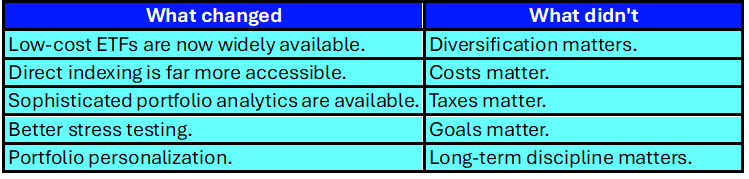
Table 1. What changed over time and what stayed the same.
Why Chasing the “Best” Portfolio Can Lead Investors Astray
Multiple advisors implied that investors often ask the wrong question.
They may ask:
“What’s the best portfolio?”
But a much better question would be:
“What portfolio will I most likely stick with?”
The point is that the best portfolio isn’t the one that guarantees the highest return (especially given that the only guarantee in investing is that higher return goes hand in hand with higher risk), but the one that you’ll stick with when, not if, markets crash.
Crider shares his simple thought process that helps when headlines scream panic, “The way we cut through headline noise is almost boringly simple. Markets reprice every day; your purpose for the money doesn’t.”
He says the key question isn’t what’s happening in the market. It’s whether anything meaningful has changed in the investor’s life. “Before we change anything in a portfolio, the question is whether something real has changed in the client’s life and goals. If the answer is no, we’re usually looking at a headline, not a reason to act.”
Table 2 points out how advisors suggest upgrading questions investors tend to ask.

Table 2. Questions investors may ask that advisors suggest upgrading.
Ideally, portfolio construction shouldn’t be seen as a search for impossible-to-achieve perfection, but more of creating a strategy that’s informed by a client’s specific situation, goals, and ability to keep the course in the face of uncertainty and market drawdowns.
Markets constantly react to short-term news:
- Political events unfold, domestic and international.
- Economic forecasts change.
- Interest rates rise and fall.
- Analysts update their prognostications.
- Entire asset classes move in and out of favor.
Trying to constantly adjust your portfolio in reaction to all these changes is one of the main reasons why investors earn lower returns than those of the funds in which they invest.
As Morningstar notes, “The more investors traded, the less their average dollar made when compared with the funds’ aggregate total returns. This underscores the importance of holding the line on transacting, which can be accomplished by keeping discretionary trades to a minimum and automating other routine tasks, like rebalancing, to the greatest extent possible.”
In the end, while searching for the “perfect portfolio” is seductive, a portfolio that lets you sleep well at night and ignore short-term noise will be more stable and let you capture, on average, a greater fraction of your assets’ long-term returns.
How Investors Should Think About Their Own Portfolio
Advisors, for the most part, didn’t seem very interested in opining about the death of the 60/40 portfolio.
They were much more interested in the underlying principles of appropriate diversification, matching portfolio allocations to clients’ personal goals and plans, and clients’ ability to stick with their plan in the face of adverse markets.
Their guiding question tends to be “What is this portfolio trying to accomplish?”
That may sound obvious, but it’s remarkably easy to lose sight of when financial headlines are driven by the desire to gain attention, rather than inform. When pundits constantly focus on what’s hot, what’s crashing, and what investors supposedly need to own next.
Scott Bishop summarizes the shift like this, “Ultimately, the future of diversification isn’t about abandoning 60/40. It’s about moving from a one-size-fits-all allocation model to a goals-based framework that integrates investments, taxes, risk management, and behavioral discipline into a single strategy.”
The objective isn’t to build the portfolio with the highest expected return. It’s to build one that’s most likely to help a specific investor achieve a specific goal.
That doesn’t always result in exotic investment vehicles.
As Higbie cautions, “Regarding alternatives specifically, things like venture capital and private real estate get a lot of attention yet have significantly underperformed similar public equities/REITs, respectively, per data from Cambridge Associates.”
Still, that doesn’t mean that the old ideas are necessarily still the best ones.
As a case in point, Crider challenges long-time asset-allocation conventional wisdom, “One assumption overdue for a fresh look: the idea that you should steadily dial down stocks as you age. The research increasingly points the other way. A ‘rising equity glide path,’ starting retirement more conservative and letting equity exposure climb over time, has held up surprisingly well, because it protects against the danger that actually sinks retirements: a bad run of returns in the first decade. Glide up instead of down, and you’re effectively buying when prices are low rather than selling into the weakness. It runs against decades of conventional wisdom, which is exactly why it’s worth a second look.”
Another relatively new development is incorporating crypto assets into portfolios.
For example, Brooks openly advises including Bitcoin in clients’ portfolios, “I use a small, deliberate allocation to Bitcoin in the models I manage, in the neighborhood of two percent, held through a regulated ETP rather than a private wallet.”
He doesn’t view it as a speculative bet, saying, “I size it as a diversifier with an asymmetric profile, not as a bet.”
His position-sizing rule reflects a broader philosophy to using speculative assets in a non-speculative manner that many investors should heed. “The rule I hold to is simple: it should be small enough that a total loss is a disappointment rather than a derailment.”
As a result, his typical asset allocation looks like this: “A typical model sits closer to 60% equities, 38% bonds, and 2% Bitcoin, with a working cash position, than to a textbook 60/40.”
The important thing to notice is that none of these are universally applicable to all investors.
They’re examples of how different investors can benefit from different portfolio constructions that align with their specific goals, risks, circumstances, and behaviors.
In the end, individual investors should not care about headlines declaring the death or resurrection of the 60/40 portfolio, or any other classic approach.
Instead, they should consider the following:
- What am I trying to accomplish?
- How much risk do I have to take to achieve that?
- What risks and/or diversification do I already have elsewhere in my financial life?
- What portfolio am I most likely to stick with through good markets and bad?
- Am I optimizing for returns, or for the highest probability of reaching my goals?
Table 3 summarizes these and why they matter.

Table 3. What you should ask yourself and why.
Different people will come up with different answers, which is exactly the point.
And that’s why one person’s optimal portfolio will be decidedly suboptimal for another.
The Bottom Line
So, is the 60/40 portfolio dead?
The right answer isn’t “Yes” or “No.”
Instead, it should be “Who cares?”
In recent decades, the 60/40 portfolio turned out to be difficult to beat, having outperformed more diversified portfolios over the trailing 3-, 5-, 10-, 15-, and 20-year periods ending in 2024, per Morningstar.
But the coming decades could very well turn out to have the opposite result.
For some investors, a 60/40 portfolio could be the right answer, depending on their individual goals and situations, including such factors as their income stability, non-portfolio retirement income, and how close to retirement they may be.
For other investors the right answer will be different.
Advisors haven’t suddenly come up with a magical new portfolio allocation that’s guaranteed to outperform the 60/40 portfolio for all investors in all seasons.
But they do offer far greater personalization when working with clients today.
They now incorporate taxes, spending needs, pensions, concentrated stock positions, business ownership, direct indexing, behavioral considerations, charitable planning, and dozens of other factors into portfolio design. They can stress test outcomes, evaluate tradeoffs, and customize strategies in ways that simply weren’t practical for most investors as recently as five or ten years ago.
Still, some things haven’t changed over the decades.
- Diversification still matters.
- Costs still matter.
- Taxes still matter.
- Goals still matter.
- Discipline and investor behavior still matter.
The portfolio that chases the highest return is unlikely to be the one most likely to help you stay invested through uncertainty and reach your long-term goals.
Most investors aren’t struggling for lack of investment options. They struggle because they’re surrounded by competing headlines, conflicting opinions, and endless predictions about what comes next.
And as one of my favorite quotes, from Danish Nobel-laureate physicist Niels Bohr says, “It’s very hard to make accurate predictions, especially about the future.”
That’s why good advisors don’t try to predict the future.
Instead, they help clients prepare for it in ways that are most likely to succeed on average over the long term.
That’s why the question about whether or not the 60/40 portfolio is dead isn’t very useful.
The more useful question is what portfolio will most likely help you achieve your own, personal, long-term goals.
And that’s a very different question.
Disclaimer
This article is intended for informational purposes only, and should not be considered financial, investment, business, tax, legal, or health advice. You should consult a relevant professional before making any major decisions.
About the author
Opher Ganel has set up several successful small businesses, including a consulting practice supporting NASA and government contractors. If you don’t want to miss future articles, you can subscribe to my articles.
메타데이터
- post_id
- 70f2d01953c4
- slug
- the-60-40-portfolio-isnt-dead-but-advisors-look-beyond-it-70f2d01953c4
- url
- https://medium.com/financial-strategy/the-60-40-portfolio-isnt-dead-but-advisors-look-beyond-it-70f2d01953c4
- canonical_url
- https://medium.com/financial-strategy/the-60-40-portfolio-isnt-dead-but-advisors-look-beyond-it-70f2d01953c4
- author_url
- https://medium.com/@opher-ganel
- status
- ok
- fetched_at
- 2026-06-24 04:09:36