What Are Dividends? A No-BS Breakdown for People Just Getting Started
Companies literally paying you just for owning their stock. No job. No hustle. No selling your stuff online at 2 a.m. Just money — showing…
What Are Dividends?
A No-BS Breakdown for People Just Getting Started
Companies literally paying you just for owning their stock. No job. No hustle. No selling your stuff online at 2 a.m. Just money — showing up, quietly, on its own schedule. Let’s talk about how that actually works.

Picture this: your phone buzzes. You look down. Money has appeared in your account no birthday, no side hustle payout, no late-night eBay sale. Just money. From a company you own a tiny piece of. For a lot of people, this is the exact moment investing finally starts to make sense.
There’s something almost absurdly satisfying about getting paid for something you’re not actively doing. And while that feeling might sound like a fantasy or worse, one of those “passive income” scams with a thumbnail of a guy on a yacht dividends are about as real and legitimate as investing gets. They’ve been quietly building wealth for ordinary people for over a century. They’re not flashy. They don’t go viral. But they work.
If you’re in your teens, twenties, or early thirties, this is your zero-jargon guide to understanding what dividends actually are, why they matter more than most people realize, and how starting young gives you an advantage that literally nobody can buy their way into later. Let’s get into it.
What’s Actually Happening
Okay, But What Is a Dividend?
Here’s the simplest version: a dividend is money a company sends to its shareholders the people who own stock in it as a share of the profits it’s made. That’s it. You own a piece of the company, the company makes money, and occasionally it sends some of that money back to you.

Think about owning a tiny sliver of Coca-Cola a company that sells billions of drinks every single day, in almost every country on earth. Customers keep buying. Profits keep coming in. And because you own even a fraction of that machine, some of those profits eventually find their way to you. That’s the core idea. Simple, and kind of incredible when you actually sit with it.
The Real Magic
The “Passive Income” Thing Everyone Talks About
Let’s say you invest $1,000 into a stock with a 4% annual dividend yield. That means you’d earn roughly $40 this year from dividends alone. Which, okay, $40 isn’t exactly life-changing. You can’t retire on that.
But here’s where it gets interesting and where most people completely miss the point. What happens when you keep adding money every month? What happens when instead of spending those $40, you reinvest them automatically buying more shares, which then earn more dividends, which then buy even more shares?
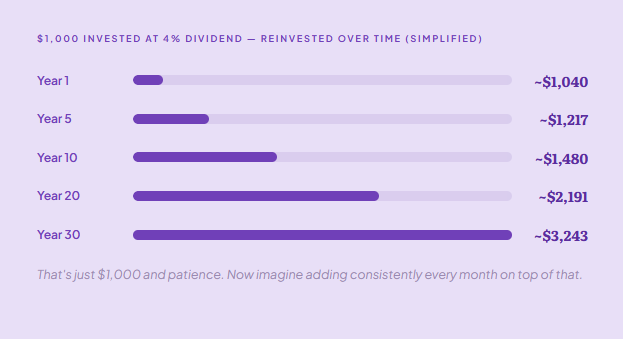
This is compounding the thing everyone says is the most powerful force in investing, and the thing that almost nobody has the patience to actually experience. Money makes money. Then that money makes more money. It sounds like a cliché until you watch it happening in your own account. Then it feels like a superpower you’ve been ignoring this whole time.
What the Legends Say
Warren Buffett: Why He Loves Cash Flow Over Hype
When people hear “legendary investor,” Buffett’s name comes up immediately and for good reason. The guy turned a few thousand dollars into one of the greatest fortunes ever built, largely through buying great businesses and holding them for decades. Not trading. Not chasing trends. Just buying and holding.
One of his most famous rules speaks directly to the dividend mindset:

Here’s something that throws people: Buffett’s own company, Berkshire Hathaway, doesn’t pay dividends. His reasoning is direct he believes he can deploy that capital better than shareholders can themselves, generating more value by reinvesting it. Fair enough, when you’ve got his track record.
But Buffett absolutely loves owning companies that pay dividends. Berkshire earned over $800 million in dividend income from Coca-Cola alone in a single year. That’s the thing about serious investors they use dividends as a tool, not a decoration. Dividend-paying companies tend to be profitable, stable, and disciplined with their money. Those aren’t glamorous qualities. They’re just the qualities that tend to survive everything.
The Psychology Nobody Talks About
Why Dividends Feel Different Than Stock Prices
Here’s something nobody told you when you first heard about investing: stock prices are emotional. They move because of vibes, news cycles, fear, greed, and occasionally things that make no rational sense whatsoever. One tweet from the wrong person and a stock can drop 20% before lunch. That’s just how it works.
Dividends are different. Dividends are tangible. They’re real cash, showing up in your account, regardless of whether the market is panicking or partying.

During market downturns the times that test every investor’s nerve seeing dividend payments continue is genuinely calming. It’s the market reminding you: businesses are still open, people are still buying stuff, profits are still being generated. The world didn’t end. Your investment is still working. That psychological anchor matters more than most finance content gives it credit for.
The Warning
But Hold On Dividends Aren’t Free Money
Okay, real talk. A lot of finance content online makes dividends sound like a cheat code like you can just buy high-yield stocks and watch money rain into your account forever. That’s not how it works. Companies can cut dividends, pause them, or eliminate them entirely. It happens all the time.

The Great Debate
Growth Stocks vs Dividend Stocks: The Internet’s Favorite Argument
If you spend any time in investing communities online, you’ll quickly discover this debate. Growth investors say dividend investing is boring and outdated. Dividend investors say growth stocks are just speculation wearing a suit. Both sides are wrong to be so certain, and both sides have a point.


Elon Musk someone who sits at the extreme growth-focused end of this spectrum has spoken about the importance of long-term thinking and being willing to endure short-term pain for long-term gain. That lesson applies across all investing styles. The time horizon is almost everything. And patience, boring as it sounds, is the real competitive advantage.
Your Real Advantage
Why Being Young Is Your Superpower Here
A lot of young people hear “dividend investing” and mentally file it under “stuff for retirees.” It’s one of the most expensive assumptions you can make not because dividends are the only way to invest, but because the advantage you have right now is something money literally cannot buy later.
Your advantage is time. And time, in the context of compounding, doesn’t just help it dominates.

This isn’t motivational poster content it’s math. Compound growth accelerates. The longer it runs, the more dramatically it curves upward. Starting at 20 and staying consistent will, in almost every realistic scenario, produce a bigger outcome than starting at 35 with more money. You already have the edge. The question is whether you’ll use it.
The Bigger Picture
The Part That Actually Changes How You Think
Money is emotional. That’s not a flaw it’s just reality. When you grow up watching financial stress, or see people panic during economic downturns, or have social media constantly showing you what “success” looks like through someone else’s filtered lens your relationship with money gets shaped by all of that.
Here’s what dividend investing quietly does to that relationship, over time:

Wealthy people, almost universally, own assets. Assets that work while they sleep, while they’re on holiday, while they’re dealing with life. Regular income from work is essential but it’s the beginning of the strategy, not the whole thing. Building even a small portfolio of dividend-paying assets changes your relationship with money in a way that’s hard to explain until you’ve experienced it.
The goal isn’t to replace your job with dividends tomorrow. It’s to stop having a single point of financial failure and start building a system that keeps working for you no matter what happens next.
Getting Started
So… Should You Actually Start?
Yes. But here’s the real answer to “should I invest in dividend stocks?” the hardest part isn’t understanding them. It’s starting before you feel completely ready. Nobody ever feels ready. Readiness is a myth the fear of loss invented to protect you from the discomfort of beginning.
The good news: the barrier to entry has never been lower. Most modern investing apps let you buy fractional shares meaning you can own a piece of a dividend-paying company for literally a few dollars. You don’t need $10,000 to begin. You don’t need a brokerage account your grandfather would recognize.
Start small. Pick something simple a broad dividend ETF, for instance, which automatically spreads your money across dozens of dividend-paying companies. Set up automatic contributions. Reinvest the dividends. And then, crucially: don’t panic when the market has a rough quarter.
Dividend investing rewards patience above almost everything else. It rewards people who can stay in the game, consistently, for years. The investors who win aren’t the smartest ones or the ones who picked the right stock at the right time they’re the ones who refused to quit when it got boring or scary.
Final Thoughts
Real wealth-building looks nothing like what you see on social media. It’s not a screenshot of a green portfolio. It’s not a coin named after a dog. It’s not a guy in a rented sports car pretending he made it in six months. Most of the time, it looks almost unbearably boring from the outside and profoundly freeing from the inside.
Dividends won’t make you rich by next Tuesday. They won’t trend on TikTok. They won’t give you a story to brag about at a party. What they will do if you start early, stay consistent, and reinvest is quietly, persistently build you something that most people never have: income that doesn’t depend entirely on showing up somewhere every day.
That’s freedom. Not the aesthetic of freedom the actual thing. And it’s built one boring, reliable dividend payment at a time.
The real flex isn’t looking rich. It’s building the systems that quietly make you free long before anyone else realizes what you’ve been doing.


Disclaimer: This article is for educational and informational purposes only. It does not constitute financial advice. All investing involves risk, including the potential loss of principal. Always do your own research and consider speaking with a certified financial professional before making investment decisions.
메타데이터
- post_id
- 7103d2c14dae
- slug
- what-are-dividends-a-no-bs-breakdown-for-people-just-getting-started-7103d2c14dae
- url
- https://medium.com/@paskalis311/what-are-dividends-a-no-bs-breakdown-for-people-just-getting-started-7103d2c14dae
- canonical_url
- https://medium.com/@paskalis311/what-are-dividends-a-no-bs-breakdown-for-people-just-getting-started-7103d2c14dae
- author_url
- https://medium.com/@paskalis311
- status
- ok
- fetched_at
- 2026-06-09 15:37:30




