Famous signal #7 — The Cosmic Microwave Background
There’s a particular kind of scientific drama that arrives looking almost embarrassingly dull.
Famous signal #7 — The Cosmic Microwave Background
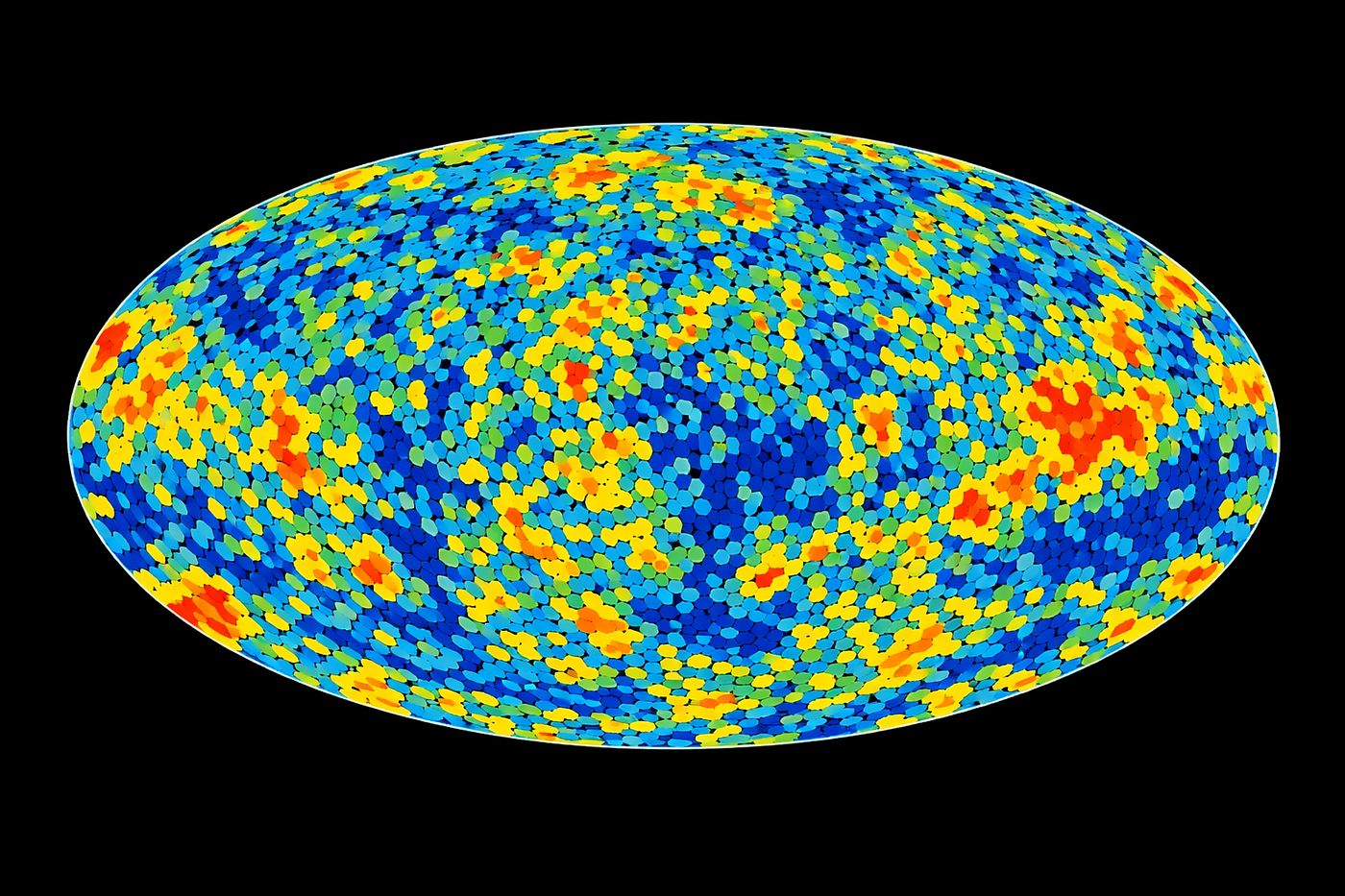
Image generated using AI
There’s a particular kind of scientific drama that arrives looking almost embarrassingly dull.
No violent burst. No mysterious code. No heroic countdown.
Just a low, stubborn hiss in the data — the sort of thing a careful engineer would normally try to subtract away — which turned out to be relic light from a universe only about 380,000 years old, now cooled to roughly 2.725 K and spread across the whole sky.
Name
The Cosmic Microwave Background, usually shortened to CMB.
Category
Outerspace — and not in a token sense.
What the physical quantity is
At its most basic, the CMB is a measurement of microwave intensity across the sky, usually expressed as brightness temperature. Averaged over the whole sky, it is an astonishingly precise blackbody signal at about 2.725 K. But the reason anyone outside cosmology has heard of it is that it is not perfectly smooth: tiny temperature differences, measured in microkelvins, vary across the sky at roughly one part in 100,000.
And that still is not the whole story. A small fraction of the CMB is also polarised — the light has a preferred orientation thanks to its last interaction with electrons before setting off across the cosmos. That polarised component carries extra information about the matter distribution in the early universe and follows the same underlying structure as the temperature pattern.
What signal processing techniques can be used to extract the information
This is where the CMB stops sounding poetic and starts looking like a spectacularly stubborn data problem.
The first trick is multi-frequency observation. You do not measure the sky in one microwave band and call it a day, because the CMB is mixed up with foreground emission from the Milky Way and other astrophysical sources. Missions such as Planck were built to observe across a broad frequency range precisely so those components could be separated rather than confused for cosmology.
Then comes calibration and map-making. Raw detector data are turned into full-sky maps, instrumental effects are corrected, and the sky is reconstructed carefully enough that subtle structure is not mistaken for hardware misbehaviour. After that comes component separation — removing Galactic dust and other foregrounds to isolate the cosmological signal underneath. Foreground removal is not a cosmetic clean-up step; it is part of the science.
Once the maps are cleaned, cosmologists often compress the blotchy sky into the CMB power spectrum: a curve showing how strong the temperature fluctuations are at different angular scales. That sounds abstract, but it is one of the great signal-processing moves in modern science — turning a messy full-sky field into a compact spectral summary you can model, compare, and test against theory.
Then there is polarisation analysis, which adds another, fainter layer of information on top of temperature. Because polarised foregrounds can imitate the signal you care about, extracting that component cleanly is a serious processing challenge in its own right.
What information it carries
A frankly ridiculous amount.
The hot and cold patches in the CMB trace tiny density differences in the young universe — slightly denser here, slightly thinner there. Those minute irregularities became the seeds of everything that followed: stars, galaxies, clusters, the lot. The famous coloured CMB maps are not just pretty; they are early structure written in temperature.
Because the CMB is effectively a snapshot of the universe at around 380,000 years old, it also lets cosmologists infer the universe’s age, composition, geometry, matter content, and expansion history. That is why this signal matters so much: it turned cosmology from a field rich in arguments into one rich in measurements.
Why it became famous
Partly because it was discovered in the most satisfying possible way: by accident. In 1964, Arno Penzias and Robert Wilson found an irritating excess microwave signal that would not go away. They checked the instrument, chased down mundane explanations, and eventually realised that the hiss was not a fault in the apparatus at all but a feature of the universe. That discovery became a crucial piece of evidence for the Big Bang and won them the 1978 Nobel Prize in Physics.
But the CMB became truly iconic when later missions turned it from “annoying background” into a map with exquisite structure. COBE showed the signal’s near-perfect blackbody nature and revealed the tiny anisotropies. WMAP sharpened the full-sky picture. Planck pushed the sensitivity, resolution, and foreground separation even further. That progression is why the CMB became the famous “baby picture” of the universe rather than merely a famous hiss.
The lesson
The first lesson is beautifully brutal: background noise is not always background.
Sometimes, the thing you are trying hardest to remove is the discovery. Penzias and Wilson were not setting out to find a relic of the early universe; they were trying to get rid of an unwanted signal. Science moved forwards because they did not stop at “that’s probably interference”.
The second lesson is pure signal processing: representation matters. A sky full of weak fluctuations is one thing. A cleaned multi-frequency map is better. A power spectrum turns that map into something you can compare against physical models with real precision. Discovery is not only about detecting a signal; it is about putting it into a form that makes its meaning visible.
And the deepest lesson may be the simplest one: the universe does not always announce itself with fireworks. Sometimes it just leaves a faint glow everywhere and waits for us to realise that the hiss is the story.
메타데이터
- post_id
- 7105e46366c2
- slug
- famous-signal-7-the-cosmic-microwave-background-7105e46366c2
- url
- https://medium.com/@cypherb0g/famous-signal-7-the-cosmic-microwave-background-7105e46366c2
- canonical_url
- https://medium.com/@cypherb0g/famous-signal-7-the-cosmic-microwave-background-7105e46366c2
- author_url
- https://medium.com/@cypherb0g
- status
- ok
- fetched_at
- 2026-06-20 20:29:01