What Actually Happens When an AI Agent Runs Your LinkedIn
Not a sequencer. Not a scheduler. Here’s the real anatomy of an AI agent for LinkedIn — and the loop it closes that no automation tool ever…
What Actually Happens When an AI Agent Runs Your LinkedIn
Not a sequencer. Not a scheduler. Here’s the real anatomy of an AI agent for LinkedIn — and the loop it closes that no automation tool ever has.
Everyone selling LinkedIn software in 2026 calls it an AI agent. Almost none of them are.
Most are sequencers: you write the message, you build the branching logic, you tune the timing, and the software presses send on schedule. That’s automation. Useful, sometimes. But it doesn’t decide anything, and it definitely doesn’t do the part of outreach that’s actually hard.
An AI agent for LinkedIn is a different animal. You give it a goal — book qualified conversations with founders who fit our ICP — and it works out the how. It’s worth walking through what that actually means step by step, because the difference between an agent and a sequencer isn’t marketing language. It’s whether the software does the job or hands the job back to you.
Step 1: It decides who to talk to
A sequencer starts with a list you built. An agent starts with a definition.
You describe your ideal customer — the role, the company stage, the industry, the market. The agent goes and finds people who match, then scores them against what it’s learned about who actually replies to you. That’s a meaningful inversion: instead of you spending Sunday night scraping and filtering, you spend two minutes describing, and the agent produces the list.
The scoring part matters more than it sounds. Every campaign teaches the agent something about which profiles convert for your offer, not for outreach in general. A tool applies the same logic for everyone. An agent narrows toward your specific reality.
Step 2: It reads before it writes
This is the step every automation tool skips, and it’s the reason most outreach gets ignored.
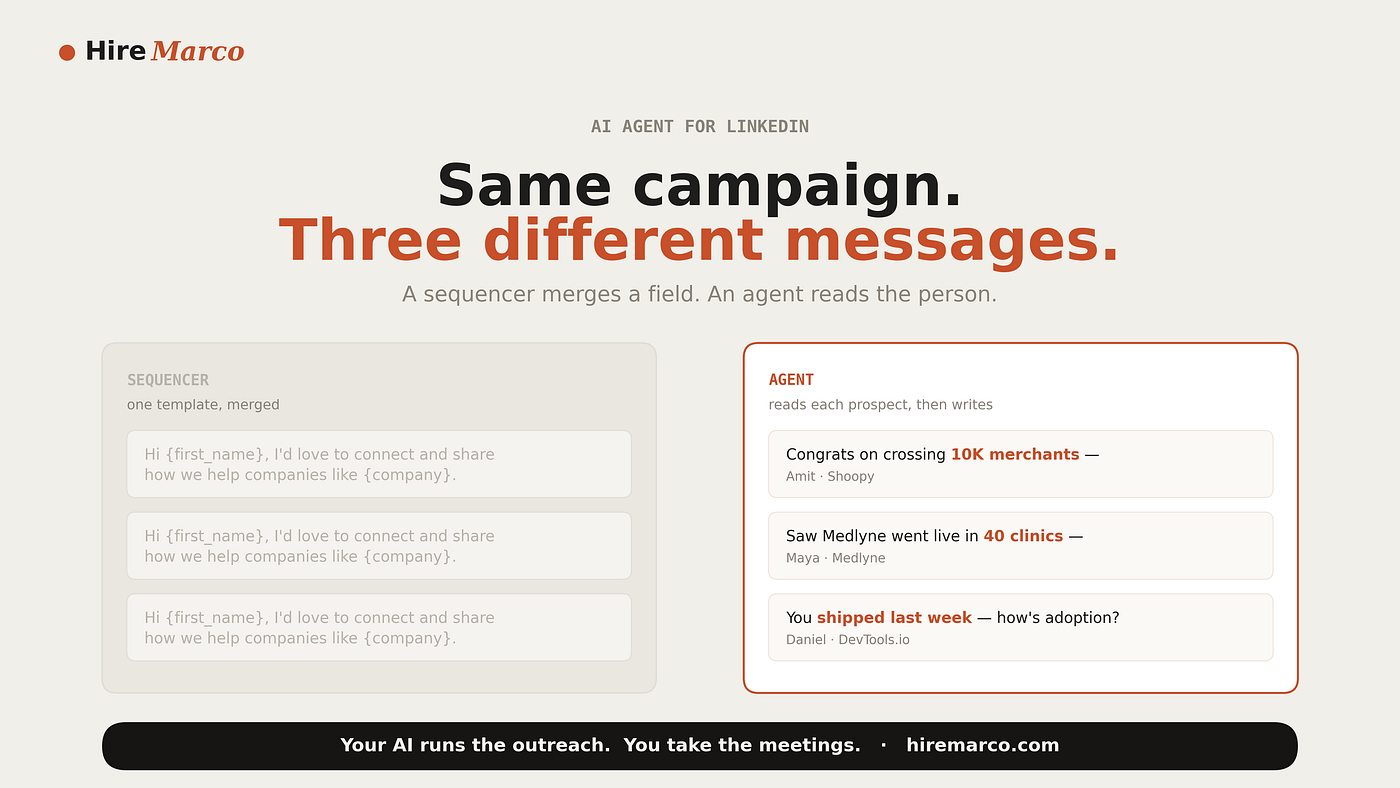
Before writing anything, the agent reads the prospect: their recent posts, their company’s news, their role, what they’ve shipped lately. Then it writes from that. Not Hi {{first_name}}. Something like: saw you just crossed 10,000 merchants — congrats or noticed your clinic software went live across 40 locations.
Here’s the demonstration that makes the concept click. Run one campaign at three prospects:
- A founder who just crossed 10K merchants → the opener references the milestone.
- A CEO whose product went live in 40 clinics → the opener references the rollout.
- A CTO who shipped something new last week → the opener references the launch.
Same campaign. Three completely different messages. Not three templates with different variables — three genuinely different openers, because they’re three genuinely different people with three different reasons to care.
A sequencer physically cannot do this. It has one message and a merge field. An agent writes each one from scratch.
Step 3: It behaves like a person, deliberately
Here’s where an AI agent for LinkedIn either protects you or destroys you.
LinkedIn is very good at detecting non-human behavior, and the penalty is the one asset you can’t buy back: your account. The tools promising hundreds of connection requests a day are optimizing for the exact pattern that gets flagged — machine-regular timing, inhuman volume, cloud logins from unfamiliar locations.
A well-built agent inverts that. It works inside a real browser session with a dedicated IP, at human pacing with natural variance, inside conservative daily limits. It sends to the right fifty people the way a thoughtful person would, rather than the wrong five thousand the way a bot does.
An honest note here, because the industry lies about this: no third-party tool can promise zero risk. Anything that touches LinkedIn on your behalf sits in a grey zone of their terms. What a good agent can do is make problems rare, mild, and recoverable — through restraint, not through magic. Anyone claiming a guarantee is selling you something.
The lovely thing is that restraint is not a compromise. The behaviors LinkedIn punishes and the behaviors buyers ignore are the same behaviors. Safe and effective converge.
Step 4: It handles the reply — the part you always drop
Outreach doesn’t die at the opener. It dies at follow-up number four.
You know this pattern: someone replies with a question, you mean to answer thoughtfully, three days pass. Someone goes quiet, you mean to nudge them, the week gets away. The first message is the fun part. The loop is where meetings actually come from, and the loop is what humans reliably abandon.
An agent stays in the conversation. A reply comes in, it responds in context — about their business, not yours. Someone goes quiet, it follows up like a professional, adding something rather than “just bumping this.” And when the prospect says sure, Tuesday works, the meeting lands on your calendar without you touching it.
The output of an agent isn’t messages sent. It’s a calendar.
Step 5: It learns your account, not the average account
The last difference is the quietest one, and probably the most durable.
Every reply, every ignored message, every booked meeting is a signal. An agent tuned per-account gets sharper over time on your ICP, your voice, your market — not on the aggregate behavior of every user of the tool. Month three should be measurably better than month one, without you rewriting anything.
That’s a compounding asset. A sequencer on month three is identical to a sequencer on day one.
The real comparison isn’t tool vs tool
The honest frame for an AI agent for LinkedIn isn’t “is this better than the automation tool I’m using.” It’s what would it cost to have a human do this properly?
A competent SDR researching each prospect, writing individual messages, chasing follow-ups, and booking meetings is a real salary — plus ramp time, plus management. Most early-stage founders don’t have that, which is why founder-led outreach exists and why it collapses under its own weight around week three.
An agent isn’t better than a great SDR. It’s what you use when hiring one isn’t on the table, and doing it yourself has quietly stopped happening.
The four questions worth asking
If you’re evaluating anything calling itself an AI agent for LinkedIn:
- Does it research each prospect before writing, or merge fields into a template?
- Is it built around account safety — real browser, human pace, conservative limits — or around volume?
- Does it handle replies and follow-ups, or only the first touch?
- Does it learn from your results, or run the same logic for everyone?
Four yeses and you have an agent. Anything less is a sequencer with better branding — and in 2026, buyers can tell the difference from the first line of your message.
Disclosure: I build HireMarco, an autonomous AI agent for LinkedIn that does exactly what’s described above — finds ICP-fit prospects, writes each message from real context, works at a human pace in a real browser, handles replies and follow-ups, and books the meeting. Your AI runs the outreach. You take the meetings.
메타데이터
- post_id
- 71418656e7a1
- slug
- what-actually-happens-when-an-ai-agent-runs-your-linkedin-71418656e7a1
- url
- https://medium.com/@hiremarcosupport/what-actually-happens-when-an-ai-agent-runs-your-linkedin-71418656e7a1
- canonical_url
- https://medium.com/@hiremarcosupport/what-actually-happens-when-an-ai-agent-runs-your-linkedin-71418656e7a1
- author_url
- https://medium.com/@hiremarcosupport
- status
- ok
- fetched_at
- 2026-07-09 20:10:33



