Fall of Giants: What Went Wrong for Germany’s Heavy Panzers in the Battle of the Bulge?
The Battle of the Bulge stands as one of the most significant engagements of World War II, shaping the course of the conflict in Europe…
Fall of Giants: What Went Wrong for Germany’s Heavy Panzers in the Battle of the Bulge?
The Battle of the Bulge stands as one of the most significant engagements of World War II, shaping the course of the conflict in Europe. This massive German offensive, launched in December 1944, caught the Allies by surprise and threatened to turn the tide of the war. Hitler’s last-ditch effort to split the Allied forces and negotiate a peace settlement ultimately failed, but not before causing substantial casualties and testing the resolve of Allied troops.
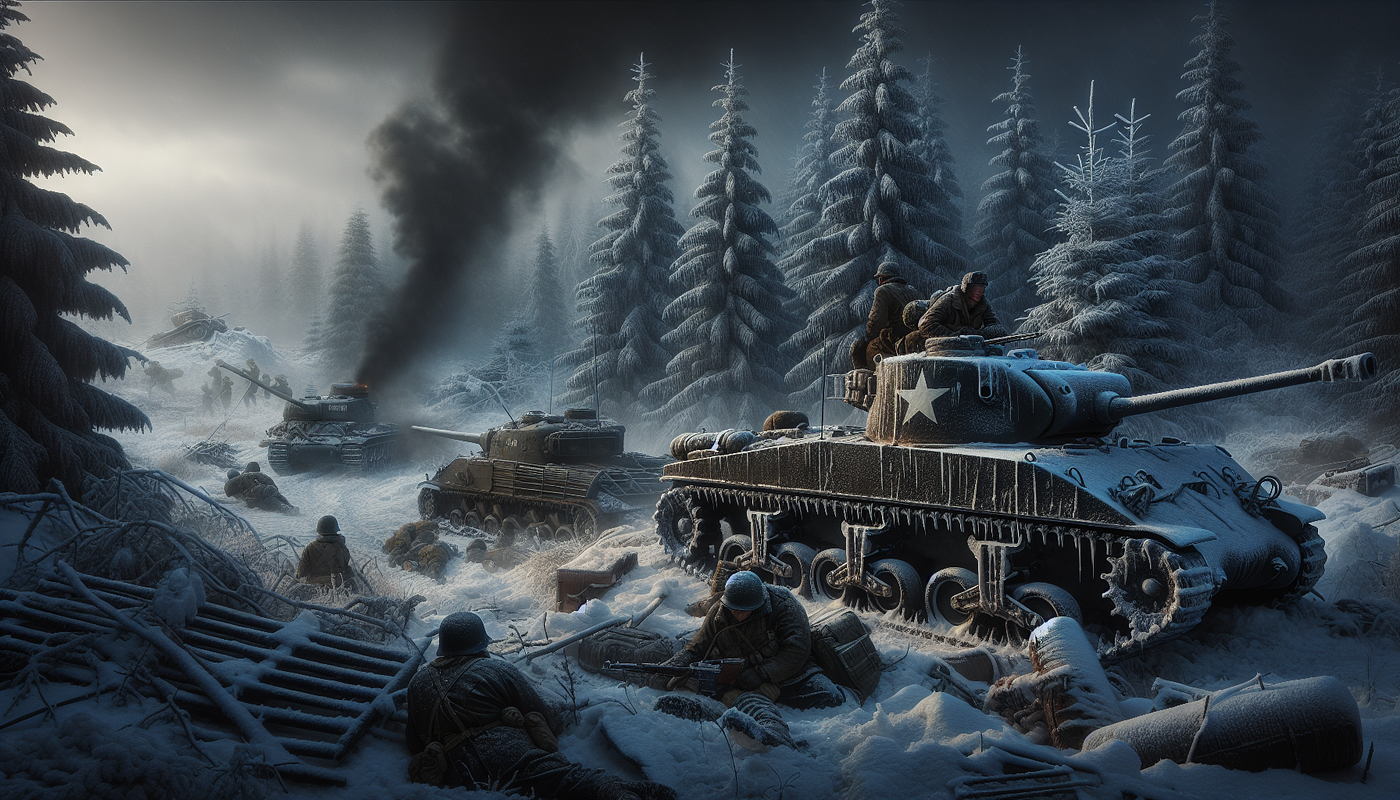
This battle had a profound impact on the war’s final stages and the post-war landscape. It showcased the resilience and adaptability of Allied forces in the face of a sudden, powerful assault. The engagement also highlighted the crucial role of logistics, intelligence, and weather in military operations. To analyze the Battle of the Bulge is to understand the complexities of modern warfare and the factors that determine success or failure on the battlefield.
[embed]
Background and Context of the Battle.
The Western Front in late 1944.
By September 1944, the situation on the Western Front had shifted dramatically in favor of the Allies. Following their successful invasion of Normandy in June, Allied forces had advanced across northern France and into Belgium . The German military found itself in a precarious position, defending on multiple fronts with dwindling resources . Allied bombers relentlessly pounded German cities, severely impacting supplies, resources, and manpower .
Despite these setbacks, the Allied offensive launched in mid-November yielded disappointing results at a heavy cost . The continuous efforts merely exhausted the attacking troops. By mid-December, General Dwight D. Eisenhower, the Supreme Commander of the Allied Expeditionary Force, had 48 divisions at his disposal. These were distributed along a 600-mile (nearly 1,000-km) front between the North Sea and Switzerland .
Hitler’s last-ditch offensive plan.
Facing the crumbling German defenses, Adolf Hitler conceived a daring plan for one last offensive that he believed could alter the course of the war . Code-named “Operation Watch on the Rhine,” the German counteroffensive aimed to break through to Antwerp, Belgium, by an indirect move. The plan was to cut off the British army group from American forces and their supplies, and then crush the isolated British .
Hitler’s strategy hinged on exploiting a perceived weakness in the Ardennes region, which he anticipated would be ill-prepared for winter operations. German intelligence had noted a gap between the main Allied efforts, and Hitler believed that catching the Allies off guard in this area could fracture the tenuous relationship between the United States and Britain.
The offensive would involve three army groups making a concentrated attack along a 60-mile front on American lines in the Ardennes forest, from Malmedy in Belgium to Echternach in Luxembourg. The attack was to be conducted by the 5th SS Panzer Army, 6th Panzer Army, and 7th Army, comprising 29 divisions, 12 of which were armored.
Allied positions in the Ardennes.
The Ardennes region was considered a quiet sector of the front, defended by just six weakened American divisions. In early December 1944, the 1st US Army, under Lieutenant General Courtney Hodges, held the center of the Allied west wall.Approximately 80,000 US soldiers were stationed in a thin line along the border, unaware of the impending German offensive.
The Allied forces in the Ardennes consisted primarily of American troops, some new and inexperienced, others exhausted and battle-worn. The Germans hoped to take advantage of this perceived vulnerability, aiming to achieve complete surprise and push westwards through the middle of the American line.
The element of surprise, coupled with unfavorable weather conditions like fog and low clouds, was seen as crucial to the German plan. Additionally, launching the attack in a situation where Allied aviation couldn’t operate freely was deemed essential for the success of the offensive.
German Preparations and Strategy.
The German counteroffensive, known as Operation Watch on the Rhine, was a meticulously planned and executed military maneuver. Hitler and his high command devoted significant resources and strategic planning to this operation, which they hoped would turn the tide of the war in their favor.
Troop and Equipment Mobilization.
The Germans committed over 410,000 men, more than 1,400 tanks and armored fighting vehicles, 2,600 artillery pieces, and over 1,000 combat aircraft to the offensive. This massive mobilization of forces represented a significant portion of Germany’s remaining military strength. The operation involved four armies, with the lead role given to the 6th Panzer Army, commanded by SS Oberstgruppenführer Sepp Dietrich.
The German plan initially called for just under 45 divisions, including a dozen panzer and Panzergrenadier divisions forming the armored spearhead. Among these were 30 newly rebuilt divisions, which included Volksgrenadier units formed from a mix of battle-hardened veterans and recruits formerly regarded as too young, too old, or too frail to fight,
Operation Watch on the Rhine.
The operational plan, primarily drafted by Generaloberst Alfred Jodl, Chief of Operations in the staff of the German Armed Forces (OKW), was ambitious . The main forces were to advance westward to the Meuse River, then turn northwest for Antwerp and Brussels. The ultimate goal was to break through to Antwerp, Belgium, by an indirect move, cut off the British army group from American forces and their supplies, and then crush the isolated British.
The plan banked heavily on unfavorable weather conditions, including heavy fog and low-lying clouds, which would minimize the Allied air advantage. However, the operation faced significant logistical challenges. Jodl estimated that 17,000 cubic meters of fuel and 50 train loads of ammunition would be required to execute the basic plan. By the evening before the attack, the German national railroad had managed to transport 12,000 cubic meters of engine fuel to the unit deployment areas.
The Element of Surprise.
The success of Operation Watch on the Rhine hinged critically on achieving complete surprise. The Germans took extraordinary measures to maintain secrecy and mislead Allied intelligence. They increased the number of flak (anti-aircraft cannons) in the area and artificially multiplied radio transmissions to create a false impression of their activities.
To minimize the risk of information leaks, all communications about the operation were handled via couriers, avoiding the use of Enigma-encoded messages . This decision, ironically motivated by Hitler’s paranoia, proved effective as the Allies were unaware that the Enigma machine had been compromised since 1941.
The Germans also exploited the Allies’ overconfidence and preoccupation with offensive plans elsewhere.The foggy autumn weather prevented Allied reconnaissance aircraft from correctly assessing the ground situation . German units assembling in the area were even issued charcoal instead of wood for cooking fires to reduce smoke and minimize the chances of Allied observers detecting a troop buildup .
These meticulous preparations paid off when the offensive was launched on December 16, 1944. The attack caught the Allied forces completely by surprise, with devastating initial results. However, despite the initial success, the operation was ultimately doomed by logistical constraints, particularly the lack of fuel to sustain the advance of over 1,400 tanks all the way to Antwerp.
Initial German Advance.
Breaking through Allied lines.
On the misty winter morning of December 16, 1944, the German forces launched a massive offensive that caught the Allied forces completely off guard. Over 200,000 German troops and nearly 1,000 tanks spearheaded Adolf Hitler’s last major offensive on the Western Front.The attack targeted the Ardennes region, a 75-mile stretch of densely forested area with few roads, held by four inexperienced and battle-worn American divisions.
The Germans achieved total surprise due to a combination of factors, including Allied overconfidence, preoccupation with offensive plans elsewhere, and poor aerial reconnaissance caused by bad weather. This initial success allowed the German forces to break through the American front, surrounding most of an infantry division and seizing key crossroads.
Creating the ‘bulge’.
As the Germans pushed westward through the middle of the American line, they created a distinctive projection that gave the battle its name — the Bulge. The German advance was swift, with their spearheads moving toward the Meuse River. By the end of the first day of fighting, the Germans had made significant progress, creating a bulge in the Allied front line.
The farthest west the offensive reached was the village of Foy-Nôtre-Dame, southeast of Dinant, where it was stopped by the U.S. 2nd Armored Division on December 24, 1944. As the Germans drove into the Ardennes, the Allied line took on the appearance of a large bulge, giving rise to the battle’s name.
Early German successes.
The initial phase of the offensive saw several German successes. They managed to capture critical road junctions and advance their spearheads, taking advantage of the element of surprise. The Germans committed over 410,000 men, more than 1,400 tanks and armored fighting vehicles, 2,600 artillery pieces, and over 1,000 combat aircraft to the offensive.
Stories spread quickly of massacres of soldiers and civilians at Malmedy and Stavelot, adding to the chaos and confusion.The Germans also employed psychological warfare tactics, with reports of English-speaking German soldiers disguised as Americans capturing critical bridges, cutting communications lines, and spreading rumors.
The weather conditions initially favored the German offensive. The attack took place during one of the coldest winters on record in the area, with average temperatures around -7 degrees Celsius. This severe weather kept Allied aircraft grounded and affected U.S. ground forces who lacked adequate winter clothing.
However, despite these early successes, the German advance began to slow down. The quick arrival of Allied reinforcements and the Americans’ tenacious defense of vital road junctions at Bastogne and St. Vith played a crucial role in halting the German momentum.By Christmas Eve, the number of Allied soldiers in the Ardennes had grown from the initial 80,000 to half a million.
The German plan had stipulated that St. Vith had to be captured by the second day of the offensive, but American troops managed to hold out for five days before eventually evacuating.Similarly, Bastogne, another critical objective, was quickly reinforced by the 101st Airborne Division and the 10th Armored Division, who arrived on December 19 and set up defenses.
As the battle progressed, the Germans faced increasing challenges. Fuel shortages became a major problem, as many Allied fuel dumps were either evacuated or destroyed before the Germans could capture them. By the end of December, the German advance had ground to a halt, and the offensive was turning into a battle of attrition that the Germans had hoped to avoid.
Allied Response and Resistance.
Eisenhower’s Reinforcement Strategy.
General Dwight D. Eisenhower, the Supreme Allied Commander, responded swiftly to the German offensive. On the night of December 16, he ordered reinforcements to the American lines and took immediate action to move fuel and supplies out of the path of the German advance. Recognizing the gravity of the situation, Eisenhower issued a stirring order to all those fighting to stop the German offensive, emphasizing the importance of this moment for the Allied cause.
Eisenhower’s strategy involved several key elements. He disbanded numerous anti-aircraft battalions, making their manpower available as infantry. This decision provided much-needed reinforcements to the front lines. Additionally, Eisenhower ordered forward the SHAEF reserve, composed of the 82nd Airborne Division under Major General James Gavin and the 101st Airborne Division, temporarily commanded by Brigadier General Anthony McAuliffe.
Defense of Key Towns: Bastogne and St. Vith.
Two towns emerged as critical points of resistance: Bastogne and St. Vith. Both locations were vital road junctions that the Germans needed to capture to maintain their advance.
Bastogne, with its convergence of seven main roads, was crucial to the German attack.The town was defended by elements of the 101st Airborne Division and Combat Command B of the 10th Armored Division.Despite being surrounded and outnumbered, the American forces in Bastogne held out against repeated German assaults.
St. Vith, located near the boundary between the German 5th and 6th Panzer Armies, was another key objective.The town was defended by units of the U.S. VIII Corps, led by the 7th Armored Division. These defenders, under the command of Generals Robert W. Hasbrouck and Alan W. Jones successfully resisted German attacks, significantly slowing their advance.
101st Airborne Division’s Stand.
The 101st Airborne Division played a crucial role in the defense of Bastogne. Alerted on the evening of December 17, the division quickly arranged transportation and moved to Bastogne, arriving by 09:00 on December 19. Brigadier General Anthony McAuliffe organized the defense, forming an all-round perimeter using various regiments of the division.
The 101st Airborne’s defense of Bastogne became one of the most famous episodes of the Battle of the Bulge. Despite being surrounded, outnumbered, and lacking in cold-weather gear, ammunition, food, and medical supplies, the paratroopers held their ground.Their stubborn resistance significantly disrupted the German timetable and boosted Allied morale across the Western Front,
The siege of Bastogne continued until December 26, when elements of General George Patton’s Third Army broke through the German lines and relieved the beleaguered defenders.The successful defense of Bastogne played a crucial role in halting the German offensive and ultimately turning a potential Allied catastrophe into a decisive German defeat.
Weather and Terrain Factors.
Impact of harsh winter conditions.
The Battle of the Bulge took place during one of the harshest winters on record in the Ardennes region. The weather conditions played a crucial role in shaping the course of the battle and significantly impacted both German and Allied forces. The Ardennes-Eifel area experienced severe weather, characterized by heavy rainfall, deep snows, and raw, harsh winds sweeping across the plateaus.A single snowstorm could deposit 10 to 12 inches of snow in a 24-hour period.
The extreme cold and snowy environment made combat operations extremely challenging. Soldiers on both sides had to dig into frozen ground and remain in these positions for extended periods .Many German troops suffered from frozen feet, while American soldiers lacked proper winter clothing, resorting to using bed sheets as camouflage in the snow.
The weather also affected mobility and logistics. When a thaw set in on December 18, it slowed German tanks and created muddy conditions .Subsequently, the ground began to freeze in patches, leaving stretches of the Ardennes roads slippery and muddy.This made vehicular movement slow and exhausting for infantry wading through snow drifts.
Ardennes forest geography.
The Ardennes forest presented a unique and challenging terrain for military operations. Covering approximately half of the area, the forest consisted of dense woodlands interspersed with natural or man-made clearings.The soil structure allowed tank movement when frozen but turned into a clay mire during rainfall.
The geography of the Ardennes channeled large troop movements east to west, often forcing units to pile up on each other and restricting freedom of maneuver.This made movement control a more significant military problem than traditional maneuver tactics. The chopped-up nature of the ground and peculiar timber formations led to the development of a series of small, semi-independent engagements once large battles were joined.
Movement across the country was limited even in good weather, as narrow valley floors could be easily blocked. The northern part of the Ardennes was lower, between 655 and 985 feet in elevation. Despite its inhospitable nature, the area’s economy increasingly depended on tourism, with its lonely forests offering respite for central Europeans from urban pressures.
Weather’s effect on air support.
Weather conditions had a profound impact on air support during the Battle of the Bulge. The German selection of the attack date was based on the prediction of poor flying weather. Initially, this worked to the Germans’ advantage, as low clouds, fog, and mist veiled their advance, contributing to their initial successes.
However, the weather situation changed dramatically on December 23, when cold, dry winds from the east stripped the German armies of their immunity to air attack. For five days, the weather favored the Americans both in the air and on the ground. This allowed Allied air power to come to bear on the advancing Germans, significantly impacting the battle’s outcome.
The Germans had specifically waited for a cold front with anticipated clouds and precipitation, hoping to ground Allied air power. They had northern weather observation posts in Norway to help predict these conditions. However, they were unaware that a maritime polar air mass was pushing into France from the northwest, which would eventually create weather conditions suitable for Allied operations.
The battle demonstrated the critical role of weather in military planning and operations. Both sides attempted to use weather forecasts to their advantage, but the dynamic nature of weather patterns in the region often led to unexpected challenges and opportunities throughout the engagement.
Turning Points of the Battle.
Clearing skies and Allied air power.
The weather played a crucial role in the Battle of the Bulge, initially favoring the German offensive. From December 16 to 18, flying conditions were marginal, characterized by very low clouds, variable visibility, and light rain. The situation worsened from December 19 to 21, with a deep, heavy fog reducing visibility to less than a hundred yards. This prevented Allied air support, causing significant concern among Allied commanders.
However, a dramatic shift occurred on December 23 when an eastern high-pressure area, known as a “Russian High,” moved over the Ardennes, providing nearly perfect flying conditions for the next five days .This break in the weather allowed Allied air forces to surge to their full capacities, providing a substantial advantage that significantly influenced the battle’s course.
The impact of Allied air power was immediate and decisive. On December 23, aerial resupply missions to the besieged troops in Bastogne began, with 249 C-47 loads dropping 230 tons of ammunition, medical supplies, and rations. The following day, the Eighth Air Force deployed over 1,800 bombers and nearly 800 fighter escorts to bomb communication centers in the tactical area.
Patton’s counteroffensive.
General George S. Patton’s Third U.S. Army played a pivotal role in turning the tide of the battle. When Allied Supreme Commander Dwight Eisenhower held a crisis meeting on December 19, 1944, Patton alone promised and then delivered decisive action. He pivoted his entire Third Army of over 250,000 men and hundreds of tanks in atrocious conditions, sending the 4th Armored Division to break the German siege of Bastogne.
Patton’s leadership was instrumental in maintaining momentum. He was seen near the action, urging his men on, and at command posts, inspiring and leading from the front. His tireless efforts forced the exhausted 4th Armored to fight through darkness against bitter German resistance, reaching Bastogne on December 26.
Eager to maintain the initiative, Patton continued to press forward, throwing even green units into the fight. His determination paid off when his men narrowly beat British commander Bernard Montgomery’s soldiers to the strategically important town of Houffalize on January 16, thereby closing the bulge caused by the German surprise attack a month before.
German fuel shortages.
One of the most critical factors in the German offensive’s failure was the severe shortage of fuel. By late 1944, Germany’s fuel production had been significantly disrupted by Allied bombing campaigns targeting the country’s oil refineries and transportation infrastructure. The Germans had only enough fuel for their initial push at the start of the offensive, with very limited reserves to sustain the advance or provide for their withdrawal.
The fuel problem was twofold. First, after the initial German advances, an insufficient number of transportation units was available to move fuel forward to units in contact. Second, the narrow road network combined with icy conditions greatly complicated the logistics effort. While the Germans did capture one Allied fuel depot of 50,000 US gallons in Honsfeld, Belgium, on December 17, subsequent attempts to secure more fuel were thwarted by Allied defensive measures.
The combined effects of Allied air attacks, ground resistance, and fuel shortages severely hampered German mobility and operational capabilities. Air attacks on cities west of the Rhine slowed the operational redeployment of units, degraded tactical mobility, and impeded supply movements. The cumulative impact of these factors was noted by almost all major German participants in the battle, with airpower frequently mentioned as the catalytic ingredient in the supply friction formula.
Final Stages and Outcome.
Allied Counterattacks.
As the German offensive lost momentum, the Allies launched a decisive counteroffensive in early January 1945. General George S. Patton’s Third Army played a crucial role in this phase of the battle. On December 26, Patton’s forces successfully broke the siege of Bastogne, demonstrating remarkable logistical prowess by accomplishing this feat within just a few days. This relief operation marked a significant turning point in the battle.
Following the relief of Bastogne, the U.S. First Army initiated a broader counteroffensive on January 3, 1945. This coordinated effort aimed to push back the German forces and regain lost ground. The Allied counterattack gained momentum as reinforcements arrived, further slowing the German advance.
Closing the Bulge.
Between January 8 and January 16, the Allied armies concentrated their strength in an attempt to pinch off the large German wedge driven into their front. This maneuver was designed to trap the German forces within the bulge they had created. However, the Germans executed a skillful withdrawal, managing to avoid being completely encircled.
Despite the German’s tactical retreat, the Allied forces made significant progress. By the end of January, they had successfully regained the positions they held six weeks earlier, effectively closing the bulge.This achievement came at a considerable cost to both sides. The Allies suffered approximately 75,000 casualties, while German losses were estimated between 80,000 to 200,000 men.
German Retreat.
As the battle progressed, it became clear that Hitler’s gamble had resulted in disaster. The German forces, facing mounting pressure and dwindling resources, were forced to retreat. By early February 1945, they had been pushed back to their starting positions, losing thousands of men and hundreds of tanks in the process.
The retreat marked the end of Germany’s final offensive capabilities in the West.Many experienced German units were effectively depleted of men and equipment, with survivors retreating to the Siegfried Line.This defeat severely weakened Germany’s armored forces, which remained largely unreplaced for the remainder of the war.
The Battle of the Bulge had significant implications for the overall war effort. While it initially appeared to be a profitable operation for Germany, disrupting Allied preparations and inflicting considerable damage, the long-term consequences were disastrous for the German military. The offensive cost Germany valuable resources it could ill afford to lose, with casualties estimated between 63,000 and 104,000 men.
In contrast, although the Allies suffered substantial losses, they could rely on a steady flow of replacements to fill the gaps.This disparity in resource availability would prove crucial in the war’s final stages. The battle effectively shortened the war and ended Germany’s ability to resist effectively on both the Eastern and Western fronts.
The Battle of the Bulge stands as the largest and bloodiest single battle fought by the United States in World War II, and the third-deadliest campaign in American history. It marked the last major offensive attempted by the Axis powers on the Western front, after which Nazi forces could only retreat for the remainder of the war.
메타데이터
- post_id
- 714902ebb2d4
- slug
- fall-of-giants-what-went-wrong-for-germanys-heavy-panzers-in-the-battle-of-the-bulge-714902ebb2d4
- url
- https://medium.com/@managing2024/fall-of-giants-what-went-wrong-for-germanys-heavy-panzers-in-the-battle-of-the-bulge-714902ebb2d4
- canonical_url
- https://medium.com/@managing2024/fall-of-giants-what-went-wrong-for-germanys-heavy-panzers-in-the-battle-of-the-bulge-714902ebb2d4
- author_url
- https://medium.com/@managing2024
- status
- ok
- fetched_at
- 2026-07-22 20:44:56






