Website Hacking 101: A Complete Guide
Website hacking refers to unauthorized access, manipulation, or disruption of websites and their underlying systems.
Website Hacking 101: A Complete Guide
Website hacking refers to unauthorized access, manipulation, or disruption of websites and their underlying systems.
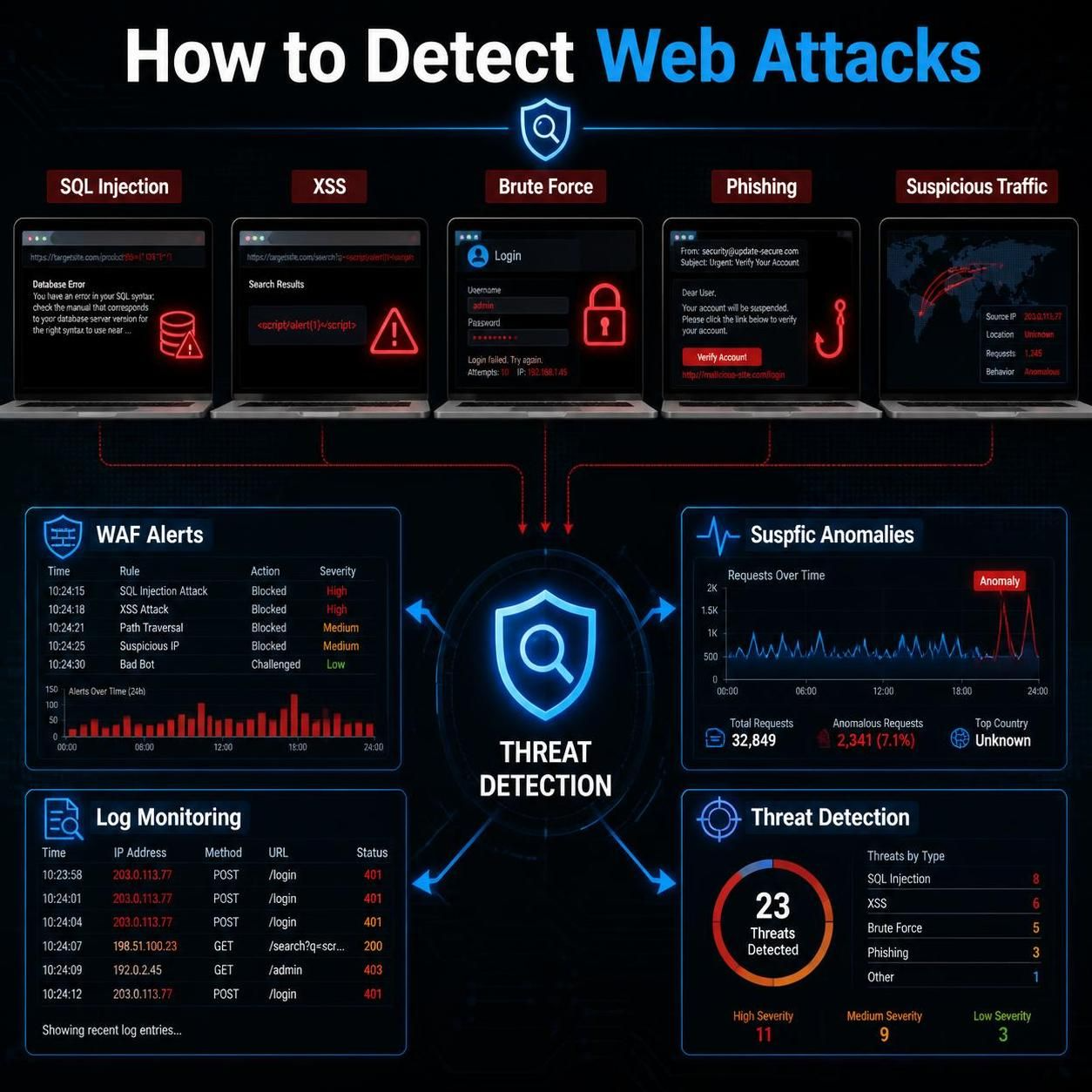
Common Website Hacking Methods;
SQL Injection:-
SQL injection is one of the most prevalent web vulnerabilities.Attackers insert malicious SQL code into input fields (like login forms or search bars) to manipulate databases. When poorly validated, this code executes on the server, allowing hackers to steal data, modify records, or delete information entirely. For example, entering ’ OR ‘1’=’1 in a username field can bypass authentication.
Cross-Site Scripting (XSS):-
Cross-Site Scripting attacks involve injecting malicious scripts into web pages viewed by other users.When a victim visits the compromised page, the script runs in their browser, potentially stealing cookies, session tokens, or sensitive information. XSS comes in two main varieties: stored (permanently embedded in the site) and reflected (temporary, sent via URLs).
Cross-Site Request Forgery (CSRF):-
CSRF tricks users into performing unwanted actions on websites where they’re logged in. An attacker creates a malicious page that, when visited by an authenticated user, sends requests to another site (like a bank) on their behalf. The user’s browser automatically includes their login credentials, allowing the attacker to transfer funds or change settings without the user’s knowledge.
Brute Force Attacks:-
Brute force attacks involve repeatedly trying countless password combinations until one works. Attackers use automated tools to test millions of passwords against user accounts. Weak or common passwords (like “123456” or “password”) can be cracked in seconds. This method is slow but effective against accounts lacking proper rate-limiting protections.
Phishing and Social Engineering:-
Phishing involves tricking users into revealing sensitive information or downloading malware. Attackers create fake login pages or send convincing emails pretending to be legitimate services. Social engineering exploits human psychology rather than technical vulnerabilities, making it highly effective. Users might willingly provide credentials or install backdoors without realizing they’ve been compromised.
Malware and Ransomware:-
Malware is malicious software designed to damage or exploit your system. Ransomware specifically encrypts files and demands payment for decryption. Website owners and visitors can be targets. Hackers inject malware into legitimate websites to infect visitors’ computers, turning them into botnets or stealing banking credentials.
Man-in-the-Middle (MITM) Attacks:- MITM attacks intercept communication between a user and a website. On unsecured connections (HTTP instead of HTTPS), attackers can eavesdrop, steal data, or inject malicious content. Public Wi-Fi networks are particularly vulnerable since traffic isn’t encrypted by default.
Zero-Day Exploits:- Zero-day exploits target previously unknown security vulnerabilities. These flaws haven’t been publicly disclosed or patched yet, giving hackers an advantage. Website owners have no defense until vendors discover and release patches. Zero-days are expensive and typically used in targeted attacks against high-value targets.
| Vulnerability | Description | Impact | Prevention | | Unpatched Software| Outdated plugins, themes, or frameworks with known security holes | Full site compromise, data theft | Keep all software updated immediately | | Weak Passwords | Default or simple credentials for admin accounts | Easy unauthorized access | Enforce strong, unique passwords; use 2FA | | Insecure Configuration | Default settings, exposed directories, unnecessary services running | Information disclosure, unauthorized access | Harden server settings; disable unused features | | Inadequate Input Validation | Forms accepting any input without filtering | SQL injection, XSS, command injection | Validate and sanitize all user input | | Missing HTTPS/SSL | Unencrypted data transmission | Data interception, MITM attacks | Install SSL certificate; force HTTPS | | Insecure APIs | Poorly protected application interfaces | Unauthorized data access, manipulation | Authenticate APIs; rate-limit requests | | Outdated Libraries | Old third-party code with vulnerabilities | Exploitation through known flaws | Update dependencies regularly | | Hardcoded Credentials | Passwords embedded in code or files | Account compromise | Use environment variables; rotate credentials |
Real-World Hacking Scenarios-
Scenario 1: E-Commerce Site Breach — A small online store uses an outdated WordPress plugin with a known SQL injection vulnerability. An attacker exploits this to access the database, stealing 50,000 customer credit card numbers. The site owner doesn’t notice for weeks. Prevention: Regular security audits and keeping all plugins updated would have prevented this.
Scenario 2: Admin Account Takeover- A website administrator reuses the same password across multiple services. That password is exposed in a data breach at an unrelated company. The hacker tries it on the website’s admin panel and gains access. Prevention: Using unique passwords and enabling two-factor authentication (2FA) would have blocked this.
Scenario 3: Malware Injection- A hacker exploits an unpatched vulnerability in a website’s upload feature. They inject malicious code that downloads ransomware onto visitor computers. Thousands of users are infected before the site owner notices unusual traffic. Prevention: Implementing file upload restrictions, regular malware scans, and security monitoring would have detected this quickly.
That’s all for today, we will meet in next article till then Bye:)
Thankyou For Reading:)
메타데이터
- post_id
- 7152aec43f09
- slug
- website-hacking-101-a-complete-guide-7152aec43f09
- url
- https://medium.com/@mainekhacker/website-hacking-101-a-complete-guide-7152aec43f09
- canonical_url
- https://medium.com/@mainekhacker/website-hacking-101-a-complete-guide-7152aec43f09
- author_url
- https://medium.com/@mainekhacker
- status
- ok
- fetched_at
- 2026-07-15 17:30:05