Investing Is a Fog of War Game, and Most People Play It Wrong
Why you never get the full map before you move, and the two-part system that lets you act anyway
Investing Is a Fog of War Game, and Most People Play It Wrong
Why you never get the full map before you move, and the two-part system that lets you act anyway
Photo by Kristen Morith on Unsplash
In strategy games, the map starts black.
You can see the square you are standing on and a small radius around it. Everything else is hidden under “fog of war.” You do not get to study the whole board, plan the perfect route, and then execute. You move, the fog lifts a little, new information appears, and you adjust. The map reveals itself only in response to your movement.
This is not a quirk of game design. It is the most accurate model of investing I know.
Most investors believe the opposite. They believe that somewhere out there is enough information to make the decision clearly, and that their job is to gather it all before acting. They wait for the analysis to be complete. They wait for the macro picture to resolve. They wait for one more data point. They are waiting for the fog to lift on its own.
It never does. The fog is not a temporary condition you wait out. It is the permanent structure of the game. And the investors who win are not the ones who eliminate the fog. They are the ones who built a system for moving through it.
Three sources of fog that never go away
It helps to be precise about what is actually hidden, because the fog comes from three different places and most people only account for the first.
The first is hidden information. You do not know what management knows, what the marginal buyer is thinking, or what is sitting on a competitor’s roadmap. This is the fog everyone recognizes, and it is the one people try to solve by reading more. More reading helps, but only at the edges. The core uncertainty does not yield to effort, because the information does not exist in any document you can find. It exists in the future.
The second is path dependence. Markets are not a static puzzle with a fixed answer. The terrain changes as everyone moves across it. The trade that was obvious becomes crowded. The mispricing that existed last quarter gets arbitraged away. The macro regime that defined the last decade quietly ends. You are not solving a maze with fixed walls. The walls move while you walk.
The third source is the one almost nobody plans for: you do not know your own future reactions. You cannot fully predict how you will behave when a position is down 30% and the news is ugly. You think you know. You do not, because the version of you reading research on a calm afternoon is a different decision-maker than the version watching the screen go red. Your own psychology is fogged terrain too.
Add these together and the conclusion is unavoidable. The demand for certainty before action is a demand that the game cannot satisfy. So the question is not “how do I see the whole map.” The question is “how do I move intelligently when I can only see one square in every direction.”
That requires two things working together: better lenses, and a bias toward motion. One comes from Charlie Munger. The other comes from a place most finance people would never look: Tony Robbins.
Part one: Munger’s latticework lifts more of the fog at once
Charlie Munger’s most useful idea was never a stock pick. It was a thinking method. He argued that you cannot understand the world through a single academic discipline, because reality does not organize itself by department. “You’ve got to have models across a fair array of disciplines,” he said, “because if you have just a few that you use as a man with a hammer sees everything as a nail, you’ll torture reality.”
In fog-of-war terms, every mental model is a different kind of vision. A single model lifts the fog in one direction and leaves the rest black. The person who only thinks in accounting sees the balance sheet clearly and the competitive dynamics not at all. The person who only thinks in narrative sees the story and misses that the unit economics never worked.
The latticework is not about being a generalist for its own sake. It is about combining lenses so that more of the map becomes visible from where you stand. Each discipline reveals a different layer of the terrain.

Each discipline reveals a different layer of the same terrain. One lens is a flashlight; the latticework is daylight.
The practical effect is that a multi-model thinker sees the same situation as a single-model thinker but with less of it hidden. When you can read a business through competitive dynamics, crowd psychology, and probability simultaneously, the fog does not disappear, but the visible radius gets dramatically wider. You make the move with more of the map showing.
This is also why the biggest mistakes are usually single-lens mistakes. The investor who got destroyed almost always had one model they trusted completely. The valuation was cheap (one lens) so they bought, and never noticed through the other lenses that the business was structurally decaying, the crowd was already gone, and the balance sheet had a hidden failure point. They had a flashlight pointed in one direction and walked confidently off a cliff in the dark.
Part two: Robbins and the action that generates the map
Munger gives you better vision. But vision alone produces a specific failure: the analyst who can see further than anyone and still never moves. More lenses can become more reasons to wait. This is where a completely different thinker becomes useful.
Tony Robbins is not an investor’s investor. He is a peak-performance coach, and finance people tend to dismiss that genre on reflex. But strip away the stagecraft and his core operating principle is one of the most important ideas in decision-making under uncertainty: massive action. The belief that you learn your way forward by doing, not by planning, and that imperfect action beats perfect analysis because action is the only thing that produces new information.
In a fog-of-war game, this is literally true. The map does not reveal itself to the player who stands still and thinks harder. It reveals itself to the player who moves. Information is endogenous to action. You do not gather data and then act. You act, and the action gives you data you could not have obtained any other way.
This reframes what an investment decision even is. The standard model treats a decision as the end of a process: you analyze, you conclude, you commit, you are done. The fog-of-war model treats a decision as a probe. You take a position partly to express a view and partly to learn what you can only learn by having skin in the game. How does the position trade? What does owning it teach you about the business that watching it never did? What did the market do that your thesis did not predict? Action is how you scout the next square.
Robbins would call the alternative “analysis paralysis,” and the term is more precise than it sounds. Paralysis is not just slowness. It is the specific error of treating a fog-of-war game as if it were a chess puzzle, demanding full information from a board that will never offer it. The paralyzed investor is not being careful. They are misunderstanding the game.
The discipline that keeps massive action from becoming recklessness
Here is where I have to be honest about the tension, because a careless reading of “massive action” is dangerous, and it appears to contradict something I deeply believe: that the best investors spend most of their time doing nothing and waiting for the fat pitch.
Both are true, and the resolution is the entire point.
Patience governs which pitches you swing at. You let a thousand mediocre setups go by. That selectivity does not change. Fog-of-war action governs how you navigate once you have committed to a fight worth having. Those are two different decisions, and conflating them is where people get hurt. “Massive action” does not mean trade constantly. It means that when you do engage, you engage decisively and you treat the engagement as a source of information, not just an expression of a finished conclusion.
The way you keep action from becoming gambling is to separate scouting from committing.
A scout move is small, cheap, and reversible. It exists to lift fog at low cost. A starter position, a deliberately undersized bet, a probe whose main job is to teach you something you cannot learn from the sidelines. The downside is capped on purpose. You are paying a small premium for vision.
A commit move is large and decisive, and you only make it once enough fog has lifted that the asymmetry is clear. This is the fat pitch. The scouting earned you the right to swing hard, because you used cheap, reversible action to convert hidden terrain into visible terrain before you put real capital at risk.
The failure modes line up cleanly once you see the game this way.

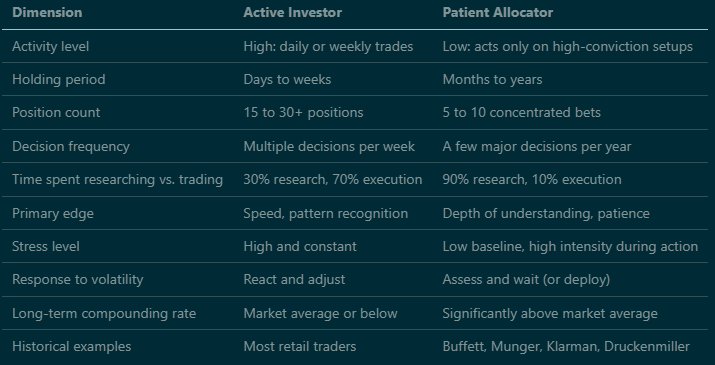
The three failure modes and the one that compounds. Most investors live in the first three and visit the fourth by accident.
The gambler and the navigator both take aggressive action. The difference is that the navigator earned the aggression with scouting and read the terrain through multiple lenses first. The gambler skipped both steps and called it conviction.
How the loop actually runs
Put the two parts together and you get a loop, not a line. The linear model of investing (analyze, decide, done) is the wrong shape. The real shape is a cycle that runs as long as you hold the position.
First, you model the situation through as many disciplinary lenses as you have. This is the Munger step, and it sets the widest possible visible radius before you move.
Second, you take a scout action sized to the fog. The thicker the fog, the smaller the move. The clearer the terrain, the larger you are willing to commit. Action here is deliberate and proportional, not a leap.
Third, you read what the action revealed. The position is now feeding you information you could not get from the outside: how it behaves, what you got wrong, what the market is telling you that your thesis missed.
Fourth, you re-model with the new information and either commit harder, hold, or kill the position. Then the loop runs again.
The kill criterion matters as much as the entry. Because you are treating positions as probes, you have to define in advance what a failed probe looks like. What would the revealed map have to show for you to conclude the thesis was wrong? Decide that while you are calm and the fog is still thick, because the fogged version of your own judgment (the third source of uncertainty) cannot be trusted to decide it later in the heat of a drawdown. A scout move with no kill criterion is not a scout move. It is just a small gamble that you will probably let grow into a large one.
This loop is also the answer to the most common objection to multidisciplinary thinking, which is that it sounds like an excuse to never reach a conclusion. It is the opposite. The lenses are not there to delay the move. They are there to make the move better informed, and the move itself is non-negotiable, because in a fog-of-war game standing still is not safety. It is just blindness with extra steps.
Why this is an edge and not just a metaphor
The investors who struggle most are usually not the ones who lack intelligence or information. They are the ones who are running the wrong mental model of the game itself. They believe investing is a test with a knowable answer, so they oscillate between two errors. They wait too long demanding certainty, then overcommit out of frustration when the waiting becomes unbearable. Paralysis followed by recklessness, which is the signature pattern of someone fighting the fog instead of using it.
The fog-of-war model dissolves that oscillation. Once you accept that you will never see the whole board, the goal changes from “be certain” to “be well-positioned to learn.” You stop trying to win the war from the loading screen. You start scouting. You read the terrain through more than one lens so you are less likely to walk off a cliff in the dark. And you keep your scouts small and your commitments earned.
Munger gives you the lenses that widen what you can see. Robbins gives you the bias toward the action that makes the rest of the map appear. Neither is sufficient alone. Vision without action is the brilliant analyst who never pulls the trigger. Action without vision is the gambler who pulls it in the dark. The edge is in the combination, run as a loop, with patience deciding which fights are worth scouting in the first place.
The map will not light up for you. It lights up for the player who moves. The only real question is whether you move blindly, or whether you move with enough lenses and enough discipline that each step earns you the next.
Lester Leong writes about capital allocation, investing frameworks, and the mechanics of building wealth across market cycles. Follow for portfolio updates and analysis.
Disclaimer: This is not financial advice. Frameworks shared for educational purposes. Do your own research.
메타데이터
- post_id
- 7174580b1bdb
- slug
- investing-is-a-fog-of-war-game-and-most-people-play-it-wrong-7174580b1bdb
- url
- https://medium.com/gradient-growth/investing-is-a-fog-of-war-game-and-most-people-play-it-wrong-7174580b1bdb
- canonical_url
- https://medium.com/gradient-growth/investing-is-a-fog-of-war-game-and-most-people-play-it-wrong-7174580b1bdb
- author_url
- https://medium.com/@LesterLeong
- status
- ok
- fetched_at
- 2026-06-20 20:29:01