A Comprehensive Scorecard of the Ramaphosa Legacy: his State of the Nation Address, 12 February…
“The ship of state is different from other ships. It can only be steered by its Captain — and only then if someone remembered to fill the…
“A picture is worth a thousand words, most of which would be unprintable in a family publication.”
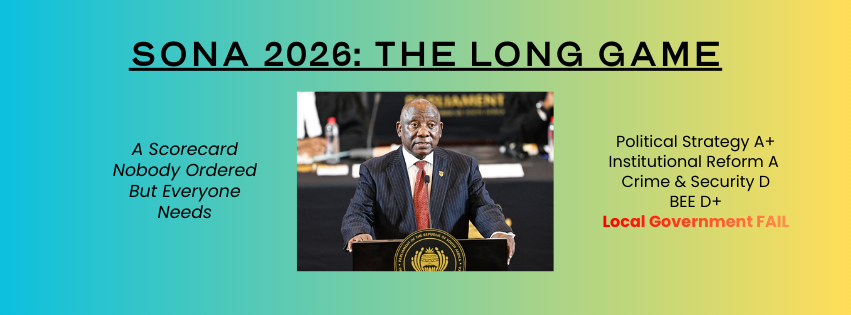
A Comprehensive Scorecard of the Ramaphosa Legacy: his State of the Nation Address, 12 February 2026.
“The ship of state is different from other ships. It can only be steered by its Captain — and only then if someone remembered to fill the fuel tank.”
SONA 2026: PROMISES vs. CONCRETE ACTIONS
“Repeat a promise often enough and it becomes a policy. Repeat it longer and it becomes a tradition.”
The Big Wins — Actual Deliverables
“Even a stopped clock has a better track record than most SOEs.”
Operation Vulindlela remains the crown jewel of the Ramaphosa era. It succeeded precisely because it bypassed the traditional bureaucracy — a tacit admission that the bureaucracy itself is broken. In 2026, its tangible outputs include:Load shedding officially ended. Maintenance outages in Johannesburg aside, the structural emergency is over. Eskom has been corporatised and unbundled.
- Passenger rail restored on more than 80% of corridors. PRASA has deployed over 200 locally produced trains — a rare victory for domestic manufacturing.
- South Africa removed from the FATF Grey List, restoring international banking credibility.
- Two consecutive primary budget surpluses achieved — the first in many years. Inflation fell to a 20-year low of 3.6%. The Rand strengthened.
- R1 trillion committed to public infrastructure over three years. The national infrastructure bond was oversubscribed twice — genuine market confidence, not ministerial spin.
- SARS rebuilt into a world-class institution; nearly R11 billion in State Capture funds recovered.
- NPA independence restored. The peaceful departure of the NDPP on her own terms, citing zero political interference, is cited as institutional proof.
- Investing Directorate Against Corruption (IDAC) established as a permanent NPA entity.
- South Africa Investment Conference targets R2 trillion in new investment over five years. Over R600 billion has already flowed into projects from prior conferences.
The Hollow Promises — Déjà Vu Department
“Never mistake a SONA for a delivery note. One arrives every February; the other rarely arrives at all.”
Some promises have now appeared in enough consecutive SONAs to qualify for a pension.
- Crime & the SANDF: Deploying the South African National Defence Force to crime hotspots in the Western Cape and Gauteng sounds formidable — until one learns that only 27% of the SANDF is medically deployable, the Air Force flew barely 6,900 of 12,000 funded hours in 2023/24, and the Navy has one seaworthy frigate to patrol 2,798 km of coastline. Promising military muscle with a hollowed-out force is governance theatre.
- Local Government: A “White Paper on Local Government” and “professionally managed utilities” for water and electricity have been promised while Johannesburg residents queued for water and Knysna had sewage in the streets. A White Paper is not a plumber.
- Municipal Councils: Coalition politics has left most large metros ungovernable. The Johannesburg water crisis — described in the SONA itself as the most pressing issue — remains “almost unfixable” despite R156 billion allocated over three years.
- “Cyril’s Economy”: Macro figures are impressive in press releases. On the ground, 31.9% unemployment, 58% of black South Africans below the poverty line, and black youth unemployment above 60% by the expanded definition tell a different story. The president has a beautiful ship’s bridge; most passengers are in steerage without food and water.
- Organised Crime & Construction Mafias: Zero-tolerance rhetoric has been annual since 2019. Construction and water mafias, illegal miners, and gang violence continue to metastasise. Technology and AI for the Illicit Economy Disruption Programme are welcome — but were announced alongside a police service the Madlanga Commission just exposed as systematically corrupt.
THE COMPREHENSIVE SCORECARD
“In which we award grades to a president who has had nine years after Zuma to make up for what Zuma did in nine.”
The following assessment covers political strategy, institutional reform, and every major sector, ranked in descending order of performance. Grades are awarded on the South African matric scale (A = 80%+, B = 70–79%, C = 60–69%, D = 50–59%, E/F = below 50%).
SUBJECT | GRADE | MARKER’S COMMENTS
**Political Strategy & Long Game | A+ | **Masterful. Turned a 56-vote 2017 mandate into 2026 dominance while rivals choked on their own ambitions.
**Institutional Reform (SARS, NPA, Treasury) | A | **State Capture reversed; SARS rebuilt from rubble; NPA finally allowed to function without political puppetry.
**Infrastructure & Energy (Operation Vulindlela) | B+ | **Load shedding ended; R1 trillion infrastructure programme launched; rails revived. Transnet still a work in progress.
**Economic Management (Macro) | B- | **Budget surpluses, FATF delisting, inflation 20-year low. Rand strengthened. But GDP growth still anaemic at ~2%.
**Economic Management (Lived Reality) | C- | **“Cyril’s Economy” — polished macro dashboard, empty stomachs. Unemployment at 31.9%; food inflation still biting.
**Crime & Security (SAPS) | D | **Madlanga Commission exposed rampant SAPS corruption. Recruiting 5,500 officers when the rot is structural is like painting a sinking ship.
**National Defence (SANDF) | D- | **27% deployable; Air Force flying 6,904 of 12,000 funded hours; one seaworthy frigate; 68% of budget swallowed by salaries. Promising SANDF crime deployments is comedic.
**Department of Health | C- | **NHI looms but funding remains fantasy. Public hospitals in structural decay. Nursing vacancies critical. Private sector thrives; the poor endure.
**Local Government | E (Fail) | **Johannesburg water crisis. Sewage in rivers. Municipal councils fractured by coalition politics. A White Paper on Local Government is bureaucratic kabuki theatre.
**State-Owned Enterprises (SOEs) | C | **Eskom restructured; Transnet improving; SAA still a zombie. Cabinet retains too many SOE oversight levers — accountability remains diffuse.
Cabinet Size & Competence
D+
GNU logic produced a bloated 32-member cabinet. Minister of Electricity position exemplifies the problem: a portfolio created to bypass incompetence, then retained despite the crisis ending.
**Parliament & Accountability | C | **GNU has neutered meaningful opposition. DA now sings in Ramaphosa’s choir rather than conducting oversight. Rubber-stamp risk is real.
**Black Economic Empowerment (BEE/B-BBEE) | D+ | **Enriched a politically connected elite. Black unemployment rose from 29.2% (2003) to 36% (2024). Cost: R145–290 billion per year (FMF/Solidarity 2025). A review is now finally underway.
FINAL RESULT: PASS — 63% | “Distinguished Reformer; Reluctant Revolutionary”
Ramaphosa has saved the ship of state from sinking. He has not yet reached the harbour. He is a meticulous engineer of institutional plumbing, but the pipes still burst in Johannesburg.
THE POWER-STRIPPING PRESCRIPTION
“Competence is best measured by whom you fire, not whom you hire.”
The Ministry of Electricity: A Ministry That Should Not Exist
“Creating a new ministry to fix the problems caused by the old ministry is like amputating a limb to treat a blister.”
Minister Kgosientsho Ramokgopa’s Department of Electricity and Energy was established in 2023 as an emergency bypass of the dysfunctional Department of Mineral Resources and Energy. The logic was sound: the energy crisis demanded dedicated executive attention. The result was load shedding ending. Credit is due.
However: the crisis is over. The department now duplicates functions, creates turf confusion with DFFE and DMRE, and adds a ministerial salary and bureaucratic layer to a restructured Eskom that arguably no longer needs political midwifery. The Vulindlela model — surgical, time-limited, focused — has been converted into a permanent department. This is mission creep dressed as institutional design.
RECOMMENDATION: Merge the Department of Electricity and Energy back into DMRE with a strengthened Electricity Regulator (NERSA) and an independent Transmission Operator. The minister has served his purpose. His portfolio should follow.
The SANDF: Senior Officers Without Planes, Ships, or Soldiers Who Can March
“An Air Force that doesn’t fly and a Navy that doesn’t sail is essentially a very expensive fancy dress competition.”
The SANDF faces a R41.2 billion budgetary shortfall against its baseline requirement of R98.3 billion. Its 2025/26 budget of R55.94 billion allocates 68% to salaries, leaving R17.94 billion for equipment, maintenance, and operations. The Air Force achieved 6,904 of 12,000 funded hours in 2023/24. The Navy achieved 2,641 of 8,000 sea hours. Only 27% of personnel are medically fit to deploy.
The 2015 Defence Review, the only policy framework for SANDF renewal, was never implemented. The SANDF Chief is not the accounting officer — the Defence Secretary is — a structural incoherence that ensures accountability falls between two chairs.
RECOMMENDATIONS:
- Retire 50–65% of generals and admirals (the ISS estimates the SANDF has a mushroom structure — small stem, enormous top). Redirect salary savings to equipment.
- Appoint only SANDF Chief candidates who can actually fly a plane, command a ship, or lead an infantry battalion — not desk generals appointed for political reliability.
- Implement the 2015 Defence Review immediately as an interim measure whilst a new White Paper is drafted.
- Ring-fence a Defence Modernisation Fund — target 1.5% of GDP as previously promised by the Deputy Minister — and protect it from annual budget raids.
- Do not deploy the SANDF on domestic crime operations without first demonstrating that it can sustain its DRC peacekeeping obligations. Both cannot be done simultaneously with current resources.
SAPS: The Madlanga Commission as a Mirror
“A police force that is corrupt is not merely useless — it is actively dangerous. This is not a metaphor; it is a Gauteng township.”
The Madlanga Commission has exposed rampant corruption in SAPS and metro police through abuse of power. The response in SONA 2026 is to recruit 5,500 additional officers — adding to 20,000 officers announced in previous SONAs who have evidently not resolved the problem — whilst the State Security Agency investigates senior management’s spending habits.
Structural rot cannot be diluted by fresh recruits. The DNA of institutional corruption is transmitted vertically through command cultures.
RECOMMENDATIONS:
- Vetting of all senior SAPS officers at Colonel level and above, with compulsory lifestyle audits. Those who fail must face disciplinary proceedings, not transfers.
- Independent civilian oversight body with teeth — not an inspectorate that produces annual reports read by no one.
- Separate the detective function from the uniformed service into a distinct investigative agency, modelled on the UK’s National Crime Agency, with its own career path and culture.
- The SANDF crime deployment in the Western Cape should be time-limited, outcomes-measured, and subject to parliamentary oversight — not a permanent outsourcing of policing to a declining military.
Department of Health: The Quiet Catastrophe
“The National Health Insurance is South Africa’s Waiting Room: everyone knows it’s coming; no one knows when; and the chairs are very uncomfortable.”
The public health system continues in structural decay. Nursing vacancies are critical. Hospital infrastructure is deteriorating. The NHI Act has been signed but its funding model remains a fantasy at current fiscal trajectories.
The DoH’s grade of C- reflects the gap between policy ambition (NHI, universal coverage) and operational reality (collapsing hospitals and clinics, stock-outs, and patient mortality from preventable causes).
RECOMMENDATIONS:
- De-link NHI implementation timelines from political announcements. Set a credible 10-year implementation schedule tied to specific fiscal milestones.
- Create a Clinical Governance Inspectorate independent of the DoH, with powers to close facilities that fail patients — not merely to issue compliance notices.
- Address the nursing vacancy crisis as a national emergency: fast-track registration of qualified nurses currently unemployed due to bureaucratic backlogs.
- Reduce the DoH’s hospital management bureaucracy and restore clinical authority to medical managers (superintendents).
Cabinet: The GNU Compromise Tax
“A cabinet of 32 ministers is not governance — it is a group photograph in which everyone gets a ministry because nobody gets none.”
The Government of National Unity produced a 32-member cabinet — the largest in post-apartheid history — driven by the arithmetic of coalition management rather than functional efficiency. Portfolio duplication is endemic. Accountability is diffuse.
The DA, once the opposition of record, has moved into Ramaphosa’s choir. Parliamentary oversight has been structurally weakened. The Madlanga Commission and the Auditor-General now do what Parliament no longer effectively does.
RECOMMENDATIONS:
- Reduce cabinet to a maximum of 22 portfolios, with deputy ministers only where the portfolio genuinely warrants it (e.g. Finance, Health, Basic Education).
- Merge the Ministry of Electricity and Energy into DMRE immediately.
- Restore meaningful parliamentary oversight by strengthening the Rules of the National Assembly to prevent GNU members from abstaining on oversight votes.
- Introduce mandatory performance contracts for all ministers, publicly tabled and audited annually by the Auditor-General.
Local Government: Where All Policy Goes to Die
“Local government in South Africa is where infrastructure goes to meet its maker, and where ratepayers go to meet their therapists and panel-beaters.”
Municipal councils fractured by coalition politics, engineers replaced by cadres, revenue collection collapsing, and infrastructure maintained with string and optimism: local government remains the single most visible point of state failure for ordinary South Africans.
R156 billion has been allocated for water infrastructure over three years. But money without competent management is merely expensive mud.
RECOMMENDATIONS:
- Activate Section 139 of the Constitution more aggressively. Provincial government must intervene in failing municipalities without the current political timidity.
- Ring-fence engineering and technical posts in municipalities and make them non-political appointments with independent remuneration scales.
- Introduce mandatory creditworthiness assessments for municipalities accessing infrastructure grants — money must follow competence, not political affiliation.
- The White Paper on Local Government is welcome only if it produces legislation, not aspirations. Set a 24-month deadline for parliamentary enactment.
SARS and Tax: The One Department That Actually Works (Oh, and please remember the Auditor-General.)
“SARS is proof that competent leadership transforms institutions. It is also proof that this lesson has been applied precisely nowhere else.”
SARS under Commissioner Edward Kieswetter is the benchmark for institutional recovery. Revenue collection, compliance culture, and technological modernisation have all improved substantially. This is Ramaphosa’s clearest institutional legacy.
The risk is complacency and political interference once the current Commissioner’s term ends. Succession planning at SARS must be insulated from cadre deployment logic.
BEE/B-BBEE: The Longest-Running Expensive Experiment With the Least Benefit for the Poorest
“Black Economic Empowerment has empowered approximately as many poor black South Africans as the Gupta family have been prosecuted.”
The evidence is now unambiguous. Since BEE was introduced in 2003, black unemployment has risen from 29.2% to 36% (Q4 2024). Black youth unemployment exceeds 60%. A 2025 study by the Free Market Foundation and the Solidarity Research Institute estimated BEE costs between R145 billion and R290 billion per year in foregone investment and compliance overhead. De Ruyter documented that BEE cost Eskom 30% in procurement premiums.
The Zondo Commission identified BEE as a key enabler of State Capture. The B-BBEE Act created a compliance industry that enriched politically connected fronting operations, not township entrepreneurs. Patrice Motsepe — one of the wealthiest individuals in Africa — remains legally eligible for BEE benefits.
SONA 2026 announced a two-phase BEE review. Dawie Roodt of Efficient Group described this as “the beginning of the end of BEE.” Chief Economist Roodt may be optimistic about the speed, but the direction is correct.
RECOMMENDATIONS:
- Replace race-based procurement preferences with poverty-based development criteria, targeting measurable outcomes in job creation, skills transfer, and community upliftment — regardless of the owner’s race.
- Sunset all existing B-BBEE codes within seven years, with mandatory parliamentary review of outcomes every two years.
- Redirect the proposed R20-billion Transformation Fund toward directly funding TVET colleges, township SME incubators, and rural infrastructure — with independent third-party auditing.
- Remove BEE eligibility from individuals and entities with taxable income or asset base above a defined threshold (e.g. R50 million). Patrice Motsepe does not need BEE; a 23-year-old woman in Langa does.
CONSTRUCTIVE vs. DESTRUCTIVE ASSESSMENT
“The optimist says the glass is half full. The pessimist says it is half empty. The South African says: who stole the water?”
✅ CONSTRUCTIVE | ⚠️ DESTRUCTIVE
Rebuilt SARS into a world-class revenue authority; recovered nearly R11 billion in stolen State Capture funds. | Weak state capacity at municipal and provincial level; sewage crises, water shortages, and collapsing roads persist across most metros.
Operation Vulindlela delivered tangible wins: end of load shedding, passenger rail restoration, Transnet improvements, and R1 trillion infrastructure commitment. | Crime and organised criminality continue to permeate society. SAPS riddled with corruption exposed by Madlanga Commission. Construction mafias and illegal miners operate largely with impunity.
Political consolidation: GNU assembled; Ace Magashule, Nkosazana Dlamini Zuma and the RET faction neutralised. DA moved from opposition to coalition partner. | SANDF: 27% deployable; ageing aircraft; one seaworthy frigate; no funded Defence Review. Promising military crime deployments with a hollowed-out force is governance theatre.
Macro-economic stabilisation: two consecutive primary budget surpluses; inflation at 20-year low (3.6%); removed from FATF Grey List; Rand strengthened. | “Cyril’s Economy”: 31.9% unemployment; 58% of black South Africans below the poverty line; black youth unemployment exceeds 60%. Macro wins do not reach dinner tables.
NPA independence restored; Investigating Directorate Against Corruption (IDAC) established as a permanent entity; whistle-blower protection legislation introduced. | BEE policy costs R145–290 billion per year (Free Market Foundation/Solidarity 2025) whilst black unemployment has worsened since 2003. Enriched a connected elite; excluded the majority.
SRD Grant extended and redesigned as permanent basic income support. Social safety net strengthened. | No clear presidential successor. Ramaphosa’s institutional gains are tied to his personal political capital and could be reversed after 2029.
South Africa Investment Conference targets R2 trillion over five years; JSE performing; market confidence signalled by oversubscribed national infrastructure bonds. | Cabinet remains bloated (32 ministers) and includes portfolios of questionable functional logic, e.g. a separate Ministry of Electricity retained after load shedding ended.
40% renewable energy target by 2030 with independent transmission projects commencing. Green economy positioning improving. | Local government remains “almost unfixable”: coalition councils paralysed; Johannesburg water crisis unresolved despite successive SONA promises; a White Paper is not a plumber.
SOE HOT-BUTTON GLOSSARY
“The language of state-owned enterprise management has been refined over 30 years into a precision instrument for saying everything and meaning nothing.”
The following phrases recur across SONA addresses, board meetings, and ministerial briefings. A translation is provided as a public service.
HOT-BUTTON PHRASE = TRANSLATION
**“We will professionalise management” = **We will eventually replace the cadres we deployed with slightly better-dressed cadres, after another commission of inquiry.
**“The entity is now financially sustainable” = **We have stopped haemorrhaging money at quite the same rate, pending the next round of irregular expenditure findings by the Auditor-General.
**“A turnaround strategy is in place” = **PowerPoint has been updated. Staff have been reshuffled. Targets have been revised downward so we can claim success.
**“We are engaging with organised labour” = **COSATU has not yet called a strike, so the agreement to agree on nothing continues to hold.
**“The SOE is critical to the developmental state” = **We cannot privatise it because too many comrades are feeding from it, and too many votes depend on the pretence that it will eventually work.
THE NIGHTMARE MAN’S VERDICT
“History is written by the victors. In South Africa, it is audited by the Auditor-General and then quietly shelved.”
President Ramaphosa has achieved something genuinely remarkable: he inherited a state that had been systematically looted for nine years, survived a 57-vote internal party election, outmanoeuvred rivals of considerably lower ethical calibre, and produced measurable institutional repair. His 2026 SONA reflects a man who has played the long game and — against considerable odds — is winning it.
The tragedy is the gap between institutional recovery and human experience. SARS works. The NPA functions. Eskom is no longer an apocalyptic risk. And yet: 31.9% of South Africans who want to work cannot find work. Children in the Western Cape are caught in gang crossfire. Johannesburg residents queue for water. The SANDF cannot sustain a DRC deployment and a domestic crime operation simultaneously.
The “long game” has produced institutional plumbing. The pipes remain broken in the house.
The reforms needed now are not subtle: strip power from demonstrably incompetent ministers and portfolios; restructure the SANDF command or stop promising its deployment; abandon race-based BEE in favour of poverty-based development; force local government to be accountable or dissolve it under Section 139.
Ramaphosa is a reformer of considerable skill who is running out of time. His legacy will be determined not by what he fixed between 2018 and 2026, but by whether the institutions he repaired survive contact with his successor.
FINAL MARK: 63% — Pass with Distinction in Strategic Patience; Supplementary Examination Required in Everything the Public Actually Experiences.
REFERENCES
“Cite your sources, or the next citation may be from the Auditor-General about you.”
Africa Defence Forum (2025). Budget Constraints Limit SANDF’s Operational Capacity.
African Insider (2026, February). Did you miss it? Here is Ramaphosa’s full 2026 SONA breakdown.
B-BBEE Commission (2025). Decoding the controversy around Black Economic Empowerment in South Africa. Daily Maverick.
Daily Maverick (2025, March 10). BEE on borrowed time: Attacks on social engineering project intensify.
Daily Maverick (2025, November 13). BEE is a bloodbath for jobs, and abandoning it is crucial for economic inclusion.
Daily Maverick (2026, February 8). The R20bn gamble to rewrite SA’s rules of empowerment.
DefenceWeb (2025, March 13). Defence budget remains stagnant despite R5 billion allocation for DRC deployment.
DefenceWeb (2025, November 14). Defence budget increases by R1.8 billion but remains stretched.
Democratic Alliance (2025, April). Without a new Defence Review, the SANDF will collapse.
Democratic Alliance (2025, December). SANDF in full-force decline: DA warns against DRC deployment under current conditions.
EWN (2026, February 12). Full speech: The 2026 State of Nation Address.
Free Market Foundation & Solidarity Research Institute (2025, June 12). New FMF research exposes staggering R5 trillion economic toll of BEE compliance
Institute for Security Studies (ISS) (2023). Is South Africa’s defence force up for new thinking?
IOL (2026, February 13). SONA 2026: 7 key points from Ramaphosa’s speech.
Joburg Etc (2025, October 22). Is South Africa’s BEE Failing the Majority? Economists and DA Say Yes.
KZN Business Sense (2026, February). Economic Transformation in South Africa: Key Takeaways of SONA 2026.
Martin Plaut (2025, June 26). South Africa’s military in ruins leaves the nation in peril.
Moneyweb (2026, February 12). WATCH: Ramaphosa’s 2026 SONA.
Newsday (2026, February 19). The beginning of the end of BEE in South Africa.
Parliament of South Africa (2026, February 12). State of the Nation Address by President Cyril Ramaphosa.
Ramaphosa, C. (2025, May 27). It’s exclusive ownership, not BEE, that’s holding back economy. Daily Maverick.
Swart, J. (2025, June 26). South Africa’s military in ruins leaves the nation in peril. Martin Plaut Blog.
The Citizen (2026, February 12). WATCH: Here are the key points Ramaphosa made at the 2026 SONA.
The Presidency. (2026, February). SONA 2026 in Numbers. SAnews.
Wikipedia (2025). South African National Defence Force.
“Ho-ho! says the ho bro.” — Anon-andon-andon
메타데이터
- post_id
- 7174c2f3c4ed
- slug
- a-comprehensive-scorecard-of-the-ramaphosa-legacy-his-state-of-the-nation-address-12-february-7174c2f3c4ed
- url
- https://medium.com/@alangh616/a-comprehensive-scorecard-of-the-ramaphosa-legacy-his-state-of-the-nation-address-12-february-7174c2f3c4ed
- canonical_url
- https://medium.com/@alangh616/a-comprehensive-scorecard-of-the-ramaphosa-legacy-his-state-of-the-nation-address-12-february-7174c2f3c4ed
- author_url
- https://medium.com/@alangh616
- status
- ok
- fetched_at
- 2026-07-15 00:42:10