Oysterless Pearls: A Vegetarian History of Faux Pearls
In the 19th and early 20th centuries, pearls were a staple of any stylish wardrobe, the price and demand for pearls¹ significantly…
Oysterless Pearls: A Vegetarian History of Faux Pearls
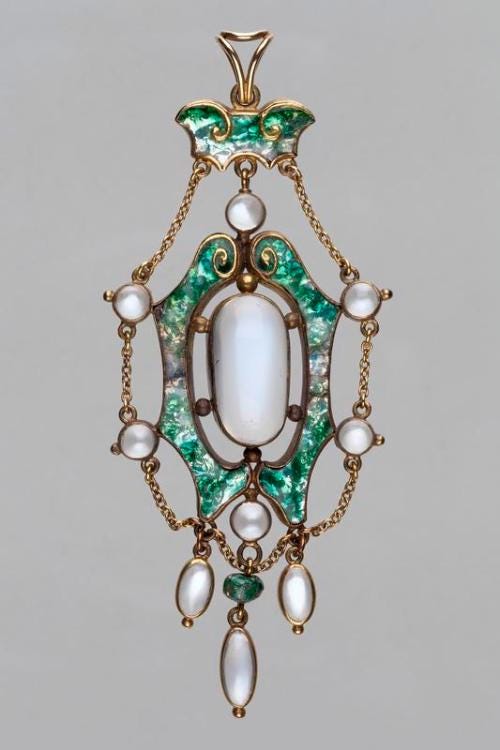
Gold Mounted Enamel And Moonstone Pendant (circa 1907) by James Cromar Watt Wikimedia Commons Image License
In the 19th and early 20th centuries, pearls were a staple of any stylish wardrobe, the price and demand for pearls¹ significantly increasing during this time period. Objections to the wearing of pearls are present amongst modern and past vegetarian and vegan organizations. Concern over cruelty to oysters, and the acknowledgement of pearls as being amongst the animal products to be avoided can be found in some primary sources. A satirical piece reprinted from a 1928 issue of The Daily Sketch was reprinted in a 1929 issue of *The Vegetarian News*, likely for its condemnation of the use of animals and animal products for fashion. The dialogue between the characters listing all of the articles of animal origin that could be found in a fashionable woman’s wardrobe included pearls and other items derived from aquatic life.
[…] Around your throat the pearls you took from the oyster ; on your finger your coral ring ; at your breast the silver-mounted bird’s claw or the model flowers made of the stained scales of fishes or sea crustacea. (p. 21)
Artificial pearls, primarily created for economic reasons, have existed for centuries, one of the most popular methods of creating convincing imitations was developed in the 17th century. Hollow glass beads were coated on the inside with guanine, also known as pearl essence, derived from fish scales. The hollow centers were then filled with white beeswax to mimic the weight and solidity of genuine pearls. This resulting product perhaps even less suitable for vegetarians than natural pearls. However, there were other less-common options that vegetarians in the past could have used as pearl substitutes.
Hematite, also referred to as ironstone, was used to imitate black pearls. The stone could be polished and carved into round beads for creating jewelry that could resemble strands of pearls. Hematite’s heavier density compared to natural pearls was considered to be the only noticeable difference in this pearl alternative and the genuine material.
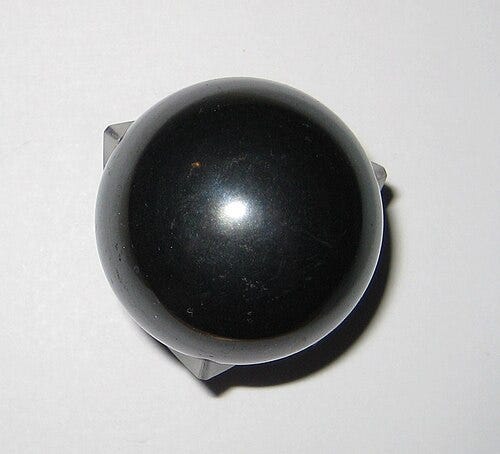
Hematite Sphere by Stephanie Clifford Wikimedia Commons Image License
Another semi-precious stone that could have been a viable pearl substitute in this time period was the opal. Once the subject of superstition, opal jewelry was popularized by Queen Victoria, and remained popular as stones found in early 20th century Art Nouveau jewelry designs.
Common opals with their range of colors and slight sheen bear some resemblance to natural pearls. Like hematite, opals could be carved into beads and were used in necklaces that could resemble strands of pearls.
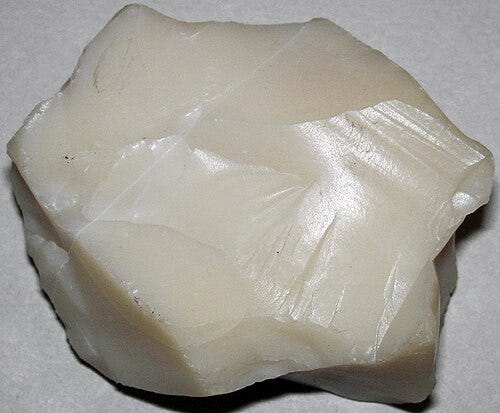
Carr et al. (1979) — Andamooka opal fields: the geology of the precious stones field and the results of the subsidised mining program. Geological Survey of South Australia Department of Mines and Energy Report of Investigations 51. 68 pp. Presented by James St. John Wikimedia Commons Image License
In 19th century jewelry design, pearls were often used interchangeably with moonstones as an accompaniment to other gems. An 1889 issue of the periodical *The Homemaker *mentioned the popularity of moonstone and opal jewelry, and included a quote that compared opals to pearls.
Moonstones and opals are fashionable, though some people have never overcome the foolish superstition with regard to the mystic opal, which has been poetically described as “a pearl with a soul in it.” (p. 406)
Gold Mounted Enamel And Moonstone Pendant (circa 1907) by James Cromar Watt Wikimedia Commons Image License
Another stone-based pearl substitute were Venice pearls, which could be made of polished material derived from igneous rock, the natural imperfections creating realistic imitation of the surface texture of genuine pearls. The pearls were sold in London during the International Exhibition in 1862, and were still being sold in Venice by the end of the 19th century. Venice pearls could also be made of glass, pigmented with metallic oxides, the process for creating this type of imitation pearl described in the *Manual of Chemical Technology, *published in 1897.
Glass Pearls. — There are two kinds of artificial or glass pearls, namely, solid or massive pearls and blown pearls. The first are known as Venetian pearls, and those made in Venice are preferred, the export from this city in 1868 representing a money value of 7,755,000 francs. The manufacture is chiefly carried on in the Island of Murano. The pearls are made from small glass tubes, either white or coloured. Oxide of tin is employed in the preparation as well as the various metallic oxides for imparting desired colours. (p. 625)
Other pearl imitations using glass that did not require pearl essence or wax were opaline glass beads. Opaline glass was discovered in 1834, and the semi-transparent, luminous variety of glass was an inexpensive material for creating faux pearls. Opaline glass could be molded into a variety of shapes, like this example of a pearlescent drapery tie-back dating from the early 19th century.
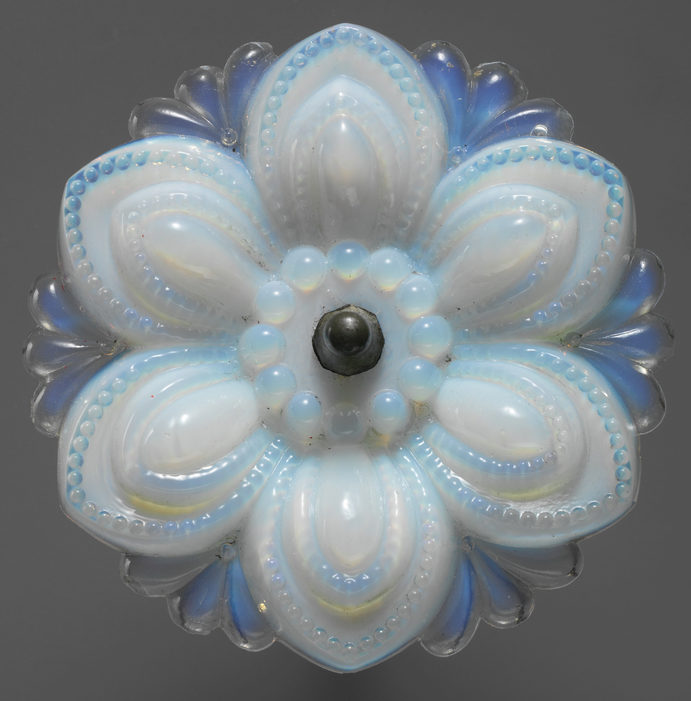
Drapery Tieback (1810–1860) THE MET Museum Public Domain
Opaline glass continued to be manufactured for the production of imitation pearls. This type of glass could be treated with hydrofluoric acid to create a pearlescent effect on the surface of the material. *The Pearl*, published in 1907, mentioned opaline glass as a substitute.
A cheap imitation of pearl is made of opal glass, a bluish-white milky appearing material, to which a pearly effect is given by treating it with fluoric acid. (p. 297)
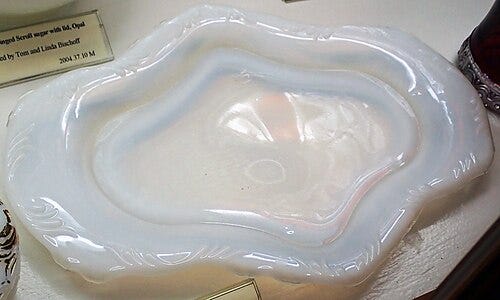
A Dresser Tray (circa 1899–1901) “1280 Winged Scroll” Opal. Commonly called milk glass. An opaque white glass. Heisey’s exhibits a large amount of “fire” when held to the light. Presented by James St. John Wikimedia Commons Image License
Another economical innovation in faux pearls that was also suitable for vegetarians and vegans was the development of early plastics, like celluloid with pearlescent finishes. Nitrocellulose was combined with mica and dyes to create false pearls in the early 20th century. Other early forms of plastic artificial pearls and mother of pearl were invented in the 1920s. There were attempts at creating synthetic pearl essence for creating artificial pearls was also developed in the same decade, and cosmetic-grade synthetic pearl essence was invented in 1930.
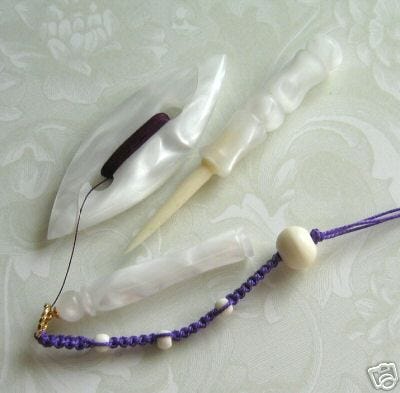
Celluloid Tatting Shuttle and Pick Set by Grizzly Mountain Arts Wikimedia Commons Image License
Driven by technological innovation and economic demand, the rise of new methods for creating artificial pearls without any animal products have created numerous vegan-friendly options for imitation pearl jewelry today. The variety of vegan-friendly faux pearls available in the current age would have been a treasure trove for pearl-loving fashion-conscious vegetarians of centuries past.
Notes:
- Information on demand for pearls in the 19th and early 20th centuries can be found on page 3 of the linked PDF.
If you love history, plants or the history of plants, consider supporting Plant Based Past by buying me a coffee!
For more vegan, vegetarian, and botanical histories, follow *Plant Based Past* on Medium.
You can sign up for email alerts to receive the next story when it becomes available, just by clicking the envelope icon. Receive a bonus historical recipe not seen in the publication, article recaps with free friend links to read, save or share once a month in your inbox by subscribing to Plant Based Past’s newsletter, Nutshell.
Next Week (7/3/26): Summertime Sweetness: Serviceberry — A Botanical History
메타데이터
- post_id
- 7175d2b4de2f
- slug
- oysterless-pearls-a-vegetarian-history-of-faux-pearls-7175d2b4de2f
- url
- https://medium.com/plant-based-past/oysterless-pearls-a-vegetarian-history-of-faux-pearls-7175d2b4de2f
- canonical_url
- https://medium.com/plant-based-past/oysterless-pearls-a-vegetarian-history-of-faux-pearls-7175d2b4de2f
- author_url
- https://medium.com/@plantbasedpast
- status
- ok
- fetched_at
- 2026-06-28 14:26:31