Oshun & Parvati: Divine Feminine that creates and destroys
Across continents, how goddesses write the history of civilisations.
Oshun & Parvati: Divine Feminine that creates and destroys
Across continents, how goddesses write the history of civilisations.
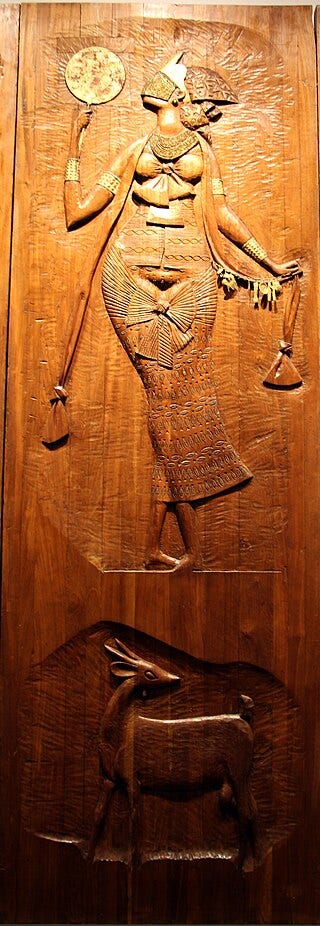
A wood carving of Oshun by Carybé (Image source- Wikimedia commons)
Let’s begin in a forest.
Ogun (the Yoruba god of iron, war, and technology, revered in Nigeria and across Yorubaland) had turned his back on humanity and vanished into the trees, disgusted by their misuse of his gift. Without him, the world tilts toward chaos.
It is Oshun (the Yoruba goddess of rivers, love, fertility, and beauty) who goes after him. In one story from Yoruba oral tradition, she ties bright scarves around her waist, lets her hips speak in rhythm, and offers honey at his lips. Ogun tastes sweetness, remembers beauty, and returns. Iron comes back to town. The world exhales. A love and passion that bends iron, restores order. All is well in the world.
This is Oshun: river’s pulse, goddess of fertility, music, and beauty. But never “soft” in the diluted sense. Yoruba memory recalls her as the indispensable envoy of creation- the only woman among seventeen orisha (divine spirits or deities in Yoruba religion, each governing aspects of the cosmos). When her counsel was ignored, creation broke down. Civilization, Yoruba tradition insists, needed her voice. Oshun’s love births abundance- but withdraws it just as easily. Honey, yes. But honey with teeth.
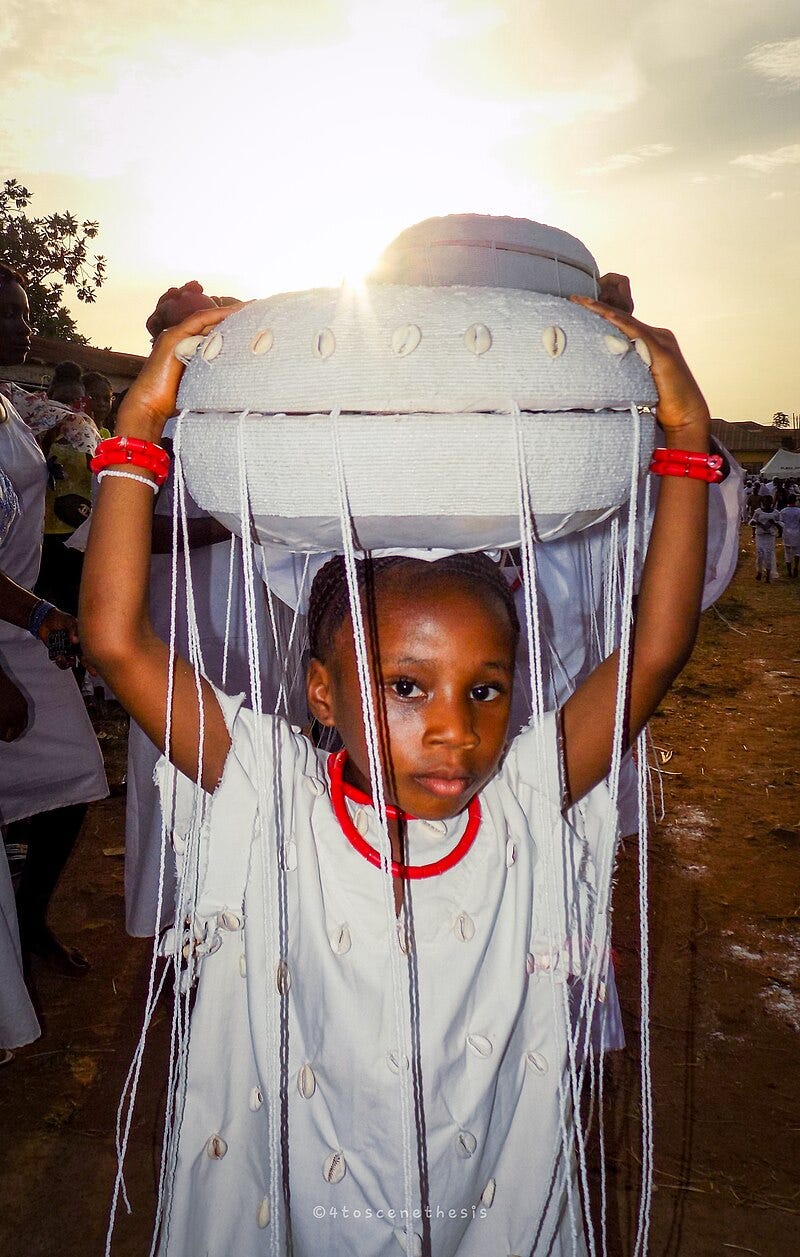
An Arugba at the Osun-Osogbo festival (Image source- Wikimedia Commons)
Each August, that paradox comes alive in Osogbo, Nigeria, at the great Osun-Osogbo festival. A young, unmarried girl, the Arugba (literally “the calabash carrier,” chosen from a royal lineage), walks through the sacred grove with a calabash balanced on her head, carrying a city’s petitions to the river shrine. In those hours, she is not only herself; she is Oshun’s vessel, the living bridge between human and divine. UNESCO calls Osun-Osogbo one of the last great sacred forests of Yorubaland. But for the community, it is not a relic; it is survival, renewed. The procession of the Arugba is a gamble on the goddess’s favor, a reminder that order rests on the fragile shoulders of one who embodies both sweetness and awe.
Across the great oceans, another story of a goddess can be heard, in chants and whispers, in temples and homes.
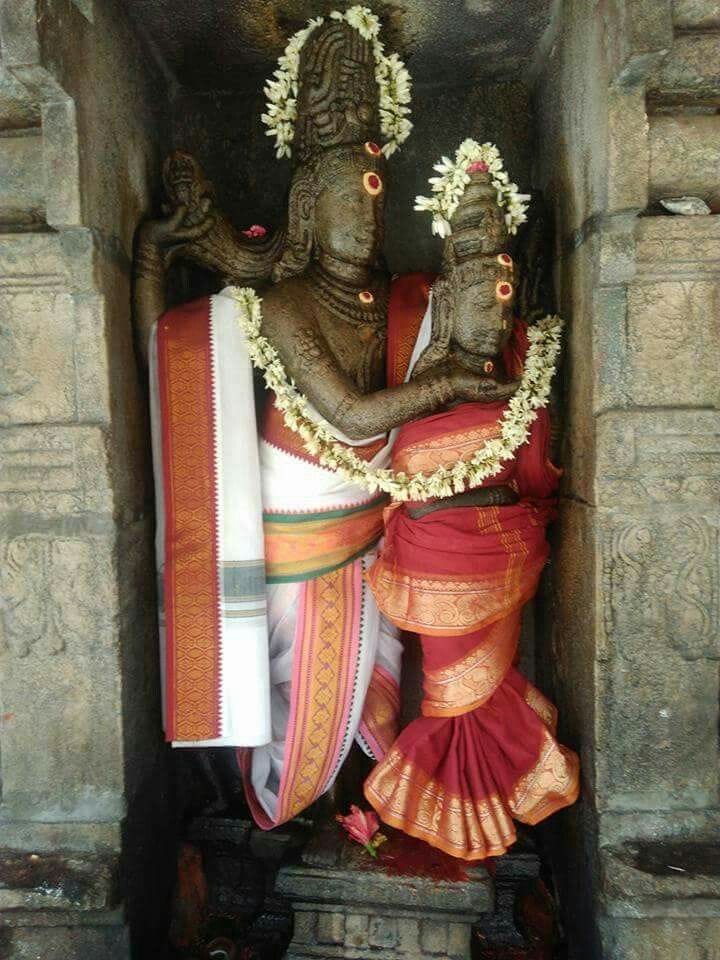
Shiva trying to please Parvati, the loving wife, who has turned away feigning anger, but hides her smile. A beautiful sculpture from Sri Meghanathar temple, Tamil Nadu, a perfect example of how the feminine energy is behind every actions, even behind the divine acts of Shiva. (Image source- https://in.pinterest.com/chitragowrisind/)
Another forest, this one in the Himalaya. Shiva sits alone, ash-smeared, withdrawn from the world. Parvati (Hindu goddess of fertility, devotion, and power, worshipped across India and Nepal) follows him. She is persistent: she prays, fasts, and endures. She becomes Shivakami (“the beloved of Shiva”), the one who softens the great ascetic. In Kashi (Varanasi), she appears as Annapurna (“She who is full of food”), placing rice in the begging bowl of the god who once scorched desire to ash.
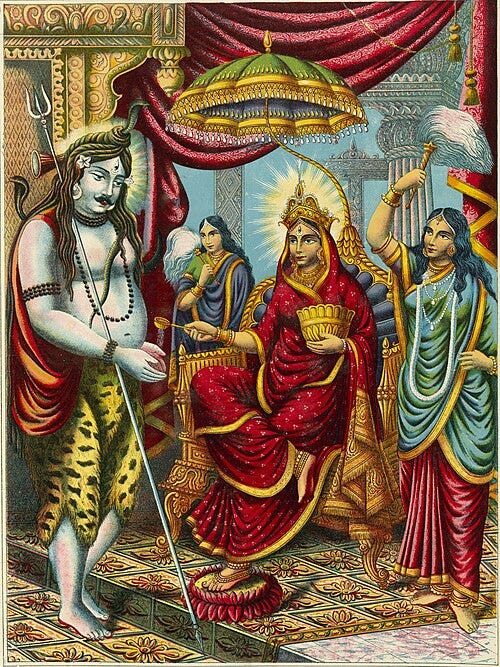
Parvati as Annapurna, giving food to Shiva, her husband (Image source- WIkimedia Commons)
Renunciation means little without the world it rejects. Annapurna is a lesson that without sustenance and blessings of the supreme feminine energy, the world will come to a halt. It is by Parvati’s motherly love that the world comes into being and is nourished.
But she has another face- Kali. The great warrior and the end of Kaal (time and death), beloved of Shiva, but in front of whom even Shiva lies still.
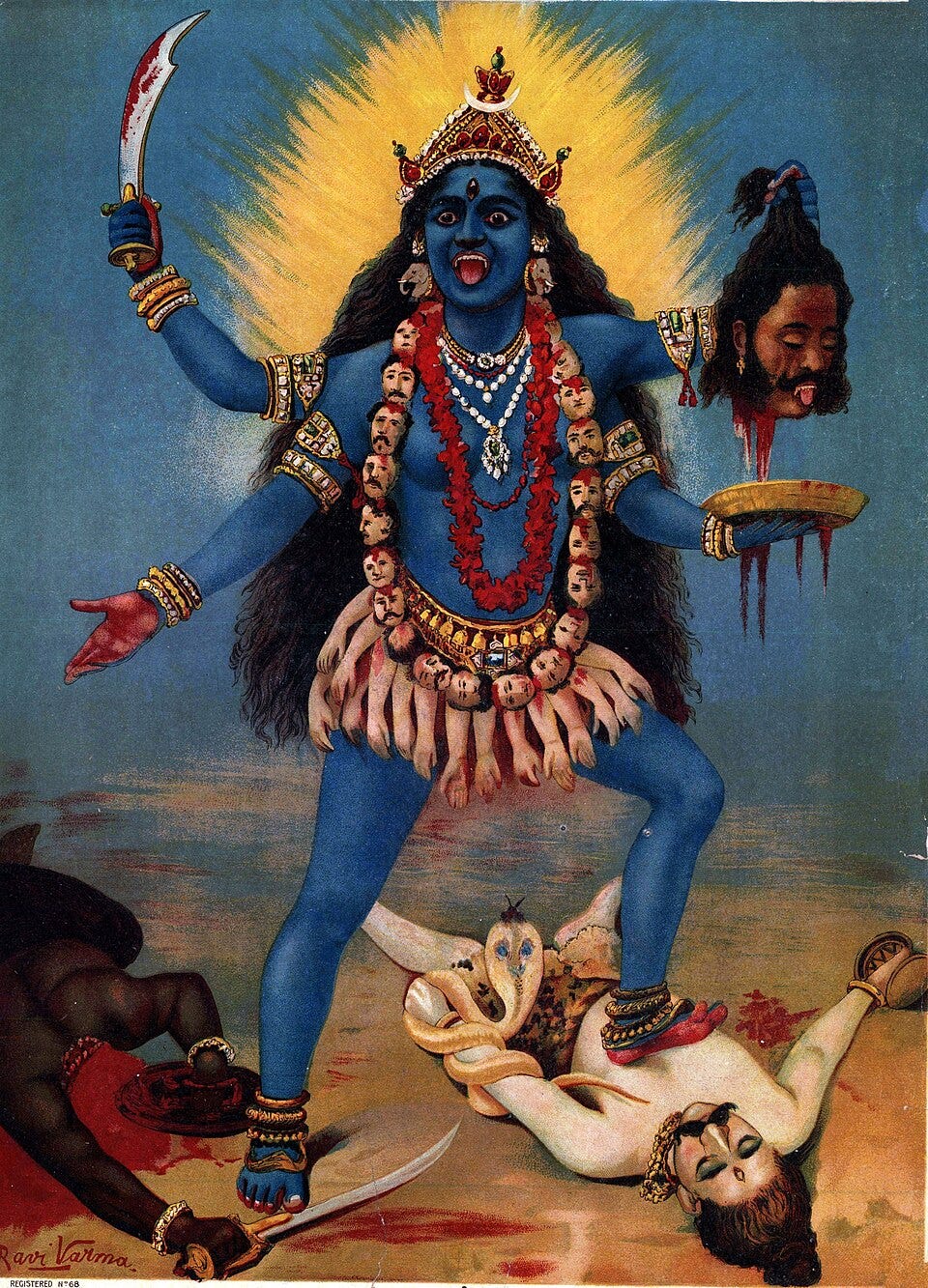
Kali by Raja Ravi Varma, a fierce aspect of the loving Parvati. Shiva in her feet. (Image source- Wikimedia Commons)
As Oshun lures Ogun back from the bush, Parvati draws Shiva back from his great asceticism. If Oshun’s honey restores iron and craft, Parvati’s pot restores food and hearth. Both bring civilization out of exile- not to weaken the wild male principle, but to yoke it again to cosmic work.
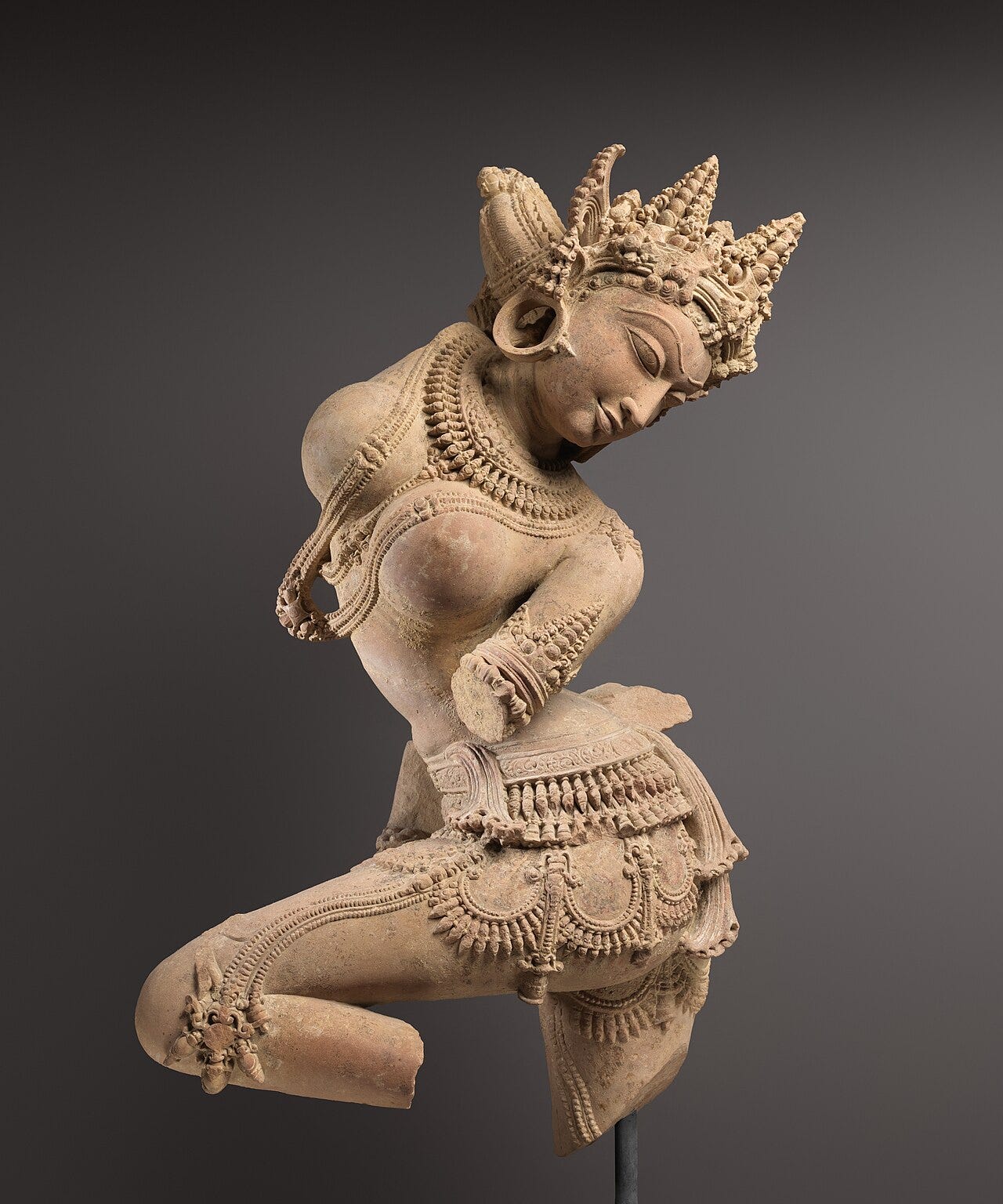
And then comes the deeper vision: Ardhanarishvara (a composite Hindu deity, half Shiva and half Parvati, depicted as one body split vertically down the middle). The image says what words cannot: creation is not conquest, but union.
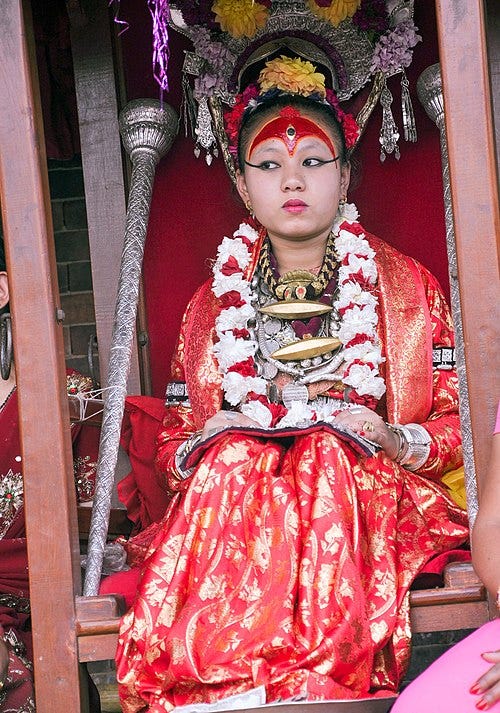
Chanira Bajracharya, the Kumari of Patan, during a procession in 2011. Kumari is the living goddess in Nepal Hinduism, a practice that is popular and controversial at once. (Image source- Wikimedia Commons)
Across cultures, the ritual logic rhymes. In Osogbo, a girl becomes Oshun’s path. In Kathmandu, Nepal, a girl becomes the goddess herself- the Kumari (a living child-goddess, worshipped until puberty, whose blessing is sought by kings and commoners alike). Seated at her carved window in Durbar Square, her glance is omen and blessing. In India, during Navaratri’s Kanya Puja (a ritual worship of nine prepubescent girls as forms of the goddess Durga), little girls are honored with washed feet, filled plates, and bowed heads. The youngest bodies carry the oldest power.
And what do these tales tell us about the human mind?
That we both fear and worship what we cannot domesticate. The feminine here is not “nice.” It is fertile and withholding, erotic and annihilating. Oshun’s river nurtures life, but without her, the land cracks. Parvati births gods, but as Kali, she drinks time itself.
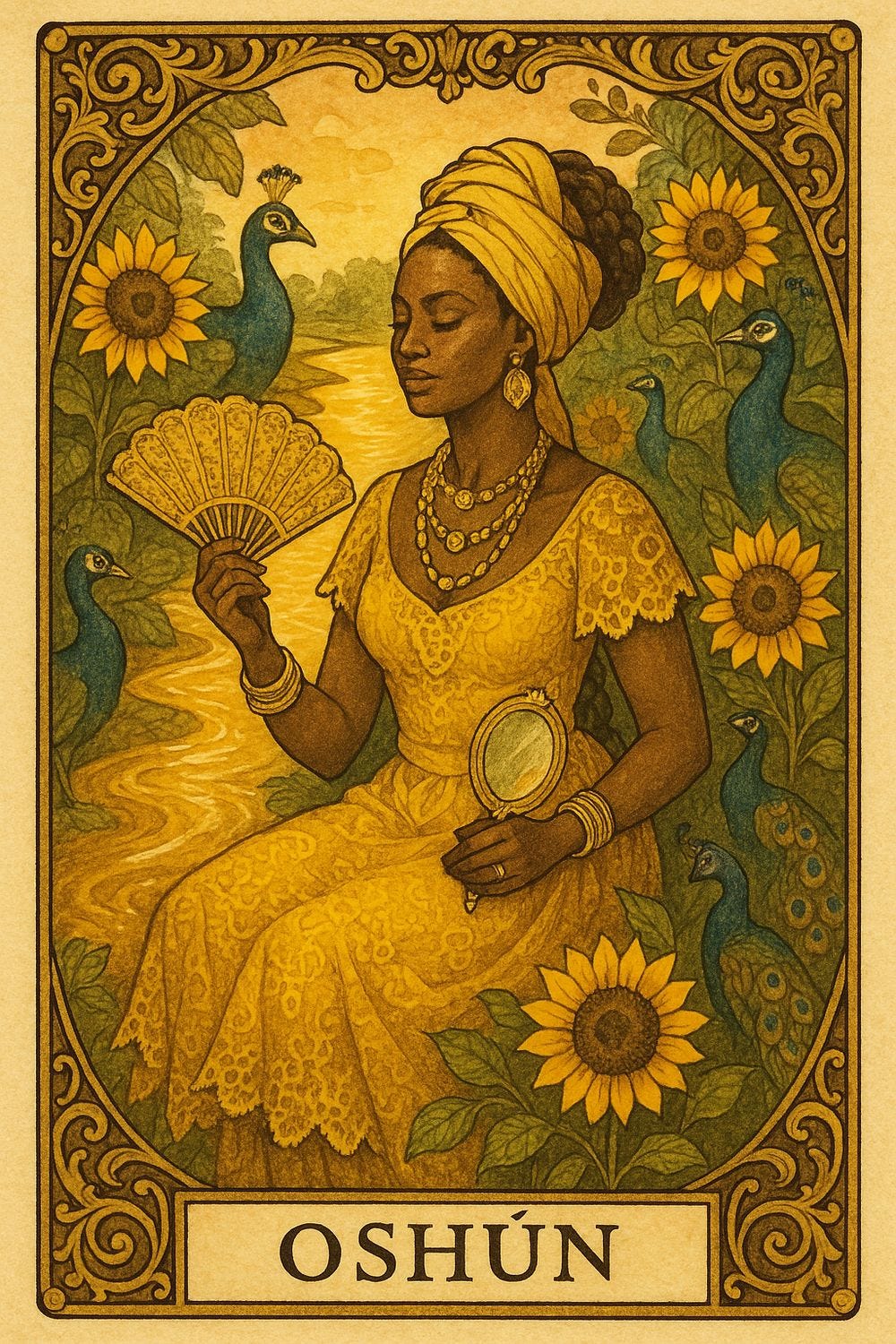
A tarot of Oshun. Her imagery and stories are also blended with Mother Mary and other Christian themes of motherhood; however, for those who follow Oshun, she represents divine femininity in her own right. (Image source- https://in.pinterest.com/PhoenixAworan/)
That societies must invite the wild back in, rhythmically, ritually. The Arugba’s walk is not quaint pageantry- it replays the risk of entrusting a city’s fate to a girl channeling a goddess who can bless, or drown it. Kanya Puja is not sentimentality; it is a reckoning with the truth that power often enters the world disguised as vulnerability.
That reconciliation is never conquest, but recognition. Ogun does not defeat Oshun. Shiva does not defeat Parvati. They resist, orbit, seduce, withhold- and then they work.
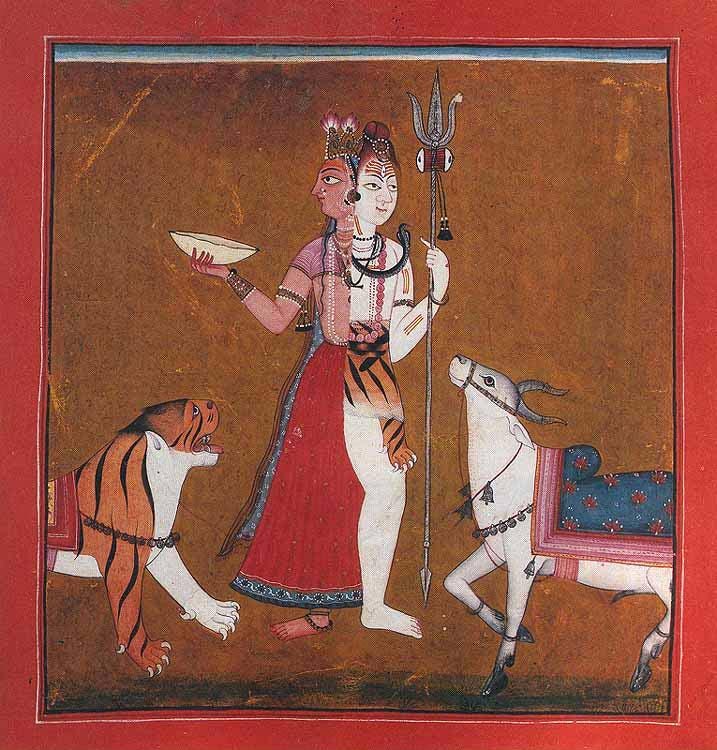
Ardhanarishwara- a half male, half female form of Shiva and Parvati. Parvati not only brings Shiva out of his ascetic state, he creates the world with him. Through their passionate and balanced Lilas, Shiva and Parvati, with Ganesha and Kartikeya (their children) make the ideal family, looked upto in Hindu tradition for harmony and familial love.
And finally, that the feminine does not merely endure death; she enthralls it. Shivakami, Kala-Kāminī (“the beloved of Shiva, the enchantress of Death”). Both lore insist the same truth: creation and destruction are twins. To face them is terror. To bow is wisdom.
So yes- continents apart, two rivers run to the same sea. Oshun and Parvati (as Annapurna, as Kali, as Durga) are not “similar goddesses,” but mirrors — reflections of a force that feeds and frightens, civilizes and unmakes, births and devours. Fear braided with reverence. Honey braided with skulls. Two stories of the divine feminine who is at the core of creation, life, destruction and everything in between.
메타데이터
- post_id
- 718301de7035
- slug
- oshun-parvati-divine-feminine-that-creates-and-destroys-718301de7035
- url
- https://medium.com/@prakritipassion/oshun-parvati-divine-feminine-that-creates-and-destroys-718301de7035
- canonical_url
- https://medium.com/@prakritipassion/oshun-parvati-divine-feminine-that-creates-and-destroys-718301de7035
- author_url
- https://medium.com/@prakritipassion
- status
- ok
- fetched_at
- 2026-07-17 10:11:07