‘Optimizing the management and use of an organization’s data, information and knowledge’.
Table of Content
‘Optimizing the management and use of an organization’s data, information and knowledge’.
Table of Content
2. Understanding Data, Information and Knowledge
3. Optimizing the Data, Information, and Knowledge
3.1 E-Commerce and Digital Business
3.3 Failures in E-Commerce and Digital Business
Introduction
“Knowledge has to be improved, challenged, and increased constantly, or it vanishes” Peter Drucker.
Knowledge comprises of pieces of information and information is gathered by polishing the data in certain formations to focus on components of information that could be useful for anyone or any organization. In order to make sure that knowledge is adding value to any process it is meant for, or extracted for, it needs to go through a progression frequently to make sure that it stays up to date to bring about the value it was meant to provide.
Computer systems collect data, produce and present information and help create knowledge (Gordon). Gordon states in his article that data is a set of fundamental facts, figures, observations, and measurements, without context or organization. While information is processed data which is organized and processed. Gordon proceeds to state that managers can use information to obtain knowledge which is an understanding or model about various components derived from information about those components.
Information plays the role of a resource like money, people, raw materials machinery or time in any organization, while information technology helps manage the information effectively and efficiently. The article will go through a set of examples of how some of the organizations have been successful in growing and becoming successful while optimally utilizing the information, along with a set of strategies and recommendations for organizations that are working towards gaining momentum in order to be successful in their businesses.
To sum it all together, it is important to understand that all three components data, information and knowledge need to be improved, validated and optimized in order to get the best value out of them.
Understanding Data, Information and Knowledge
In order to better understand the concept and relationship of data, information and knowledge,
Let’s take a look at figure 1. It explains the relationship between the 3 components under discussion. The figure shows the transformation of unprocessed data into knowledge or an understanding about sales.
While the relationship of data, information and knowledge is understood, the next step is to understand the concept of Information Systems.
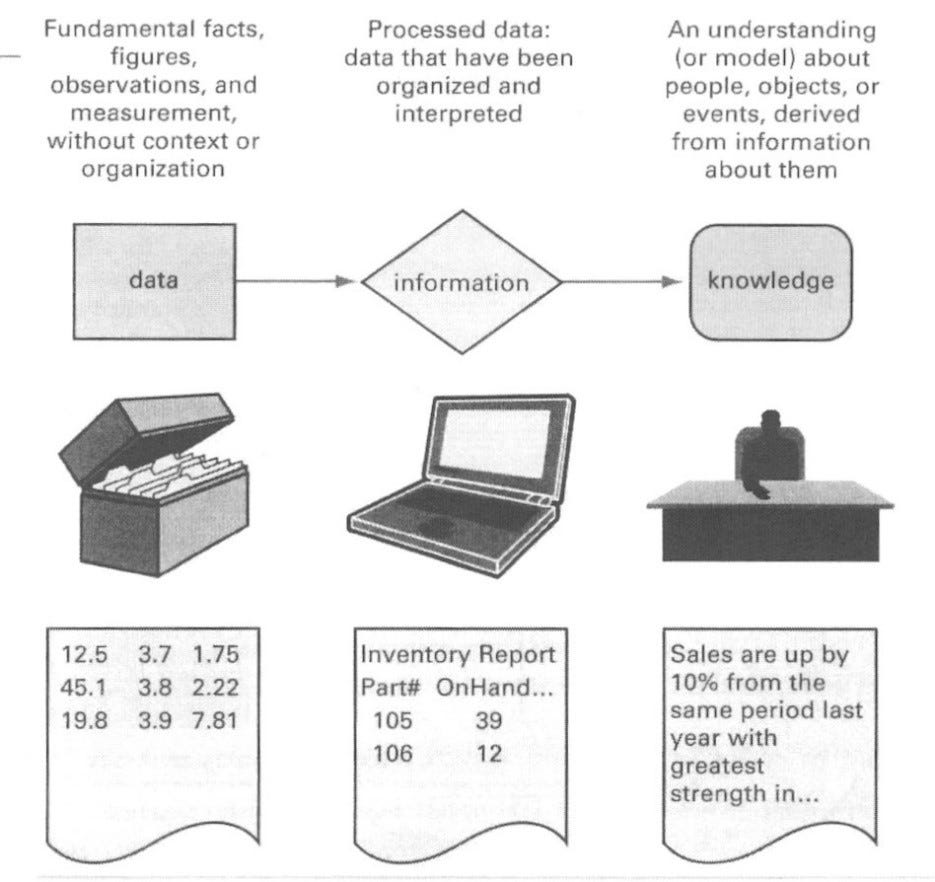
Figure 1 (Gordon, 2004)
Information Systems combine information technology with data, procedures for processing data, and people who collect and use the data. It is obvious that Information Systems and three components go hand in hand. In early days, information systems were used to process data and generate reports, however the phenomenon has increased its intents at many levels such as connecting various reports to produce more refined knowledge and use it to the benefit of growing businesses or making them more profitable.
Optimizing the Data, Information, and Knowledge
Since the inception of computers, organizations have been involved in the evolution process of various systems to improve the utilization of computers to aid them into reaching out to clients and users and to grow their profitability. In today’s world, as Cordoba-Pachon (2010) points out, life without computers is a thing of the past for many or something they didn’t experience at all. “For some people not only technologies but also information is the key to success. They have built companies and new ways of working based on the possibility of electronically exchanging information. Wireless technologies also make exchange of information faster an immediate”. (Cordoba-Pachon, 2010). While scholars have pointed out positive impacts of using technologies to make state of affairs improved, there could be some negativities that may come about while using the same utilities, this article will go through that point of view as well at a later time.
When it comes to view the benefits of optimization of these 3 components, let us understand what scenarios have been created by organizations over time. Noted in University of London CeFIMS (2017) few of these utilities are WWW (World Wide Web), internet, software applications (websites, applications). These tools are some of the ways organizations make the best use of data available to them, and they end up extracting useful information and using that knowledge to grow the foot print and user base of their businesses.
E-Commerce and Digital Business
One of the main result or benefit of using data, information and knowledge to your benefit is to take your business towards an approach of e-Commerce and/or Digital Business. While these are the very basic forms of how the organizations utilize computer or information systems to their advantage, few other tools created out of these systems are digital marketing, social media, and mobile commerce to name a few.
E-Commerce as defined by Chaffey (2015) is the act of buying and selling using the internet. While that is the main intent of e-Commerce, few other definitions of e-Commerce transpire it to be used for improving communications, business processes, services, and of course buying and selling of products and information online. While e-Commerce is defined above, Digital Business is broader in scope. A popular term coined by IBM in 1997 as pointed out by Chaffey (2015, page 14) is “the transformation of key business processes through the use of internet technologies”.
Success Stories
Such an example of growing users and gaining benefits given by Chaffey (2015, page 16) is of SunCorp whereby this financial services group has implemented a tool called Yammer which helped its teams across the globe share, discuss and innovate together. Jeff Smith, Suncorp, the Chief Information Officer of Yammer, explains the benefits as follows: “Yammer has enabled us to harness the wisdom of our people who are spread across multiple teams, geographies and brands to help achieve our purpose of delivering business solutions for competitive advantage”. (Chaffey, 2016)
Suncorp is clearly an example of using a combination of internet and intranet, and has definitely increased informal knowledge flow and collaboration.
In another example, eBay, an internet based business (which needs no introduction), describes its purpose as to “pioneer new communities around the world built on commerce, sustained by trust, and inspired by opportunity”. (Chaffey, 2004). The case study in Chaffey, 2004 goes on to explain the revenue model for eBay which is based on commission of completed sales, while Paypal, one of the subsidiaries provides revenue through commission which is charged for each transaction that is done through Paypal. It’s important to note that “Margin on each transaction is phenomenal, since once infrastructure is built, incremental costs on each transaction is tiny — all eBay is doing is transmitting bits and bytes between buyers and sellers”. (Chaffey, 2016)
Above examples of eBay and Suncorp allow us to understand the fact that there is an evolution that has taken place from simply generating reports from the initial model described in Figure 1, and more modern steps are being taken to make sure that utilization of data, information and knowledge is at its optimum level. It is necessary to mention that in both case studies, CIO from SunCorp made the decision to come up with a collaboration tool, while in eBay’s case, Pierre Omidyar waited at least couple of years before the users caught on the idea of using such a tool. In my opinion, above two examples make best use of data and information, and knowledge but let’s take a look at a case study that allows us to understand how social media marketing has revolutionized the ad-based model and take the concept of using data to its advantage at an ideal level. Facebook, another internet based, social media company that needs no introduction, held the largest initial public offering (IPO) in the history with a peak market capitalization of over $104 billion. The value proposition provided by Facebook is described as follows:
“Marketers can engage with more than one billion monthly active users on Facebook or subsets of our users based on information people have chosen to share with us such as their age, location, gender, or interests. We offer marketers a unique combination of reach, relevance, social context, and engagement to enhance the value of their ads”. (Chaffey, 2015)
The revenue model is ad-based and targets the users by age, interests, location, gender, and more. Facebook has optimized its presence and services for the users by making best use of polishing and massaging the data it gets from users and also has provided various platforms where users can access the Facebook utility. “People can access Facebook through our website, mobile sites, smartphone apps, and feature phone products” as described in Chaffey (2015, page 9). Now that Facebook has a precedence as the largest social network website, it still has aggressive plans to grow itself in countries where it lacks presence as it does in US and other countries around the world. These countries are relatively less-penetrated, large markets’ such as Brazil, India, Mexico and Japan.
Without undermining the effort that goes into processing and polishing the data, a paper published on Facebook’s research website will help readers of this article understand the depth of intricacy that goes into the engineering of various systems that allow Facebook’s team to handle Gigabytes of data per second. This *paper *states in its abstract that “In this paper, we identify five important design decisions that affect their ease of use, performance, fault tolerance, scalability, and correctness. We compare the alternative choices for each decision and contrast what we built at Facebook to other published systems.” (Chen, et al., 2016)
Failures in E-Commerce and Digital Business
Analyzing the examples of Suncorp, eBay, and Facebook allows us to understand that organizations have gone to lengths to make sure that they get the best usage out of data that they have been gathering in order to produce information and apply decisions based on knowledge gained out of the whole process. In doing so, there are some examples whereby such an exercise have resulted in failure if an organization has not used the data to its own advantage. One of those examples is Ecomom as described by Chaffey (2015, page 71) which was a startup, internet retail company selling earth friendly mum and maternity products. The irony is seen in the details of the case study that company’s CEO didn’t understand the numbers ad reports on finances of the company and simply refused to review them. To top it off, most of the accounting, payroll and bookkeeping was outsourced. Discounting strategy was another reason that allowed for the failure and loss of money in 2012. The company closed in 2013 and shortly after that, the CEO Jody Sherman took his own life. Ecomum story tells us that not only it’s important to have an information system in place, but there are elements such as Information management, role of people in information systems, and motivation to use IS must be paid attention to while the organization is going through changes in its life cycle of surviving and growing. Change management is another aspect of organizations’ survival and growth, and when it comes to changes in information systems, it is the responsibility of information manager that change project is supportive enough for the employees.
Other than the failures such as described above in the example of Ecomum, in general, there are few other negative impacts in the work environment in organizations that are, at times, dealt with. Few of these negative impacts are possible loss of organizational flexibility and adaptability, myth of omniscience, and loss of autonomy, etc. It is seen from arguments above that when it comes to an organization putting an information system in place, besides technical, there are human and organizational factors that have to be considered to make it to a success story.
Conclusion
We have established an understanding of how the 3 core elements data, information and knowledge which are the catalysts for creating information systems tie together and what kind of benefits and organization can achieve by using these three to their advantage. We have also realized that it is important for organizations to stay up to date with the technologies and inputs (data, information, knowledge) so that the advantage is at an optimum level. Stale data or information simply will not be helpful in many cases as older it gets, it becomes inadequate. It is also important to understand that not every organization has been successful in creating the systems around these elements and faced failure for one reason or another.
In essence, technology works as a combination of many factors, especially people. People are what make these systems successful, if they adapt well to the change (New system in place), they have higher chances of succeeding. It is not enough to only adapt to a change, the next phase is for people to actually understand the information, and use the knowledge to their advantage. Key factor is that how the technology and people are being managed and if they are guided in the right direction to utilize the data and it’s outcomes to their advantage optimally. And finally, it’s the people in the organization who realize that time has come to attain more data, improve the information and gain more knowledge so that system in place is performing at its best. There isn’t a technical system in place known to mankind that can make the decision as to when the time is appropriate to refresh the data (at least not as good as humans). It’s a job that is usually performed by humans once they analyze the information at hand and make that decision. Facebook isn’t the only organization that asks for user data, however it’s the only organization that has mastered the art of using the data optimally, staying in business and growing at a thrilling pace. “Eleven years later Zuckerberg (№1, Businessperson of the Year) has built something beyond cool: He has willed into being a global phenomenon. Facebook FB 1.47% is a nearly 16,000-employee media powerhouse worth $350 billion — and also an advertising-technology juggernaut on track to annual revenues of more than $27 billion in 2016 and gaudy profits of $7 billion” (Lashinsky, 2016)
Reference
-
Gordon Steven and Judith Gordon (2004) The Concept of Information, Information Systems: A Management Approach, 3rd Edition, New York: John Wiley & Sons.
-
Chaffey, D. (2015) Digital Business and E-Commerce Management, Strategy, Implementation and Practice. 6th Edition. Harlow UK: Pearson Education Limited.
-
Cordoba-Pachon, JR. (2010) Systems Practice in the Information Society. 1st Edition. Oxon UK: Routledge.
-
Chen, G. J. et al. (2016) Realtime Data Processing at Facebook [Online] https://research.fb.com/wp-content/uploads/2016/11/realtime_data_processing_at_facebook.pdf? [Accessed 1st May 2017]
-
Lashinsky, A. (2016) The Unexpected Management Genius of Facebook’s Mark Zuckerberg: Here’s what you can learn from Fortune’s Businessperson of the Year [Online] Available from: http://fortune.com/facebook-mark-zuckerberg-business/ [Accessed: 2nd May 2017]
메타데이터
- post_id
- 71a7b7a5bc5d
- slug
- optimizing-the-management-and-use-of-an-organizations-data-information-and-knowledge-71a7b7a5bc5d
- url
- https://medium.com/@adnan_md/optimizing-the-management-and-use-of-an-organizations-data-information-and-knowledge-71a7b7a5bc5d
- canonical_url
- https://medium.com/@adnan_md/optimizing-the-management-and-use-of-an-organizations-data-information-and-knowledge-71a7b7a5bc5d
- author_url
- https://medium.com/@adnan_md
- status
- ok
- fetched_at
- 2026-06-16 20:05:23



