What Is Education For?
You spent your best years becoming very good at exactly what a machine now does for free.
What Is Education For?
You spent your best years becoming very good at exactly what a machine now does for free.
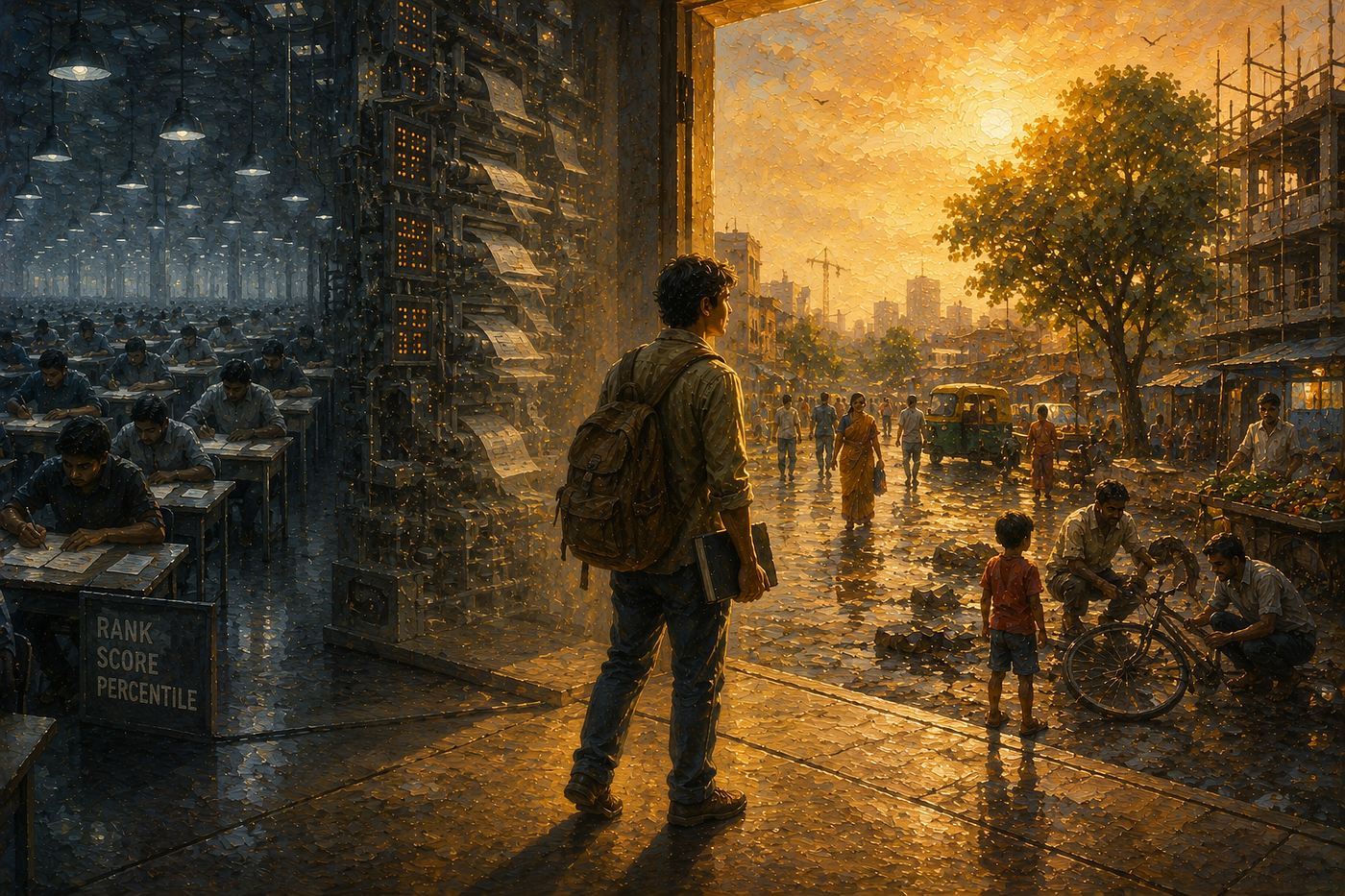
In 2025, with no announcement and no ceremony, a machine sat the JEE Advanced, India’s fiercely competitive entrance exam for its top engineering institutes, the one a whole generation of teenagers organizes its life around.
It was not enrolled and it did not travel to a center; researchers simply handed it the 2025 question papers. It placed around eighteenth in the whole country, among the nearly two hundred thousand who fight their way into the exam’s final round, itself the top slice of the more than a million who sit for it each year. It finished each three-hour paper in well under an hour. And it was not only the JEE. The same kind of system has passed the bar exam, cleared medical licensing exams, and taken gold at the International Mathematical Olympiad. Every fearsome gate we make our young adults climb through, software now walks through, cold, in minutes, for nothing.
Think about that. When a machine can effortlessly ace the very tests we use to measure human worth, it is not a victory for the machine. It is a question mark over the kind of society we have built.
For years you were told that your worth would be measured by these exams, so you trained. You became fast, accurate, obedient, able to produce the right answer under pressure. In effect you were being shaped into a certain kind of machine, a reliable answer-producing device. You gave it your best years, and your family gave it their savings. And then, just as you finished, an actual machine arrived that does the whole thing better than you ever could, instantly, and at no cost.
And this reaches far past the exam hall. The same wave is moving through real work: machines now write code, draft copy, review contracts, read scans, and take the first pass at almost any knowledge job. The careful, rule-following, answer-producing tasks that used to fill the early years of a career are exactly the ones being handed to software. The exam was only the rehearsal. The workplace is where it plays out.
The rank, the grades, the degree: none of it was ever really knowledge. It was a signal, a token you could hand a stranger to prove you were worth hiring, admitting, betting on. That is what a grade and a degree are: not the thing itself, but a marketable sign of it. And a signal that any piece of software can now produce on demand, for anyone, is worth nothing. The score, the seat, the certificate quietly lost their value, because scarcity was the only thing that gave them value, and scarcity is gone.
That should frighten you. It should also set you free, because it forces the question no one ever made you ask. If the machine can do all of that, what is left that is truly ours?
Start with what only a person can do: bring real knowledge and skill to bear on real problems, in the shifting, noisy world where those problems actually live. That is also what the exams were built to check, a quantitative measure of whether you carry the knowledge and skills a society needs, and that is their one honest purpose. But here is the trouble. The thing that matters most, judgment inside a live and changing situation, is exactly the thing the exam never tested. And it is exactly the thing the machine has not mastered either.
A machine is superb at puzzles. A puzzle is closed and tidy: the question is fixed, the answer exists, and someone already knows it. That is what an exam is, and it is exactly what a computer is built to win. But almost nothing in a real life is a puzzle. Life gives you problems, and a problem is a different animal, messy and particular, unfolding in an actual place, with real stakes and no answer key at the back. A problem falls to the person standing inside it: the one who understands the situation because they live in it, who can weigh what matters, and who will have to live with how it turns out. A machine can hand you the answer to a puzzle. It cannot stand in your life and decide.
That standing-inside, that judgment under real stakes, is the one thing the exam never measured and the coaching never built. And it is now the only thing worth a human’s years, because it is the only thing left that is truly yours. That is the human’s part now: not the answer, but the judgment of the person who has to live with it.
And this is not a contest against the machine, which you would lose. It is a partnership you get to lead. Let the machine take the routine, the recall, the first draft, the tidy puzzles it was built for, and spend what it frees on the part only you can do: choosing which problems matter, bringing judgment to the messy ones, and deciding what to do. Used well, it does not replace the thinker; it multiplies one. The person who can aim a machine at a hard, real problem and get somewhere faster and better than either could alone is exactly the person the world is short of.
Which settles, at last, what an education is really for. Not what it was reduced to, cramming you with answers so you could out-score the person next to you, but what it was always meant to do: build the ability to act well in complex, unfamiliar situations no one has faced before. That purpose has not reversed in the age of AI; it has only become unavoidable. Real education still means what it always should have: learning to think, and to solve real problems in a dynamic, noisy world. To ask whether a claim is true and how you would know. To carry what you know into a situation no textbook prepared you for, and to decide well as the person on the hook. This is not a soft ideal for gentler times. In an age of machines that answer everything and understand nothing, it is survival. And for those who learn it well, it is the way they will thrive.
You were trained to be a machine at the exact moment the world stopped needing more of those. The years ahead can go to becoming the one thing it will always need and can never build: a person who can think, put the machines to work, and solve real problems in the real world. And that is what an education is truly for. It leaves a harder question: how did the grade, a mere signal of learning, ever come to matter more than the learning itself?
메타데이터
- post_id
- 71a86d2be40d
- slug
- what-is-education-for-71a86d2be40d
- url
- https://medium.com/@jain49/what-is-education-for-71a86d2be40d
- canonical_url
- https://medium.com/@jain49/what-is-education-for-71a86d2be40d
- author_url
- https://medium.com/@jain49
- status
- ok
- fetched_at
- 2026-08-18 06:12:11






