The IRGC Says It Hit 85 American Targets.
In the early hours of July 8, 2026, Iran’s Revolutionary Guard launched its most ambitious single strike package of the war. What the two…
The IRGC Says It Hit 85 American Targets. The Pentagon Says Nothing Happened. Both Statements Cannot Be True.
In the early hours of July 8, 2026, Iran’s Revolutionary Guard launched its most ambitious single strike package of the war. What the two sides say happened next tells you everything about where this conflict is heading.
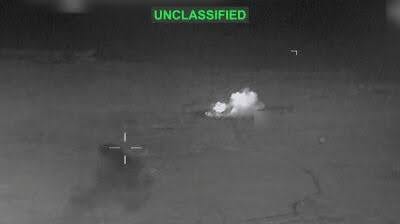
Released images of US strike on Iran.
The Islamic Revolutionary Guard Corps announced on July 8 that its Navy and Aerospace Force jointly struck 85 key US military facilities in Bahrain and Kuwait in a missile and drone operation, while also shooting down an American MQ-9 drone. The targets, according to Tehran, included the US Fifth Fleet headquarters at Port Salman in Bahrain and Ali Al Salem Air Base in Kuwait, two of the most strategically significant American military installations in the Gulf. The IRGC described the operation as a “decisive response” to US strikes on five Iranian coastal positions earlier the same day.
A US official told Reuters there were no reported casualties and no major damage to American facilities in the region. Both governments delivered their statements within the same news cycle. Both cannot simultaneously be true.
What We Know About the Strikes
The IRGC confirmed its Navy and Aerospace Force launched ballistic missiles and armed drones between 02:00 and 03:00 local time, targeting installations at Ali Al Salem and the Fifth Fleet’s Salman Port headquarters. Qatar’s Ministry of Defence separately reported that Al Udeid Air Base, home to US Central Command’s forward headquarters, was also hit, though it said no casualties resulted. A Qatari citizen on a coastguard vessel died from shrapnel wounds sustained during the regional military operations, according to Qatar’s Interior Ministry.
[embed]
Bahrain called the strikes a “dangerous escalation” that violated its sovereignty. Kuwait condemned what it described as “repeated, heinous Iranian aggressions” and a “flagrant violation” of its sovereignty. The UAE called the attacks a “blatant violation” of Gulf state sovereignty and a threat to regional security and stability.
The Credibility Gap
The gap between what Tehran claims and what Washington acknowledges is not new in this conflict, but the June 28 exchange exposed it in particularly stark terms. Commercial satellite imagery from earlier 2026 strike waves had shown damage to fuel bladders, structures, and aircraft shelters at Ali Al Salem that was not reflected in contemporaneous US public statements. OSINT analysts identified what appeared to be a direct hit on an early-warning radar inside the base perimeter. A separate analysis identified three Kuwaiti Eurofighter Typhoons destroyed and two Italian fighters damaged, though neither government confirmed these losses.
The pattern is consistent: the IRGC claims destruction, CENTCOM reports no impact, and satellite imagery released weeks later tells a more complicated story. As of June 28, the Pentagon had confirmed 13 US service members killed in the conflict and approximately 373 wounded, figures that reflect a war producing real casualties regardless of the divergent damage assessments.
The Ceasefire That Keeps Breaking
The June 28 strikes represent the third major Iranian strike wave against Kuwaiti territory in four months. The conflict began on February 28, 2026, when US and Israeli forces launched coordinated airstrikes on Iranian military and government sites, killing Supreme Leader Khamenei. Iran retaliated with ballistic missile and drone strikes across the Gulf and blocked the Strait of Hormuz, through which approximately 20% of the world’s oil transits.
A ceasefire MOU was agreed on April 7, but the June 28 escalation followed an Iranian drone strike on the Singapore-registered container ship Ever Lovely on June 25, a US response hitting Iranian coastal sites, and then Iran’s retaliatory strike on the Gulf bases. The IRGC explicitly warned that any future violation of the ceasefire would result in the “complete suspension of all related processes,” a direct threat to Phase 2 nuclear negotiations already described as uncertain.
메타데이터
- post_id
- 71a8ac2dc739
- slug
- irgc-85-us-targets-bahrain-kuwait-strikes-july-2026-71a8ac2dc739
- url
- https://medium.com/@GoldaMizrahi/irgc-85-us-targets-bahrain-kuwait-strikes-july-2026-71a8ac2dc739
- canonical_url
- https://medium.com/@GoldaMizrahi/irgc-85-us-targets-bahrain-kuwait-strikes-july-2026-71a8ac2dc739
- author_url
- https://medium.com/@GoldaMizrahi
- status
- ok
- fetched_at
- 2026-07-11 02:02:54