You’ve read so many Self-Help Books. Why Hasn’t Your Life Changed?
There’s a quiet frustration that lives inside ambitious people.You consume books, listen to podcasts, fill journals with highlights, and…
You’ve read so many Self-Help Books. Why Hasn’t Your Life Changed?

There’s a quiet frustration that lives inside ambitious people.You consume books, listen to podcasts, fill journals with highlights, and genuinely want to grow.
And yet, five years later, your life looks strangely similar to where you started. I was in the same situation after reading so many self-help books, but my life hardly changed.
Same habits. Same patterns. Same loop.
If this sounds familiar. You’re caught in what researchers call the Self-Help Paradox — and once you see it clearly, and understand exactly how to escape it, everything changes.
The Paradox Nobody Names
Self-help is unique among all genres. It’s the only field where you can become a lifelong consumer and still feel like a complete beginner.
You can read Atomic Habits, The Power of Now, Think and Grow Rich, Deep Work, and fifty more — and still struggle with the same procrastination, confusion, and inconsistency you started with.
Why?
Because self-help gives you clarity without commitment. Hope without responsibility. A sense of progress without any real movement.
In short: self-help makes you feel like you’re changing while keeping your life exactly the same.
The Cycle That Keeps You Stuck
Most self-help readers fall into a predictable loop:
- Feel stuck
- Read a book for clarity
- Get momentarily inspired
- Fail to act consistently
- Feel stuck again
- Seek another book for relief
It’s not a reading habit. It’s a dependency.
The key thing to notice: step 6 loops back to step 2, not to step 4. Every time the cycle completes, you go get more information instead of going back to fix the execution failure. More input. Same output.
Why Smart People Fall for This Hardest
The more intelligent and ambitious you are, the easier it is to get trapped.
High performers love frameworks. They love planning. They love learning how things should work.
But high performers share one critical blind spot:
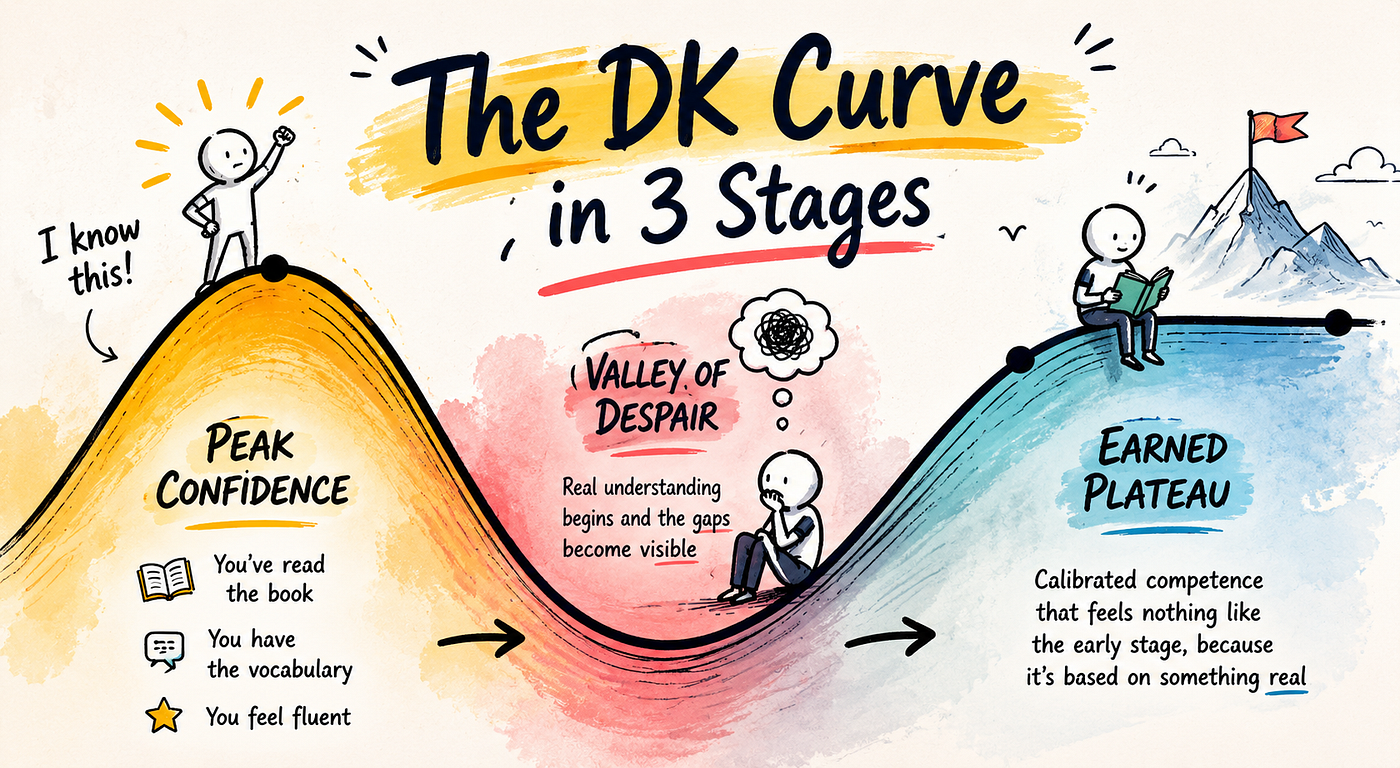
They confuse understanding with executing.
This is not an intelligence deficit — it is a deeply documented structural problem. Organizational psychology identifies it as the “knowing-doing gap”: the persistent failure to translate acquired learning into real-world action (Cheng et al., 2020; Bailey & Ford, 2003). The mechanism is straightforward. Thoughts and cognitive pattern-matching are biologically inexpensive. Tangible action requires substantial metabolic and emotional effort. When knowledge is acquired but action is deferred, the brain mistakes the accumulation of information — potential energy — for behavioral execution, which is the only thing that actually produces change.
Knowing how a gym works won’t build muscle. Knowing how a habit works won’t build discipline.
Knowledge is potential energy. Action is kinetic energy. Most self-help readers never make the conversion.
When Self-Help Becomes Self-Sabotage
At a certain point, reading becomes an escape from real problems. A way to feel prepared without committing. A substitute for doing the uncomfortable things.
Self-help becomes self-sabotage when it replaces courage with comfort.
You feel productive. You’re actually safe. You feel aware. You’re not moving. You feel inspired. You’re avoiding the truth.
There’s a specific sign to watch for: if your first instinct when you feel stuck is to open a new book instead of revisiting what you already know and haven’t applied yet — you’ve crossed the line from learning into avoiding.
The Way Out: A Method, Not a Mindset
The answer isn’t to stop reading. It’s to change how you read. Specifically, there’s a three-step ritual that closes the gap between absorbing information and actually changing your life.
Step 1: Read to find ONE idea — not to finish.
Most people read for completion. Instead, read with this question running in the background: What is the one idea in this chapter that would change something in my life if I applied it today? The moment you find it, stop. You have what you came for.
Step 2: Extract three things — nothing more.
Write down: 1.the key idea in one sentence, 2. the specific action it calls for, and 3. when and where you’ll do it. That’s it. No long summaries. No highlight collections. Three things on a single card.
Here’s what that looks like in practice: You read a chapter about habit formation. Your extraction is — Key idea: small habits compound over time. Action: do 5 push-ups every morning. Trigger: right after I brush my teeth. Done.
Step 3: Apply within 24 hours.
Here’s the neuroscience behind this: the human brain actively prunes newly acquired information that is not immediately used. Modern replications of the Ebbinghaus Forgetting Curve confirm that retention drops to approximately 33% within 24 hours of passive exposure — meaning up to 70% of what you read disappears within a single day if you don’t act on it (Murre & Dros, 2015). The window is short. The action needs to be small — two minutes or less — but it must happen the same day.
This is the shift from collector to converter. You stop building a library of ideas and start building a life of habits.
Start Right Now
Before you open the next book, go back to the last one you read. Pick one idea you highlighted but never acted on. Write the action and the trigger. Do something about it today — even if it’s small.
That single act is worth more than the next five books you were planning to read.
Share this with someone who has a shelf full of self-help books and a life that hasn’t changed. They don’t need another recommendation. They need this.
The Architecture Behind the Method
The three-step ritual above solves the immediate problem: what to do with a single book you just finished. But most serious readers have a deeper problem — years of highlights, ideas, and half-applied frameworks scattered across notebooks, apps, and memory, none of it connected, almost none of it retrievable when you actually need it.
That’s not a discipline problem. That’s an architecture problem.
The Zettelkasten method is the structural answer. A knowledge system built not to store what you read, but to think with it. Instead of a growing archive of notes you never return to, a working Zettelkasten produces connections between ideas across books, disciplines, and years. The output isn’t a better filing system. It’s original thinking you couldn’t have reached by reading alone.
The problem is that most introductions to Zettelkasten stop at theory. The philosophy is explained clearly. Monday morning is left blank.
**Zettelkasten with Obsidian and a Notebook* is written specifically for the reader who has already tried — who has read How to Take Smart Notes*, watched the tutorials, and still faces an empty vault and a blank page. It gives you a complete two-layer system: a physical notebook for daily capture and Obsidian for permanent, linked storage. Every step is shown through real examples — the daily capture ritual, the weekly processing session, and the linking method where original ideas actually come from.
If the gap between reading and doing is the problem this post describes, this is the system that closes it permanently.
**Get your copy here →**https://amzn.to/3Rf7rqe
Everything I write is free — and will stay free. If this helped you think differently, you can support it here: https://ko-fi.com/mz_ahmad It directly funds more writing like this.
References
Bailey, J., & Ford, C. (1996/2003). Knowing–doing gap in business schools. Academy of Management Learning & Education. https://doi.org/10.5465/AMLE.2003.11902092
Cheng, C., et al. (2020). Navigating the leadership knowing-doing gap in leveraging leadership development. Academy of Management Learning & Education. https://doi.org/10.5465/amle.2020.0534
Murre, J. M. J., & Dros, J. (2015). Replication and analysis of Ebbinghaus’ forgetting curve. PLOS ONE. https://doi.org/10.1371/journal.pone.0120644
메타데이터
- post_id
- 71ae685cd142
- slug
- youve-read-so-many-self-help-books-why-hasn-t-your-life-changed-71ae685cd142
- url
- https://medium.com/@mohammadzeyaahmad/youve-read-so-many-self-help-books-why-hasn-t-your-life-changed-71ae685cd142
- canonical_url
- https://medium.com/@mohammadzeyaahmad/youve-read-so-many-self-help-books-why-hasn-t-your-life-changed-71ae685cd142
- author_url
- https://medium.com/@mohammadzeyaahmad
- status
- ok
- fetched_at
- 2026-06-09 15:37:30