OK Computer or the Modern Memento Mori
Though today we think of Radiohead as pioneers in alternative and experimental rock, we can’t forget their origins in the “Cool Britannia”…
OK Computer or the Modern Memento Mori

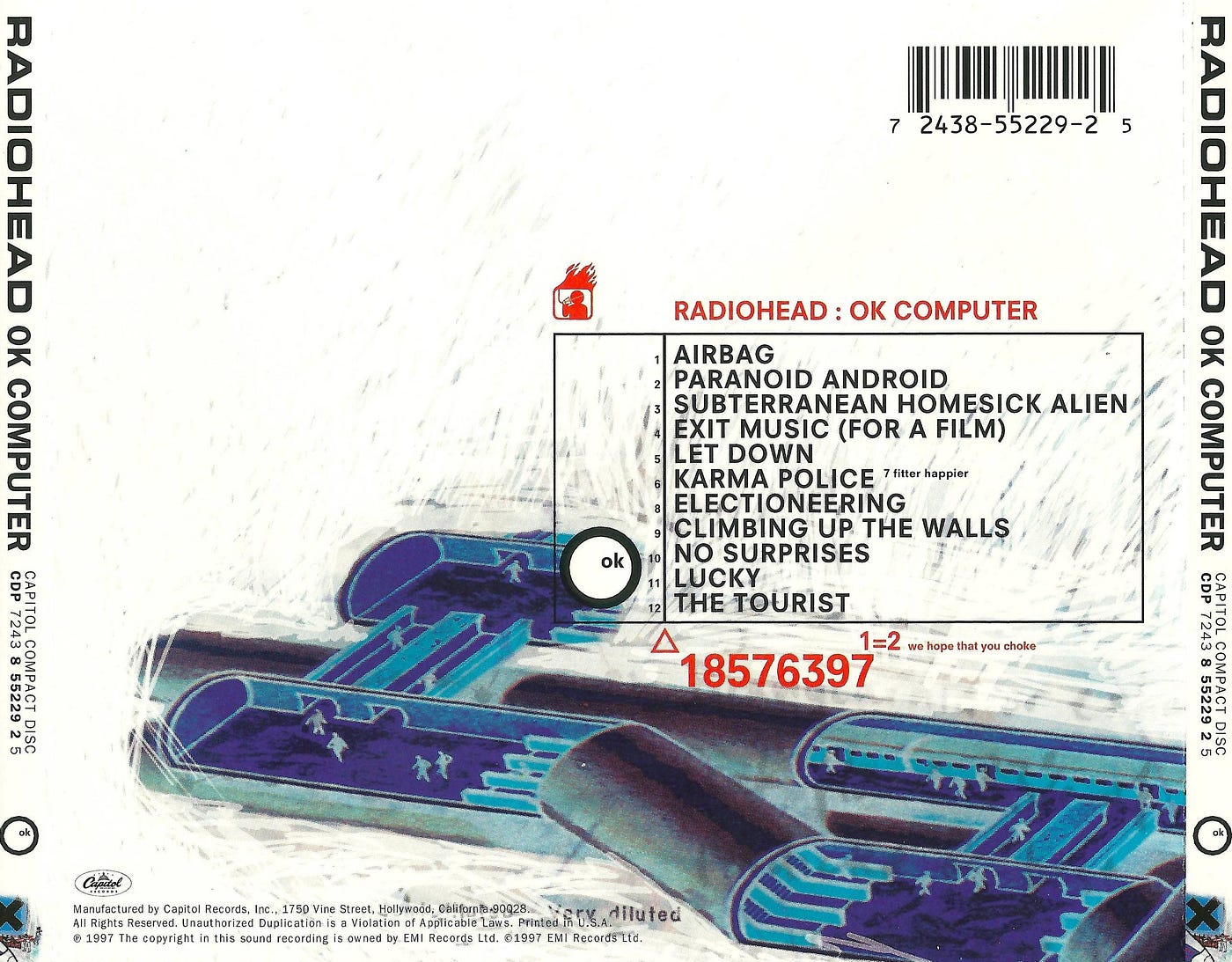
Though today we think of Radiohead as pioneers in alternative and experimental rock, we can’t forget their origins in the “Cool Britannia” era of the 90’s. Their #1 hit single Creep made them a herald of Britpop, much to their own dislike. After their critically acclaimed sophomore album of The Bends, the band wanted to remove and distance themselves from the lump of other pop-rock acts of the time. Surviving a tiresome touring schedule and a gruesome recording process, Radiohead released their seminal album OK Computer in 1997, rebranding themselves to the world as a band beyond genres or labels. Separating from the angst and deeply personal narratives of their previous albums, OK Computer explored more abstract themes but also explicitly criticized struggles with the artificiality of modern society; some would even say foreshadowed the dystopian coming of late-stage capitalism. Though the band has repeatedly refuted that OK Computer is not a concept album and there’s no unity between the lyrical content of each song, I’m going to be one of those critics that points to an overarching theme, even if it was unintentional from Radiohead’s part.
OK Computer serves a reminder to the 21st human that we will die; it is a modern memento mori if I dare say. The entire album’s lyrical content shows Thom Yorke’s struggle with his own mortality as he enters through the stages of grief. Every song serves as a stage ultimately reaching acceptance of death as the inevitable bridge Yorke will eventually cross.
We begin with the song Air Bag, where Yorke details the experience he went through after suffering a car crash. Instead of being grateful of the modern technological safety advances, Yorke chooses a more arrogant attitude, “I am born again…I’m back to save the universe” alluding to God-like powers, re-incarnation and omnipotence; all a big denial of Yorke’s mortality. This introduction is followed by Paranoid Android, where Yorke continues with the arrogance but adds anger to his voice. Screaming over screeching electric guitars, Yorke relinquishes his omnipotence but not his power, because he now refers himself as “king”. Almost as if Yorke was reborn again in medieval times, he justifies this power through the divinity, “God loves His children/ God loves His children, yeah” but lashes out to Death, now a full-fledged entity personified. He points at Death and asks his servants to “off with his head” and only gets madder with power and rage when Death doesn’t remember his name:
You don’t remember, you don’t remember Why don’t you remember my name? Off with his head, man, off with his head, man Why don’t you remember my name?
Because to Death, Yorke is no king, he is just another soul to be reaped. Yorke’s violence and power-hunger eases as he enters into the bargaining stage with Subterranean Homesick Alien. He is no longer a king or a God, but rather seems to regain his youth and live in a small town, in a small world, fit of his small presence in the grand picture of life. He asks for super-natural beings, in this case aliens who simply visit Earth to make movies, to take him and raise him to the heavens beyond his “country lanes” and take him for a ride,
I wish they’d swoop down in a country lane
Late at night while I’m driving Take me on board of their beautiful ship Show me the world as I’d love to see it
A world where he doesn’t have to die, a world where he would know “the meaning of life”. Yorke feels isolated and refers to his friend as non-believers, and wishes he could be an eternal observer of the world instead of actively participating in this life where he one day, will eventually die. Yorke is trying to leave behind his home world, his home life and begs for a lift to the heavens to rise above his mortal being. With a quieting ending, we enter a depressive state with Exit Music (For a Film), where Yorke starts to come to terms with Death and feels its presence, “…there’s such a chill, such a chill”. The cold grip of death is chilling Yorke as he attempts to “keep breathing” but futilely realizes he “can’t do this alone”. The stage of depression begins but doesn’t realize its full potential because anger rises immediately after, again going after Death, “Now we are one in everlasting peace/ We hope that you choke / That you choke” almost with the attitude that Yorke will bring down Death with him.
Full depression sets in, and in the most beautiful way imaginable. Let Down describes the life around, the external world, because Yorke can’t look inward, “the emptiest of feelings” consumes him and he so disappointed all he sees are people who are just like him; people who rejoice in excess “disappointed people clinging on to bottles”. Yorke feels cheated out of life and takes a Kafkaesque attitude himself “crushed like a bug on the ground/ Let down and hanging around” He continues his metamorphosis with “…juices flowing, wings twitch, legs are going” but his nihilist attitude expands “hysterical and useless/ hysterical and / let down and hanging around”.
Unfortunately, Yorke reverts back to bargaining as he seeks help from the universe. Being karma the ultimate law, Yorke asks the Karma Police to arrest the man, the big man that oppresses all: Death. To the surprise of the listener, karma responds with “This is what you’ll get/ This is what you’ll get”. This is what’s waiting for you, death is waiting for you at the end. This is just another attempt of bargaining, as Yorke relinquishes his power entirely and asks for help from universal laws or beings. He is exhausted of fighting and declares it “Karma police, I’ve given all I can/ It’s not enough…” and begs for a way out. And again the repeated chorus echoes, but this time its karma accompanied by Death, “This is what you’ll get/ When you mess with us.” The universe answers back and re-iterates that Yorke, like everyone else, will die. In a fit of stubbornness, or natural survival, Yorke enters in denial again, “for a minute there I lost myself” as the song ends.
If he can’t fly away or catch a ride with super-natural beings, Yorke chooses to shut off and not participate at all. A monotone avoidant voice reciting lyrics detailing a life full of emptiness and unfulfilling goals, Fitter Happier isn’t even sung. A synthesized voice from a Macintosh computer replaces Yorke’s vocals, alluding to Yorke giving up his free will and choosing a machine to speak for him instead. Ironically, this fake plastic song is the richest in lyric content and almost in a poetic way describes all the ways he attempts to distract himself with meaningless arbitrary life goals just to deny his own mortality. While Electioneering is very much explicitly a political satire, it doesn’t deviate from the stages of grief nor the battle Yorke is having with Death. Being a polar opposite of the previous song, Electioneering takes a political and activist approach. Yorke is back again in charge of his own life, and with an over-zealous attitude against the modern world. From choosing to not participate in his own life, Yorke springs back and becomes part of a revolutionary movement against the oppressive forces in his world, attempting change to make his legacy live, all again, in the hopes of evading death. “I will stop at nothing” Yorke yells through his teeth. All a tangent to deviate his mind from the obvious: death is coming.
At last, Death has had enough and sings through Yorke’s voice. Climbing Up Your Walls is a terrifying statement and reminder that no matter how many “walls” Yorke puts up, no matter where he goes Death will reach him,
You know we’re friends till we die
And either way you turn, I’ll be there Open up your skull, I’ll be there Climbing up the walls
Even with plentiful food, modern medicine miracles, and the same technological Air Bag that saved his life six songs prior, Yorke is reminded that time and Death will eventually catch up to him and is finally forced to accept the inevitability of it all. This is Death speaking directly, through Yorke’s voice and reminding him that no matter how many futile attempts he tries, Death will eventually claim his soul.
Finally, Yorke accepts his fate, but not without reminiscing the previous songs. No Surprises begins with references to Electioneering and Fitter Happier as he speaks of “bring[ing] down the government” and “a job that slowly kills you”, but alas Yorke embraces and accepts Death for what it is,
I’ll take a quiet life A handshake of carbon monoxide And no alarms and no surprises No alarms and no surprises No alarms and no surprises
No need to be alarmed or surprised with the events the life may throw at him, Yorke shakes the hand of Death like a friend. With this newfound acceptance of Death, Yorke explores the beauty beyond him and outside, the beauty found in the world he couldn’t see in Let Down, “Such a pretty house, such a pretty garden”. Yorke fully embraces death and to a further extent that need be, or so it seems to be the case in the following song Lucky. He feels fortunate not only to be alive, he feels lucky he is a mortal, and engages in mania. Like every romantic, Yorke over-indulges and not only welcomes death but seeks it,
I’m on a roll I’m on a roll, this time I feel my luck could change
Kill me Sarah Kill me again with love It’s gonna be a glorious day
We don’t know who Sarah may be, but to ask her to kill him tells us that Yorke not only trusts her with his life but with taking it. Not only does Yorke no longer fears the day he’ll l die, but revers it as a “glorious day”, fully engaging with the call of the void as he looks down on the deep, “We are standing on the edge” he declares with joy.
Yorke, however, snaps back to his senses and reminds himself that he is a The Tourist in this world. Being closed off inside his head, he puts death back in a place of respect but not friendliness. He recalls “It barks at no one else but me” reminiscent of Climbing Up Your Walls but instead of dwelling in a pit of despair or rushing to death in a gleeful way, Yorke reminds himself “hey man slow down, slow down, idiot, slow down slow down.” This acceptance, contrary to the Lucky attitude, is a peaceful and composed resolution.
Whether Radiohead intended to create a musical memento mori or not is irrelevant at this point. The abstract nature of the lyrics, though verging on anti-capitalistic and modern society critique, pay mind to no one or anything; and hence are susceptible to interpretation of the reader or listener. Though there was no direction or unifying connection stated by the band, Thom Yorke painted a sonic picture that sprouted from his close call with actual death, and created a lyrical journey through his grief from that experience that is difficult to ignore or deny. Paving a struggle with the embodiment of death, Radiohead released not just an album but a reminder to the human of the 21st century that he or she shall die, despite our technological advances.
메타데이터
- post_id
- 71cc5d6ab0b5
- slug
- ok-computer-or-the-modern-memento-mori-71cc5d6ab0b5
- url
- https://medium.com/@mxplife/ok-computer-or-the-modern-memento-mori-71cc5d6ab0b5
- canonical_url
- https://medium.com/@mxplife/ok-computer-or-the-modern-memento-mori-71cc5d6ab0b5
- author_url
- https://medium.com/@mxplife
- status
- ok
- fetched_at
- 2026-06-22 12:55:45




