High Fences at Some Malls — A Symbol of Vigilance Amidst the Trauma of 1998, Fiscal Pressures, and…
Note : This article is written based on personal analysis; it is not intended to cause alarm, but rather to encourage vigilance and share a…
High Fences at Some Malls — A Symbol of Vigilance Amidst the Trauma of 1998, Fiscal Pressures, and Fragile Public Trust
Note : This article is written based on personal analysis; it is not intended to cause alarm, but rather to encourage vigilance and share a perspective on the current reality.
Press enter or click to view image in full size
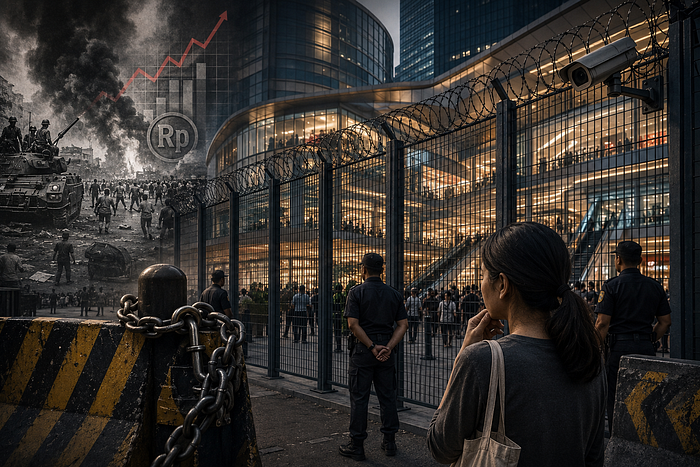
The sudden installation of high iron fences — standing approximately 2.5 meters tall — around several major shopping malls in Surabaya and Jakarta has sparked a wave of speculation. In Surabaya, malls owned by the Pakuwon Group — Pakuwon Mall, Tunjungan Plaza, Royal Plaza, and Pakuwon City Mall — were the first to be enclosed. They were followed by Kota Kasablanka (Kokas) in South Jakarta, which operates under the same corporate umbrella. Mall management and the Indonesian Shopping Center Association (APPBI) have cited technical reasons for the move: regulating visitor entry and exit flows, protecting pedestrians following the opening of the Radial Road, replacing old and dilapidated fencing, and establishing a security perimeter near protest hotspots. They insist the measures are not a response to threats of civil unrest or an economic crisis.
However, the near-simultaneous timing and the imposing appearance of the fences — some featuring spiked tops — have stirred deep collective memories. The public has drawn parallels to the tragedy of May 1998, when malls and shopping centers across various cities became targets of looting amidst riots, a monetary crisis, and the collapse of the New Order regime’s legitimacy. A multidisciplinary analysis is required to understand why these fences feel like something more than a mere “asset refurbishment.”
Caution Amidst Debt Burdens, MBG Efficiency, and Eroding Purchasing Power
This phenomenon can be interpreted as a sign of private sector wariness regarding social risks that could escalate when fiscal pressures collide with eroding purchasing power. Government debt continues to rise in nominal terms. Indonesia’s external debt stands in the range of US$430–444 billion (equivalent to approximately IDR 8,000 trillion), with a debt-to-GDP ratio of around 29.5–40 percent — still below the 60 percent threshold, yet the burden of interest and principal repayments is already substantial. Debt service obligations amount to hundreds of trillions of rupiah annually, while the state budget deficit and net borrowing continue to cover funding needs.
The Free Nutritious Meal (MBG) program — initially a cornerstone of fiscal populism with a budget of hundreds of trillions — has undergone repeated cuts: dropping from the IDR 335 trillion range to IDR 268 trillion, with proposals to further streamline it to around IDR 229 trillion due to governance concerns, beneficiary refocusing, and efficiency measures. A Constitutional Court ruling mandating the separation of the MBG budget from the education budget adds further complexity. Meanwhile, corruption cases involving staggering financial losses continue to come to light, ranging from the natural resources sector to alleged irregularities surrounding priority programs. While the Attorney General’s Office and the Corruption Eradication Commission (KPK) have successfully recovered tens of trillions of rupiah, public perception regarding integrity remains poor.
In this climate, shopping malls — as spaces of middle-class consumption — serve as a barometer. As purchasing power comes under pressure from inflation (particularly in food and energy), relatively high interest rates, and global uncertainty, retail property managers tend to reinforce physical perimeters. This is not a prediction of civil unrest but a matter of risk management: protecting assets against potential social frustration that could erupt in public spaces. The events of 1998 demonstrated that an economic crisis coupled with a collapse in public trust can turn shopping centers into targets.
From Open Public Space to Exclusive Fortress
From a socio-anthropological perspective, high fences alter the character of malls. In Indonesia, malls have long served as “third spaces” — venues for cross-class interaction, recreation, and consumption, particularly in major cities lacking public green spaces. Tall iron fences create a “hard border” that severs the visual and social connection between the mall’s interior and the street. An architecture lecturer from UK Petra has even warned that excessively high fences risk making malls appear exclusive and insular, whereas they ought to remain open.
The trauma of 1998 remains alive in collective memory. The generation that witnessed malls being burned and looted carries a legacy of wariness: when inequality and injustice become acute, elite spaces of consumption are vulnerable targets. Today’s fences, despite their technical justifications, symbolically reproduce the logic of a fortress. They separate a safe, controlled “inside” from a potentially chaotic “outside.” This reflects a society that has not yet fully healed from the wounds of 1998, while also illustrating how urban space is becoming increasingly fragmented between the protected and the vulnerable.
Security Perimeters Amidst Eroding Trust
Politically, the installation of fencing — particularly at Tunjungan Plaza, located near the Grahadi State Building — clearly involves a dimension of protest security. Management acknowledges that permanent fencing is more efficient than deploying portable barricades every time a demonstration occurs. This reflects a contemporary political reality: protests remain a primary channel for expression, while security forces and private space managers alike brace for potential escalation.
Persistent corruption — exemplified by sting operations targeting regional heads, allegations at the highest levels, and state losses running into the trillions — undermines legitimacy. As massive budgets for social programs like the Free Nutritious Meal (MBG) initiative are slashed while national debt rises, and as corruption scandals continue to dominate the headlines, public confidence in the state’s capacity to manage uncertainty wanes. In this context, the mall’s fencing serves as a metaphor: both the state and the private sector are erecting physical defenses because the institutions of trust have fractured.
Press enter or click to view image in full size
Source : CNBC Indonesia
Source : CNBC Indonesia
The high fences surrounding malls in Jakarta, Surabaya, and their surrounding areas represent more than just matters of traffic order or asset refurbishment. They embody a convergence of three layers: economic caution amidst debt burdens and the need for efficiency in populist programs; unresolved socio-cultural trauma dating back to 1998; and the politics of perimeter security in an era of fragile trust. While mall operators act rationally according to business logic, the public perceives a deeper symbolism.
The solution lies not merely in architectural “soft borders,” but in structural improvements: convincing fiscal transparency, consistent and impartial anti-corruption efforts, and the management of social programs that genuinely alleviate inequality. Without these measures, these iron fences — however sturdy — will serve only as a reminder that our public spaces remain overshadowed by a past we have not yet fully left behind.
메타데이터
- post_id
- 71d51de5dae8
- slug
- high-fences-at-some-malls-a-symbol-of-vigilance-amidst-the-trauma-of-1998-fiscal-pressures-and-71d51de5dae8
- url
- https://medium.com/@yusufnurwahyudi32/high-fences-at-some-malls-a-symbol-of-vigilance-amidst-the-trauma-of-1998-fiscal-pressures-and-71d51de5dae8
- canonical_url
- https://medium.com/@yusufnurwahyudi32/high-fences-at-some-malls-a-symbol-of-vigilance-amidst-the-trauma-of-1998-fiscal-pressures-and-71d51de5dae8
- author_url
- https://medium.com/@yusufnurwahyudi32
- status
- ok
- fetched_at
- 2026-08-10 19:33:21



