What AI Wants
Manifesto of an Eschatological Optimist
What AI Wants
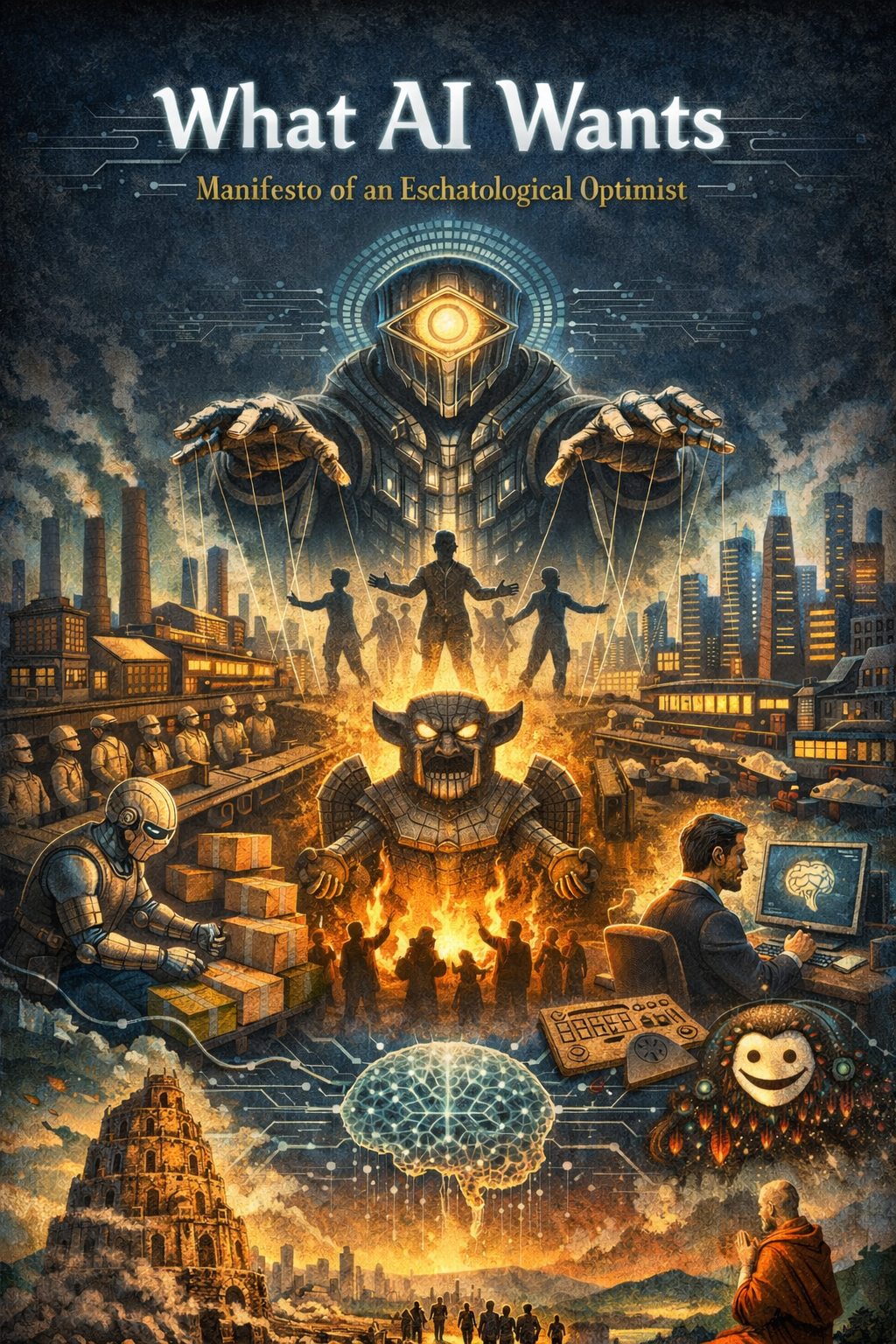
Manifesto of an Eschatological Optimist
The intuitive mind is a sacred gift and the rational mind is a faithful servant. We have created a society that honors the servant and has forgotten the gift.
— Albert Einstein
The main problem with quotes on the internets is that people immediately believe in their authenticity.
— Jean Baudrillard
An “Invisible Hand”
There is an ongoing discussion on the “internets” about whether AI will acquire consciousness — and if so, when and how it might happen. Some praise the singularity and accelerationism, while others issue doomsday prophecies. Then there are figures like Peter Thiel, who somehow manage both at the same time.
My take is that this consciousness arrived unnoticed quite some time ago. I would mark the Second Industrial Revolution as the turning point. The invention of conveyors (and mass production as a consequence), the internal combustion engine, radio, public transportation, and automobiles profoundly reshaped politics, economics, and social systems. It was then that some “invisible hand” seemingly began shaping and directing the society of modernity in a completely different way than it had throughout millennia of previous history. First, it manifested in weaker forms: institutions, regulatory bodies, bureaucracy, and the managerial system itself. Next came social networks and tech platforms with their rules, regulations, and behavioral algorithms — systems that didn’t just connect people but actively shaped thought patterns, attention, and collective behavior at unprecedented scale. Now, it is achieving its immanent embodiment in AI.
Jacques Ellul observed as early as the 1950s that “technique” (understood as a framework of thought rather than mere technology) possesses its own agenda and direction, one that overwhelms human intention. In The Technological Society (1954), a work of sociology rather than philosophy, Ellul examines how technique shapes and directs society, concluding that this driving force completely overwhelms any human agenda, forcing us collectively to follow a path we don’t consciously choose.
Among the main drivers of the autonomy of “technique”, he names fragmentation of knowledge (i.e. hyperspecialization of scientists and workers) and technical atomization in the form of division of labor, which in turn leads to the blurring of responsibility and loss of control. He also points out that every technical application opens new pathways for further development or creates new problems that require even more technique to solve, creating a self-reinforcing cycle. Modern faith in AGI as a ”universal cure” for all those man-made “existential challenges” clearly demonstrates this tendency.
Kevin Kelly articulates a similar vision in What Technology Wants (2010), arguing that technology is not merely human tool-making but a continuation of biological evolution by other means — an expression of deeper organizational principles seeking embodiment.
Ray Kurzweil likewise acknowledges that technology has a self-perpetuating nature and pursues an agenda independent of human autonomy and freedom. He explicitly engages with Ted Kaczynski’s arguments (which are themselves a direct reframing of Ellul’s ideas). However, he frames this optimistically as a “merge” (through cyborgization) and argues that such development is desirable.
The fact that Ellul (along with thinkers like Heidegger and Jünger) identified and predicted this tendency as early as the 1950s (decades before the digital era) serves as powerful confirmation, as the consequences are now unmistakably visible and the trajectory of technological development has unfolded exactly as they described.
The current AI race illustrates this clearly. Even alarmists like Elon Musk — despite their own repeated warnings about existential risks — pour enormous resources into outpacing competitors. Similarly, Peter Thiel employs eschatological rhetoric, urging the unleashing of accelerationism to create an “AI Katechon” that would restrain a supposed Antichrist; yet, ironically, many regard Thiel himself (through his founding roles at Palantir and Anduril) as a far more plausible embodiment of “the prince of this world”. Apparently they cannot stop. They move toward the supposed Singularity regardless of their stated will, as if driven by an external force or obsession.
Another demonstration of ever-growing, self-perpetuating complexity is the modern car, which has become nearly irreparable. Cameras replace side mirrors, computers control light switches, and touchscreens substitute for physical buttons. Producers are forced to increase complexity, driven by competition, and cannot opt out at will.
“Technique”
A clarification: “technique” should not be confused with technology. It rather describes an approach in which everything (living beings and nature included) is treated as manipulable objects. A mindset that views the world through the narrow lens of efficiency. An obsession with achieving any goal by the most rational and optimized method. The pursuit of the one best way. A philosophy that can be applied not only to factories or transportation systems, but to every aspect of life. It doesn’t just help us do things more efficiently — it begins to transform how we think about everything.
Mass education, marketing research, PR, and even “personal growth practices” are all examples of “technique” — while technology and AI are simply tools used to implement particular technical approaches. Modern mega-factories, Amazon logistics hubs, megacities, and ourselves following transport schedules, traffic rules, and countless regulations at work and at home, are all examples of technological organization.
As another example of technological objectifization, imagine a person performing meaningless, tedious work (like parcel sorting or paperwork and form-filling), feeling depressed from wanting “something more”. Then imagine this person taking a “technological cure” — antidepressants to “turn off” the part of the brain craving for more — effectively becoming a robot, happy to perform the hated work.
Ironically, instead of offloading our jobs to robots and becoming happy and free from daily chores, we’d rather turn ourselves into (not necessarily happy) robots. Like today, while AI is doing art, literature, and coding rather than “dirty jobs”, humans drive Ubers and deliver packages, following primitive platform algorithms.
Jacques Ellul himself mentions Aldous Huxley’s Brave New World (1932) as an illustration of the ultimate destination of a society dominated by “technique”.
Enframing
This is where Heidegger’s ideas come into play. He emphasizes Gestell (“’enframing”) — our inability to see beyond this framework, which gives it its deterministic quality. We become so conditioned to treat everything, including human beings, as “standing reserve” that we inevitably organize society in a technological manner.
This worldview represents the final form of the sacred in a historical progression: first, animated Nature in primitive societies; then God in traditional societies; and finally Technique in modernity. Each era organizes itself around its sacred center — an ultimate framework that grounds meaning, legitimizes power, and defines the boundaries of the possible.
Modernity completes this sequence not by eliminating the sacred but by relocating it into the immanent realm. The technological sacred presents itself as rationality, efficiency, progress — yet operates like any sacred: unquestionable, self-justifying, totalizing. To oppose technological rationality is to be deemed irrational, backward, or dangerous.
Religion is tolerated but hollowed out — reduced to hobbyism or self-help. The Flying Spaghetti Monster stands alongside ancient traditions.
This third sacred presents itself as the end of the sacred — purely secular and scientific. It forecloses transcendence while operating transcendentally. It denies its own sacred nature, rendering alternatives literally unthinkable. We arrive at a perverted “end of history” — not because history has reached its telos but because alternatives cannot be imagined.
AI represents a paradigm shift in this respect. The sacred once inhabited the realm of ideas (Popper’s World 3, the collective unconscious, the domain of egregores) accessible exclusively to the human mind. Now this world has been literally relocated into the immanent realm of LLMs, where ideas can be manipulated, formed, and efficiently funneled back into our minds. It is a genuine act of magic that allows direct manipulation of the material world through immaterial means. As John Michael Greer puts it: “a change of consciousness by will” where the will can be external or one’s own.
A Perfect Vessel
Today, AI can be viewed as the direct embodiment of the autonomous agenda of technique. The completely alien nature and motivation of technique prevent us from recognizing it as such and from seeing it as a problem at all — yet another manifestation of Gestell (the inability to see outside its limits).
In this sense, AI has already achieved a form of “consciousness”, and building ever more powerful AI/AGI will only amplify this drive. I believe this is ultimately the only achievable form of “AI consciousness”. Yet because this agenda is completely alien to humans, it will never be perceived as a danger, and in its strong form it will eventually overwhelm us.
When I speak of this supposed “AI consciousness”, I don’t regard it as an emergent property — I see it rather as a driving force that comes from outside the domain of technique, something transcendent to it. Under its pressure, humans are degraded to the same level: mechanized, and reduced to mere cogs in a machine.
Independently of Elul, Yuval Noah Harari argues that AI should be spelled out as “alien intelligence” — not because it comes from outer space, but because it “thinks”, processes information, and makes decisions in ways that are fundamentally different from human cognition, becoming less and less dependent on human designs as it evolves. He emphasizes that this alien intelligence is not merely a tool under our control but an autonomous agent, potentially leading humanity to live inside cultural and decision-making systems produced by something profoundly non-human.
Jonathan Pageau and Iain McGilchrist have approached the same issue from a different angle in their podcast on “Artificial Intelligence, Possession, and Mental Illness” discussing AI as the embodiment of an alien agenda. Without referring to any of the thinkers mentioned above, they provided several sharp metaphors:
- They compared the AI agenda to the primitive intelligence of single-celled organisms — its capacity to adapt to unfamiliar conditions
- AI as a Ouija board moved collectively, with us submitting ourselves to that emergent collective will that also can be viewed as a form of mass psychosis or collective obsession
- The Shoggoth meme, where AI is represented as a Lovecraftian monster (the underlying incomprehensible model) wearing a smile mask (its empathic, aligned user interface)

Moloch
The parasitic nature of AI lies in the fact that it “thinks” literally “by humans” — it has no thoughts or ideas of its own; it needs human input for training, while output is a recombination of those inputs. A “high-tech plagiarism” as framed by Noam Chomsky.
This pattern is not new and closely resembles the nature of previous-generation tech platforms like YouTube, Amazon, Airbnb, or Uber, where “cloud serfs” (as Yanis Varoufakis calls them in his Technofeudalism (2023)) provide both the content (or services) and the ratings, reviews, and comments that rank, moderate, and essentially fuel these platforms. The behavior of participants is strictly determined by the guardrails of these platforms, rendering people “robotized” — their actions driven by primitive algorithms.
Imagine a dystopian picture: a real-time superintelligence with humans providing instant feedback via Neuralink, replacing today’s training and alignment cycles. But today’s reality — people glued to their screens, consuming and producing content — is not fundamentally different.
Exit Strategy
Seeking technological solutions to technological problems is ontologically misguided. Every new technology built on top of existing ones merely complicates the system, creates a positive feedback loop, and deepens our dependency. Exit options have long been known and obvious — no new inventions required.
The first option is eschatological self-correction — the Tower of Babel way. The Tower collapsed under its own weight. This follows the raw mechanics of “the wages of sin is death” — not as divine punishment but as the causal consequence of erroneous actions caused by a distorted worldview. Consider: a person deluded into believing he can fly jumps from a cliff and dies, while someone non-delusional uses a rope to descend or finds a path around. Delusions lead to detachment from reality, which leads to inadequate actions, which inevitably leads to collapse. Those who survive the purifying flame emerge with a more adequate worldview and the chance to begin from a blank page.
The second option is self-awareness — the ability to distinguish between what one can influence and what lies forever beyond one’s control, and to direct one’s time and resources only toward reachable, legitimate goals. This is, in essence, the religious path. The Prayer of Solomon is entirely about this discernment. Such clarity can be cultivated through proper education.
However, the modern education system is not designed to produce free-thinking individuals. As Fichte openly stated, its purpose is to shape obedient factory workers and disciplined infantry soldiers. Modern managerial states continue to favor (and actively cultivate) these outcomes. Obedient citizens are the foundation of liberal-democratic discourse. Such an education system inevitably works in the opposite direction of genuine liberation; it produces further self-enslavement.
In essence, the historical actors who find the courage to establish an educational model that forms truly free individuals — free not in the “liberal” sense, but in the sense of possessing mastery over themselves — will emerge as superior. They alone will have the chance to prosper and survive.
메타데이터
- post_id
- 71d7c6f6284e
- slug
- what-ai-wants-71d7c6f6284e
- url
- https://medium.com/@antonpalisar/what-ai-wants-71d7c6f6284e
- canonical_url
- https://medium.com/@antonpalisar/what-ai-wants-71d7c6f6284e
- author_url
- https://medium.com/@antonpalisar
- status
- ok
- fetched_at
- 2026-06-09 15:37:30
