What Actually Causes Fat Loss? The No-BS Guide to Calorie Deficit
Most people think fat loss is about “eating clean,” cutting carbs, doing cardio, or following some magical diet. But fat loss only…
What Actually Causes Fat Loss?
The No-BS Guide to Calorie Deficit

Most people think fat loss is about “eating clean,” cutting carbs, doing cardio, or following some magical diet. But fat loss only happens for one reason — and it’s not luck, genetics, or what time you eat.
[embed]
This guide breaks down exactly how fat loss works, why some people lose weight faster, and how you can create a calorie deficit without starving yourself.
The Simple Science: What Is a Calorie Deficit?

What Is a Calorie Deficit?
Your body burns calories every day to:
- stay alive (breathing, organ function)
- move
- digest food
- build/repair muscle
This is called your Total Daily Energy Expenditure (TDEE).
You lose fat ONLY when:
Calories In < Calories Out
Meaning you eat less energy than your body burns.
When this happens, your body pulls stored energy (fat) to make up the difference.
No diet works without a calorie deficit. Keto, intermittent fasting, low carb, vegan, low fat — they all work ONLY if they reduce your total calories.
Why Weight Loss Sometimes Feels Hard

If the formula is simple, why do people fail? Because life, habits, and hormones can make things feel more complicated.
Common reasons people think they’re in a deficit but aren’t:
1. Hidden calories
Oil, sauces, nuts, sugary coffee, small snacks. These add up FAST.
2. Portion size is larger than expected
Restaurant food is notorious for this.
3. Liquid calories
Smoothies, juices, Starbucks, alcohol.
4. Eating “healthy” but high-calorie foods
Granola, avocados, peanut butter, hummus.
Healthy ≠ low calorie.
5. NEAT drops without noticing
NEAT = steps, movement, daily activity. When dieting, people subconsciously move less.
Why Cardio Alone Doesn’t Work

Why Cardio Alone Doesn’t Work
Cardio burns calories — but it also increases appetite. And when people rely only on cardio, they often overeat after.
Strength training + calorie deficit = ✔ keeps muscle ✔ burns fat ✔ raises metabolism ✔ improves insulin sensitivity
If you can only pick one: Lift weights. If you can pick both: Lift + some cardio = unbeatable.
How Big Should Your Calorie Deficit Be?

How Big Should Your Calorie Deficit Be?
The ideal deficit depends on your current body fat level:
- Small deficit (200–300 kcal) Best for lean people doing a small cut.
- Moderate deficit (400–600 kcal) Best for most people.
- Large deficit (700–900 kcal) Works for short periods, not long-term.
Avoid going below 1,200 calories (women) and 1,500 calories (men) unless supervised.
How to Create a Calorie Deficit Without Starving
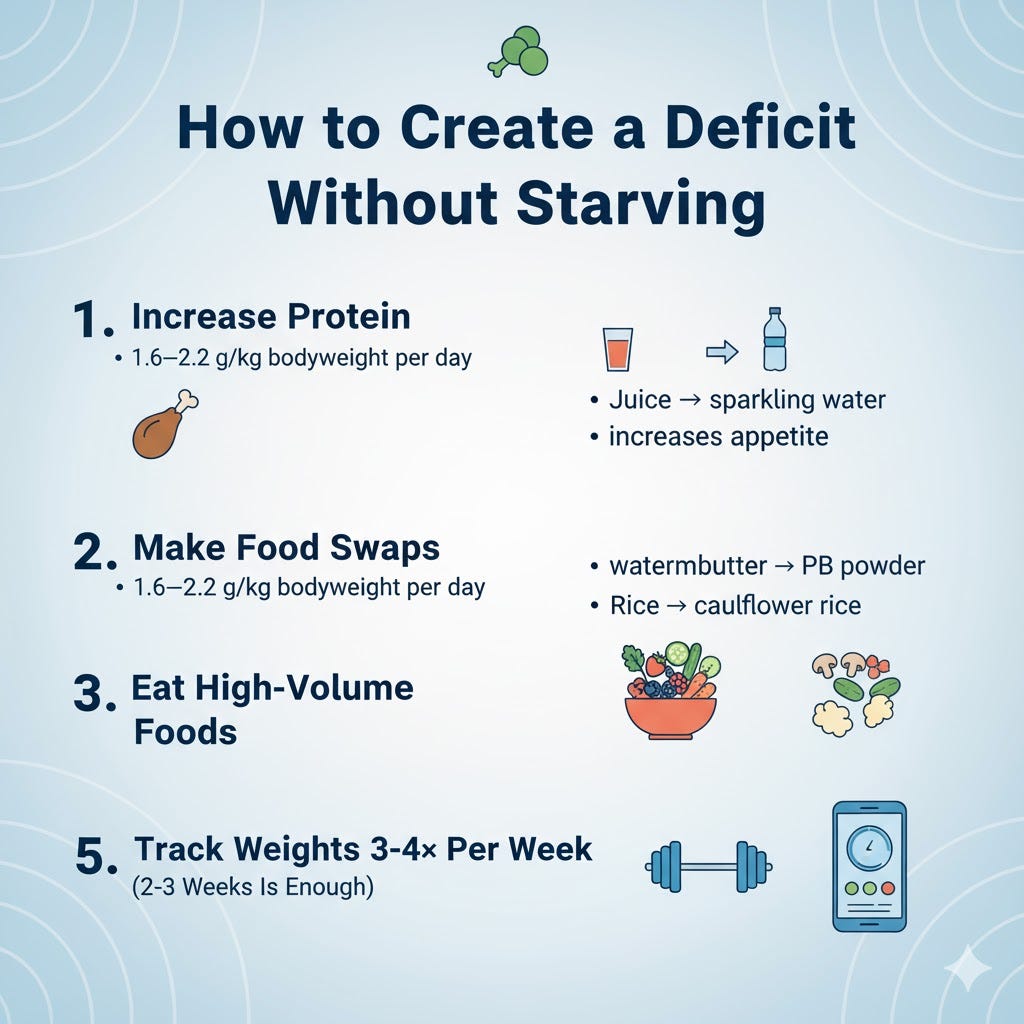
How to Create a Calorie Deficit Without Starving
1. Increase protein
Protein keeps you full, boosts metabolism, and preserves muscle. Aim for 1.6–2.2 g/kg body weight.
2. Make food swaps
- Replace rice with cauliflower rice
- Replace sugary snacks with Greek yogurt
- Replace juice with sparkling water
- Replace peanut butter with powdered PB
3. Eat high-volume, low-calorie foods
- cucumbers
- watermelon
- popcorn
- mushrooms
- lettuce
- berries
These fill your stomach for very few calories.
4. Lift weights 3–4 times per week
Keeps metabolism high while cutting. Prevents that “skinny fat” look.
5. Track your calories
You don’t need to track forever — just 2–3 weeks to recalibrate your portions.
How to Know Your Deficit Is Working

How to Know Your Deficit Is Working
Signs you are in a deficit:
✔ Weight trend is going down ✔ Clothes feel looser ✔ Belly looks flatter ✔ Waistline decreases ✔ Energy dips slightly (normal)
Signs you are NOT in a deficit:
✘ Weight stable for 3+ weeks ✘ No change in measurements ✘ You “feel” like you’re dieting but snacking often ✘ You eat heavy on weekends and compensate on weekdays
The Truth: Fat Loss Is Simple, Not Easy
Fat loss isn’t complicated. Sticking to the deficit is the part most people fail at.
Here’s the real formula:
Consistent calorie deficit + high protein + strength training = fat loss.
No magic. No secret tricks. Just a simple system that works every single time.
메타데이터
- post_id
- 71dbd02f0e86
- slug
- what-actually-causes-fat-loss-the-no-bs-guide-to-calorie-deficit-71dbd02f0e86
- url
- https://medium.com/things-you-should-know-about-fitness/what-actually-causes-fat-loss-the-no-bs-guide-to-calorie-deficit-71dbd02f0e86
- canonical_url
- https://medium.com/things-you-should-know-about-fitness/what-actually-causes-fat-loss-the-no-bs-guide-to-calorie-deficit-71dbd02f0e86
- author_url
- https://medium.com/@nilmadhab
- status
- ok
- fetched_at
- 2026-06-16 19:09:56




