The Role of QA at Each Stage of the SDLC
As a QA joining a project at its early stages, you might wonder:
The Role of QA at Each Stage of the SDLC
As a QA joining a project at its early stages, you might wonder:
What should I, as a QA engineer, be doing outside of the actual testing phase?
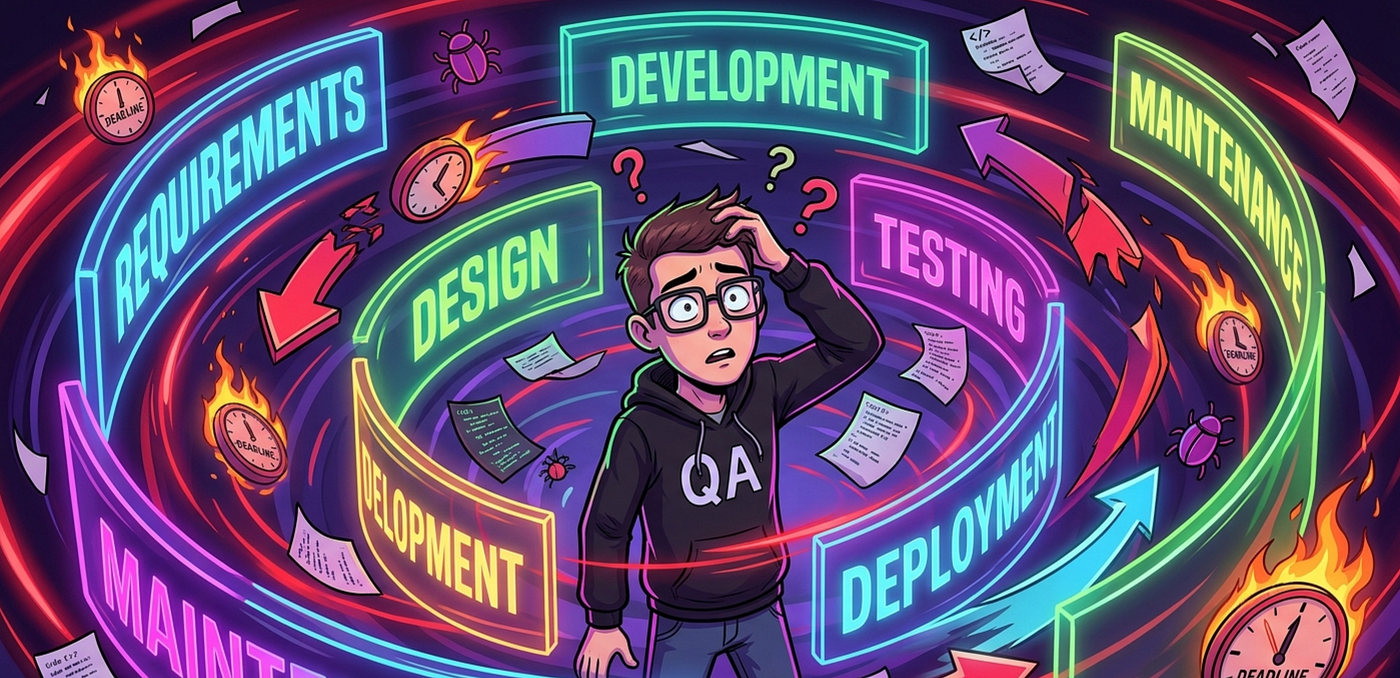
In the past, QA teams were often involved only during the later phases of development, sometimes joining when the product was already being built. On my first QA job, I was asked to test the app only when the build was already ready on the dev environment. There hadn’t been a tester on the team before. However, today’s best practices — especially those guided by the “shift left” approach in agile — emphasise the importance of involving QA as early as possible in the Software Development Life Cycle (SDLC).
SDLC (Software Development Life Cycle) is a structured process for developing software, consisting of sequential stages: planning, requirements analysis (sometimes combined with planning), design, development (or coding), testing, deployment, and maintenance. Each stage ensures quality, manageability, and efficiency in the creation of software products. https://www.ibm.com/think/topics/sdlc?mhsrc=ibmsearch_a&mhq=sdlc

Shift-left testing is an approach in software development that emphasizes moving testing activities earlier in the development process. This approach aims for improved software quality, better test coverage, continuous feedback and a faster time to market. https://www.ibm.com/think/topics/shift-left-testing
The shift left approach means that QA is not just about finding bugs at the end, but about preventing them from the start. By participating in every SDLC stage, you help identify risks early, clarify requirements, and ensure quality is built into the product from day one. Of course, the level of QA involvement can vary depending on the project, and there is no one-size-fits-all rule. In this article, I’ll share one of the effective ways a QA engineer can contribute at each SDLC stage, based on industry standards and practical experience.
It is important to note that STLC (Software Testing Life Cycle) does not directly correlate with SDLC, as it represents a slightly different set of stages. While SDLC covers the entire software creation process, STLC focuses specifically on the testing phases. However, in this material, we have aimed to combine these steps based on practical experience, demonstrating how development and testing processes can interact and complement each other https://www.guru99.com/sdlc-vs-stlc.html https://www.geeksforgeeks.org/software-development-life-cycle-sdlc/https://www.geeksforgeeks.org/software-testing-life-cycle-stlc/.

Below, you’ll find a brief description of each SDLC stage, along with the corresponding QA activities you can perform to maximize your impact.
1. Planning & Analysis
This stage focuses on gathering and analyzing all requirements for the future software product. The goal is to understand what the system should do and what constraints exist.
QA Activities:
- Defining test types and priorities
- Preparing the device Compatibility Matrix
- Assessing automation feasibility
- Preparing the test plan and strategy
- Clarifying requirements with stakeholders from testing perspective
- Resource planning and role allocation
- Training preparation
- Comparing test tools
- Establishing quality metrics
2. Design
During the design phase, the system’s architecture and technical solutions are defined. This includes both high-level and detailed design documentation.
QA Activities:
- Identifying testable requirements
- Estimating test effort
- Reviewing acceptance criteria and design
- Giving feedback on the app’s UI and UX flows
- Improving requirements
- Risk assessment

3. Development
The actual coding and implementation of the software take place during this phase.
QA Activities:
- Creating checklists and test cases
- Preparing test data
- Reviewing unit tests and code
- Monitoring continuous integration (CI)
- Performing smoke/sanity testing
- Validating the test environment
- Collaborating with developers
- Developing automation scripts
4. Testing
This is the stage where the developed software is tested to ensure it meets requirements and is free of critical defects.
QA Activities:
- Executing tests
- Reporting and tracking defects
- Preparing re-testing plans
- Assessing test coverage
- Managing the test environment
- Performing regression testing
5. Deployment
The software is released to production or delivered to the customer. Final checks are performed to ensure everything works as expected.
QA Activities:
- Verifying deployment
- Analyzing test results
- Conducting smoke/post-deployment testing
- Validating the release (e.g., go-live in app stores)
- Monitoring defects
- Verifying rollback procedures
- Supporting users
- Preparing final sign-off and reports
- Communicating with stakeholders
- Analyzing and closing defects
6. Maintenance
After deployment, the software enters the maintenance phase, where updates, bug fixes, and improvements are made as needed.
QA Activities:
- Supporting ongoing quality assurance during updates and bug fixes
- Monitoring the production environment for issues and anomalies
- Collecting and analyzing user feedback
- Reviewing customer reviews and ratings in app stores or other platforms
- Collaborating with support teams to address reported problems

Conclusion:
QA activities are important at every SDLC stage. Involving QA early — guided by the shift left approach — helps prevent defects, improves quality, and reduces costs. While the exact process may differ from project to project, the approach described here is one effective way to integrate QA throughout the software development lifecycle. A key insight is that QA has many activities beyond just the testing phase, contributing value throughout the entire process. Sometimes, these responsibilities are divided among roles: for example, a QA lead may focus on planning and strategy, while testers join during development and testing. However, it’s increasingly expected that QA professionals have a broader perspective, ensuring quality from the very beginning and at every stage of the SDLC.
메타데이터
- post_id
- 71f5405d8bbe
- slug
- the-role-of-qa-at-each-stage-of-the-sdlc-71f5405d8bbe
- url
- https://medium.com/mobilepeople/the-role-of-qa-at-each-stage-of-the-sdlc-71f5405d8bbe
- canonical_url
- https://medium.com/mobilepeople/the-role-of-qa-at-each-stage-of-the-sdlc-71f5405d8bbe
- author_url
- https://medium.com/@samoilenkons
- status
- ok
- fetched_at
- 2026-06-21 15:33:18