Securing Openflow Runtimes: A Layered Approach to Deploy, Operate and Monitor
A well-architected Openflow deployment doesn’t happen by accident. It requires intentional decisions about environment isolation, runtime…
Securing Openflow Runtimes: A Layered Approach to Deploy, Operate and Monitor
A well-architected Openflow deployment doesn’t happen by accident. It requires intentional decisions about environment isolation, runtime security, and operational visibility — decisions that compound in impact as your organization scales.
Deployment Strategies for Openflow
Organizations running data integration pipelines typically need to support multiple environments — development, testing, and production — each with appropriate isolation, access controls, and governance boundaries.
Choosing the right deployment strategy is critical: it impacts how teams collaborate, how changes are promoted, and how security is enforced at each stage of the pipeline lifecycle.
Option 1: If you have different Snowflake account for different environments like dev/test/prod, Then the recommendation will be to deploy Openflow in each environment.
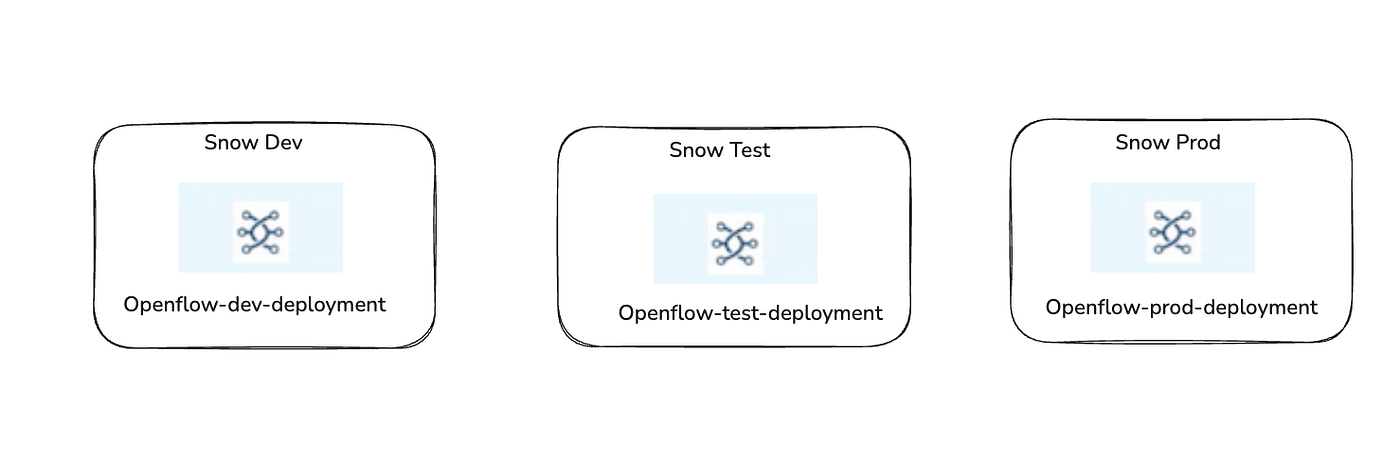
Snowflake Deployment each per env
Option 2: If you have a single account and you segregate environments by databases and roles. Then the recommendation will be one Openflow deployment and segregate environments by runtime and its roles.
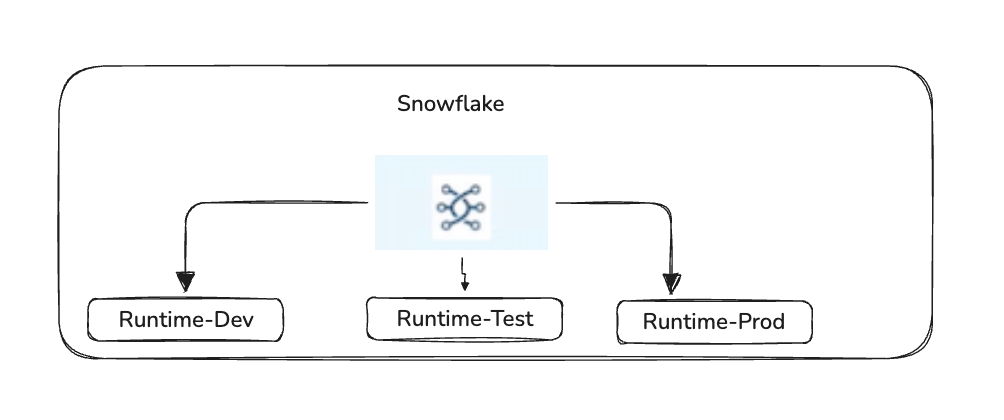
Single Openflow deployment and environment by runtime
Restricting access to deployments
Once your deployment topology is in place, the next step is locking down who can do what within deployment.
Openflow provides three granular grants — USAGE, OPERATE, and MONITOR — that control access at the deployment level. Each grant maps to a distinct operational responsibility, allowing you to enforce least-privilege access without complex policy layering. Simply assign the appropriate grant to a role, and that role’s users inherit only the capabilities they need.
This means access control becomes a deliberate, auditable decision rather than an afterthought. You’re not managing permissions per user or per pipeline — you’re defining clear boundaries at the role level that align with your team’s responsibilities. The result is a security model that’s easy to reason about, straightforward to implement, and scales naturally as your organization grows.
Understanding the Grants
Usage: Designed for your developer team. This grant allows users to create and manage runtimes under the deployment. Users with this privilege can facilitate the creation and lifecycle of child objects — but do not have broader control over the deployment itself. Think of it as the “build within boundaries” permission.
Operate: Designed for your admin team that needs elevated access without full Openflow admin privileges. This grant allows users to perform maintenance operations on the deployment, including upgrades, restarts, and configuration changes. It’s the operational layer — enough power to keep things running, without the ability to alter governance boundaries.
Monitor: Designed for read-only visibility. This grant allows users to observe deployment status, health metrics, and view child runtimes — without the ability to modify or execute anything. Ideal for platform engineers, SREs, or compliance teams who need observability without intervention.
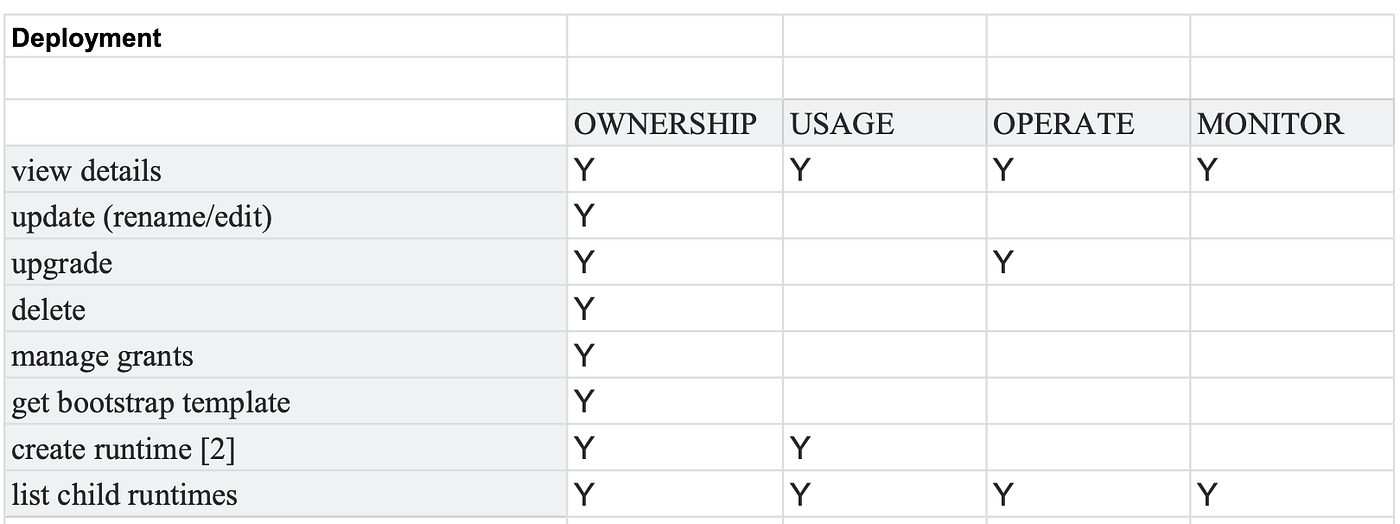
Operational Matrix
Restricting Access to Runtime
Securing your Openflow runtimes follows the same principle as your deployment strategy — intentional, layered, and role-appropriate.
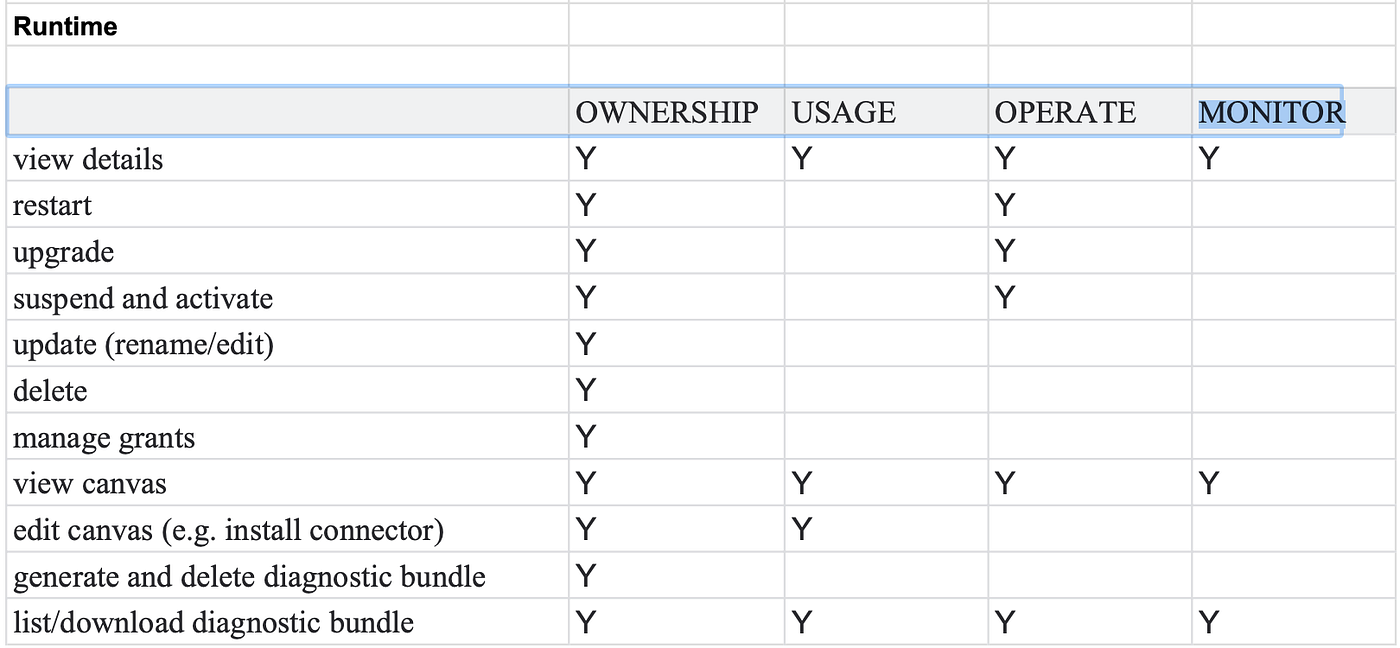
Openflow provides three distinct privilege levels for runtime access control: USAGE, OPERATE, and MONITOR. Each maps to a specific operational concern, and together they form a least-privilege model that scales cleanly across teams and environments.
The approach is straightforward: assign the right grant to the right role — nothing more, nothing less. A developer who needs to build flows doesn’t need the ability to start or stop runtimes. An operations team managing pipeline execution doesn’t need visibility into performance metrics meant for platform engineers.
By mapping these three grants deliberately to your organizational roles, you ensure that every persona — from flow developer to SRE — has exactly the access they need to do their job, and no more
Below is matrix of what each Grant can do at runtime level.
Conclusion
Securing Openflow doesn’t require complex tooling or bespoke frameworks — it requires intentional decisions made early and enforced consistently.
By choosing the right deployment pattern for your organizational boundaries and applying the right grants to the right roles, you create a security model that is both robust and simple to maintain. Developers build within their boundaries. Admins operate without overreach. Observers monitor without risk.
The key takeaway: treat your deployment strategy and access control as two sides of the same coin. One defines the isolation boundaries — the other enforces who can cross them. Get both right, and your Openflow runtimes scale securely from day one.
메타데이터
- post_id
- 71fee07c4a3f
- slug
- securing-openflow-runtimes-a-layered-approach-to-deploy-operate-and-monitor-71fee07c4a3f
- url
- https://medium.com/snowflake/securing-openflow-runtimes-a-layered-approach-to-deploy-operate-and-monitor-71fee07c4a3f
- canonical_url
- https://medium.com/snowflake/securing-openflow-runtimes-a-layered-approach-to-deploy-operate-and-monitor-71fee07c4a3f
- author_url
- https://medium.com/@shantanu.gope85
- status
- ok
- fetched_at
- 2026-06-09 15:37:30