Does it matter to be an environmentalist today?
In the face of so many human rights violations, should environmentalism be a priority?
Does it matter to be an environmentalist today?
The sun is blaring in my eyes. It’s the one downside to a writing table that faces the beautiful outdoors — the early morning sun can stream right in.
But most days here in Iceland, a thick sheet of clouds cover the sky.
Not today — but I’m not complaining.
Today we make our weekly one-hour drive to the grocery store. It will be the first time I can actually see the local landscape.
When I asked Vid, one of the people who runs the artist residency I’m attending here in Iceland, if he would ever permanently live in Iceland, he said, “No. I love the sun.”
I’ve taken the sun for granted for the past 10 years.
In New Jersey, we get plenty of sun days.
Before that, I lived in Tucson, Arizona — one of the sunniest places in the United States. That area of the country gets more days of sunlight than anywhere else.
And before that, I lived in Hawai’i. Needless to say, there was plenty of sun there. Even when there were clouds, they were big, bold, and beautiful wonders that moved quickly through the sky and revealed the sun.
Here in Iceland, the clouds are always shape-shifting. The first three days, they hovered in a dense fog right next to the ground. I couldn’t even tell there were mountains directly across the Fjord from us.
I’m at this artist residency to work on a creative project about environmentalism.
It’s a rather amorphous word. Natalie, an architect I interviewed about environmentalism said, “Environmentalism — I don’t know how to define that.”
I don’t either.
And that’s part of the reason I’m here in Iceland. I’m looking at what this word means to us now, and what is our connection with nature.
As I type these words, a woman is outside hanging her laundry. She is taking advantage of this glorious sunshine.
The last time it was sunny here, all of the residents scattered outside to various nature trails. We are all clearly influenced by the sun.
Vid won’t consider permanently living in Iceland due to the environment.
I know many people who are also governed by the climate. When I lived in Tucson, every winter “snow birds” would flock to the city to escape their snowy climates.
I know the same happens in Florida, where my aunt runs a business that takes care of people’s Florida homes when they return to their permanent homes in the North for the summer.
We’re all connected to the environment in one way or another.
But we all certainly wouldn’t call ourselves environmentalists.
Natalie grew up in Colorado. In her tiny town in the northwest corner of the state, people love nature. Natalie told me, “Everyone is tied to the outdoors.” The people fiercely protect nature and wildlife, but wouldn’t necessarily call themselves environmentalists.
Perhaps this is because “environmentalist” has become such a politically charged word, and one that is often associated with liberalism.
Some people think environmentalism means prioritizing the environment above people.
Environmentalism is also thought of in extreme terms. We may picture people who tie themselves to trees to or lie down in front of bulldozers.
We have so many associations with environmentalism that the word may be too far-gone to be useful.
So when I tell people about my creative project about environmentalism, I’m usually quick to explain, “I’m looking at how we care for ourselves and the environment at the same time.”
I don’t see a hierarchy when it comes to the environment and people. I think that when we care for ourselves better, we are more likely to care for the environment. I think the inverse is true: when we care for the environment, we are more likely to care for people.
I also think we can choose actions that benefit both people and the environment — like when we address air pollution. It increases the life span of people, as well as reduces the carbon load on the environment.
The same goes when we address polluted waters. We are able to drink cleaner water and enjoy recreation in them, and the ecosystems within the waters are improved.
But there are certainly some areas of hardship — like the amount of money it takes to improve these things.
And as Ed, an earth science professor, told me, “It’s hard to sell hardship.”
And that’s why I believe environmentalism is an intersectional issue. We cannot look at improving the environment without looking at social justice.
Riley, a poet I interviewed, stated this exact sentiment, “For there to be environmental justice, there has to be social justice.”
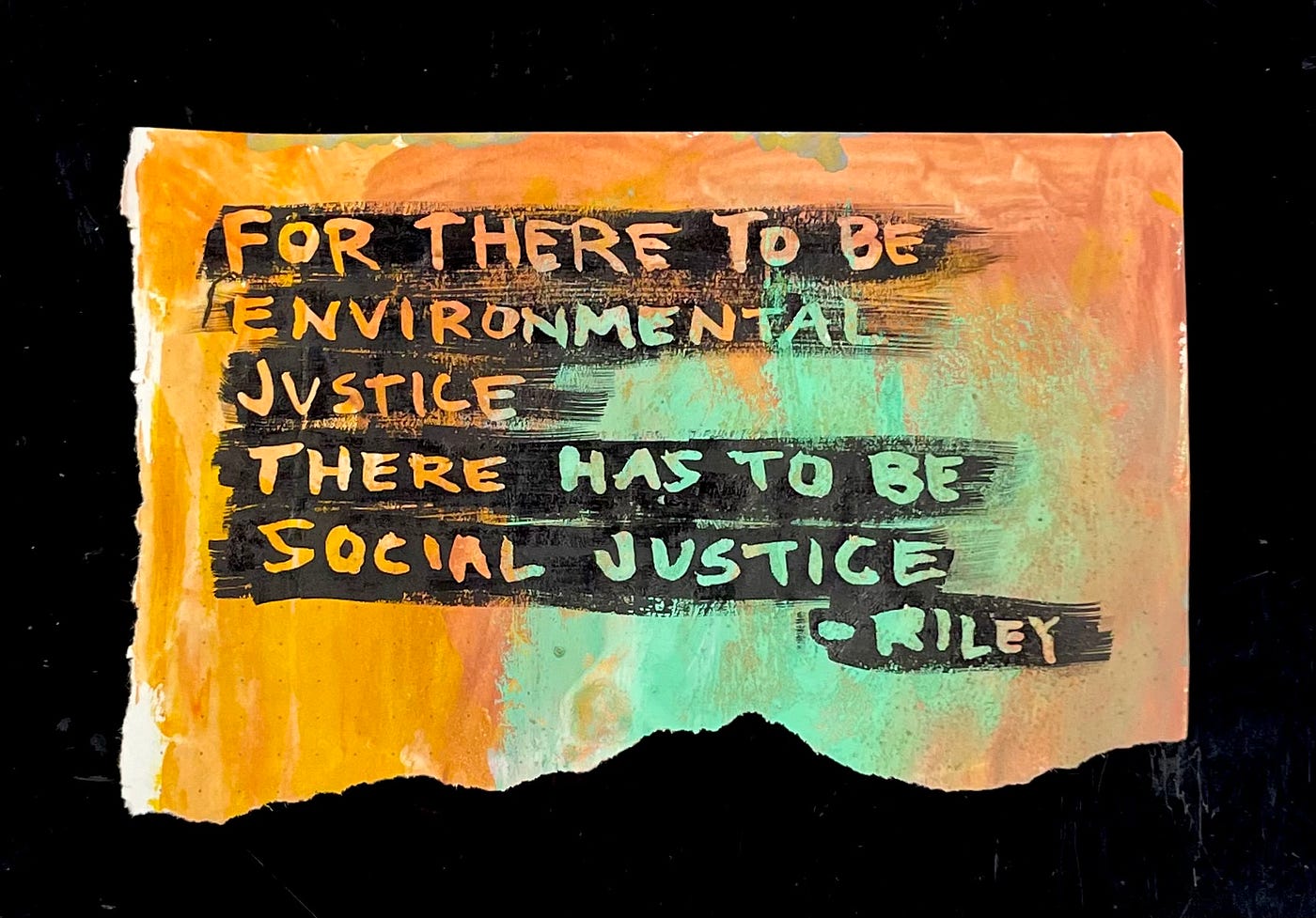
Artwork I made of Riley’s quote
And while that is no small undertaking, I think we are at a critical juncture in history. We are becoming more and more aware of social injustices and how we care (or don’t) for people.
We are making shifts, forward and backward.
In the US, we’re looking at colonialism. We’re acknowledging the racism that exists. We’re looking at systems that privilege certain populations over others.
And we’re also going through political upheaval that is pushing back.
But I take that as a sign that these issues are right at the forefront of our minds.
And while people might think “environmentalism” is an odd thing to focus on when there are so many human rights violations occurring in the US, I see them going hand in hand.
I think how we treat the environment is directly reflective of how we treat others.
When we’re willing to exploit the earth and ignore the consequences, we’re likely to do the same with people. We’ll exploit their labor and humanity, and then ignore the consequences.
So when I say I’m doing a creative project about environmentalism, what I’m really saying is I’m doing a creative project about our humanity and how we connect with other people.
I’m looking at how we grapple with getting our own needs and wants met, and not taking advantage of people or ecosystems to do that.
I’m looking at how we acknowledge our own shortcomings, and the decisions we then make to shift.
And to look at those things, I’m interviewing as many people as I can. I believe it will take a collective effort, full of myriad ideas, to make shifts.
But I am invested in that kind of change.
And I guess that makes me an environmentalist.
Thanks for reading!
This essay is part of my ongoing art exhibition: *How can we care for the earth and ourselves?* I first interview people, and then create response art and write essays.
If you’d like to connect with me more, here are 2 ways:
- ***Sign up for my free FUNletter. *I share a weekly list of all the things I find fun.
- ***Check out my books.***
메타데이터
- post_id
- 720467433ec9
- slug
- does-it-matter-to-be-an-environmentalist-today-720467433ec9
- url
- https://medium.com/@jackieschuld/does-it-matter-to-be-an-environmentalist-today-720467433ec9
- canonical_url
- https://medium.com/@jackieschuld/does-it-matter-to-be-an-environmentalist-today-720467433ec9
- author_url
- https://medium.com/@jackieschuld
- status
- ok
- fetched_at
- 2026-07-10 20:41:43