The Physics of Feelings: Why Your Brain Gets Stuck — and How to Unfurl It
How a new mechanistic model of the mind decodes emotional blocks, solves therapeutic plateaus, and maps your mental profile.
The Physics of Feelings: Why Your Brain Gets Stuck — and How to Unfurl It
How a new mechanistic model of the mind decodes emotional blocks, solves therapeutic plateaus, and maps your mental profile.
We’ve all been there: You want to feel happy, but your brain refuses to cooperate. You try to process a wave of sadness, but it instantly morphs into an ugly flare of anger. Or maybe you’ve been in therapy for months with zero progress, only to wake up one Tuesday experiencing a massive, unexplainable emotional breakthrough.
For decades, affective science has debated why our emotions behave so erratically. Are emotions hardwired biological circuits, or are they just stories we tell ourselves based on how our bodies feel?
A groundbreaking new paper by researcher Jamel Bulgaria introduces the Core Emotion Framework (CEF). It suggests we’ve been looking at therapy and emotional agility all wrong. Emotions aren’t just abstract feelings or hardwired biological categories; they operate like a mechanical system governed by ten functional “operators”. And just like any machine, these operators can get jammed, fused, or overridden.
Here is how the CEF mechanics explain why your emotional life gets stuck — and how to finally fix it.
The 10 Operators Driving Your Mind
According to the CEF, your psyche is split into three primary processing centers (Head, Heart, and Gut), plus a baseline state. Within these centers, ten specific operators dictate how you interact with the world:
┌───────────────────────────────────────────────────────────────────┐
│                      THE CEF OPERATOR SYSTEM                      │
├──────────────┬──────────────────┬─────────────────┬───────────────┤
│    CENTER    │ OUTGOING (State) │ REFLECTING (In) │ BALANCING     │
├──────────────┼──────────────────┼─────────────────┼───────────────┤
│HEAD (Mind)   │ Sensing          │ Calculating     │ Deciding      │
├──────────────┼──────────────────┼─────────────────┼───────────────┤
│HEART(Emotion)│ Expanding        │ Constricting    │ Achieving     │
├──────────────┼──────────────────┼─────────────────┼───────────────┤
│GUT (Body)    │ Arranging        │ Appreciating    │ Boosting      │
├──────────────┼──────────────────┼─────────────────┼───────────────┤
│BASELINE      │       --         │       --        │ Accepting     │
└──────────────┴──────────────────┴─────────────────┴───────────────┘
(Note: “Boosting” functions as the balancing “on” mode, while “Accepting” acts as the baseline “off” mode ).
In a perfectly agile mind, you fluidly slide between these operators depending on what life throws at you. But life isn’t perfect. Instead, our operators fall into three dangerous mechanical traps.
1. Chronic Dominance vs. Suppression
Why You Can’t “Just Calm Down”
Have you ever wondered why some people flare into an emotional state instantly, while others seem completely numb?
CEF explains this through operator scaling. If an operator is dominant, it has an incredibly low activation cost. It scales up in milliseconds but scales down painfully slowly. If your Calculating or Constricting operator is dominant, you will compulsively overthink or shut down, and no amount of “just relax” advice will work because the neural pathway is over-practiced and hyper-excitable.
Conversely, suppressed operators are rusted shut. They scale down to zero instantly but require immense effort to scale up. When an emotion is suppressed, you don’t lack the capacity to feel it; you lack the somatic familiarity to route energy to it.
2. Operator Fusion (Entanglement)
Why Your Anger Instantly Turns to Shame
One of the most frustrating psychological phenomena is “emotional spillover” — when one feeling immediately triggers another without your consent.
CEF calls this Operator Fusion. When two operators become entangled, they form a mechanical coupling.
- If your Expanding (Heart) and Arranging (Gut) operators are fused, you cannot experience an emotional opening without simultaneously needing to control or organize your environment.
- You lose the ability to isolate a single operator, and your brain uses cross-operator language to describe them.
This explains emotional blending perfectly: it’s not a subtle nuance of feeling; it’s a hardware entanglement where flipping switch A accidentally turns on furnace B.
3. The Clinical Diagnostic Breakthrough
Telling the Difference Between Numbness and Absence
How do therapists know if a patient is genuinely missing an emotional capacity (like deep alexithymia) or if they are simply suppressing it due to trauma?
The CEF offers a brilliant, 15-minute behavioral assay using simple up-and-down scaling tasks:
The Suppressed Operator:* If you ask someone to ramp up a suppressed operator, they will show intense somatic resistance, anxiety, or physical tension. But they can scale it down to zero easily because the baseline is already low.
The Absent Operator:* There is no baseline activation to reduce, and zero upward scaling ability. The individual will give a purely conceptual, detached description: “I know what sadness means intellectually, but I feel absolute zero in my body.”
The “Quantum Leap” of Therapy: Detanglement
This framework finally explains the mystery of sudden gains — those moments in therapy where a patient suddenly makes a massive, permanent leap forward after months of plateauing.
Traditional psychology views emotional healing as a slow, gradual learning curve. CEF disagrees. Because operator fusion is a binary threshold state — your operators are either fused or they aren’t — the act of detangling them severs the mechanical coupling instantly.
When you successfully isolate a fused operator (e.g., separating Achieving from Deciding), the emotional system experiences a discrete, sudden shift. The valve opens, and emotional availability rushes back in a single session.
Mapping Your Resistance Profile
By calculating three simple metrics per operator, researchers can now build a personalized “treatment resistance profile” before you even start an intervention:
- Dominance Score: Ease of upward scaling divided by difficulty of downward scaling.
- Suppression Score: Ease of downward scaling divided by difficulty of upward scaling.
- Entanglement Index: Measured by co-activation and cross-operator language during testing.
Instead of guessing why a specific cognitive strategy isn’t working, the CEF shifts the question from “Which strategy should we use?” to “Which specific operator state are we targeting?”
It’s time to stop treating our emotions like mysterious, unpredictable weather patterns. By viewing our minds through a mechanistic lens, we can stop fighting our feelings and start engineering our own psychological agility.
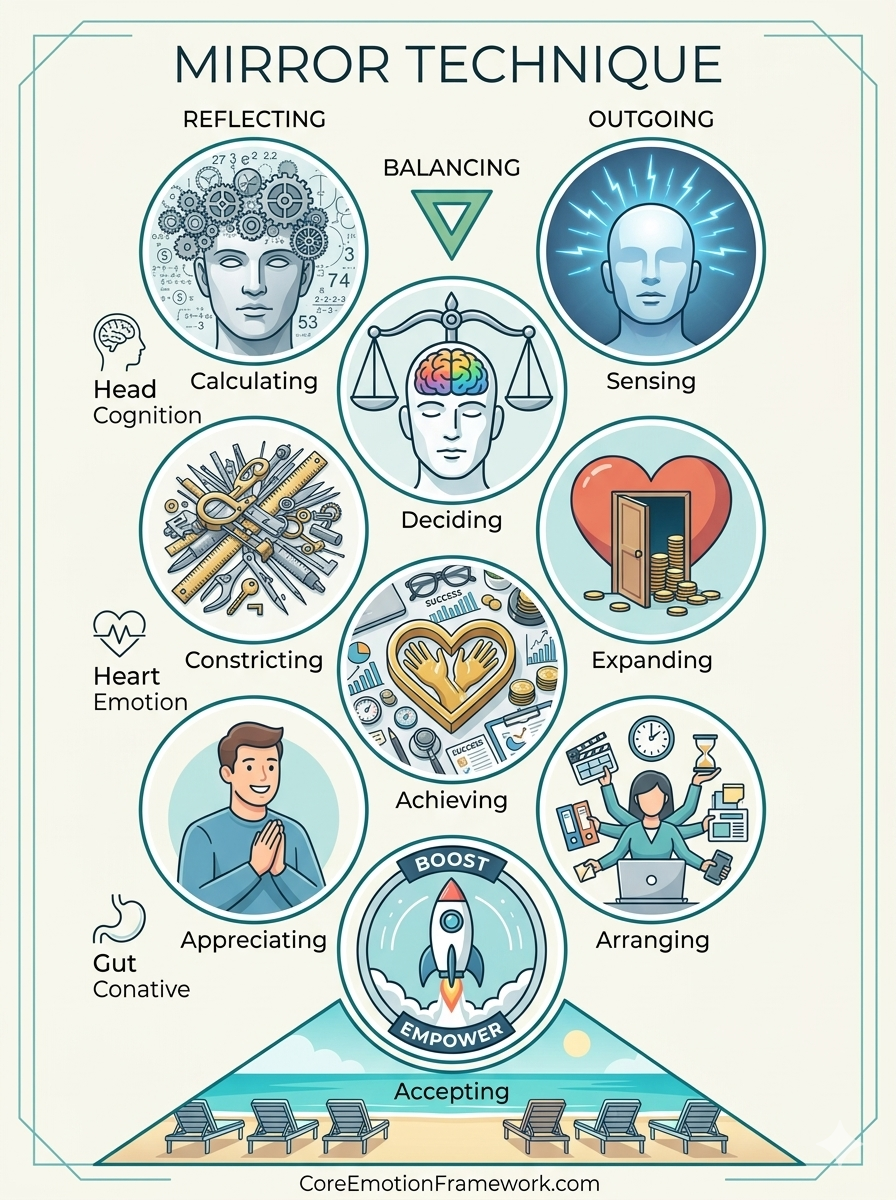
The Human OS — 3x3+1
See:
- Jamel Bulgaria, The Core Emotion Framework (CEF): Mechanistic Answers to Ten Open Questions in Affective Science — PhilPapers
- https://philpapers.org/rec/BULMOR
- https://philpapers.org/rec/BULROT-3
- https://www.optimizeyourcapabilities.com
- https://www.optimizeyourcapabilities.pro
- https://cefmethod.com
- https://cefmirror.com
- https://coreemotionframework.org
- https://www.coreemotionframework.com
메타데이터
- post_id
- 720f42aa3ab1
- slug
- the-physics-of-feelings-why-your-brain-gets-stuck-and-how-to-unfurl-it-720f42aa3ab1
- url
- https://medium.com/@jamelbulgaria/the-physics-of-feelings-why-your-brain-gets-stuck-and-how-to-unfurl-it-720f42aa3ab1
- canonical_url
- https://medium.com/@jamelbulgaria/the-physics-of-feelings-why-your-brain-gets-stuck-and-how-to-unfurl-it-720f42aa3ab1
- author_url
- https://medium.com/@jamelbulgaria
- status
- ok
- fetched_at
- 2026-06-09 15:37:30




