Pain During Periods: When Is It Normal and When Should You Worry?
Most of us learn about periods through a patchwork of awkward school videos, whispered conversations in crowded washrooms, and a whole lot…
Pain During Periods: When Is It Normal and When Should You Worry?
Most of us learn about periods through a patchwork of awkward school videos, whispered conversations in crowded washrooms, and a whole lot of trial and error. Nobody actually sits you down and says, “Here’s the exact threshold where period pain stops being a nuisance and starts being a medical red flag.” So we’re left guessing. We compare notes with friends, we scroll through symptom checkers at 2 AM, and we inevitably flip between two extremes — either convincing ourselves we’re complete wimps or spiraling into the belief that something is terribly wrong.
As someone who spends most days walking women through the confusing landscape of reproductive health, I can tell you that the number one question I get isn’t about pregnancy or fertility. It’s about pain. Is this normal? Should I just pop a pill and move on? Or is my body screaming at me for a reason? And honestly, the fact that we have to ask this at all tells me we aren’t having nearly enough honest conversations about it.
The Chemistry Behind the Cramp
Let’s strip away the mystery and talk about what’s actually happening under the hood. That dull, gripping ache in your lower belly isn’t your uterus being dramatic for no reason. It’s chemistry. Your uterine lining produces these chemicals called prostaglandins, and their job is to make your uterine muscles contract so the lining can shed. Think of them as the foreman on a demolition crew — necessary for the job, but they can get a little overzealous.
Here’s the kicker: the more prostaglandins your body produces, the harder your uterus works. And when it works too hard, it squeezes off the blood supply to your uterus for brief moments, which is exactly what causes that cramping pain. This also explains why some women get the short end of the stick with nausea, headaches, or even digestive issues during their flow. Prostaglandins don’t just stay in the uterus; they travel, and they don’t care whose day they ruin.
The Baseline: What “Normal” Actually Feels Like
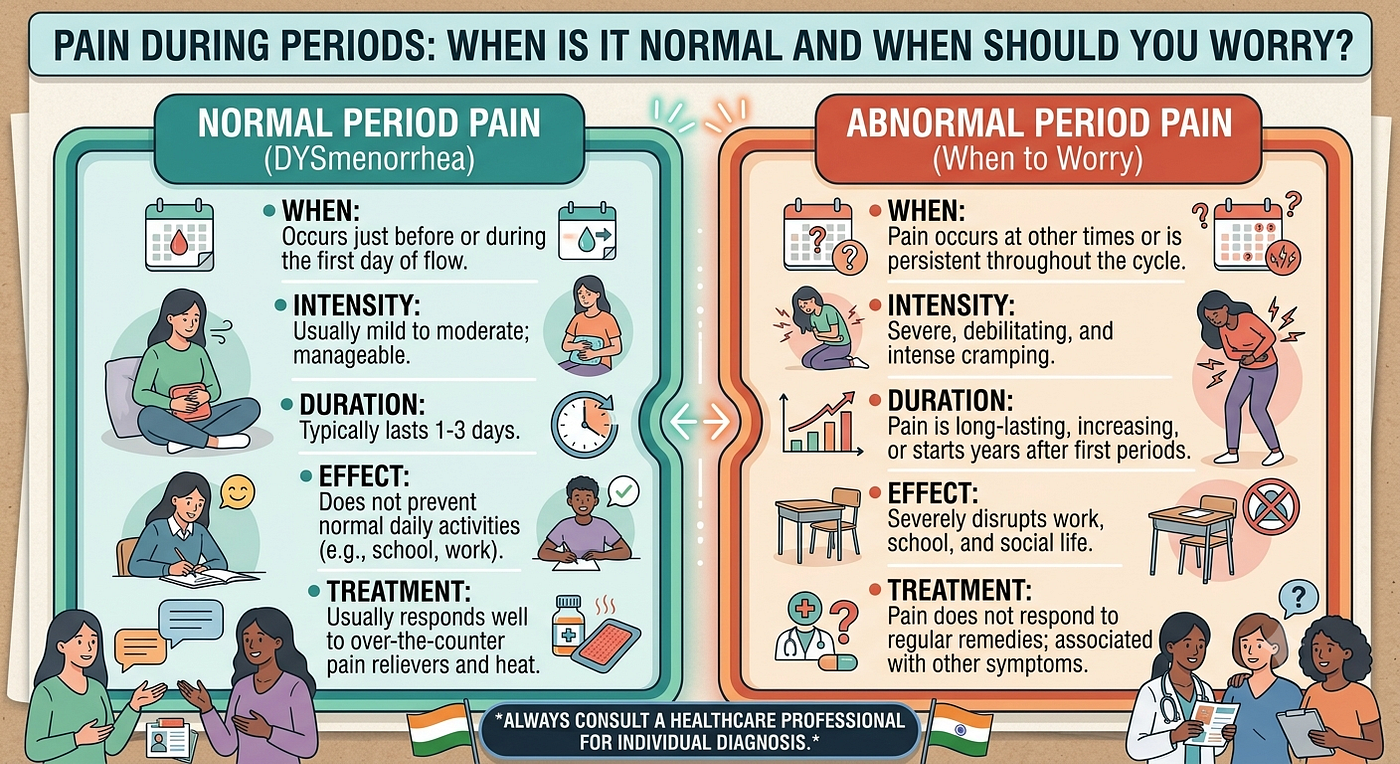
If I had to define a “normal” period, it looks something like this: a low-grade, throbbing ache that starts a day or so before the bleeding kicks in, peaks during the first 24 to 48 hours, and then gradually fades out like a receding tide.
It’s the kind of discomfort where a hot water bottle actually provides noticeable relief. It’s the kind where a standard dose of ibuprofen or a naproxen takes the edge off enough for you to go about your business — maybe you skip the heavy deadlifts at the gym, but you can still walk the dog, go to work, and cook dinner. It’s annoying, sure. It might make you a little short-tempered. But it doesn’t stop your life.
If that sounds like your experience, you’re probably in the clear. Your body is just doing its monthly housekeeping, and while it’s messy, it’s working as designed.
The Warning Bells: When Your Body is Trying to Get Your Attention
This is where we need to get serious for a minute. There is a massive, glaring difference between discomfort and distress. If your period pain regularly has you canceling plans, calling in sick, or lying on the cold bathroom floor because the heat of the bed is too much, we have crossed a line.
Pay very close attention to these specific red flags:
First, pain that builds rather than breaks. Normal cramps tend to ease up after the first couple of days. If you are on day three or four and the pain is worse than when you started, or if the agony starts a full week before your period even shows up, that is not a typical cycle. That is a curveball.
Second, the medication failure. If you take two ibuprofen and forty-five minutes later you still can’t straighten your back, your pain is too strong for over-the-counter solutions to handle. That usually means the underlying cause is mechanical or structural, not just chemical.
Third, the collateral damage. If you are soaking through a super-plus tampon or pad in under an hour, passing large clots (bigger than a coin), running a fever, or feeling like you’re going to pass out, please hear me on this: that is not a badge of honor. That is a medical symptom. Pain during intercourse or a sudden change in your bowel habits around your period are also part of this picture.
The Usual Suspects Behind the Severe Pain
When we sit down with women who are experiencing these severe symptoms, we usually find one of a handful of specific conditions at play. Endometriosis is a big one — this happens when tissue that behaves like the uterine lining sets up shop outside the uterus, sticking to ovaries or bowel. It affects about 1 in 10 women, and the pain is often a deep, stabbing, dragging sensation.
Then there are fibroids, which are non-cancerous growths in the uterine wall. They don’t just cause pain; they often bring heavy, flooding bleeding with them. Adenomyosis is similar, but it’s when that tissue grows directly into the muscular wall of the uterus itself. It makes the uterus feel boggy and heavy, and the cramps can feel like a vice grip.
Sometimes it’s ovarian cysts making their presence known, or an underlying infection like Pelvic Inflammatory Disease that flares up during that time of the month. The point is, these aren’t just “bad periods.” They are specific, diagnosable conditions that have real treatments.
The Middle of the Month Plot Twist
I also want to clear up a quick misconception while we’re here. If you feel a sharp, localized twinge around day 14 of your cycle — usually on one side — that is mittelschmerz, or ovulation pain. It generally lasts a few hours to a day. It’s your ovary releasing an egg, and it’s perfectly normal. You don’t need to call a doctor for that; you just need to know it’s not the beginning of a medical crisis.
Making That Appointment (Without the Anxiety)
Here is the reality: if you are nodding your head to the red flags I just mentioned, the next step is straightforward, but I know it feels heavy. We often hesitate because we don’t want to seem dramatic. We think, “It’s probably nothing, I don’t want to waste their time.”
But let me reframe that. You aren’t going to a doctor to complain. You are going to gather data. When you **consult with a Gynecologist in South Delhi** or wherever you are based, you are simply hiring an expert to help you read the map of your own body.
During that visit, your doctor is going to ask you about the timeline of your pain, what you’ve tried for it, and your family history. They’ll likely do a pelvic exam to check for any obvious tenderness or masses, and they might recommend an ultrasound. That ultrasound is the game-changer — it lets them look at your ovaries, your uterine lining, and the muscle wall to spot fibroids, cysts, or signs of adenomyosis. Blood tests might also be ordered to check for anemia if your bleeding is heavy.
I can promise you this: there is zero judgment in that room. Gynecologists see women with these exact concerns daily. They aren’t going to think you’re weak; they’re going to think you’re proactive.
The Lifestyle Piece (and Why It’s Not a Cure)
I’d be doing you a disservice if I didn’t mention lifestyle, but I want to be careful here. Eating anti-inflammatory foods, getting regular exercise, and managing stress do help reduce prostaglandin levels. I’ve seen women reduce their pain significantly just by improving their sleep hygiene and cutting down on processed foods.
However, and I cannot stress this enough, lifestyle changes do not cure fibroids, endometriosis, or cysts. They are a support system, not a solution. If you have a structural issue, no amount of kale or yoga is going to dissolve it. So use lifestyle to manage the edge, but use medicine to fix the root cause.
The Final Verdict
Trust your gut. If you have that tiny, nagging voice inside you that says, “This doesn’t feel right for me,” please listen to it. The spectrum of period pain is wide, but your experience sits somewhere on that spectrum for a reason. You don’t have to white-knuckle your way through life for five to seven days every month.
If you are reading this and feeling that pang of recognition, start tracking your symptoms today. Write down the intensity, the timing, and what fails to help. Then, pick up the phone. Don’t wait until you’re in a crisis to **book an appointment with the best gynecologist in South Delhi** you have access to. Your quality of life matters. Your reproductive health is not a nuisance to be tolerated; it’s a vital sign of your overall well-being. Get it checked, get it diagnosed, and get back to living your life on your own terms.
메타데이터
- post_id
- 7223882dc03e
- slug
- pain-during-periods-when-is-it-normal-and-when-should-you-worry-7223882dc03e
- url
- https://medium.com/@dramritaseo/pain-during-periods-when-is-it-normal-and-when-should-you-worry-7223882dc03e
- canonical_url
- https://medium.com/@dramritaseo/pain-during-periods-when-is-it-normal-and-when-should-you-worry-7223882dc03e
- author_url
- https://medium.com/@dramritaseo
- status
- ok
- fetched_at
- 2026-07-26 10:31:45