EU Audit Readiness: The Hidden Risk in Non-Immutable DPP Platforms
Why overwrite-based databases are a compliance liability under the ESPR — and what Immutable Record Keeping actually looks like in…
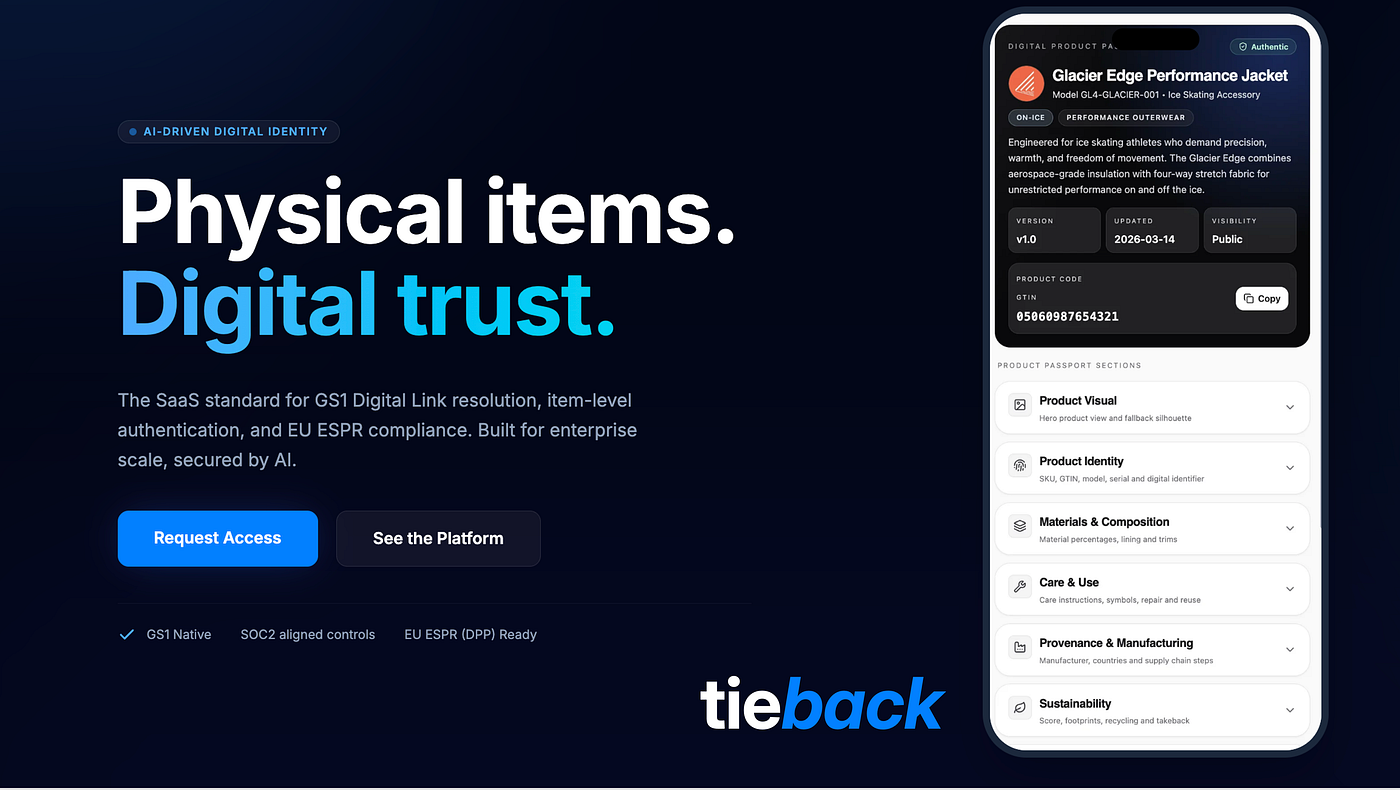
https://tieback.io -tieback Digital Product Passport platform showing a product passport with authentication status, GS1 Digital Link, materials composition, and provenance data.
EU Audit Readiness: The Hidden Risk in Non-Immutable DPP Platforms
Why overwrite-based databases are a compliance liability under the ESPR — and what Immutable Record Keeping actually looks like in practice.
There’s a question almost nobody is asking about Digital Product Passport platforms.
Not “does it support GS1 Digital Link?” Not “can it handle our SKU volume?” Not even “does it meet ESPR data requirements?”
The question is simpler than all of those — and far more dangerous to get wrong:
Can you prove your data wasn’t altered after the fact?
The Audit Scenario Nobody Is Preparing For
The EU Ecodesign for Sustainable Products Regulation (ESPR) doesn’t just require brands to collect product data. It requires them to demonstrate that data to market surveillance authorities — on demand, under audit conditions.
Starting from the 2025 financial year, large companies operating in the EU must publicly report destruction volumes: how many unsold products they destroyed, why, what exemptions they invoked, and what measures they took to prevent destruction in the future. This data must follow a standardised EU-wide reporting format. It will be published on the company’s own website. It will be read by competitors, customers, sustainability analysts, and journalists.
But the reporting obligation is only half the picture.
When an EU market surveillance authority audits a brand’s Digital Product Passport data — and they will, because the ESPR explicitly empowers them to do so — the question they ask won’t be “do you have the data?”
It will be: “Can you prove this record existed in this exact form at the time you claim it did?”
That’s a fundamentally different question. And most DPP platforms cannot answer it.
The Overwrite Problem
To understand why, you need to understand how most software systems store data.
The vast majority of Digital Product Passport platforms — and the legacy Product Information Management (PIM) systems feeding them — run on standard relational databases. These are well-established, reliable systems. They power most enterprise software. And they have a fundamental characteristic that becomes a liability under audit conditions: they use UPDATE commands.
When a record is changed in a standard database, the UPDATE command overwrites the previous value. The old data isn’t archived. It isn’t versioned. It’s replaced. The historical state is destroyed the moment someone hits save.
This is how databases have worked for decades. For most applications, it’s perfectly fine. For a product catalogue, a CRM, or an inventory system, you typically care about the current state of a record, not what it said three months ago.
But under the ESPR, you care very much about what it said three months ago.
Consider this scenario: an EU auditor asks your compliance team, “What exactly did this Digital Product Passport state on March 15th at 9 AM?” In a system built on overwrite-based storage, the answer is: we don’t know. The data that existed on March 15th was overwritten when someone made an update on March 22nd. The historical state is gone.
Now consider the follow-up question: “How can you prove the destruction figures you reported in your annual disclosure haven’t been adjusted after the fact?”
In an overwrite-based system, the answer is: we can’t.
That’s not a minor technical limitation. That’s a compliance liability that scales with every passport, every lifecycle event, and every annual disclosure cycle.
Why “We Have Backups” Isn’t an Answer
The first response most IT teams give when this question comes up is: “We have database backups.”
Backups solve a different problem. They exist for disaster recovery — restoring a system after a failure. They are not designed for granular, point-in-time auditability of individual records.
Reconstructing the state of a single Digital Product Passport from a full database backup requires restoring the entire backup to a separate environment, locating the specific record, and hoping the backup cadence (daily? weekly?) captured the exact state the auditor is asking about. If the change happened between backup windows, the data is still lost.
More importantly, backups themselves are mutable. They can be modified, replaced, or selectively restored. An auditor has no way to independently verify that a backup hasn’t been tampered with. The backup proves your IT team is diligent. It does not prove the data is trustworthy.
Audit readiness requires something architecturally different. It requires immutability.
What Immutable Record Keeping Actually Means
Immutability, in the context of compliance data, means that once a record is written, it cannot be retroactively altered, overwritten, or deleted — not by a user, not by an administrator, not by the system itself. The record exists in its original form, permanently, with a verifiable chain of every subsequent change.
This is how tieback’s architecture works.
WORM Storage for Published Passports
When a Digital Product Passport is published on tieback, it is frozen into an immutable snapshot with strict WORM (Write Once, Read Many) compliance locks. WORM is a well-established storage paradigm used in financial services, healthcare, and legal industries — anywhere regulators require proof that records haven’t been tampered with.
Once a passport is published, that snapshot is locked. It cannot be silently overwritten, modified, or deleted. Not by a brand user. Not by a tieback administrator. Not by anyone. The immutability is enforced at the storage layer itself, not by application logic that could theoretically be bypassed.
This matters because application-level “soft locks” — where the software prevents deletion but the underlying data store allows it — are not true immutability. If a system administrator with database access can modify or delete a record, then the system is mutable regardless of what the application interface shows.
Append-Only Ledgers for Lifecycle Events
Products don’t exist in a static state. Ownership changes. Warranty claims are filed. Care instructions are updated. Recycling guidance evolves as regulations change. A Digital Product Passport is a living record, and it needs to accommodate change.
The question is: how do you accommodate change without destroying history?
tieback’s answer is append-only ledger tables. For every lifecycle event — an ownership transfer, a warranty claim, a correction, a metadata update — the system creates a net-new, timestamped record. The previous state is preserved exactly as it was. UPDATE and DELETE operations are architecturally forbidden at the database layer.
This is a critical distinction from systems that merely “log changes” in a separate audit table while still allowing the primary record to be overwritten. In those systems, the audit log and the live record can drift apart. The log says one thing; the database says another. Under audit, that discrepancy becomes a vulnerability.
In tieback’s architecture, there is no discrepancy. The ledger is the record. Every version of every passport, every lifecycle event, every change — all append-only, all timestamped, all preserved.
Point-in-Time Reconstruction
The practical result of WORM storage plus append-only ledgers: tieback can reconstruct the exact, legally defensible state of any Digital Product Passport at any second in its history.
Not an approximation. Not a “last known value.” Not a best-effort reconstruction from backups. The precise state of the passport — every field, every value, every relationship — as it existed at the exact moment the auditor is asking about.
With a complete chain of who changed what, when, and why.
When the auditor asks “what did this passport say six months ago?” — you don’t scramble to pull reports. You show them. In seconds.
Why This Matters More Than Most Compliance Teams Realise
The ESPR’s mandatory public disclosure requirement creates an environment where data integrity isn’t just an internal concern — it’s a public one.
Your destruction data, your circular economy metrics, your compliance documentation — all of this will be visible to competitors, investors, and the press. If that data lives in a mutable, overwrite-based system, you have no defence against allegations of manipulation, even if the data is perfectly accurate. You simply cannot prove it wasn’t changed after the fact.
This is the gap between “we reported this” and “we can prove this was the record at the time.”
In regulated industries like financial services, this distinction has been settled for years. WORM storage and immutable audit trails are not optional — they’re a regulatory requirement. The ESPR is bringing that same standard to product compliance. The brands that recognise this early will build on platforms that meet it. The brands that don’t will discover the gap when an auditor finds it for them.
The Question to Ask Your DPP Vendor
If you’re evaluating Digital Product Passport platforms right now — or if you’ve already chosen one — there’s one question that will tell you everything you need to know about its audit readiness:
“If I need to reconstruct the exact state of a passport from six months ago, can your system do that — and can you prove the record wasn’t altered?”
If the answer involves the word “backup,” you have a problem.
If the answer involves “audit logging” in a separate table while the primary record is overwritable, you have a more subtle problem — but a problem nonetheless.
If the answer is “yes, every record is immutable from the moment of publication, every change is append-only, and we can reconstruct any state at any point in time” — you’re building on the right foundation.
The brands choosing DPP infrastructure right now are making a platform decision they’ll live with for the next decade. The ESPR is the beginning, not the end. Make sure the platform you choose can survive an audit — not just pass a demo.
Coming in Q2 2026: for luxury and high-end fashion brands that want the ultimate provenance guarantee, tieback will offer optional blockchain-backed tokens as an immutable source for their Digital Product Passports. Enterprise-grade immutability today. Blockchain-grade provenance when you’re ready.
메타데이터
- post_id
- 72ccccda3c9e
- slug
- eu-audit-readiness-the-hidden-risk-in-non-immutable-dpp-platforms-72ccccda3c9e
- url
- https://medium.com/@pydtcptk/eu-audit-readiness-the-hidden-risk-in-non-immutable-dpp-platforms-72ccccda3c9e
- canonical_url
- https://medium.com/@pydtcptk/eu-audit-readiness-the-hidden-risk-in-non-immutable-dpp-platforms-72ccccda3c9e
- author_url
- https://medium.com/@pydtcptk
- status
- ok
- fetched_at
- 2026-06-16 19:09:56