$1.29 Trillion Digital Health Market by 2035; Is Healthcare Entering Its Smartest Era Yet?
Healthcare is no longer limited to hospital walls. Today, a smartwatch can monitor heart rhythm, a mobile app can track diabetes, and a…
$1.29 Trillion Digital Health Market by 2035; Is Healthcare Entering Its Smartest Era Yet?
Healthcare is no longer limited to hospital walls. Today, a smartwatch can monitor heart rhythm, a mobile app can track diabetes, and a doctor can consult patients through a video call within minutes.
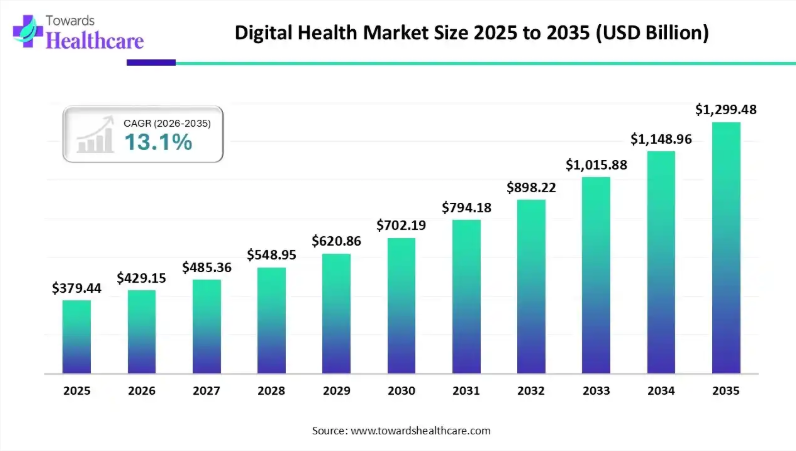
The global **Digital Health market is expected to reach nearly USD 429.15 billion in 2026 and may cross an extraordinary USD 1.29 trillion by 2035, growing at a strong 13.1% CAGR**. The industry is transforming because patients now expect healthcare to become faster, smarter, cheaper, and more personalized.
**Downlaod FREE Sample Report**
Artificial intelligence, telehealth, mobile health apps, cloud systems, wearable devices, and big data analytics are no longer future concepts. They are already becoming part of everyday healthcare operations across hospitals, clinics, insurance systems, and even homes.
Telehealth Becomes the New Front Door of Healthcare
The biggest shift in digital healthcare is happening through telehealth. Patients increasingly prefer virtual consultations over long hospital waiting times.
Before the pandemic, more than 54% of adults in the U.S. already showed interest in telehealth services to reduce healthcare expenses. That demand accelerated rapidly afterward, pushing healthcare providers to invest heavily in virtual care infrastructure.
Telehealth technologies now include:
- Video consultations
- Remote patient monitoring
- Digital prescriptions
- Chronic disease tracking
- AI-powered patient engagement systems
This segment dominated the market in 2024 and continues to expand because it reduces hospital readmissions, improves access in rural regions, and cuts operational costs for providers.
At the same time, remote monitoring devices now allow doctors to track patients in real time using connected glucose monitors, pulse oximeters, blood pressure trackers, and wearable sensors.
Mobile Health Apps Turn Smartphones into Personal Clinics
The rapid rise of smartphones is fueling explosive growth in the mHealth segment. Healthcare apps are no longer limited to fitness tracking.
Patients now use mobile apps for medication reminders, virtual therapy, mental wellness, chronic disease management, appointment scheduling, and access to electronic medical records.
Digital health platforms are especially helping patients with:
- Diabetes management
- Hypertension monitoring
- Mental health support
- Sleep disorder tracking
- Preventive wellness programs
The wearable technology boom is accelerating this trend further. Germany alone reported that nearly 19.3% of adults use consumer wearables, and over 77% of those users actively collect health-related data.
In the UK, digital adoption has become mainstream. More than 28 million people actively use the NHS application, while over 40 million citizens now hold NHS digital logins.
AI and Big Data Push Healthcare Into Predictive Mode
Healthcare is moving from reactive treatment to predictive care. AI-driven software now helps physicians identify diseases earlier, personalize treatments, and reduce diagnostic errors.
The U.S. FDA had already approved more than 1,247 AI and machine learning-based medical devices by mid-2025, showing how quickly intelligent healthcare systems are entering mainstream medicine.
Healthcare software platforms are also becoming the fastest-growing component of the market. The software segment alone may rise from nearly USD 165.82 billion in 2025 to over USD 471 billion by 2034.
AI-powered healthcare systems now support:
- Disease prediction
- Personalized treatment recommendations
- Clinical decision-making
- Hospital workflow automation
- Population health analytics
This digital shift is helping hospitals improve efficiency while lowering healthcare delivery costs.
Asia-Pacific Emerges as the Fastest Digital Health Battleground
Europe currently leads the global digital health market, but Asia-Pacific is becoming the fastest-growing region.
Countries like China, India, Japan, and South Korea are aggressively investing in telemedicine platforms, healthcare apps, AI systems, and connected healthcare infrastructure.
India alone now hosts nearly 7,700 digital health companies, making it one of the world’s fastest-expanding digital healthcare ecosystems.
China’s health-tech expansion is equally massive. The country now has more than 2,624 health-tech startups, while major digital platforms already serve tens of millions of patients digitally.
Governments are also accelerating digital healthcare transformation through centralized health information systems, smart hospital initiatives, and nationwide telemedicine programs.
Cybersecurity Becomes Healthcare’s Biggest Digital Challenge
As healthcare becomes more digital, cybersecurity risks continue to rise sharply.
Electronic health records now store massive volumes of highly sensitive patient information, making healthcare systems a prime target for cyberattacks.
Healthcare organizations are increasingly investing in:
- Multi-factor authentication
- Data encryption systems
- Secure cloud infrastructure
- Cybersecurity audits
- AI-driven threat monitoring
The challenge is becoming more urgent as hospitals continue shifting toward fully connected healthcare ecosystems.
The Next Decade Could Redefine Global Healthcare
Digital healthcare is no longer an experimental industry. It is rapidly becoming the backbone of global healthcare delivery.
From AI-powered diagnostics and wearable monitoring devices to telemedicine platforms and predictive analytics, the industry is reshaping how healthcare systems operate worldwide.
The numbers clearly show the scale of transformation ahead. A market moving toward USD 1.29 trillion by 2035 signals far more than technological growth; it signals a complete reinvention of healthcare itself.
The next decade may not just digitize healthcare. It may fundamentally redefine how the world experiences health, treatment, prevention, and patient care.
Access our exclusive, data-rich dashboard dedicated to the healthcare IT market — built specifically for decision-makers, strategists, and industry leaders. The dashboard features comprehensive statistical data, segment-wise market breakdowns, regional performance shares, detailed company profiles, annual updates, and much more. From market sizing to competitive intelligence, this powerful tool is one-stop solution to your gateway.
Access the Dashboard: https://www.towardshealthcare.com/access-dashboard
Checkout the Market Report Now at: https://www.towardshealthcare.com/checkout/5040
About Us
Towards Healthcare Research and Consulting is a global strategy partner in the **healthcare IT market**, covering digital health, telehealth, EHR, analytics, and cybersecurity. We help providers and tech companies navigate digital transformation through data-driven insights. Our focus is on improving interoperability, optimizing operations, and unlocking value from health data to drive better outcomes.
Become a valued research partner with us — https://www.towardshealthcare.com/schedule-meeting
You can place an order or ask any questions, please feel free to contact us at sales@towardshealthcare.com
Powering Healthcare Leaders with Real-Time Insights: https://www.towardshealthcare.com/healthcare-intelligence-platform
Europe Region — +44 778 256 0738
North America Region — +1 8044 4193 44
APAC Region: +91 9356 9282 04
Visit Our Website: https://www.towardshealthcare.com
메타데이터
- post_id
- 72ce054c8271
- slug
- 1-29-trillion-digital-health-market-by-2035-is-healthcare-entering-its-smartest-era-yet-72ce054c8271
- url
- https://medium.com/@SanskrutiSathe/1-29-trillion-digital-health-market-by-2035-is-healthcare-entering-its-smartest-era-yet-72ce054c8271
- canonical_url
- https://medium.com/@SanskrutiSathe/1-29-trillion-digital-health-market-by-2035-is-healthcare-entering-its-smartest-era-yet-72ce054c8271
- author_url
- https://medium.com/@SanskrutiSathe
- status
- ok
- fetched_at
- 2026-06-09 15:37:30