A guide to climbing Japan’s highest peak, Fuji-San (Mt. Fuji)
Mt fuji is massive, you can see it from almost 20 percent of Japan. It has an almost perfectly geometrical conical shape, however this…
A guide to climbing Japan’s highest peak, Fuji-San (Mt. Fuji)
Mt fuji is massive, you can see it from almost 20 percent of Japan. It has an almost perfectly geometrical conical shape, however this perfect shape wasn’t achieved in one eruption. It went over 3 eruptions (with the latest one happening as recently as the 1700s) to get its signature shape.
Picture from 36 views of Mt Fuji by the artist- Hokusai
Fuji san, although seemingly massive and quiet right now, is an active volcano, with scientists predicting a 30–40 percent chances of eruption in the next 50 years, Mt Fuji is thus seen as a quiet yet powerful force of nature, which if it erupts can have signifant effect over transportation, communication and agriculture of the Kanto region and the metropolis of Tokyo as well. In this blog we will explore how to climb with ease, and grace this mighty volcano, which is etched as a cultural symbol in Japanese history and art.
We started the climb from Fuji-Kawaguchiko, a city which provides a clear view of Mt Fuji, and even has an amusement park named Fuji-Q Highland which apparently provides amazing views of Fuji during the rides.
Weather
An important factor to consider while climbing Fuji San is the weather, so i would recommend to check beforehand if the weather is sunny/less cloudy, as that will determine if you get a clear view from the top, which in my opinion enhances the hike a lot. (weather predictions in Japan are pretty accurate compared to most parts of the world, as metereology is something which is a major factor in an economy which faces typhoons, tsunamis etc.)
Gear
Mt Fuji’s climbing season’s official website (https://www.fujisan-climb.jp/en/) lists the following gear as mandatory to enter the gates from the 5th station : Trekking Shoes (proper trekking shoes, not sports shoes), Waterproof Trousers, Waterproof Wind-sheeter jackets, if you do not fulfill the above, there is a very high chance, you won’t be allowed to go past the gates of the 5th station, there are dedicated people who check this.)
Regarding gear, you don’t need to buy all of this beforehand, there are rental shops, just across the road of Kawaguchiko Bus station, who provide the above items (and also other things like headlamps, gloves, socks, walking sticks etc) at a decent price. to give a rough figure, A pair of Shoes+Trousers+Jackets+headlamps cost us about 15000 Yen per person. They accept cash and credit cards and sometimes Pay-Pay as well.
One souvenir which is highly recommended to get is a plain wooden walking stick which you can buy from Kawaguchiko or the 5th station and you can get it stamped along the way as you climb different stations, there are shops all along the trail, who give representative stamps of each station etched with super hot iron stamp rods. Each stamp costs about 300–400 Yen.
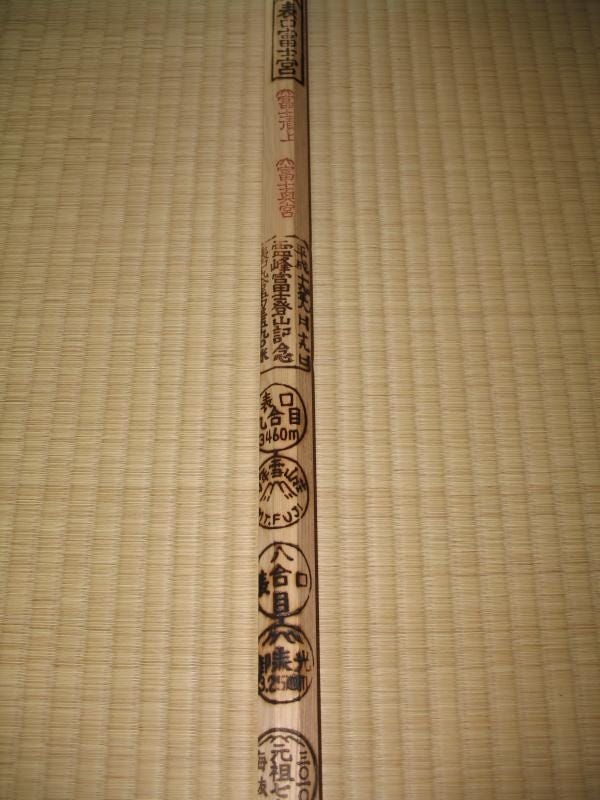
Mt Fuji walking sticks from Stamps from different stations.
How to get there
In the climbing season, you need to be at the gates of the 5th station by max 2 PM, otherwise they may reserve the right to deny you entry. (However i’ve heard of instances whereby if you show the booking of a hut at the top, they may allow you an entry, but that is purely upto the discretion of the staff, so its best to reach before 2 PM.
You can get a bus or a taxi from the Kawaguchiko station to the 5th station.
The Trek
Mt Fuji is divided into stations, which can be seen as pit stops, which generally have huts, sometimes medical facilites, shops for stamps, mini konbinis (Japanese word for convenience stores) etc. 5th station being roughly half of the mountain and 10th station being the summit.
Officially you can climb the mountain from different trails like Yoshida, Subashiri and Ohachimeguri. I climbed the Yoshida (and it is the only one i know about) so i will talk about climbing through that. Yoshida is perhaps the most popular of the trails during the climbing season.
Different stations and trails to climb Fuji San
The total climb to the summit is around 10–12 hours if you’re an average climber (like me).
We started the trek from the 7th station at around 2 PM, reached the 6th station at about 4 PM and we were at the 7th station by approximately 8 PM.
The climb up top Yoshida is stony + a bit of gravel, but not so much that your shoes might get stuck or get dug inside, overall its an interesting rugged climb.

On the way to the 7th station
Accomodation
Mountain huts happen to be the only modes of accomodation atop the volcano, they generally go for a good price of about 20,000 Yen on average. Don’t go into the huts expecting a room and an onsen, you’re gonna be dissapointed :p, however they are an experience in itself, they feel like bunkers in a submarine, cozy yet very compact, you fit in with slight room for sitting, we were provided with a sleeping bag, a pillow and a really nice evening meal. we reserved Kamaiwakan which is midway between the 7th and 8th station, you can have a look at it here : https://www.japanmountainhuts.com/kamaiwakan.html.
You can however prefer to rent a moutain hut at 8th station as well, as after resting you would need to climb a bit less for the peak.
The purpose of the hut is to provide you a place to eat food and rest for about 3–4 hours before you begin your ascent to the summit.
The Ascent to the Top
If you’re a bit open and friendly, along the trail you will find numerous people, waving at you and saying “Ganbatte” — which roughly translates to All the best or you can do it!
After a failed attempt at sleeping in the huts for 4 hours after our body was shocked after climbing for 5 hours due to the sudden change in activity from sitting the whole week in an office near Tokyo to suddenly climbing, we decided to start the climb at around 11 PM, with an estimate of reaching the summit by sunrise, which is approximately at 5:30ish PM, with our headlamps on, me and my friend Max, started the ascent to the summit, along the way we were re-united with our friends we made that afternoon and decided to climb together, a group among those group realising that we we were too slow to keep pace for them to catch sunrise, parted and started ascending at a faster pace, so it was 6 of us climbing to the top.

The climb team : 2 friends and 4 strangers, divided by nations and politics, united by Fuji San :). Americans, indians, mexicans and japanese climbed together.
We would get stamps along the way wherever we could get the opportunity, in the above picture you could see our almost fully stamped sticks. By the time we got to the 8th station, it started getting a bit windier and cold, i as a matter of fact was unprepared and a very kind guy from New York lended me his jacket which i wrapped beneath my Wind Sheeter. This was around 15th of July.
We reached the top at around 6 AM, missing the sunset at the summit, but we enjoyed it from about 100 metres below.

100 metres from the Summit
At the top there is a shrine and a souvenir store where you can buy badges, certificates and some holy symbols.

At the top, overlooking the crater.
At the top is a crater, which is a kind of depression, remenants of the explosion which formed Fuji, the crater is completely closed with Lava several miles beneath it. There is a rope encircling the crater and you can do a round around it, whic is also considered sacred.
The Descent
The descent down Mt Fuji is a different challenge, currently it is a bulldozed path with several feet deep gravel along the path, it is different from the rocky+mild gravel path you see when climbing up. Due to the gravel, if you’re not familiar with the technique of being able to navigate such paths you might find yourself fatigued due to the excessive loss of energy cause by your feet getting inside the gravel. This is the tricky part which might make your descent longer or shorter. I’ve met australian folks pretty good at hiking who were able to climb down the mountain running in 2 hours, and then there was us who took about 5–6 hours climbing down.
富士山に一度も登らぬ馬鹿、二度登る馬鹿 Fuji-san ni ichido mo noboranu baka, nido noboru baka.
“A fool who never climbs Fuji, and a fool who climbs it twice.”
A funny saying above goes like that, due to the reason of Mt Fuji being a bit tiring during the descent and being a bit challenging due to being largely a 1 day hike.
What to Pack and take care of
Food at the top of Fuji is scarce and expensive, we packed a bunch of Items like Energy Jelly packs, red bulls (Not reccomended 💩), chips, chocolates, etc which kept us well fed during some tiring times.
AMS (Altitude Mountain Sickness)
Fuji san at its highest is roughly 3,800 metres, due to the volcanic nature of its origin, the nature of its soil and general altitude at about roughly 2,800 metres the “Treeline” dissapears. (Treeline in a mountain refers to the last point where there is a resonable concentration of vegetation or trees providing oxygen). So the upper reaches after the 8.5th station, has a bit of oxygen deficiency, due to this some climbers might face AMS, which can be deadly if not taken care of soon. If you get a headache, start feeling drunk (which is one of the first symptoms of AMS) you should either : a) return immediately to the bottom or b) try to get some oxygen and wait, if the oxygen doesn’t help and the headache becomes more throbbing you should begin an assisted descent to the bottom, AMS can become very deadly very fast.
you can get small oxygen canisters for about 1000 Yen as you climb the top along the stations. I highly recommend getting them.
富士山に登らせていただきました。
Fuji-san ni noborasete itadakimashita.
“I was privileged to be allowed to climb Mt. Fuji.”
I approached Fuji San not as a mountain but as this huge magnificent tower of astounding proportions, infront of it, my problems and my thoughts felt smaller, if you can, bring Fuji San home with you in your heart :)
Thank you very much for reading my blog, Arigato Gozaimashita :)
메타데이터
- post_id
- 72d5207cdf1b
- slug
- a-guide-to-climbing-japans-highest-peak-fuji-san-mt-fuji-72d5207cdf1b
- url
- https://medium.com/@aditya.acharya.bme23/a-guide-to-climbing-japans-highest-peak-fuji-san-mt-fuji-72d5207cdf1b
- canonical_url
- https://medium.com/@aditya.acharya.bme23/a-guide-to-climbing-japans-highest-peak-fuji-san-mt-fuji-72d5207cdf1b
- author_url
- https://medium.com/@aditya.acharya.bme23
- status
- ok
- fetched_at
- 2026-08-28 17:11:18