Angkor Wat and Its Astonishing Shared History with Hinduism
Why my trip to Cambodia was an eye-opener
Angkor Wat and Its Astonishing Shared History with Hinduism
Why my trip to Cambodia was an eye-opener
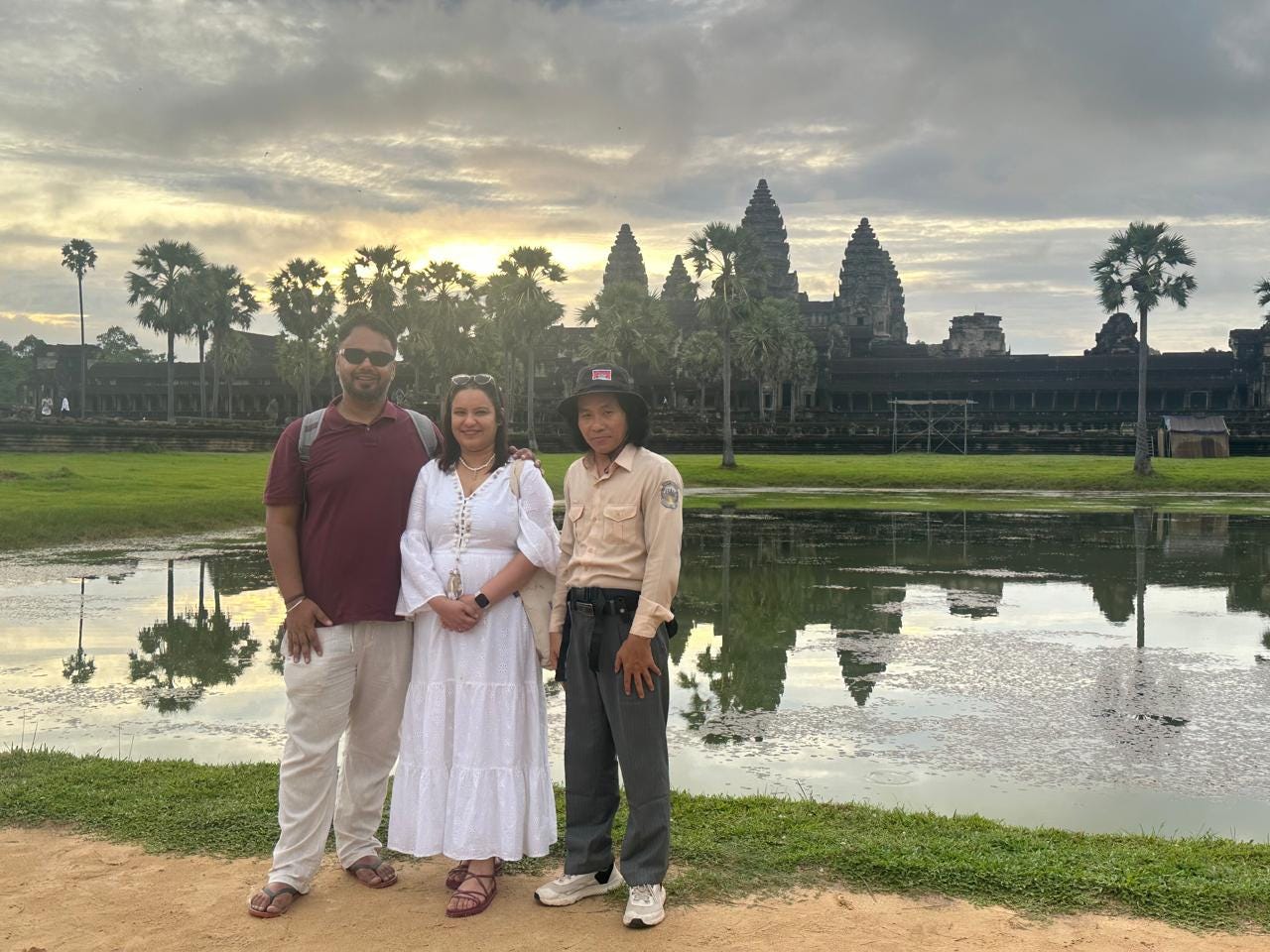
With our guide, Mr. Makara, at Angkor Wat (All photos by author)
Last month, when my husband and I were planning a trip to Cambodia, I wasn’t sure of what to expect from the country, which was hardly talked about or spoken of in today’s global scenario. Generally, I don’t like to read much about a place before visiting it, because honestly, it defeats the entire purpose of visiting a new country. When you haven’t read much about a place, you go with an open mind and zero preconceived notions, and that's where the charm of travel really lies. Unpacking one location at a time, soaking in all the newness (and sometimes, strangeness) of the culture, land, and people, is where the thrill lies. Cambodia, for me, was just that.
The only place I had heard about was the remarkably famous Angkor Wat (translated to City of Temples in Khmer), in Siem Reap, which is the largest religious complex in the World. So on the day of our visit, I was pretty excited for what was in store. Our pick up was planned in a way that we reached Angkor Wat well before sunrise. While on our way, our guide informed us that Angkor Wat marked the highest point of Khmer architecture.
When we entered the complex at the crack of dawn, it was quite dark to comprehend the magnanimity of what was in front of us. However, after 30 minutes or so, we could see the full-blown structure. To not be in awe of the Khmer architecture was impossible.

The stunning Angkor Wat at the crack of dawn
As per our guide, Angkor Wat was initially constructed in the 12th century by King Suryavarman II and was originally dedicated to the Hindu gods Vishnu and Shiva, before transitioning into a Buddhist site.
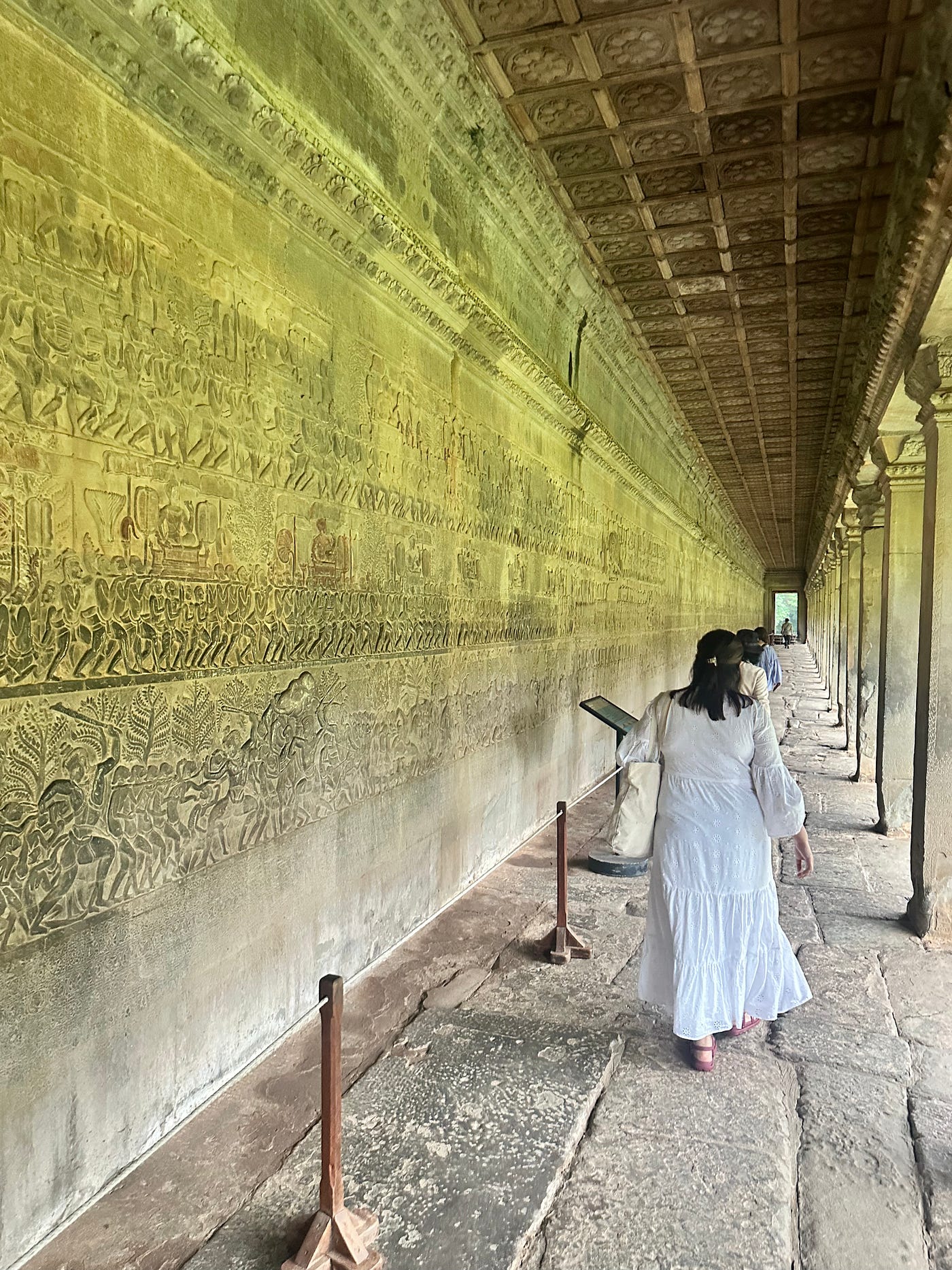
Author walking through the alleys of Angkor Wat
As we walked through, we discovered how Angkor Wat’s architecture depicts events in the well-known Indian epics of the Mahabharata and Ramayana (like the one in the picture below) — confirming that those texts were widely known at Angkor even in the 12th century.

Churning of the Sea of Milk (or Samudra Manthan), a well-known event in Hindu mythology depicted on the walls of Angkor Wat
Another carving in the temple we stopped by was of Yama, the god of justice and death as per Hindu mythology. He is depicted as a multi-armed figure riding his vahana (sacred mount), a water buffalo. His multiple arms symbolize his immense reach and capacity to deliver absolute justice.
I was truly mesmerized by all these carvings since I hardly had any clue about the shared history between Khmer and Hindu religions. Clearly, the ties must have been deep because to have such intricate and detailed inscriptions of events from Hindu mythology on the walls could not be a mere coincidence.
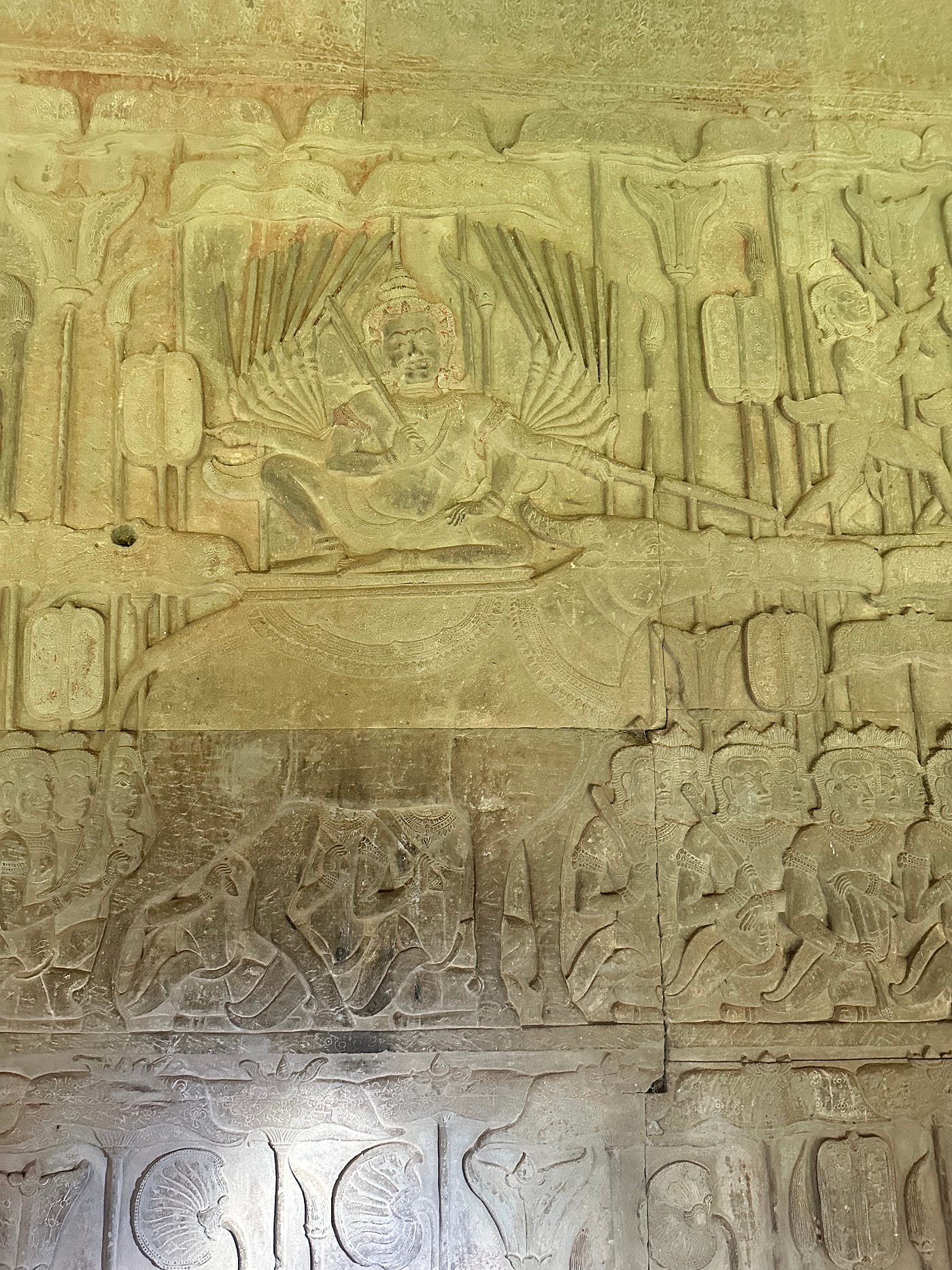
Depiction of Yama
After coming out of Angkor Wat and a tiny breakfast break, we drove to Angkor Thom (The Great City), which at its heart housed the majestic, The Bayon (my personal favourite) with four faces, each pointed towards the cardinal directions; although, some of the towers at Bayon had three or just two faces. The faces themselves were uniform in style. The smiles were broad, and the eyes seemed open (or maybe closed, what do you think?!).
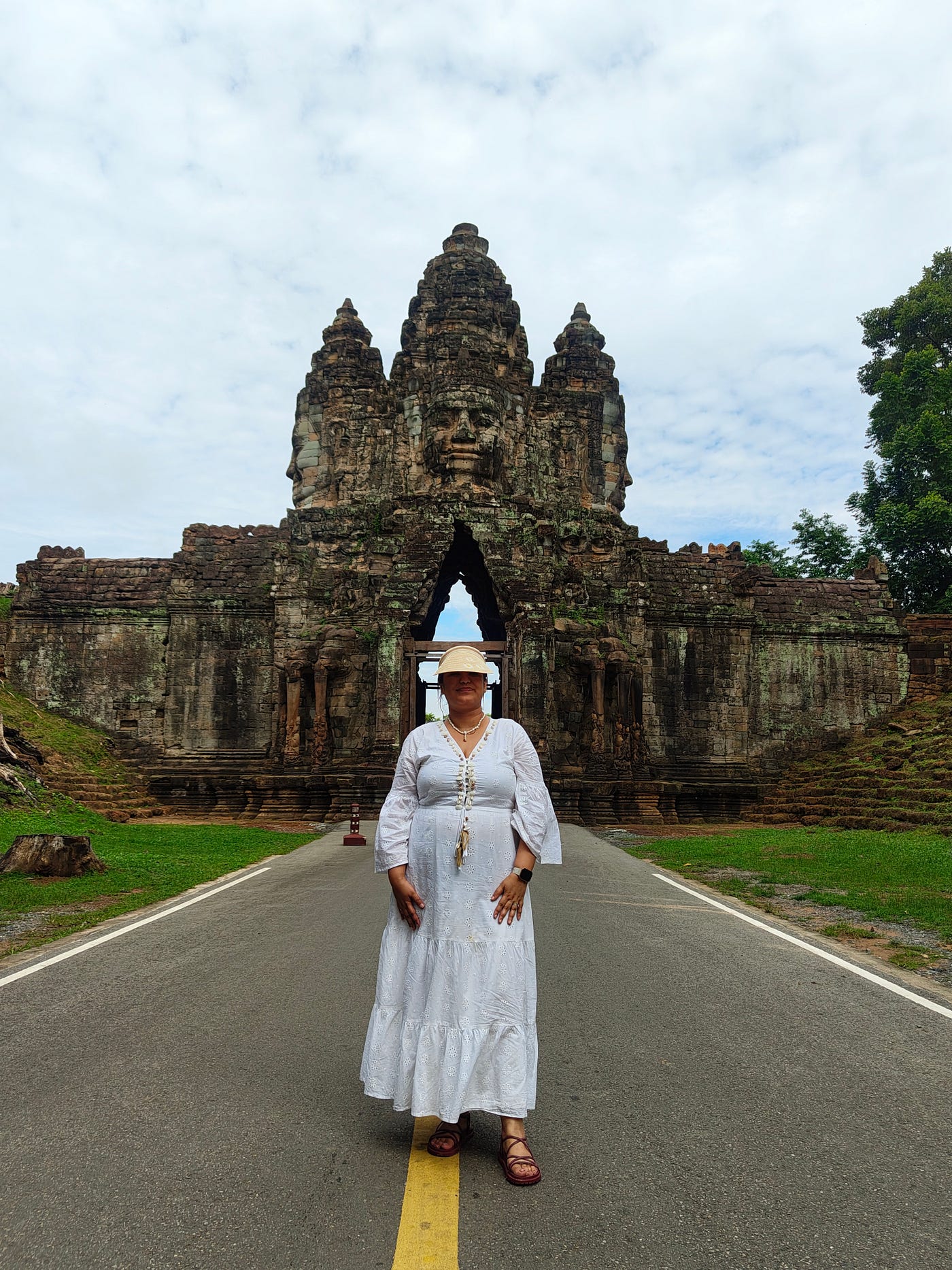
Author at the entrance of the Bayon, Angkor Thom
Our guide told us there was no clarity on who these faces represent, but it is popularly believed that they represent either Lord Buddha or the Hindu deities Brahma and Shiva. As per him, the temple was so huge that nobody knew the exact number of towers or faces!

Side-view of the entrance of the Bayon
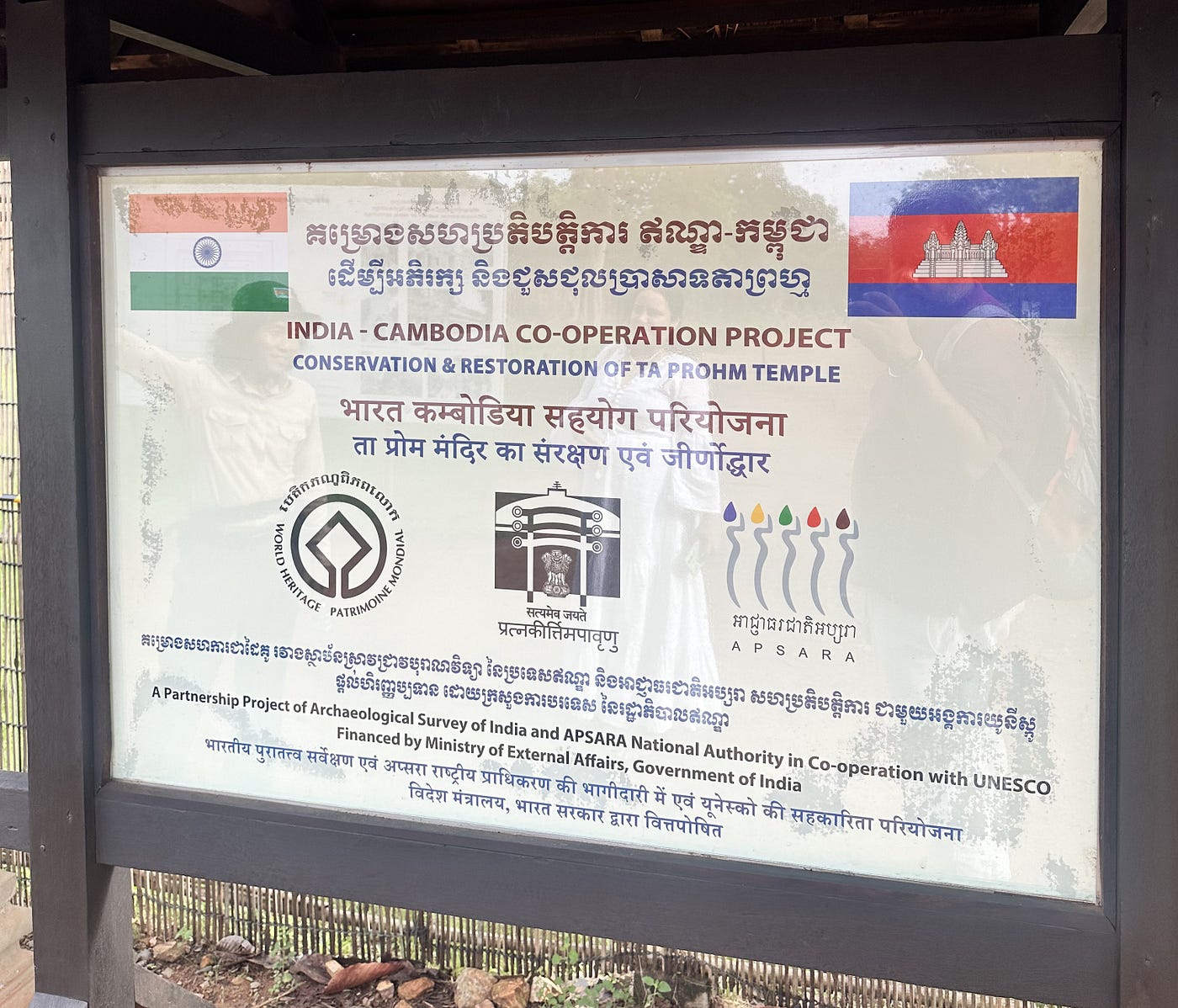
The next temple we visited at Angkor Wat was Ta Prohm, an ancient Buddhist temple characterized by huge silk-cotton trees that have their roots cutting through the temple roof and walls. Our guide told us that these roots are slowly destroying the ancient stones by forcing them apart, yet they are also holding the collapsing walls together. If you cut down the tree, the temple wall behind it would likely crumble. You really have to see it to believe it!
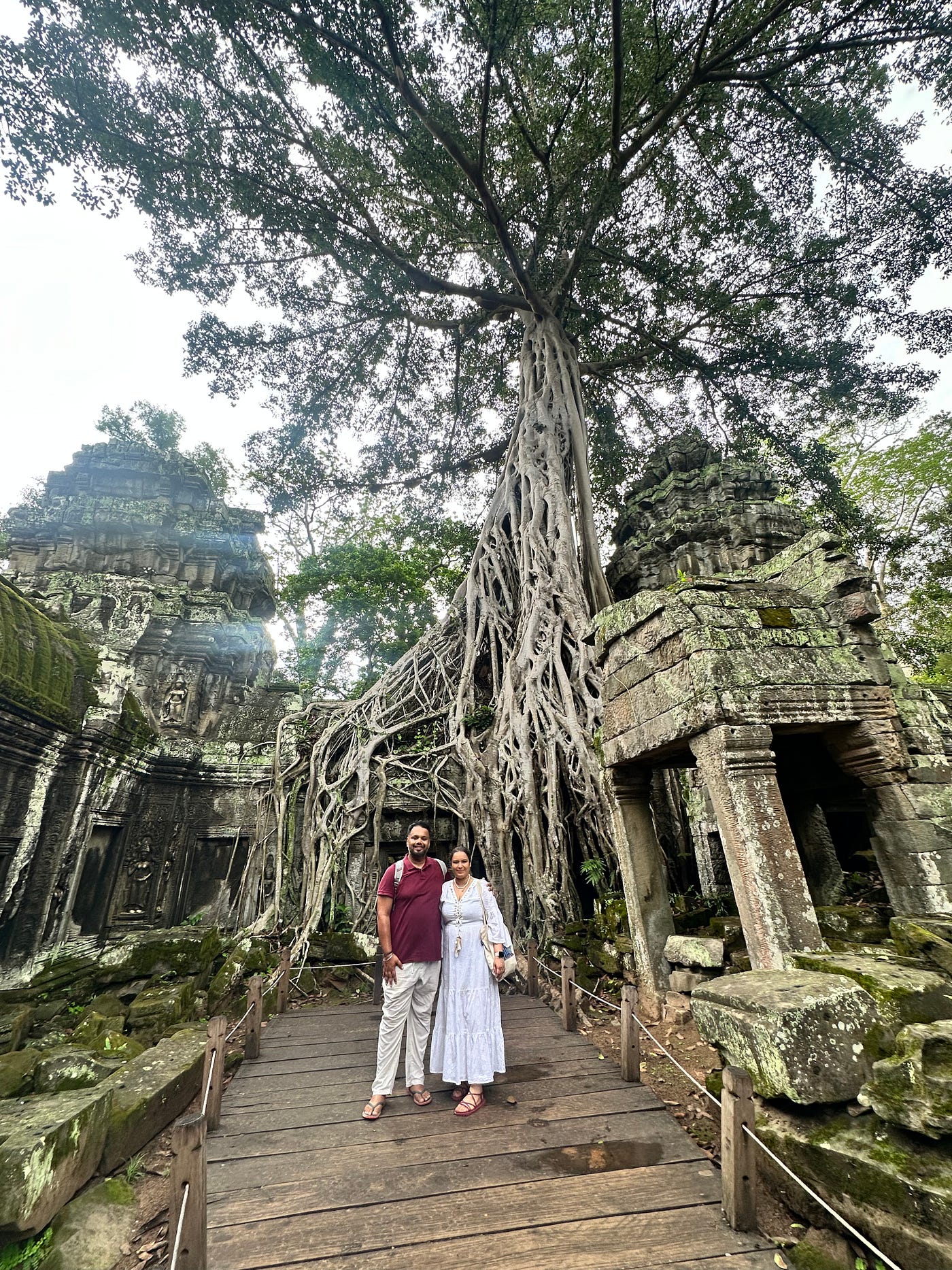
At the famous ‘Tomb Raider’ tree inside Ta Prohm
It is said that this temple was intentionally never restored like Angkor Wat and Angkor Thom because its charm lay in its ‘natural state.’ If you look at it the way I saw it, it essentially felt like a temple swallowed by the jungle. Interestingly, it is one of the few temples in the Angkor region where an inscription provides information about the temple’s dependents and inhabitants. Almost 80,000 people were required to maintain or attend the temple.
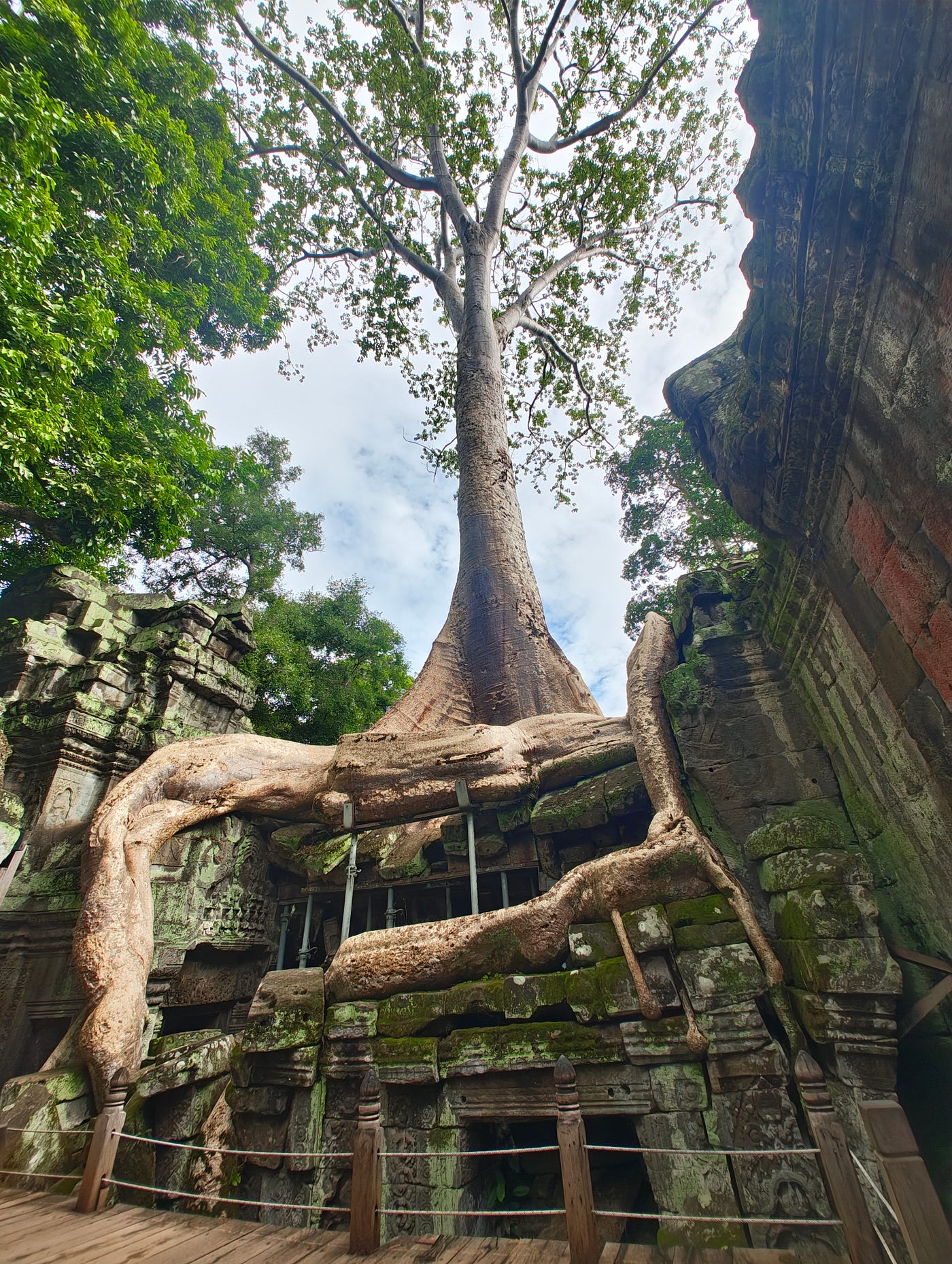
Natural and man-made forces working in harmony at Ta Prohm
Needless to say, our entire day was packed with the kind of history I never imagined I would get to witness so intricately-two Khmer kingdoms that became capitals to various kingdoms spanning from the 9th to the 15th centuries, plundered and redeveloped multiple times; their extremely close trade relations with India; innumerable carvings depicting Hindu deities like Garudas, Nagas, Shiva and Vishnu; and the fact that they still stand strong is a testament to the greatness and uniqueness of Khmer engineering and architecture.
Honestly, I could have easily spent a whole day in this mossy wonderland (if the weather was a tad bit better!) soaking in the magical and mysterious atmosphere and exploring the history of the ruins. At times though, if you are a history geek like me, even an entire day may seem less.
메타데이터
- post_id
- 72dda604acd9
- slug
- angkor-wat-and-its-astonishing-shared-history-with-hinduism-72dda604acd9
- url
- https://medium.com/globetrotters/angkor-wat-and-its-astonishing-shared-history-with-hinduism-72dda604acd9
- canonical_url
- https://medium.com/globetrotters/angkor-wat-and-its-astonishing-shared-history-with-hinduism-72dda604acd9
- author_url
- https://medium.com/@aasthagupta91.ag
- status
- ok
- fetched_at
- 2026-07-13 14:44:14